Octane Files
Browse CarsJeep Wagoneer SJ

Jeep Wagoneer SJ

Overview

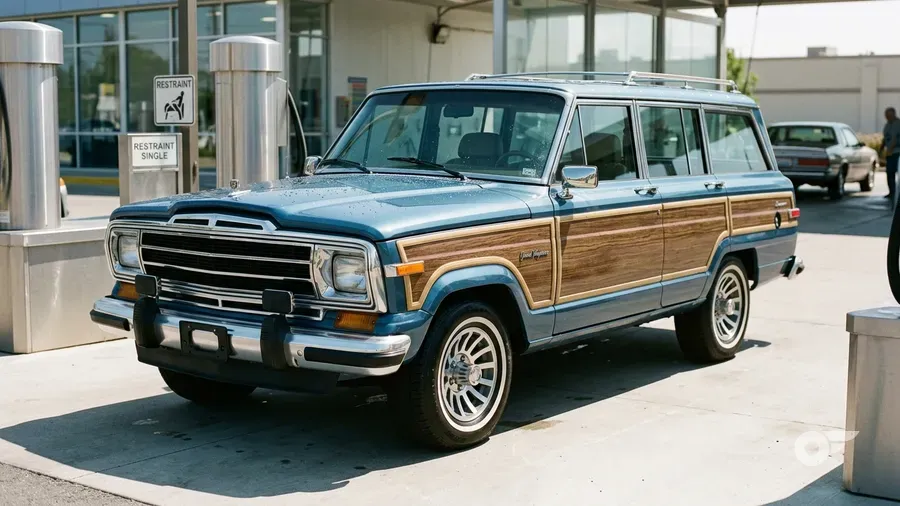
Jeep built the Wagoneer for twenty-nine model years on one body, 1963 to 1991, under three different owners, and no other American vehicle of the era survived that long without being redrawn. Brooks Stevens gave it flat glass, thin pillars and a 110-inch wheelbase, and Willys-Jeep launched it in 1963 with a list of options no other mainstream four-wheel-drive vehicle offered: an automatic transmission, power steering, a factory radio, air conditioning, and independent front suspension, standard on the rear-drive cars and a $135 option on the 4x4s. Under the hood sat the 230-cubic-inch Tornado, the first post-war overhead-cam car engine designed and mass-produced in the United States. Kaiser sold it, AMC took over in 1970 and added the 360 and 401 V8s and Quadra-Trac full-time four-wheel drive in 1973, and Chrysler finished it, building the last one on 21 June 1991. The best year on record is 1978, fifteen years in, when Jeep built 28,871 of them. By then the truck was a period piece competing against vehicles conceived two decades after it, and still selling. Everything the world now calls an SUV starts in this shape.

Distinctions

The defining attributes and collector status that make this car garage-worthy.

Legend
A car that transcended the hobby, known far beyond the people who drive them.
Octane Files Select
Renowned for its history, engineering, or cultural weight.

Collectibility scorecard

Rated 1 to 10 on the traits that matter for owning, driving, and holding on to a car like this.

Desirability
7/10
Rarity
4/10
Driving thrill
4/10
Investment trajectory
7/10
Usability
6/10
Ease of restoration
6/10
Cultural impact
8/10
Electronic dependence
Fully analogHeavily electronic

Every SJ engine is carburetted, from the 1963 Tornado six through to the 360 V8 in the last 1991 truck, and there is no engine management computer anywhere in twenty-nine model years. Early cars run points ignition and a generator. Electronic ignition and emissions plumbing arrive through the 1970s and thicken up on the last Chrysler-built trucks. Quadra-Trac is a mechanical full-time system rather than an electronic one, and the power windows, locks and seats are motors and relays. It scores 2 rather than 1 only because the final decade carries enough emissions wiring to be worth understanding before you chase a running fault.

Market data

Demand tier, price trend, and typical values by condition, based on recent sales data.

Demand tier
EntrySolidHighBlue-chip

A dependable market. Well-kept cars hold their value and find ready buyers.

Value trajectory
AppreciatingStableCooling

Values are climbing. The market wants more of these than exist.

Price by condition
Driver
$12k
Excellent
$30k
Concours
$58k

The band describes a driver-quality 1970s or early-1980s woodgrain V8 four-door, which is the car most buyers will actually encounter. Super Wagoneers and the 1963 to 1965 Kaiser cars trade above it on rarity, and the 1984 to 1991 Grand Wagoneer is a separate and dearer market covered on its own page. Values climbed through the 2010s as restored Grand Wagoneers became status objects and the earlier cars followed them up. Rust and missing trim, not mechanical condition, are what separate the bottom of this band from the top.

Values as of August 2026.

Buyer's guide

What anyone seriously considering this car should know first.

Why it's worth it
The first mainstream 4x4 you could order with an automatic, power steering and air conditioning
Callout
Twenty-nine model years on one body, 1963 to 1991
What to watch for
A 1963 Kaiser Wagoneer and a 1991 Chrysler one share a silhouette and almost nothing else, so decide which era you are buying before you look at a single car. Kaiser, 1963 to 1970. Historically the interesting ones and practically the hardest. The Tornado overhead-cam six earned a bad name from front mounts bolted to a cover rather than to the block, and a great many were pulled and replaced decades ago, so a running original is a find rather than the default. Trim, glass and brightwork for these years are close to unobtainable. Rear-drive-only Wagoneers existed until they were phased out between 1967 and 1969, and they are worth less. AMC, 1971 to 1987. The volume years and the ones to own. AMC 360 and 401 V8s, Quadra-Trac full-time four-wheel drive from 1973, woodgrain from 1971. Check the tailgate, the rear wheel arches, the floors and the frame around the rear spring hangers, then check behind the woodgrain applique, where water has been sitting against steel for decades. Chrysler, 1987 to 1991. Best assembled, best supported, dearest. Buy on body and interior. The mechanical side of any SJ is cheap; trim is what ends projects.

The Story

Driving character

Nothing about an SJ pretends to be a car, which is the point. It weighs around 4,514 pounds on a 110-inch wheelbase, rides on leaf springs at both ends once the early independent front option went away, and steers through a recirculating-ball box that asks you to aim it rather than place it. The flat glass and thin pillars give visibility no modern SUV can match. You sit up and look out. An AMC 360 with the three-speed automatic behind it is the standard experience and a pleasant one. Torque arrives immediately, the automatic takes the rest of the decision away, and the truck ambles rather than accelerates, holding any speed you would sensibly want without fuss. A 401 turns that into real shove and makes the fuel gauge move while you watch. Quadra-Trac from 1973 means the four-wheel drive is simply always on, with no lever to think about, which was the entire idea in 1973 and still feels civilised. What none of it disguises is the mass. Plan your stops.

Design

Brooks Stevens, who drew this, is the man who popularised the phrase planned obsolescence, defining it as instilling in the buyer the desire to own something a little newer, a little better, a little sooner than is necessary. He then produced a shape that stayed in production for twenty-nine years. The same hand did the Oscar Mayer Wienermobile, the Excalibur, the 1962 Studebaker Gran Turismo Hawk and the 1949 Harley-Davidson Hydra-Glide. The Wagoneer works because it is drawn flat. Flat glass, upright pillars, a horizontal beltline, a body that reads as a box on purpose rather than by accident, which is why it never dated so much as settled. Almost every change across three decades happened at the ends. The 1979 restyle brought one-piece aluminium bumpers and a one-piece chrome plastic grille, the nose owners call the pig nose, and it ran to 1985. Simulated woodgrain arrived on the flanks in 1971 and stayed to the end in 1991. The two-door version was redrawn and reissued in 1974 as the Cherokee.

Motorsport pedigree

There is no Wagoneer competition record, and the reason is visible from twenty feet away: this is a 4,500-pound family wagon, and Jeep put its competition energy into the CJ, which was light, cheap and already winning in the desert. The engine is a different story. The 230-cubic-inch Tornado overhead-cam six that launched the Wagoneer in 1963 was dropped in the United States after two model years, but Kaiser's Argentine arm, IKA, kept building it from 1965 to 1973, where it became the engine of the Torino. In 1969 IKA took works Torinos to the Nürburgring for the 84-hour Marathon de la Route with around 250 horsepower at 5,200rpm. The number three car, driven by Eduardo Copello, Alberto Rodríguez Larreta and Oscar Mauricio Franco, covered 334 laps, more than any other entry in the race, and was classified fourth after the penalties it collected along the way. The engine America gave up on ran four days flat out around the Nordschleife.

In culture

The Wagoneer is the vehicle that taught Americans to want a truck in the driveway, and it closed the argument with fake wood. Simulated woodgrain went on the flanks in 1971 and stayed for twenty years, the last mass-market echo of the wood-bodied station wagon, and it became shorthand for a particular kind of money: ski towns, horse trailers, coastal driveways, the school run in something that could genuinely tow. Jeep has never let the name go. It returned in 1993 on the ZJ Grand Cherokee as a one-year Grand Wagoneer, 6,378 built and then dropped, and again in 2022 as the flagship Wagoneer and Grand Wagoneer, sold explicitly on the memory of this truck. There is a small restoration industry underneath it as well. Wagonmaster in Texas has been rebuilding and reselling Grand Wagoneers since 1991, the year the last one was made, which is not something many discontinued vehicles can claim.

Owning One

Why collectors want it

The argument for the Wagoneer is a date. In 1963 it offered an automatic, power steering, air conditioning and a factory radio in a four-wheel-drive wagon, and the rest of the industry took until the Range Rover in 1970, and the American full-sizers of the late 1970s, to agree that this was what buyers actually wanted. Everything since is a footnote to that decision.

The hierarchy inside the generation is steep and easy to read. The Super Wagoneer of 1966 to 1969 sits at the top, about 3,989 built, the first genuinely loaded 4x4 anyone sold and the hardest to find complete. Below it, the 1963 to 1965 Kaiser cars carry the historical weight: the Tornado overhead-cam six, the optional independent front suspension, and very few survivors, because nobody thought to keep them. The 1971 to 1983 AMC woodgrain cars are the volume of the market and the sensible way in. The 1984 to 1991 Grand Wagoneer has its own page and its own money, and the run-up in Grand Wagoneer values through the 2010s pulled every earlier Wagoneer along behind it.

Which one to look for

Super Wagoneer, 1966 to 1969, about 3,989 built, is the one to chase. It came with a push-button radio, a seven-position tilt wheel, ceiling courtesy lights, air conditioning, power brakes and steering, a power-retracting tailgate window and a console-shifted TH400 automatic, which in 1966 was an absurd specification for a four-wheel-drive vehicle. Nothing else in the generation is close on rarity. Below it, order matters more than badge. The 1963 to 1965 cars with the Tornado overhead-cam six are the historically significant ones, and a factory independent-front-suspension 4x4 from those years is a real curiosity, because the option cost $135 and almost nobody ticked it. The Limited arrived for 1978 at $10,500, which was Cadillac money, and set the template the Grand Wagoneer inherited. The 1984 Wagoneer Custom is the connoisseur's oddity: a full-size Wagoneer with no woodgrain at all, introduced mid-year, ignored by buyers and dropped after one season. Any 401 car is worth a second look. The 1984 to 1991 Grand Wagoneer is covered on its own page.

Brougham

Upper trim of the AMC-era Wagoneer line, sitting between the standard car and the Limited. Dropped when AMC consolidated the SJ range for 1984.

Grand Wagoneer · 1984–1991

The Limited renamed for 1984, and from 1985 the only full-size Wagoneer Jeep sold. Standard 360 V8, Selec-Trac four-wheel drive with a Trac-Lok limited-slip differential, and woodgrain flanks to the end.

Limited · 1978–1983

The trim that turned the Wagoneer into a luxury vehicle outright and set the template the Grand Wagoneer inherited. Launched at US$10,500, which put it in Cadillac and Lincoln territory, with the two-barrel 360 V8 standard and the four-barrel 401 optional.

Super Wagoneer · 1966–1969

The first genuinely loaded four-wheel-drive vehicle sold in America. Standard equipment ran to a push-button radio, a seven-position tilt steering wheel, ceiling courtesy lights, air conditioning, power brakes and steering, a power-retracting tailgate window and a console-shifted TH400 automatic. It carried a new full-width grille and listed around $1,000 above the deluxe Custom.

Wagoneer Custom · 1984

A deliberately cheaper full-size Wagoneer introduced mid-year without the simulated woodgrain, sold alongside the newly renamed Grand Wagoneer. Buyers ignored it and it was dropped after a single season, which makes a plain-sided 1984 the oddity of the generation.
What owning one is like

Rust is the whole conversation. An SJ is body-on-frame steel with a tailgate that holds water, rear wheel arches that rot from the inside, floors under the carpet and a frame that suffers around the rear spring hangers. Then add the woodgrain, which seals moisture against the body sides, so the panel that looks best is often hiding the worst of it. Lift a corner before you commit. Everything mechanical is friendly by comparison. The AMC sixes and V8s are simple, understressed and cheap to rebuild, the Dana axles are shared with half the American 4x4 industry, and the three-speed automatics are as durable as anything of their era. Quadra-Trac's full-time system is the one piece worth understanding before you buy, because a neglected one is a specialist job rather than an afternoon. The other thing to expect is thirst. A 360 or 401 four-wheel-drive wagon of this weight was never economical even when fuel was cheap, and the last Grand Wagoneers were being called gas-guzzlers while they were still in the showroom. Owners budget for it and stop thinking about it.

Upkeep & parts

Mechanically the SJ is one of the cheaper classics to keep running. The AMC 232, 258, 360 and 401 share parts with CJs, J-series pickups and SJ Cherokees, so engine, brake, steering and axle components are current catalogue items rather than swap-meet hunts, and any competent shop can work on them without special tooling.

Body and trim is where the money goes. Panels, glass rubbers, tailgate hardware and interior trim get progressively harder as you go back through the 1970s and into the Kaiser years, and Super Wagoneer specifics are effectively unobtainable. Woodgrain kits are reproduced for the 1971-on cars, which solves the most visible problem.

The community is strong and organised around the term FSJ. The International Full Size Jeep Association is the club and the reference point for the whole full-size family, and Wagonmaster in Texas has been restoring and reselling these since 1991, which makes it the benchmark for what a finished one should look like. Budget for bodywork rather than parts, and buy the best shell you can find.

Country of origin
USA
Class
Off-Road
Production years
1963–1991
Units built
~400,000
Marque
Model
Wagoneer
Nickname
FSJ
Body
SUV
Layout
Front-engine, RWD / 4WD
Engine
230ci Tornado OHC I6, 232ci AMC I6, 258ci AMC I6, 282ci VAM I6 (Mexico only), 327ci Vigilante V8, 350ci Buick Dauntless V8, 360ci AMC V8, 401ci AMC V8
Transmission
3-speed Borg-Warner T-90J manual, 4-speed manual, 3-speed GM TH400 automatic, 3-speed Chrysler A727 automatic, 3-speed Chrysler A999 automatic
Designer
Brooks Stevens