Octane Files
Browse CarsJeep CJ-7

Jeep CJ-7

Overview

Ten inches of wheelbase changed what a Jeep was for. The CJ-7 arrived for 1976 on a 93.3 inch chassis against the CJ-5's 83.5, and American Motors used the extra length for things no previous CJ had offered: an automatic gearbox, a full-time four-wheel-drive system called Quadra-Trac, a moulded one-piece hardtop, and steel doors that latched. A CJ had always been a machine you tolerated. This was one you could commute in. That did not soften it, because underneath sat the same body-on-frame layout with live axles on leaf springs and the same short-overhang geometry that made the CJ the class benchmark off road. It just made the vehicle sellable to people who were never going to plough anything. AMC built 379,299 of them across eleven years, the CJ-5 was dropped in 1983 while the CJ-7 carried on, and when production ended in 1986 the Wrangler replaced it with the same axles, the same springs and a squarer face. The CJ-7 is the point where the Jeep stopped being equipment and became a choice.

Distinctions

The defining attributes and collector status that make this car garage-worthy.

Octane Files Select
Renowned for its history, engineering, or cultural weight.

Collectibility scorecard

Rated 1 to 10 on the traits that matter for owning, driving, and holding on to a car like this.

Desirability
8/10
Rarity
3/10
Driving thrill
6/10
Investment trajectory
7/10
Usability
5/10
Ease of restoration
8/10
Cultural impact
8/10
Electronic dependence
Fully analogHeavily electronic

Mechanically simple with a thin layer of 1970s and 1980s emissions electronics on top. Every engine offered is carburetted, with electronic ignition standard, and later cars carry an emissions control system that manages the carburettor and the ignition timing rather than injecting anything. There is no engine management computer of the modern sort, no fuel injection, and no electronic driver aid whatsoever: no ABS, no traction control, no stability system. Power steering and power front disc brakes were available and are common, but they are hydraulic assistance rather than electronic. Throttle, clutch, gearbox and transfer case are all direct mechanical linkages, and the Quadra-Trac full-time system is a mechanical differential arrangement, not an electronically controlled one.

Market data

Demand tier, price trend, and typical values by condition, based on recent sales data.

Demand tier
EntrySolidHighBlue-chip

A dependable market. Well-kept cars hold their value and find ready buyers.

Value trajectory
AppreciatingStableCooling

Values are climbing. The market wants more of these than exist.

Price by condition
Driver
$15k
Excellent
$35k
Concours
$60k

The strongest CJ market and the one that has moved most since the late 2010s, driven by nostalgia for the decor packages and by a professional restomod trade that has pushed the ceiling well past the band. Unmodified original cars are the scarce commodity; V8s and the 1982 Jamboree cars trade above the band. Band figures are editorial estimates only, because no market data source was reachable during research.

Values as of August 2026.

Buyer's guide

What anyone seriously considering this car should know first.

Why it's worth it
The CJ that turned a working vehicle into a recreational one
Callout
Ten inches longer than a CJ-5, and the first CJ you could order with an automatic
What to watch for
The frame is the entire negotiation. Look at the rear spring hangers, the shock mounts, the skid plate area and the rails where they step outward at the back, and treat any plated repair as a reason to look underneath properly rather than a reason to walk. Body tubs rot at the floors, the rear corners, the seams under the tailgate and around every body mount, and the bulkhead behind the pedals is where the expensive rot hides. Check the AMC 20 rear axle on anything pre-1986, because its housing is the weak part of the vehicle and a working CJ-7 will usually have had it braced, replaced or ignored, and only two of those are acceptable. Cars from mid-1986 got the Dana 44 instead and are worth seeking out. Establish what has been modified, since lifts, arch flares, engine swaps and axle changes are near universal and all cost value even when neatly done. Verify the hardtop is present if the car is advertised with one, because they were expensive, they leak when the seals go, and they are much dearer to buy separately than anyone expects.

The Story

Driving character

The extra ten inches transform it. A CJ-5 is a vehicle you correct constantly; a CJ-7 tracks straight enough that you can look at the scenery, and that single change is why so many were sold. It is still tall, still on leaf springs, and still steered through a recirculating ball box that reports road conditions rather than wheel angle, so nobody would call it precise. The 258 six is the character of the thing: enormous low-down torque, no interest at all in revving, and a gentle shove from just off idle that suits low range and a rutted track perfectly. The 304 V8 gives it a proper burble and genuine straight-line pace in something weighing 2,707lb. With the hardtop and steel doors it is a surprisingly civilised vehicle in cold weather. With the top off, the windscreen folded and the doors in the garage, it is the reason people buy Jeeps, and no amount of engineering progress since has produced anything that feels the same at 35mph on a summer evening.

Design

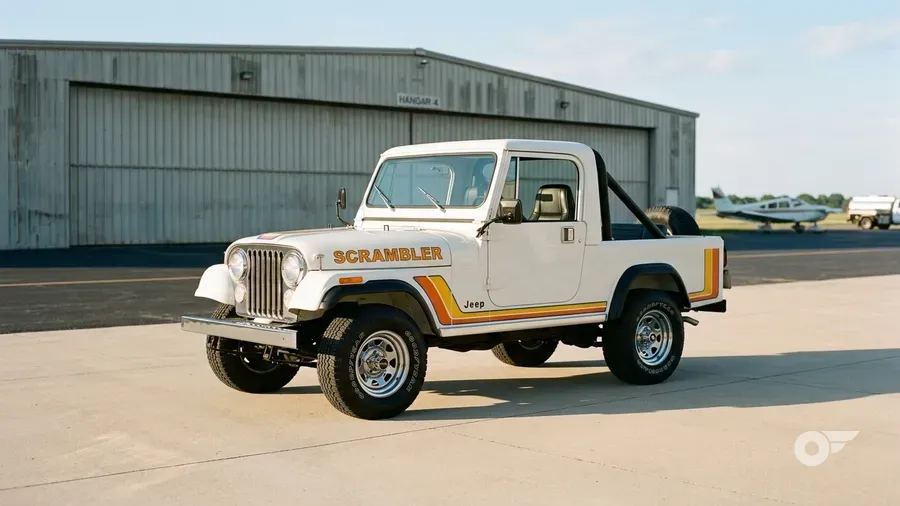
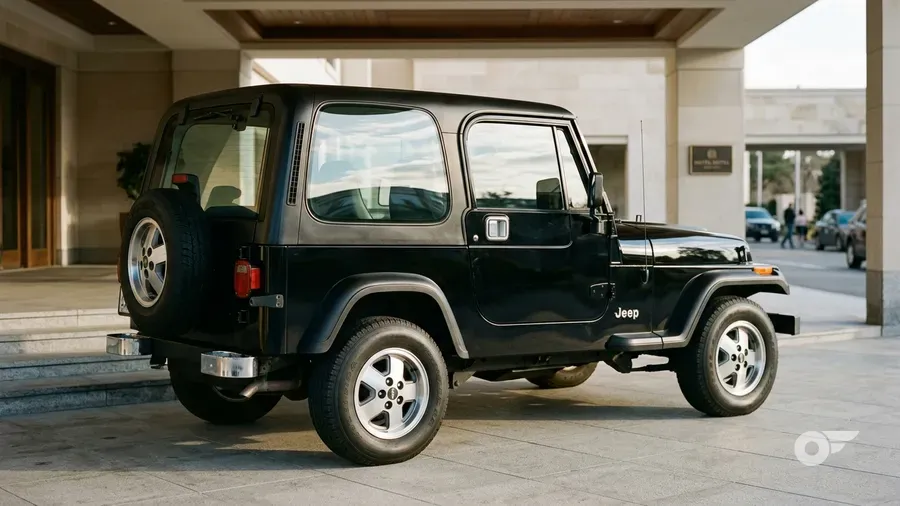
Richard Teague's studio at AMC did something clever with the CJ-7: it stretched the vehicle without making it look stretched. The extra wheelbase went into a curved cutout ahead of the rear wheel arch rather than a longer flat panel, which gave the CJ-7 its distinctive door aperture shape and let the optional steel doors hang from real hinges for the first time. The frame changed to two parallel C-section rails stepped outward at the rear, moving the suspension closer to the body sides. The seven-slot grille, folding windscreen, exposed hinges and bolt-on wings all continue untouched, because AMC understood exactly what it was not allowed to change. What did change is the decoration, and it is now most of the appeal. The Golden Eagle bonnet decal, the tape stripes, the gold and white steel wheels and the tan interiors are pure late-1970s American product design, and they date the vehicle precisely in a way the shape itself never does. The moulded one-piece hardtop is the other visual signature, and it turned the CJ from an open vehicle with a cover into two distinct vehicles.

Motorsport pedigree

AMC ran no factory competition programme for the CJ-7 and had no money to start one: the company was fighting for survival through the entire production run and its motorsport spending had gone to the Trans-Am Javelin years earlier. There was also no obvious series to enter, since American road racing had no place for a leaf-sprung utility and rally in the United States was a small, largely privateer affair. What the CJ-7 has instead is a deep amateur record. It became the standard vehicle of the off-road club movement, and its central event is the Rubicon Trail's Jeepers Jamboree, which AMC thought important enough to commemorate with 630 numbered cars in 1982. That is a factory acknowledging a competition culture it did not create and could not have organised. CJ-7s were also common in privateer desert racing and in stadium off-road events through the 1980s, and the vehicle remains the basis for a large share of the trials and rockcrawling machinery competing today. The pedigree is real, it is just not a works one.

In culture

The CJ-7 is the Jeep of the American 1980s, and it got there by being visible rather than famous. It was the vehicle in the driveway on television, the beach vehicle, the ski-town vehicle, and the one every teenager wanted because the doors and the roof came off in about ten minutes and the whole thing looked like a decision rather than a purchase. That shift is the point: the CJ-2A was sold to farmers and the CJ-7 was sold to people expressing something, and the option sheet followed, with eagle decals and gold wheels and colour-keyed hardtops. It is also the vehicle that carried Jeep through American Motors' decline and into Chrysler's hands, and it did that so effectively that when the Wrangler replaced it in 1986 the complaint was not that the new one was different but that it was not a CJ-7. Four decades on it remains the shape used to signal outdoorsy American authenticity in advertising, and restored CJ-7s now sell for money that would have astonished anyone in 1986.

Owning One

Why collectors want it

The CJ-7 is the one most people should buy and the market has worked that out. It is the last CJ, the most usable, the best supported, and the one that carries the imagery of the whole 1970s and 1980s Jeep era: eagle decals, tape stripes, painted steel wheels, half doors and a bikini top. Values have climbed hard since the late 2010s and unmolested cars have become the constraint rather than the money. The hierarchy is clear. Late cars from 1984 to 1986, with the boxed frame sorted and the better gearboxes, are the usable end. The 304 V8 cars are the enthusiast pick and the least common engine you will encounter. The 1982 Jamboree Commemorative Edition, 630 numbered cars, is the rarest factory CJ-7 and the closest thing this model has to a grail. Renegade and Golden Eagle packages carry a clear premium over a base car purely on period charm. What genuinely separates a good buy from a bad one is originality: these were modified as a matter of course, and a stock CJ-7 with its factory drivetrain is now the unusual thing.

Which one to look for

The Renegade ran the whole eleven years and is the CJ-7 most people picture, with its wheels, roll bar and graphics. Golden Eagle from 1977 to 1980 is the loudest and most collectable of the decor packages thanks to the enormous bonnet decal, and Golden Hawk was its one-year 1980 replacement. Laredo from 1980 to 1986 went the other way, adding chrome, better seats and a properly finished interior, and it makes the most sense as a car to actually use. Limited, offered only in 1982 and 1983, is the rarest of the regular trims and the plushest CJ ever sold. The one to hunt is the 1982 Jamboree Commemorative Edition, 630 numbered cars built to mark the Rubicon Trail's Jeepers Jamboree, and the rarest factory CJ-7 there is. On the mechanical side the choices matter more than the badges. The 258 six is the default and the easiest to live with, the 304 V8 is the entertaining one and increasingly hard to find unmodified, and the four-cylinder cars are best treated as projects. Quadra-Trac cars have their own following.

Golden Eagle · 1977–1980

The loudest of the decor packages and now the most collectable, defined by the large eagle bonnet decal, gold-finished wheels and tan interior trim.

Golden Hawk · 1980

A single-year replacement for the Golden Eagle, using a hawk graphic in place of the eagle.

Jamboree Commemorative Edition · 1982

Built to mark the Rubicon Trail's Jeepers Jamboree. Numbered plaque, unique paint and trim, and a factory acknowledgement of a competition culture Jeep had not created.

Laredo · 1980–1986

The upmarket CJ-7: chrome bumpers and grille surround, better seats and a properly finished interior. The easiest CJ-7 to live with day to day.

Limited · 1982–1983

The plushest CJ ever sold, offered for two years only and the rarest of the regular trims.

Renegade · 1976–1986

The sporting package, offered for the whole eleven-year run and the CJ-7 most people picture: distinct wheels, roll bar and bodyside graphics.
What owning one is like

The lived reality of a CJ-7 is that it rusts and everything else is straightforward. Frame rails go at the spring hangers and shock mounts, body tubs go at the floors, rear corners and bulkhead, and a car that has seen winter salt will have had at least one of those addressed. The AMC 20 rear axle on pre-1986 cars has a housing that flexes under real load, so owners who use them properly either brace it or fit something else, and it is the one component worth planning around. Soft tops leak, hardtop seals perish, and the doors never sealed brilliantly even when new. The steering box develops play and needs periodic attention. Fuel consumption from the carburetted sixes and the V8 is exactly what you would expect and is not going to improve. Set against that, the engines are close to indestructible, parts are everywhere, and there is essentially nothing on the vehicle a reasonably confident owner cannot repair in a domestic garage. Most CJ-7 owners spend less on upkeep than they expected and more time under it than they planned.

Upkeep & parts

Nothing in the classic world is better supported than a CJ-7. Complete replacement frames, body tubs, panels, floors, wings, interiors, tops and glass are all in production, and mechanical parts for the AMC sixes, the 304 V8, the T-18 and T-5 gearboxes and the Dana axles are stocked off the shelf by multiple large suppliers. That depth means the vehicle can be rebuilt from almost any starting point, which is exactly why so many rough ones still exist. Budget for the frame and the tub, since those are the two jobs that decide the cost of a project, and for the rear axle if you plan to work the vehicle. Everything else is inexpensive. The aftermarket is enormous and split cleanly between restoration suppliers and off-road builders, so it pays to be clear which you are buying from. Community support is excellent, with dedicated CJ forums and eWillys covering the older family, and the specialist suppliers will identify parts from a photograph. Insurance and running costs are modest; fuel is the main ongoing expense.

Country of origin
USA
Class
Off-Road
Production years
1976–1986
Units built
379,299
Marque
Model
CJ-7
Nickname
No nickname (Renegade, Golden Eagle and Laredo name option packages, not the generation)
Body
SUV, Convertible
Layout
Front-engine, 4WD
Engine
150ci (2.5L) AMC I4, 151ci (2.5L) GM Iron Duke I4, 232ci AMC I6, 258ci (4.2L) AMC I6, 304ci AMC V8, 145ci Isuzu C240 diesel I4
Transmission
4-speed Borg-Warner T-18 manual, 4-speed Tremec T-4 manual, 5-speed Tremec T-5 manual, 3-speed automatic
Designer
Richard A. Teague (vice-president of styling, American Motors)