Octane Files
Browse CarsSuzuki Samurai

Suzuki Samurai

Overview

Suzuki brought the Samurai to the United States in 1985 as a 1986 model at $6,200, a price that in 1986 bought almost nothing else with four-wheel drive. It was the SJ413, the wider-tracked version of the SJ series with 90mm more track than the SJ410 that Canada and Puerto Rico had already been buying, and it weighed roughly a tonne. Leaf springs on solid beam axles at both ends, a part-time transfer case with proper low range, a 1.3-litre four, a soft top or a bolt-on hardtop, and very little else.

America took 47,000 in the first year and more than 80,000 in 1987. Then in 1988 Consumer Reports called it not acceptable on rollover grounds, sales collapsed inside eighteen months, and Suzuki spent from 1996 to 2004 in court about it. The Samurai left the American market after 1995, replaced by the softer Sidekick, and carried on being built elsewhere for decades: Spain to 2004, India to 2018.

It is the last genuinely small, genuinely cheap four-wheel drive sold new in America, which is most of why people still want one.

Distinctions

The defining attributes and collector status that make this car garage-worthy.

Octane Files Select
Renowned for its history, engineering, or cultural weight.

Collectibility scorecard

Rated 1 to 10 on the traits that matter for owning, driving, and holding on to a car like this.

Desirability
6/10
Rarity
4/10
Driving thrill
6/10
Investment trajectory
7/10
Usability
5/10
Ease of restoration
8/10
Cultural impact
6/10
Electronic dependence
Fully analogHeavily electronic

Almost nothing here is electronic. Every Samurai up to August 1991 runs a carburettor and a distributor, and the four-wheel drive is a lever on the floor plus a pair of hubs you get out and turn by hand. From September 1991 the 1.3 gained throttle-body fuel injection and 66hp, which brings a small engine-control module and is the only computer on the vehicle. There is no ABS, no traction control, no stability system, no airbag, no electronic differential of any kind. A pre-1991 car is honestly a 1 on this scale; the score sits at 2 to cover the injected cars, and even those are trivially simple by any modern standard.

Market data

Demand tier, price trend, and typical values by condition, based on recent sales data.

Demand tier
EntrySolidHighBlue-chip

The accessible way in. Prices still forgive mistakes, and the upside is real.

Value trajectory
AppreciatingStableCooling

Values are climbing. The market wants more of these than exist.

Price by condition
Driver
$6k
Excellent
$15k
Concours
$28k

The band describes a running, largely unmodified US-market Samurai with an honest frame and body. Modified trail rigs sit outside it entirely and are priced on the build rather than on the vehicle, and genuinely low-mileage survivors, of which there are more than you would expect because so many were parked after 1988, can beat the top of the band. Values have climbed steadily as clean examples thinned out and buyers went looking for a small, simple 4x4 that no manufacturer will build again. Frame condition is what separates a $6,000 car from a $15,000 one; almost nothing else moves the number as much.

Values as of August 2026.

Buyer's guide

What anyone seriously considering this car should know first.

Why it's worth it
The tiny cheap 4x4 that started America's small-SUV boom, then got tangled in a rollover fight
Callout
47,000 sold in its first American year, at $6,200
What to watch for
Two questions decide everything. Has it rusted, and has it been modified. Rust first, because this is a cheap 1980s Japanese vehicle that was never engineered to survive salt. Check the frame rails, the body mounts where the tub bolts to the chassis, the floors, the rear wheel arches and the tailgate. A rotten body mount is the one that ends the conversation, because it is structural and it hides under the tub. Then modification. The great majority of survivors have been lifted, re-geared, re-shod on much larger tyres, and quite a few have had the engine swapped. None of that is a fault, and a well-built trail rig is a wonderful thing, but it is a different purchase from an original car and it is priced differently. Work out which one you actually want before you go looking, because photographs make them look alike. On the drivetrain, engage four-wheel drive and low range and confirm the manual hubs lock and unlock properly. Prefer the September 1991-on throttle-body injected cars, at 66hp, if the vehicle is going to see any road at all. And be honest with yourself about the gearing before you buy: this is not a highway machine.

The Story

Driving character

The Samurai is the only vehicle on this site where the best answer to how fast is it is that the question is not relevant. It weighs around a tonne, sits on a 2,030mm wheelbase, and makes at most 66hp, so 55mph is genuine work and a headwind is an event. Motorway journeys are a bad idea and everybody who owns one knows it. Take it off the road and the arithmetic reverses. Light, narrow and short, with a real low range and hubs you lock by hand, it goes places that need winching for a vehicle twice its weight, and it does it on traction rather than power. The body leans hard on the leaf springs and then simply holds the angle, which takes some getting used to and then becomes the most enjoyable thing about it. Everything is direct. Unassisted steering with real feel, a gearlever that moves in short mechanical arcs, a transfer lever that clonks. Nothing filters anything. On a dirt track at 20mph a Samurai is more entertaining than most sports cars are at three times the speed, and that is the whole argument for owning one.

Design

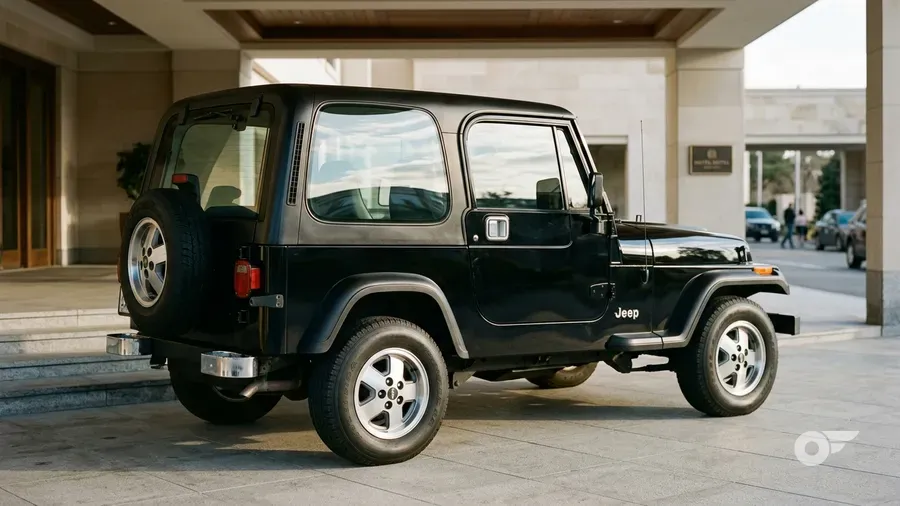
The Samurai is drawn as a box because everything it descends from was a box. Suzuki's LJ10 of April 1970 was the first four-wheel-drive kei car put into series production, and the line from that tiny two-stroke through the LJ20, LJ50 and LJ80 to the SJ410 and this SJ413 is one of steady growth without a single change of philosophy. Flat panels, exposed hinges, bolt-on wings, a spare on the tail, and glass set as upright as it will go. The only substantive change in the shape between SJ410 and SJ413 was the 90mm of extra track, added for stability, which is a detail worth remembering given what 1988 brought. Wider track, same body, same everything else. The result is a vehicle that reads as a Willys jeep scaled to about four fifths and drawn by people who had internalised why the original was shaped that way. There is no ornament anywhere and no styling in the ordinary sense, which is precisely why it still looks right forty years later while its 1980s contemporaries have aged badly.

Motorsport pedigree

The Samurai had no factory competition programme, and the reason is straightforward: Suzuki's works racing effort in this period was on two wheels, where it had been winning motorcycle Grand Prix races since the 1960s, and the company's serious four-wheel motorsport ambitions came later and went to other vehicles. What happened instead is arguably more interesting. The Samurai became the default grassroots off-road competition vehicle in a dozen countries, because it was light enough to recover with three friends, narrow enough for tracks that stopped everything else, cheap enough to break without regret, and simple enough to repair in a car park. Club trials, hill climbs, mud events and, later, rock crawling all filled up with them, and the modification industry that grew around the platform exists because of competition rather than fashion. It is worth stating the mechanism, because it explains the vehicle. At around a tonne, a Samurai gets up things by having very little mass to lift and enough articulation to keep tyres loaded. Heavier vehicles do the same job with power. That is a different sport, and the Samurai never pretended otherwise.

In culture

The Samurai's cultural footprint in America is one story, and there is no honest way to write the page without it. In 1988 Consumer Reports announced at a press conference that the vehicle had demonstrated a tendency to roll and rated it not acceptable. Sales, which had run past 80,000 in 1987, fell to a few thousand a year by 1989 and never recovered. Suzuki sued the magazine's publisher in 1996, after the Samurai was referred to again in an anniversary issue, and the case ran for eight years. It ended in July 2004 with a settlement in which no money changed hands and no retraction was issued, though Consumers Union agreed to stop citing the sixteen-year-old test results in its advertising and promotional material. This page does not adjudicate that argument. Both sides went to court, both left saying they were right, and the documented record is what is set out above. What the Samurai also did, before and after all of that, was show American buyers that a small, cheap four-wheel drive had a market. The Sidekick arrived in 1989 and everything since has followed.

Owning One

Why collectors want it

The case for the Samurai is that nothing like it can be sold new any more, anywhere. A ladder frame, leaf springs, solid axles, manual hubs, low range and a kerb weight around a tonne, in a vehicle with a 79.9-inch wheelbase, which is within an inch of a wartime Willys. Every regulation written since 1995 pushes in the opposite direction, and the small 4x4 the industry now sells is a raised hatchback with a computer deciding which wheel gets torque.

Rarity here is about survivors rather than build numbers. Suzuki sold plenty of them, but the Samurai was bought cheap, used hard and modified relentlessly, so an unmolested, rust-free one is genuinely difficult to find and the market has noticed.

The hierarchy is short and clear. Unmodified hardtops with original ride height sit at the top, followed by the September 1991-on fuel-injected cars, which are the ones you can actually live with. Lifted trail rigs are cheapest to buy and often the most fun, but they are priced on the build rather than on the vehicle.

Which one to look for

The engine and the roof are the two decisions. Engines: the 1.3 in carburetted form ran from the 1986 model year, and from September 1991 Suzuki fitted throttle-body fuel injection and 66hp. The injected cars start properly cold, hold a steadier idle and are the ones to have if the Samurai will be driven on roads. The 970cc F10A SJ410 at 45PS predates the Samurai name in North America and was sold in Canada and Puerto Rico; it is a curiosity in the US and genuinely slow. Roofs: the soft top is the shape everyone pictures and the one that lets a Samurai be what it is. The bolt-on hardtop is quieter, more secure and much better preserved, which is why the best surviving cars are usually hardtops. Outside North America the SJ family also came as long-wheelbase pickups and panel vans on a 2,375mm wheelbase, and Santana of Linares built Spanish Samurais from March 1985 with softer springs and, later, Peugeot and Renault diesels. None of those were US Samurais, but they are worth knowing about if an import crosses your path. The one to hold out for: a late fuel-injected hardtop, unmodified, with a clean frame.

Fuel-injected 1.3 · 1991–1995

From September 1991 the 1.3 gained throttle-body fuel injection and 66hp. Better cold starting, a steadier idle and the version to buy if the vehicle will see real road use. The last specification sold in North America.

Santana-built (Spain) · 1985–2004

Built by Santana Motor in Linares from March 1985, with softer springs for a better on-road ride and, from around 1998, Peugeot XUD9 and Renault F8Q diesel options. Not a US-market car, but the reason Samurais were still being made new long after America stopped buying them.

SJ410 · 1981–1985

The 970cc F10A four, 45PS, on the narrower SJ track. Sold in Canada and Puerto Rico before the Samurai name existed in North America, and elsewhere in the world alongside and after the SJ413. Very slow, and the direct link back to the LJ-series kei jeeps.

SJ413 Samurai (carburetted) · 1985–1991

The car America knew: the 1.3-litre four on a track widened by 90mm over the SJ410, launched in the US in 1985 for the 1986 model year at $6,200. Leaf springs, solid axles, part-time four-wheel drive, manual hubs, soft top or bolt-on hardtop.
What owning one is like

Owning a Samurai is cheap in every direction except patience. Nothing on it is complicated, nothing on it is expensive, and almost anything can be fixed at the roadside with a small toolkit, which is exactly the deal people sign up for. What you live with is rust and pace. The frame rails and body mounts are the parts that matter, and because they sit under the tub they get ignored until they are serious, so the sensible move is to look properly once a year rather than once a decade. Everything above them is bolt-on. Pace is the other one. At around a tonne, with at most 66hp and gearing chosen for low-speed work, a Samurai is loud, breezy and busy at any speed a modern road expects, and no amount of sympathetic ownership changes that. People who buy one as a second vehicle for short journeys and green lanes keep them for years. People who buy one as a commuter sell within a season. The soft tops leak eventually, the seats are thin, and the heater is optimistic. None of that stops anyone.

Upkeep & parts

Parts are the good news. The mechanical side of the Samurai is still supported far better than its age suggests, partly because Suzuki went on building the same basic platform elsewhere long after North America gave up on it, in Spain until 2004 and in India until 2018. Service items, clutches, brakes, steering and suspension parts are cheap and easy, and the aftermarket that grew up around off-road use covers everything from stock replacements to complete rebuild kits.

Body panels and interior trim are the harder half, and rust repair sections for the frame and body mounts are the things worth buying before you need them.

For knowledge, ZUKIWORLD is the long-running English-language Suzuki resource covering the Samurai, SJ and LJ, and the Suzuki owner forums carry decades of accumulated fixes. Budget almost nothing for parts, budget your time for rust, and expect the running costs of a small hatchback with the maintenance schedule of a lawnmower.

Country of origin
Japan
Class
Off-Road
Production years
1985–1995
Units built
~206,000
Marque
Model
Samurai
Nickname
No nickname
Body
SUV, Convertible
Layout
Front-engine, 4WD
Engine
1,324cc G13A petrol I4, 1,298cc G13BA petrol I4, 1,298cc G13BA petrol I4 with throttle-body fuel injection (66hp, from September 1991), 970cc F10A petrol I4 (SJ410, Canada and Puerto Rico)
Transmission
4-speed manual, 5-speed manual, 3-speed automatic (Japan, from 1992)
Designer
Suzuki in-house; no individual stylist credited