Octane Files
Browse CarsWillys MB

Willys MB

Overview

The vehicle that gave a brand its name was not invented by the company that ended up owning the name. In July 1940 the US Army circulated a specification for a light reconnaissance car and gave bidders 49 days to deliver a running prototype. Two firms answered. American Bantam won it, and its freelance engineer Karl Probst had a preliminary design the day after he read the brief. Bantam delivered on 23 September 1940, then discovered it could not build anything like the 75 vehicles a day the Army wanted, so the Army handed Bantam's drawings to Willys-Overland and Ford and told them to get on with it. What emerged was the MB: 80 inches of wheelbase, a 60hp side-valve four, four-wheel drive through a two-speed transfer case, and almost nothing else at all. Willys built more than 359,489 of them. Ford built a further 277,896 to the same blueprints, badged GPW, and by January 1944 the parts genuinely interchanged between the two. Roughly 637,000 standardised jeeps went to war between them. General Marshall called it America's greatest contribution to modern warfare, and nobody has seriously argued with him since.

Distinctions

The defining attributes and collector status that make this car garage-worthy.

Legend
A car that transcended the hobby, known far beyond the people who drive them.
Octane Files Select
Renowned for its history, engineering, or cultural weight.

Collectibility scorecard

Rated 1 to 10 on the traits that matter for owning, driving, and holding on to a car like this.

Desirability
8/10
Rarity
4/10
Driving thrill
4/10
Investment trajectory
6/10
Usability
3/10
Ease of restoration
9/10
Cultural impact
10/10
Electronic dependence
Fully analogHeavily electronic

Fully analog in every sense the scale can measure. Six-volt electrics, a battery-and-coil ignition with a conventional distributor, a carburettor fed by a mechanical pump, and a shielded ignition harness whose only purpose was to keep the engine running through deep water rather than to manage anything. There is no fuel injection, no electronic ignition, no computer, no sensor of any kind, and every driver input is a direct mechanical linkage: throttle rod, clutch, gearbox lever, transfer case lever, unassisted steering and unassisted drum brakes. Nothing on the vehicle can fail in a way a competent person cannot diagnose with a test lamp.

Market data

Demand tier, price trend, and typical values by condition, based on recent sales data.

Demand tier
EntrySolidHighBlue-chip

A dependable market. Well-kept cars hold their value and find ready buyers.

Value trajectory
AppreciatingStableCooling

Values are holding steady. What you pay today is what it's worth tomorrow.

Price by condition
Driver
$18k
Excellent
$35k
Concours
$58k

Values are driven by documented history and originality rather than by condition alone, which is unusual. The military-vehicle market is deep, patient and well informed, and it has held MB prices remarkably steady across decades rather than spiking. Early pre-stamped-grille cars and jeeps with traceable wartime service sit well above the band. Band figures here are editorial estimates only, because no market data source was reachable during research.

Values as of August 2026.

Buyer's guide

What anyone seriously considering this car should know first.

Why it's worth it
The standardised wartime jeep every Jeep built since has descended from
Callout
The FTC barred Willys in 1948 from calling itself the creator of the jeep
What to watch for
Identification comes first, because Willys and Ford parts interchange by design. A vehicle sold as an MB may be a GPW, or a mixture of both, and the grille will not tell you: Ford's stamped nine-slot pressing was adopted by Willys as a cost saving, so it appears on plenty of Willys-built jeeps. Work from the data plates, frame stampings and serial numbers, and get someone from the military-vehicle community to look before you commit. Postwar military derivatives get sold as wartime jeeps more often than anyone likes to admit, so confirm you are looking at a flat-fendered 1941 to 1945 vehicle and not a later round-fendered one. Structurally, the body tub is where the money goes. Check the floors, the seams at the tub corners, the toolbox recesses and the area under the fuel tank, all of which trap water. Check the frame at the spring hangers. Reproduction tubs are available and honest sellers say so. Finally, decide early whether you want a correct restoration or a usable one, because the two cost different money and correcting a wrong-spec jeep afterwards is slow, fiddly work.

The Story

Driving character

Nothing prepares you for how small and how loud it is. The Go Devil makes 60 gross horsepower and 85 lb-ft, the whole vehicle weighs 2,453 pounds, and the gearing is chosen for pulling rather than for speed, so it accelerates willingly to about 40 and then makes it very clear that it has finished. The three-speed gearbox wants deliberate, unhurried shifts and the transfer case lever is a two-handed argument until you learn the trick of it. Steering is slow, direct and heavy at parking speeds, and the moment you are moving it becomes light and rather good. The seating position is upright, the pedals are close together, the windscreen folds flat onto the bonnet, and with the top down at 35mph the noise and the wind are the entire experience. Off road it still shames vehicles built fifty years later, because 80 inches of wheelbase and huge approach and departure angles are not things engineering fashion can improve on. It is not fast, it is not comfortable, and after twenty minutes you will not care.

Design

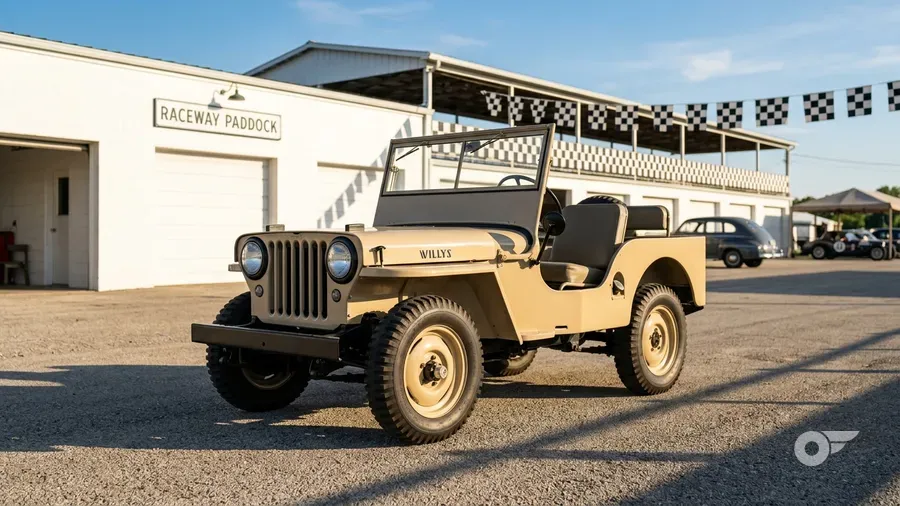
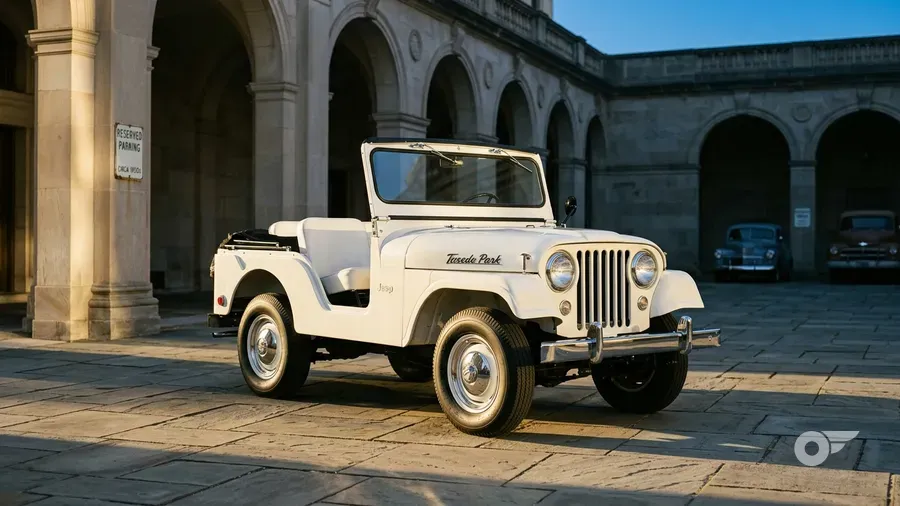
The MB looks the way it does because every line is an answer to a manufacturing or military problem, which is exactly why it has never dated. Delmar Roos holds design patent 136819 for the nose: a slightly tapered clamshell hood, a vertical slatted grille, and headlights set into the grille rather than perched on the wings. The grille itself is the good story. Willys built early cars with a welded flat-bar arrangement, then adopted Ford's stamped sheet-steel pressing with nine vertical slots enveloping the headlights, because a stamping was cheaper than a fabrication. Nine slots, not seven; the seven-slot grille that became the brand's face arrives later, on the civilian CJ-2A. Everything else is subtraction. Flat fenders because flat panels stamp easily and take a boot. A folding windscreen because height mattered on a landing craft. No doors, no exterior handles, no ornament of any kind. Owners call these vehicles flatfenders, a term that covers the MB, the Ford GPW and the civilian CJ-2A, CJ-3A and CJ-3B alike rather than naming this one specifically.

Motorsport pedigree

The MB has no competition record, and the reason is worth stating plainly: it was built entirely inside the war years, it was government property from the moment it left Toledo, and there was nowhere in America to race anything while it was in production. Its performance brief topped out around 45mph, which put it outside any series that existed before or after. What it did instead was create a form of competition that had not existed. Once surplus jeeps reached civilian hands the flatfender became the default tool for hillclimbs, mud trials and the improvised desert and mountain events that grew into organised off-road sport, and it is still the vehicle class rules are written around at vintage trials today. The military-vehicle world runs its own version of judged competition through convention concours events, where an MB is scored on originality rather than lap time. So the honest summary is that the MB never entered a race and instead supplied the machinery for a whole branch of motorsport that had to be invented around it.

In culture

Very few objects have given a word to the language, and this one did it inside a year. Army slang already used jeep for raw recruits and for unproven vehicles before 1941, which is precisely why no single origin story survives scrutiny. Willys president Joe Frazer claimed he coined it by slurring the initials G.P.; others credit the Popeye character Eugene the Jeep, a small creature that went between dimensions and solved impossible problems. What is actually documented is a moment: in February 1941 Willys test driver Irving Hausmann drove one up the steps of the Capitol in Washington, and when asked what it was he answered that it was a jeep. Katharine Hillyer's account ran nationally on 19 February 1941 and the name stuck. The commercial fight over it ran for years. The FTC held that the idea originated with American Bantam and in 1948 barred Willys from claiming to be the jeep's creator; Willys registered the trademark anyway in June 1950. As late as 2015 Pennsylvania's legislature was still formally crediting Butler with inventing it.

Rivals

Cars from other manufacturers that competed for the same buyers when new.
Owning One

Why collectors want it

Almost no other vehicle lets you own a genuinely decisive piece of the twentieth century for the price of a used family car, and that gap between historical weight and entry cost is the whole argument for an MB. The hierarchy inside the generation is narrow but real. Earliest Willys MBs, built before Ford's cheaper stamped nine-slot grille pressing was adopted across both makers, sit at the top and are chased hard by collectors who can identify one across a field. Below them sit ordinary MBs, then the January 1944 composite-body cars, then Ford GPWs, which some buyers discount and Ford people specifically hunt. Documented wartime history moves the needle more than paint does: a vehicle with a traceable unit, theatre or delivery record is worth meaningfully more than a beautifully restored one with no story. Over-restoration is the trap in the other direction, because a jeep finished to a standard the Army never applied reads wrong to anyone who knows. The market here is driven by history and by the military-vehicle community rather than by driving, and it has been remarkably steady for decades.

Which one to look for

The MB is the volume car and the one most people should buy, but the family around it is where the interest sits. The earliest Willys MBs, built before the stamped nine-slot grille arrived, are the connoisseur's pick and command a clear premium. The January 1944 composite body, developed by American Central Manufacturing to merge Willys and Ford features, marks the point at which the two makers' jeeps became genuinely interchangeable and is a useful dating landmark. The Ford GPW is the same vehicle from a different factory, 277,896 of them, and is worth knowing about because plenty are sold as MBs. Further out are the true rarities: the Willys MA, only 1,555 built and mostly shipped to the USSR, the roughly 4,458 Ford GPs, and the Bantam BRC-40, of which roughly 2,600 were made and which is the vehicle that started all of it. The Ford GPA amphibian, around 13,000 built, is a different proposition entirely and a specialist restoration. A genuine Bantam is the grail, and hardly ever changes hands.

What owning one is like

Living with an MB is mostly a matter of accepting the specification rather than fighting it. The six-volt system is the first thing owners meet: it works perfectly when the battery, earths and cables are all in good order and it is miserable the moment any of them is not, which is why so many jeeps have been quietly converted to twelve volts. Brakes are unassisted drums that need a firm leg and regular adjustment. The gearbox has no synchromesh on first, so you learn to stop before selecting it. The body tub rusts at the floors, the seams and the toolbox wells, and any jeep that has lived outdoors under a canvas top will have collected water somewhere. Canvas tops and side curtains leak by design and there is no heater worth the name, so an MB is a fair-weather vehicle unless you are unusually committed. On the other side of the ledger, nothing on it is complicated, nothing needs a specialist tool, and an owner with basic mechanical confidence can fix essentially anything that breaks on a Sunday afternoon.

Upkeep & parts

Parts support is as close to total as it gets for an eighty-year-old vehicle. Kaiser Willys and a handful of other suppliers reproduce nearly every component including complete body tubs, and the surviving stock of new old parts is still substantial. The engine, gearbox, axles and transfer case are simple, cheap and widely understood, and a rebuild costs a fraction of what any other vehicle of comparable historical standing would ask. The real budget item is the body tub and its mounting points, because a badly rotted tub is the one repair that turns a cheap project into an expensive one. Expect to spend money on correct fittings rather than on mechanical work, since originality is what the community judges and correct canvas, markings, data plates and small hardware add up faster than a gearbox rebuild. The Military Vehicle Preservation Association is the organising body worth joining, and the G503 forums hold decades of accumulated knowledge on identification and correct specification that no book matches.

Country of origin
USA
Class
Off-Road
Production years
1941–1945
Units built
~359,489
Model
MB
Nickname
Flatfender
Body
SUV
Layout
Front-engine, 4WD
Engine
134ci (2.2L) Willys L134 Go Devil side-valve I4 (60hp gross, 54hp net, 85 lb-ft)
Transmission
3-speed Warner T-84 manual, 2-speed transfer case
Designer
Karl Probst (American Bantam, original design), Delmar G. Roos (Willys-Overland executive vice-president and chief engineer)