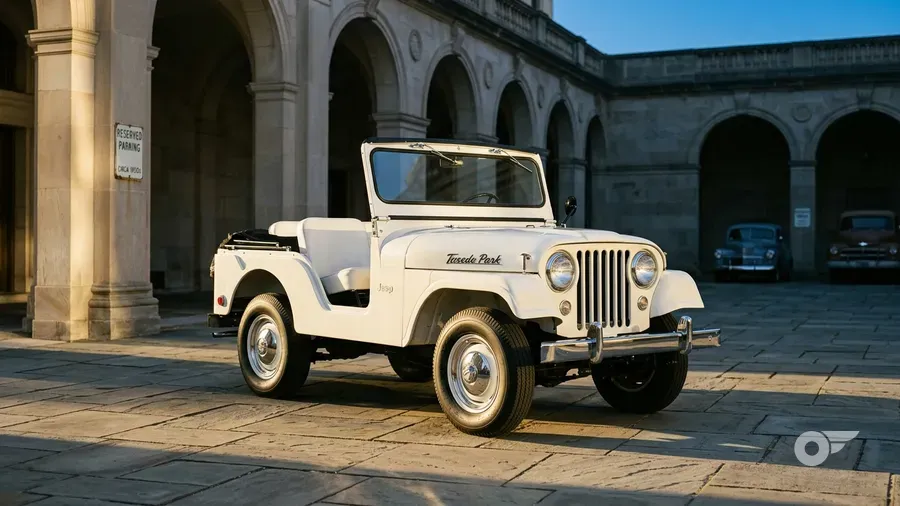
Jeep CJ-5
USA·Off-Road·1954–1983

Production started on 17 July 1945, weeks before the war it was built for ended, and that timing is the whole point of the CJ-2A. Willys-Overland had spent four years building a vehicle the entire world now recognised, and it had no intention of going back to selling ordinary cars. So it took the MB, added a tailgate, moved the spare wheel to the side, fitted larger headlights and a stronger Borg-Warner T-90 gearbox, and sold it to farmers. The pitch was not adventure. It was that a jeep would plough, tow, haul, and then drive your family into town, and Willys backed that up with front and rear power take-offs and a catalogue of agricultural implements to bolt on. The name on the brochures was Universal Jeep. Even the colours were agricultural: Pasture Green with Autumn Yellow wheels, Harvest Tan with Sunset Red wheels. It worked. 214,760 were built in four years, and in the process Willys invented a market that had not previously existed, the civilian four-wheel-drive vehicle. Everything from a Land Rover to a modern crossover traces back to this decision.
The defining attributes and collector status that make this car garage-worthy.

Rated 1 to 10 on the traits that matter for owning, driving, and holding on to a car like this.
There is no electronic content of any kind. Six-volt electrics on early cars, a battery-and-coil ignition with a distributor and points, a single-barrel carburettor and a mechanical fuel pump. Every control is a direct mechanical connection: throttle rod, clutch, three-speed lever, transfer case lever, unassisted steering box and unassisted drum brakes on all four corners. There is no fuel injection, no electronic ignition, no sensor and no computer, and the only electrical accessories on a base vehicle are the lights and a horn. Many have been converted to twelve volts over the years, which is the one change a purist will notice and the one an owner will thank themselves for.
Demand tier, price trend, and typical values by condition, based on recent sales data.
A dependable market. Well-kept cars hold their value and find ready buyers.
Values are holding steady. What you pay today is what it's worth tomorrow.
Priced well below the wartime MB despite being scarcer in genuinely original condition, largely because the military-vehicle collecting world drives MB values and has no equivalent interest here. Pre-13453 cars, original launch colour combinations and surviving power take-off equipment carry clear premiums. Movement has been slow and upward rather than volatile. Band figures are editorial estimates only, because no market data source was reachable during research.
Values as of August 2026.
What anyone seriously considering this car should know first.
The CJ-2A drives like an MB that has stopped apologising. Same 134ci Go Devil, same 80 inch wheelbase, but the T-90 gearbox is a real improvement and takes shifts that the wartime box resented. It weighs 2,137lb, which is nothing, and the gearing is chosen for hauling, so it pulls hard from idle and then runs out of enthusiasm somewhere around 45mph on a level road. Sitting in it is the strange part: you sit high and upright with your knees bent, the windscreen folds flat, and there is very little between you and the weather. Steering is heavy at a standstill and pleasant once rolling. The brakes are unassisted drums and want planning. Off road, low range and a genuinely short wheelbase still make it capable of embarrassing modern vehicles on anything steep or broken, and the low-speed control from the Go Devil's torque is the reason so many were bought as working machines. It is loud, slow, drafty and completely absorbing, and nobody who drives one comes back complaining about the pace.
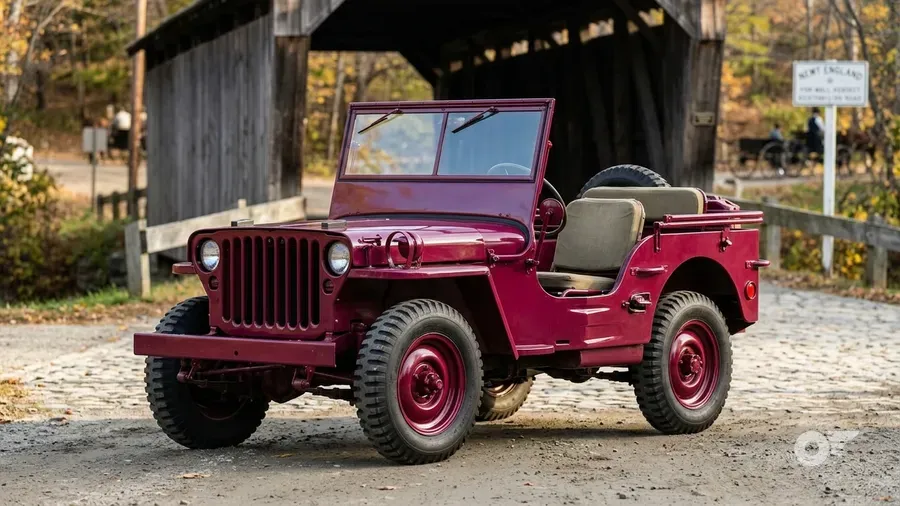
The most consequential design decision on the CJ-2A takes about a second to explain and has outlasted everything else about the vehicle. The military jeep's stamped grille had nine vertical slots. Willys built the civilian one with seven, and set larger, slightly bulging headlights flush into it. Every Jeep since has carried seven slots, and the shape is now the marque's legal and visual signature. Beyond that, the changes from the MB are all about turning a military tool into something you could sell. A tailgate appeared, so the vehicle could actually be loaded. The spare wheel moved to the side, freeing the rear. Everything else stays: flat fenders because flat panels stamp cheaply and survive a boot, a folding windscreen, exposed hinges, no exterior door handles because there are no doors. Owners call this whole family flatfenders, a term that covers the wartime MB and GPW and the civilian CJ-2A, CJ-3A and CJ-3B together rather than naming this vehicle on its own. The colour names tell you exactly who Willys thought was buying.
The CJ-2A has no competition history, and the reason is that Willys never wanted one. There was no factory competition department, no budget for it, and no interest in it, because the entire marketing effort was aimed at farmers, ranchers and municipal buyers who cared about drawbar pull and power take-off output rather than lap times. The vehicle's own specification excluded it anyway: 60 gross horsepower and a top speed in the mid forties left no series it could sensibly enter, and the events Willys did contest were ploughing and hauling demonstrations at agricultural shows, where the jeep was pitted against tractors and horses rather than other cars. What the CJ-2A did do was arm a generation of amateurs. Surplus and secondhand flatfenders became the standard machinery for hillclimbs, mud runs and improvised desert events through the late 1940s and 1950s, and the four-wheel-drive clubs that formed around them wrote the first rulebooks for what is now organised off-road competition. The CJ-2A never raced, but a great deal of off-road sport was built on top of it.
The CJ-2A is the vehicle that taught the world that four-wheel drive was something a private citizen could buy, and the cultural consequences of that are larger than anything it did on screen. Willys sold it as the Universal Jeep, a machine that would work all week and take the family out on Sunday, and the advertising leaned hard on the vehicle everyone had just watched win a war. That transfer of military credibility to a consumer product is now a standard marketing move and this is close to its first fully worked example. Its visual legacy is even more direct. When a toy, a logo, a film prop or a modern Jeep concept reaches for the idea of a jeep, it reaches for this shape: flat fenders, folding windscreen, and the seven-slot grille that arrived on this model and has never left. Rubicon-badged Wranglers built eighty years later still carry it. The CJ-2A also went everywhere. Willys pushed exports hard, and the sight of a small American four-wheel-drive vehicle working in agriculture on every continent is a large part of why the word jeep became a generic noun in several languages.
Cars from the same manufacturer family, like platform siblings or shared-era relatives.
Cars from other manufacturers that competed for the same buyers when new.
The CJ-2A is the missing link, and it is priced as though nobody has noticed. It is the vehicle that turned a military tool into a consumer product and created the four-wheel-drive market outright, yet it costs a fraction of what a wartime MB with paperwork does, and less than a good CJ-7. Inside the generation the hierarchy is subtle rather than steep. The earliest cars, built before serial number 13453 and still carrying military-specification components, are the ones knowledgeable buyers chase. Original colour combinations matter, and the launch pairings of Pasture Green over Autumn Yellow wheels and Harvest Tan over Sunset Red are far more sought after than the black and the later shades. Vehicles retaining their factory power take-off and period implements are unusual, because most were scrapped or lost decades ago, and they tell the story the vehicle exists to tell. Working provenance counts here in a way it does not on most classics: a CJ-2A with a documented life on one farm is a better object than a bare restoration. Values have moved up slowly and steadily rather than spiking, which suits the vehicle.
There is no trim ladder to work through, because Willys sold one CJ-2A and a thick options catalogue instead. That makes the meaningful distinctions mechanical and chronological. The dividing line collectors care about is serial number 13453: before it, the vehicle still uses military-specification running gear inherited from the MB, and after it Willys switched to the Dana 41 rear axle. Early cars are the ones enthusiasts hunt. The option list is where the individuality lives. Front and rear power take-offs turned the jeep into a stationary power source and drove a whole industry of bolt-on implements, from mowers to welders to post-hole diggers, and a surviving PTO vehicle with period equipment is genuinely rare and worth a premium over a plain one. Canvas top, passenger seat, rear seat and heater were all extras rather than standard fitment, so a fully equipped car left the factory noticeably more expensive than a bare one. Original launch colour combinations are the other thing to look for. Later 1946 additions including Princeton Black are common; the founding green-and-yellow and tan-and-red pairings are not.
An honest CJ-2A asks very little of an owner and gives back more than it should. The six-volt system is the usual first complaint, working faultlessly when the battery, earths and cables are all sound and sulking the moment one is not, which is why so many have been converted to twelve volts. Unassisted drum brakes want regular adjustment and a firm leg. There is no synchromesh on first gear, so you learn to come to a stop before selecting it, and the transfer case lever needs a technique rather than force. Rust is the real running cost: floors, tub seams, toolbox wells and frame spring hangers all collect water, and any vehicle that has spent its life under a canvas top has been wet inside more often than not. The top and side curtains leak, there is no meaningful heater, and above 45mph the vehicle makes its opinion known. Against all of that, essentially nothing on the vehicle is beyond a home mechanic with ordinary tools, and the pleasure of that is a large part of why people keep them.
Upkeep is genuinely cheap and the parts situation is close to ideal. Kaiser Willys and several other specialists reproduce nearly everything including complete body tubs, frames, glass and trim, and Go Devil internals, T-90 gearsets and axle parts are all readily available new. Prices for mechanical components are a fraction of what any comparable-era car costs. Budget instead for bodywork: a rotten tub and rusted frame hangers are the repairs that turn a cheap project into an expensive one, and welding a jeep tub properly is slow work. Correct hardware, canvas and decals add up faster than people expect if originality matters to you. The community is the best part of ownership. eWillys publishes daily on early jeeps and is the standing archive for identification questions, the CJ3B site carries deep reference material covering the whole flatfender family, and the specialist suppliers all answer the phone and know these vehicles individually. Very little about running one requires a professional.