Octane Files
Browse CarsToyota Land Cruiser BJ/FJ20

Toyota Land Cruiser BJ/FJ20

Overview

The Land Cruiser exists because the United States government placed an order. In 1950, with the Korean War running, it wanted 100 light utility vehicles built to the then-new Willys specifications and gave the work to Toyota. The prototype that followed in January 1951 was called the Toyota Jeep BJ, and it carried a 3.4-litre Type B petrol six making 85 PS at 3,600rpm, a bigger and torquier engine than the Jeep it was measured against. That July, test driver Ichiro Taira drove one to the sixth stage of Mount Fuji, higher than any vehicle had climbed, and Japan's National Police Agency ordered 289. Regular production began at the Honsya plant in 1953. Then Willys objected to the word Jeep, and in June 1954 Toyota's director of technology, Hanji Umehara, went looking for a replacement. He chose Land Cruiser with one eye on England, where Land Rover was the competitor and the new name had to sound no less dignified. The 20 Series that arrived in 1955 was the first version built to be sold rather than to fill a contract, and it is where Toyota's export business actually begins.

Distinctions

The defining attributes and collector status that make this car garage-worthy.

Octane Files Select
Renowned for its history, engineering, or cultural weight.

Collectibility scorecard

Rated 1 to 10 on the traits that matter for owning, driving, and holding on to a car like this.

Desirability
7/10
Rarity
10/10
Driving thrill
3/10
Investment trajectory
7/10
Usability
2/10
Ease of restoration
2/10
Cultural impact
7/10
Electronic dependence
Fully analogHeavily electronic

Nothing on this vehicle is electronic. A carburettor, a distributor with points, a generator and a lighting circuit is the whole extent of it, and the four-wheel drive is engaged by a lever that moves a mechanical dog clutch. There is no low range at all on the BJ or the 20 Series, because the two-speed transfer case did not arrive until the 40 Series in 1960. Everything a driver touches is a rod, a cable or a linkage.

Market data

Demand tier, price trend, and typical values by condition, based on recent sales data.

Demand tier
EntrySolidHighBlue-chip

Strong, sustained collector demand. Good examples never wait long for a buyer.

Value trajectory
AppreciatingStableCooling

Values are climbing. The market wants more of these than exist.

Price by condition
Driver
$35k
Excellent
$70k
Concours
$120k

Supply, not demand, sets this market. Genuine BJs effectively do not trade, and 20 Series cars surface a few times a year at most, usually out of Japan or Australia. That makes comparable sales thin and prices erratic: two similar FJ25s can be a long way apart depending on who is in the room. The band below describes an honest, running, unrestored 20 Series rather than a BJ, which sits outside any band. Direction is upward, driven by the same collector interest that has lifted the FJ40, plus the simple fact that nothing new is being found.

Values as of August 2026.

Buyer's guide

What anyone seriously considering this car should know first.

Why it's worth it
The first Toyota anyone outside Japan wanted, and the origin of the whole Land Cruiser line
Callout
Renamed Land Cruiser in June 1954 after Willys objected to the word Jeep
What to watch for
Almost everything about buying one is establishing what it actually is. Model codes were reused through the 1950s, a great many survivors have been rebuilt from the parts of several vehicles, and a BJ badge on a 20 Series chassis is not unheard of, so buy the documentation as hard as you buy the truck. Know the dates. The BJ ran from 1951 to 1955 on the 3.4-litre Type B six; the 20 Series ran from 1955 to 1960 on the 3.9-litre Type F, which is the engine that went on to power Land Cruisers for another twenty-five years. Neither has a low range, because the two-speed transfer case did not arrive until the 40 Series in 1960, so if the vehicle in front of you has one it is not what the seller thinks. Bodies rot from inside the sills and footwells outward and no reproduction panel industry exists, so assess the shell as though you will be fabricating, because you will. Check the frame at the spring hangers. Most of what survives is in Japan or Australia, so put shipping and an import path into the price before you agree one.

The Story

Driving character

Slow, heavy and completely unhurried, which is the point. The Type B six makes its 215Nm at 1,600rpm and the whole vehicle is geared to use it there, so you drive on torque and let the engine lug rather than revving it. Three forward gears, no synchromesh worth relying on, and no low range at all: four-wheel drive is either engaged or it is not, and steep ground is taken in first with the engine barely turning. The steering is a worm-and-sector box with real slack in it, the brakes are drums at all four corners with no servo, and the ride on leaf springs at both ends is exactly what that implies. What surprises people who expect a crude copy of a Jeep is how much more substantial it feels. The BJ is longer, heavier and considerably more powerful than the Willys it was benchmarked against, and it pulls hills the American vehicle would need a run at. The 20 Series adds nothing to the driving experience except a quieter cabin and a body that keeps more weather out.

Design

The BJ is upright, narrow and almost entirely functional: a flat vertical grille, a folding windscreen, exposed hinges and a canvas roof over a simple steel tub. Nothing on it was styled. There is one intriguing piece of prehistory. During the war Japan captured a Bantam or Willys jeep in the Philippines and asked Toyota for something similar with a different appearance, which produced the AK10, a half-ton truck with an upright grille, a folding windscreen and flat front wheel arches that angled down and back, exactly the way the FJ40's would twenty years later. Toyota is clear that the postwar BJ inherits no mechanical parts from it, only lessons, so this is a resemblance rather than a bloodline. The 20 Series is where somebody finally drew the vehicle rather than engineered it. The panels are smoother, the grille is wider and set into a proper front, and the range grows to include a hardtop and a five-door wagon. It was done for export, and it worked.

Motorsport pedigree

There is no competition record here and there was never going to be one. Toyota in the early 1950s was a company recovering from near-bankruptcy, building trucks under contract, with no motorsport budget and no reason to spend one on a vehicle whose customers were police forces and government departments buying on tender. What the BJ has instead is one genuine proving run, and it is the reason the vehicle exists at all. In July 1951 test driver Ichiro Taira took a BJ prototype up Mount Fuji to the sixth stage, higher than any vehicle had been driven, and the demonstration converted Japan's National Police Agency into a customer for 289 units. That single climb did more for the model than any rally result would have. The contrast is worth holding on to: Land Rover would win the first Paris-Dakar in 1979 and win it again in 1981, and Toyota's own first Dakar car-category victory did not come until 2019, with a Hilux. The Land Cruiser's evidence was always work rather than racing.

In culture

The cultural weight here is commercial rather than cinematic. This is the vehicle that made Toyota an exporter. Land Cruisers reached Saudi Arabia in 1955 under the Abdul Latif Jameel agreement and Yemen in 1956, which is the beginning of a Middle Eastern relationship that has outlasted several governments. In 1958 FJ25 production started in Brazil, the first Toyota vehicle ever built outside Japan, sold locally as the Bandeirante from January 1962. The same year Toyota entered the United States with the Toyopet Crown, which flopped badly enough that exports of it were suspended in favour of the Land Cruiser. In 1959 the model reached Australia as FJ25 and FJ28 cab chassis, the first Japanese vehicle regularly exported there, and went straight to work on the Snowy Mountains hydroelectric scheme. Every reputation Toyota now has for durability in hard places was earned by this vehicle first, in those four markets, before anybody in Europe or America had heard of the company.

Owning One

Why collectors want it

This is the origin point, and it is collected as history rather than as a vehicle. Almost nothing from the BJ years survives: production was tiny, the buyers were police and fire departments who used them until they were finished, and Japan had no preservation culture in the 1950s. A genuine BJ is museum property. The 20 Series is the realistic end of this row and it is still very scarce, particularly outside Japan, because the export volumes were small and the cars that went to Saudi Arabia, Brazil and Australia went to work. The reasons to want one are specific. It carries the name change that made the model, it carries the first Toyota engine anybody trusted, and it is the vehicle that convinced Toyota that exporting was worth doing at a moment when the Toyopet Crown had just failed in America. Within the row the hierarchy is simple: a documented BJ outranks everything, a Japanese-market FJ25 comes next, and a Brazilian-built FJ25 sits below both while carrying its own distinction as the first Toyota assembled outside Japan.

Which one to look for

The Toyota Jeep BJ of 1951 to 1955 is the grail and the one almost nobody will find. It is a two-door soft top on a 3.4-litre Type B petrol six, sold overwhelmingly to Japan's police and fire services. Late in that run the 3.9-litre Type F six appeared, at first only in the fire-engine chassis, and that engine is the one that matters historically because it went on to power Land Cruisers for the next quarter century. The 20 Series of 1955 to 1960 is the realistic buy and the more interesting vehicle: same three-speed gearbox, the F engine as standard, and bodywork deliberately softened for civilian and export tastes. It came as a soft top, a hardtop, a pickup and a five-door station wagon. The FJ25 is the common designation and the one to look for; Australia took FJ25 and FJ28 cab chassis from 1959 and bodied them locally, which produced a handful of genuinely unique survivors. Brazilian FJ25s built from 1958 are the first Toyotas made outside Japan and are collected on that basis alone.

Bandeirante FJ25 · 1958–1968

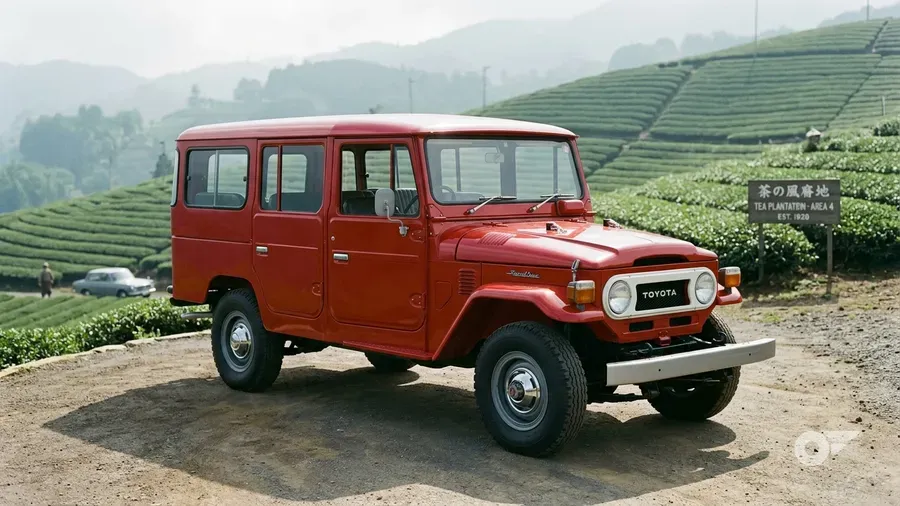
Brazilian-built FJ25, and the first Toyota vehicle ever manufactured outside Japan. Mechanically a 20 Series, it was assembled at São Bernardo do Campo and from 1962 fitted with a locally produced Mercedes-Benz diesel engine.

FJ25 · 1955–1960

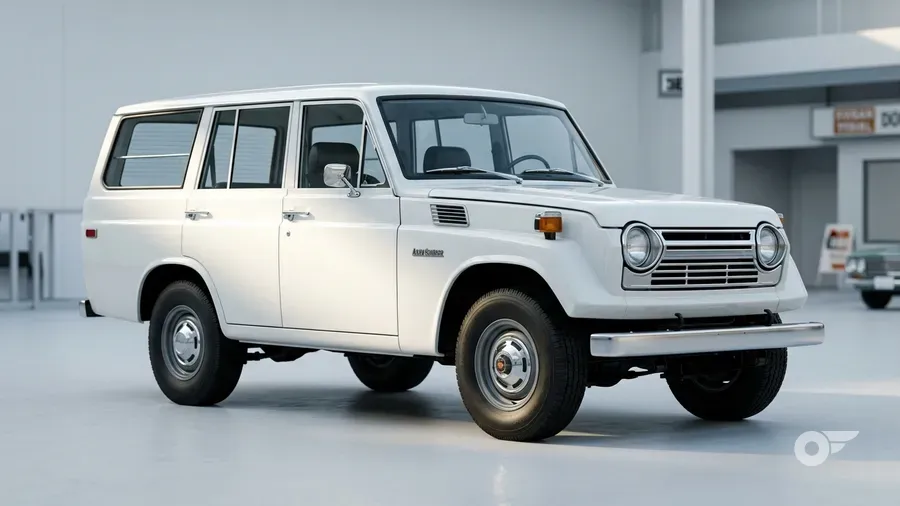
The 20 Series, and the first Land Cruiser built to be sold rather than to fill a contract. Bodywork was deliberately softened for civilian and export buyers and the 3.9-litre Type F six replaced the Type B, though the three-speed gearbox carried over. Offered as a soft top, a hardtop, a pickup and a five-door station wagon.

Toyota Jeep BJ · 1951–1955

The original. A two-door soft top on a 3.4-litre Type B petrol six making 85 PS at 3,600rpm, developed in January 1951 against a United States government order for 100 vehicles built to Willys specifications. Four-wheel drive with a single-speed transfer case, three-speed gearbox, drum brakes. Sold almost entirely to Japanese police and fire services.
What owning one is like

The mechanical side is the easy part and it is genuinely easy. The Type B and F sixes are understressed, slow-turning cast-iron engines that will run on indifferent fuel more or less indefinitely, and the gearbox, axles and transfer case are agricultural in the best sense of the word. Everything else asks something of you. Bodies rot from inside the sills and the footwells outward, and with no reproduction panels available a rotten tub means fabrication rather than a parts order. The wiring in a seventy-year-old working vehicle is generally somebody's improvisation by now. Brakes are unassisted drums that want adjusting often and reward it when they get it. Glass, instruments, badges and interior trim are what actually stop restorations, because they were never made in quantity and nobody saved them. The honest limit of the vehicle is about 45mph, and a day's driving is a day's work. None of that puts owners off. The people who have these tend to have had them for decades, treat them as historical objects rather than as cars, and are the reason any survive at all.

Upkeep & parts

Budget for fabrication rather than for parts, because for the BJ years there are almost no parts. Anything shared with the later 40 Series, and that includes a surprising amount of the F engine, can be sourced from the specialist trade that grew up around the FJ40, with Specter Off-Road the deepest of them. Anything specific to the BJ or 20 Series body, trim, glass or instruments generally has to be found second hand in Japan or made. The Toyota Land Cruiser Association, running since 1976, and the IH8MUD forum are where the knowledge sits, and both have members who have been through this. The Land Cruiser Heritage Museum in Salt Lake City is worth a call before committing to a restoration, since it holds examples most owners will never otherwise see. Running costs once sorted are trivial by collector-car standards: the engine is happy on regular fuel, service items are simple, and there is nothing on the vehicle that needs a specialist to adjust.

Country of origin
Japan
Class
Off-Road
Production years
1951–1960
Units built
~20,000
Model
Land Cruiser
Nickname
No nickname ("Toyota Jeep BJ" was the factory's own name until June 1954, not an owner nickname)
Body
Coupe Utility, SUV, Wagon
Layout
Front-engine, 4WD
Engine
3.4L Type B OHV I6 petrol (85 PS), 3.9L Type F OHV I6 petrol
Transmission
3-speed manual
Designer
Toyota in-house; no individual stylist credited. The BJ was engineered to a 1950 United States military specification rather than styled, and the shape follows the brief.