Overview
The Scrambler is not a CJ-7 with a longer body. It is a small four-wheel-drive pickup, and Jeep built it by stretching the CJ chassis to a 103.5 inch wheelbase, ten inches beyond a CJ-7, then fitting a removable half cab so the rear of the tub became an open load box. There is no separate bed bolted to a frame the way a conventional pickup is built. It is one body, cut differently, and that is why a Scrambler looks like nothing else Jeep has made. American Motors launched it for 1981 into a market that was buying compact four-wheel-drive pickups by the hundred thousand, and it never landed. 8,355 sold in the first year, then 7,759, then 5,405, and by 1986 the total for the final year was 128 vehicles. Across six years American Motors built 27,792, against 379,299 CJ-7s. That failure is now the whole story: the Scrambler is by a wide margin the rarest thing in the CJ family, and the market has spent the last decade working out what that is worth.
Distinctions
The defining attributes and collector status that make this car garage-worthy.
Collectibility scorecard
Rated 1 to 10 on the traits that matter for owning, driving, and holding on to a car like this.
Simple carburetted mechanicals with a thin layer of early-1980s emissions control on top. The AMC four and six are both fed by carburettors with electronic ignition, and later cars carry an emissions system that manages ignition timing and mixture rather than any form of fuel injection. There is no engine management computer of the modern kind, no ABS, no traction control and no stability system. Power steering and power front discs were available and are hydraulic rather than electronic. Throttle, clutch, gearbox and transfer case are all direct mechanical linkages, and the four-wheel-drive system is engaged by a lever rather than a switch.
Market data
Demand tier, price trend, and typical values by condition, based on recent sales data.
Strong, sustained collector demand. Good examples never wait long for a buyer.
Values are climbing. The market wants more of these than exist.
The clearest scarcity story in the CJ family and the market has priced it accordingly, with Scramblers pulling well clear of equivalent CJ-7s over the last decade. Original half cabs, unmodified 258 cars and documented low-mileage examples lead. Restomod builds trade far above this band on their own terms. Band figures are editorial estimates only, because no market data source was reachable during research, and this is the car in the batch where that limitation matters most.
Values as of August 2026.
Buyer's guide
What anyone seriously considering this car should know first.
The Story
Driving character
The extra ten inches over a CJ-7 do exactly what you would expect and slightly more. A Scrambler tracks straight, settles over undulations that would set a CJ-5 pitching, and will hold a motorway speed without the constant small corrections that define every shorter Jeep. It is the first vehicle in this family you could drive across a country without resenting it. The AMC 258 six is the right engine for it, all low-down torque and no interest in revving, which suits a vehicle designed to carry things and to crawl. Off road the long wheelbase costs it the CJ-5's agility on tight, steep ground and gives back a stability on side slopes and rutted trails that the short cars never had. The steering is the same heavy, vague recirculating ball arrangement as every CJ, the ride is leaf-sprung and firm, and the load box amplifies noise behind your head. With the half cab on it feels like a small truck. With the top off it feels like nothing else on the road, and that is most of the reason people want one.
Design
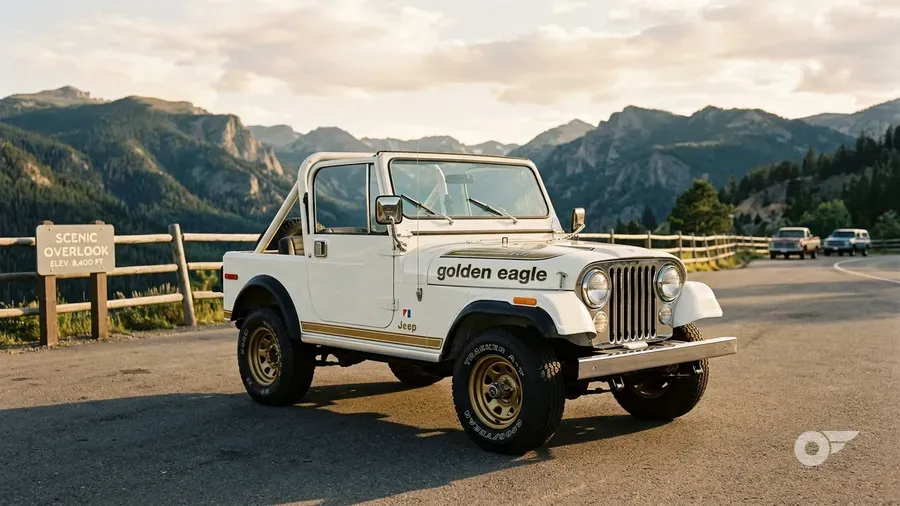
The Scrambler works visually because Jeep resisted the obvious solution. Rather than bolting a separate pickup bed onto a longer frame, American Motors stretched the CJ tub itself and cut a removable half cab out of it, so the load box and the passenger compartment are one continuous body with a joint rather than two assemblies fighting each other. The result has a low, long line broken only by the cab, and none of the awkward step that afflicts most small pickups of the era. Everything forward of the windscreen is pure CJ-7: seven-slot grille, round headlights, flat bonnet, exposed hinges, bolt-on wings. Everything behind it is new. The SCRAMBLER graphics across the load box sides are the period signature and now a large part of the appeal. Eighteen years after the last one was built, Jeep launched the Wrangler Unlimited on a 103.4 inch wheelbase, within an inch of the Scrambler's. When the company finally built a Wrangler pickup again for 2020, Scrambler was reportedly the name most often discussed before Gladiator was chosen.
Motorsport pedigree
No factory competition programme existed, and American Motors was in no financial condition to start one in 1981: the company was under Renault control, fighting for survival, and spending what it had on the XJ Cherokee. There was also no series for a long-wheelbase four-wheel-drive pickup to enter. What the Scrambler has instead is a working record and an amateur one. Its length and load capacity made it a useful support vehicle at off-road events rather than a competitor in them, carrying fuel, spares and recovery gear for the short-wheelbase machinery that was actually running. In privateer hands the long wheelbase found a natural home in desert running and in expedition use, where stability over broken ground at speed matters more than the ability to turn inside a CJ-5. Some were built into competition trucks; most were not, because they were worth more working. The honest summary is that the Scrambler is the one member of this family whose competition contribution was logistical, and the vehicles that survived did so partly because nobody destroyed them racing.
In culture
The Scrambler's cultural life happened almost entirely after it stopped being built. It sold badly, it was not the vehicle in anybody's film, and for two decades it was the odd Jeep in the corner of the lot that nobody could price. What changed it was scarcity meeting a visual moment: as the classic four-wheel-drive market moved online, the half-cab silhouette and the block SCRAMBLER graphics turned out to be exactly what a generation of buyers wanted to look at, and restored examples became a fixture of the enthusiast image world. Jeep noticed. The Wrangler Unlimited that arrived in 2004 sits within an inch of the Scrambler's wheelbase, and when the company finally built a Wrangler-based pickup again for 2020, Scrambler was reportedly the name most seriously considered before Gladiator was chosen, although Jeep lists the CJ-10 and the Comanche as that vehicle's formal predecessors rather than this one. It is a strange kind of fame: a commercial failure that became the reference point for what the company built forty years later.
Related cars
Cars from the same manufacturer family, like platform siblings or shared-era relatives.
Rivals
Cars from other manufacturers that competed for the same buyers when new.
Owning One
Why collectors want it
Rarity here is real rather than theoretical. 27,792 vehicles across six years against 379,299 CJ-7s means that for every Scrambler there are more than thirteen CJ-7s, and the gap on the ground is wider still because these were bought as working trucks and worked accordingly. Survivors in original condition are genuinely scarce, and values have pulled clear of the CJ-7 in a way that would have looked absurd twenty years ago. Beyond the numbers there is the shape. The half cab and open box give the Scrambler a proportion nobody has repeated, and it photographs unlike any other Jeep, which matters more in the current market than anyone wants to admit. It is also the most usable classic CJ by some margin: the long wheelbase settles the ride, the load bed makes it genuinely practical, and it will do a motorway journey a CJ-5 would make miserable. The hierarchy is simple. Original half cabs, unmodified drivetrains and honest frames lead; the 230 right-hand-drive postal vehicles are the curiosity; and a Scrambler that has been converted into a lifted show truck is a different, softer market.
Which one to look for
There is no meaningful trim ladder to work through, so the decisions are about configuration rather than badges. The half cab is the first one. Scramblers were sold with a soft top, a half cab hardtop, or a full-length hardtop, and a vehicle retaining its original hard top is worth noticeably more than one that lost it decades ago, because replacements are scarce and expensive. The second is the engine. The 258 six is the one to have, with the torque the vehicle's length and load capacity actually need, and the four-cylinder cars are best understood as projects unless you are unusually patient. Gearbox choice follows: five-speed cars are the easiest to live with on a road, and the automatic makes the most sense if the vehicle is going to tow. The curiosity is the right-hand-drive postal Scrambler, 230 built with automatic transmission for mail delivery, and it is the rarest configuration Jeep produced here by an enormous margin. Early cars from 1981 and 1982 account for well over half of all production, so a 1985 or 1986 vehicle is genuinely uncommon.
What owning one is like
Owning a Scrambler is CJ-7 ownership with two extra concerns and one large compensation. The extra concerns are frame and top. The longer rear frame section has spent its life carrying loads and rusts at the spring hangers and crossmembers like every CJ, but with more leverage working on it, so inspect and maintain it properly rather than optimistically. Original half cabs and hardtops are scarce and expensive, seals perish, and rear glass is not something you find easily on a Sunday. Otherwise it is familiar territory: tub floors and corners rot, the bulkhead hides the costly rust, soft tops leak, the steering box develops play, and fuel consumption from the carburetted six is what it is. The compensation is that this is the CJ you can actually use. It rides better, tracks straighter, carries a genuine load and covers distance without wearing you out, and because values are now high enough to justify proper work, most surviving Scramblers have been looked after rather than run into the ground.
Upkeep & parts
Mechanically a Scrambler is a CJ-7, so the engines, gearboxes, axles, brakes and suspension are all supported by the same enormous aftermarket and cost the same modest money. Anything forward of the windscreen interchanges. Where the Scrambler differs is in its own bodywork, and that is where the budget goes. Rear tub sections, load box floors, tailgates, half cabs and hardtops are specific to the CJ-8, made in far smaller numbers than CJ-7 equivalents and correspondingly harder and dearer to source, so buying a complete vehicle is nearly always cheaper than completing an incomplete one. Reproduction body panels do exist but the choice is narrower. Budget for the frame first as with any CJ, and for the top second. Community knowledge is concentrated rather than broad: the general Jeep forums cover the mechanicals thoroughly, and Scrambler-specific knowledge tends to live with a smaller group of owners who know exactly what is correct. Values now comfortably support proper restoration work, which was not true fifteen years ago.