Octane Files
Browse CarsChevrolet K5 Blazer 2nd Gen

Chevrolet K5 Blazer 2nd Gen

Overview

Nineteen model years is not one vehicle, and this one has three distinct lives. The Rounded Line body arrived for 1973, seven inches longer overall on a wheelbase stretched two and a half inches, and for three years it did what the first Blazer had done: the entire roof came off. Then came 1976 and the half-cab, a fixed roof over the front seats with a removable section behind, and the Blazer stopped being a convertible. From there it settled into being the default American 4x4, peaking at 90,987 in 1979 before the second fuel crisis took two thirds of that away in a single year. The 1980s truck is different again: square headlamps from 1981, a 6.2 Detroit Diesel from 1982, throttle-body injection from 1987, and a body that outlived the pickups it was based on by four years because GM had already moved them onto the GMT400. By the time the last 7,332 were built in 1991, Chevrolet had made 829,878 of them.

Distinctions

The defining attributes and collector status that make this car garage-worthy.

Octane Files Select
Renowned for its history, engineering, or cultural weight.

Collectibility scorecard

Rated 1 to 10 on the traits that matter for owning, driving, and holding on to a car like this.

Desirability
7/10
Rarity
2/10
Driving thrill
5/10
Investment trajectory
7/10
Usability
6/10
Ease of restoration
8/10
Cultural impact
7/10
Electronic dependence
Fully analogHeavily electronic

Nineteen years cover a lot of ground here. A 1973 truck is entirely mechanical: carburettor, distributor, cable throttle, a lever for the transfer case. The 6.2 Detroit Diesel offered from 1982 is if anything more analogue still, since its injection pump is purely mechanical and it will run with the battery disconnected. The other end of the generation is different. Throttle-body fuel injection arrived for 1987 with an engine control module making the fuelling decisions, and by then emissions hardware, a lock-up converter and assorted sensors are part of the picture. Nothing here is drive-by-wire and nothing corrects the driver, which is why the score sits low, but a 1990 truck and a 1973 truck are not the same proposition to work on.

Market data

Demand tier, price trend, and typical values by condition, based on recent sales data.

Demand tier
EntrySolidHighBlue-chip

A dependable market. Well-kept cars hold their value and find ready buyers.

Value trajectory
AppreciatingStableCooling

Values are climbing. The market wants more of these than exist.

Price by condition
Driver
$15k
Excellent
$32k
Concours
$58k

Two variables set the price: whether the top comes fully off, and how straight the body is. The 1973-1975 full-convertible trucks trade above everything else here, and rust-free southwestern examples above rust-repaired ones by a wide margin. Squarebody enthusiasm has lifted the whole platform over the last decade, and the K5 benefits more than the pickups because far fewer were built. The band describes a 1976-1980 350 four-wheel-drive half-cab.

Values as of August 2026.

Buyer's guide

What anyone seriously considering this car should know first.

Why it's worth it
Nineteen model years and 829,878 trucks, all on one body
Callout
The full-length removable top died in 1976 and the shell it left behind ran until 1991
What to watch for
Rust decides almost every one of these, and it is predictable. Look at the rear wheel arches and the quarter panels below them, the cab corners, the rocker panels, the front floor pans and the cowl where the vents dump water onto the firewall. On any 1976-onward truck, the joint where the removable rear top meets the fixed cab collects water and rots both parts at once, and the rear top is expensive to replace. Check the tailgate, which rots from the bottom seam upward and has electrics inside it. Then work out exactly what you are looking at. Rear-wheel-drive Blazers were built until 1982 and a converted one is not a real 4x4 truck. The 1973-1980 trucks came with either the part-time NP205 transfer case or the full-time NP203, which behave differently and are not equally loved; from 1981 it is the NP208. Diesels are 1982 onward and four-wheel drive only. Lifts, big tires and swapped drivetrains are the norm rather than the exception, so a stock truck needs documenting.

The Story

Driving character

A squarebody Blazer drives like a well-sorted pickup, which is to say better than you expect and worse than anything modern. The 106.5-inch wheelbase and the extra length over the first generation calm it down noticeably at speed, and a truck with the full-time NP203 transfer case can simply be left in four-wheel drive on wet roads, which was genuinely useful in 1973 and is still pleasant now. The 350 does the work: torque from just above idle, no drama anywhere, and a soundtrack every American recognises. The 400 is stronger and thirstier and the 250 six is honest transport for someone with time. Steering is slow, body roll is generous and the brakes want planning. Take the rear top off, which even the later half-cab trucks allow, and it becomes something else entirely: a big square open-air machine with a wind pattern that makes conversation impossible above fifty and a view over the hedges. Off pavement it is unhurried and hugely capable, and its size is the only thing that ever stops it.

Design

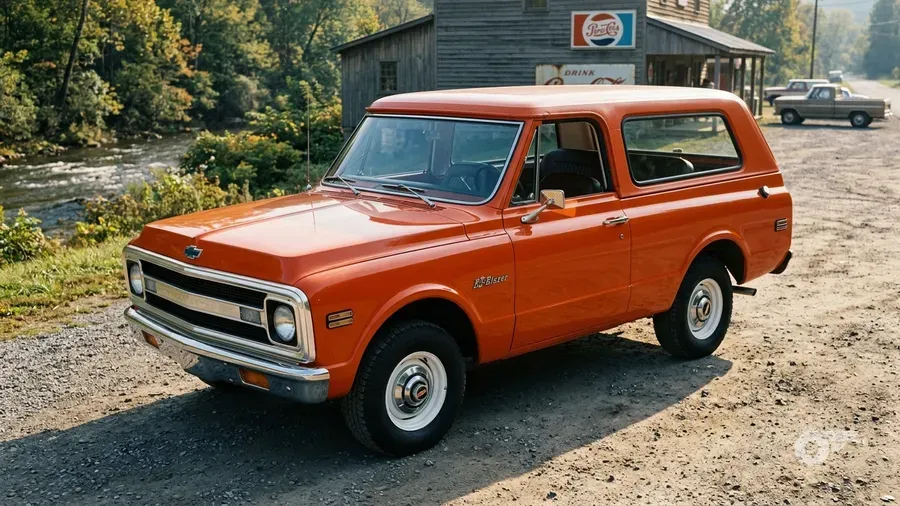
GM called this generation the Rounded Line, which is an odd name for the shape everyone else calls the squarebody. Both readings are fair: the panels are flat and the corners are square, but the edges are all slightly softened, which is why the trucks photograph better than their outlines suggest. The 1973 body is the more elegant of the two faces, with a single-bar grille, round headlights and a long unbroken flank. The 1981 restyle squares it up with stacked twin headlamps and a heavier grille, and the 1989 change to a GMT400-style face is the odd one, a modern grille bolted to a sixteen-year-old body. Details reward attention: the K5 emblems disappeared in 1988, and from 1987 the badging switched from C/K to R/V so buyers would not confuse these with the incoming GMT400 pickups. The half-cab of 1976 is the biggest visual change of all, adding a fixed roof section and a full rear pillar where there had been nothing but sky.

Motorsport pedigree

No factory Blazer competition programme is documented at any point in nineteen years. General Motors had stood outside official motorsport since the Automobile Manufacturers Association banned factory-supported racing in 1957, and unlike Ford, which walked away from that agreement in 1962 and promptly went desert racing with Bill Stroppe's Broncos, GM stayed out of it. So the Blazer has nothing to put beside the Bronco's outright Baja 1000 wins in 1969, 1971 and 1972, or the International SSII that took production four-wheel-drive honours in 1977. What it has instead is a second life as raw material. The squarebody chassis is cheap, immensely strong and endlessly modified, which is why it became a fixture of privateer desert running, rock crawling and short-course competition long after Chevrolet stopped caring, and why the racing that matters here happened in the hands of people who bought the trucks used. The Blazer's competition record is written by owners, and it is still being written.

In culture

The squarebody is the American truck the 1980s ran on, and the Blazer is its two-door open-topped face. These were the vehicles of ski towns, county sheriffs, ranches and construction sites, and they turn up in the background of nearly every American film shot outdoors between 1975 and 1992 without anyone ever making them the star. That anonymity has flipped completely. Squarebody culture is now one of the biggest movements in the hobby, with its own forums, its own restoration industry and its own aesthetic of two-tone paint and steel wheels, and the K5 sits at the top of it because it is the rarest and most charismatic shape on the platform. Chevrolet has kept the name alive on vehicles that have nothing to do with this one, most recently a crossover, which has only sharpened the affection for the original. The 1973-1991 Blazer never had a defining film role. It has something less glamorous and more durable, which is that a whole generation of Americans grew up in the back of one.

Owning One

Why collectors want it

The Blazer market splits on one date and everybody in it knows the date. A 1973, 1974 or 1975 truck has a full-length removable top and is a convertible in the literal sense; a 1976-onward truck has a fixed cab roof and a lift-off rear section, and it is worth meaningfully less for that reason alone. That is the first thing to understand about buying one. The second is that this is a squarebody, and squarebody culture has become one of the largest movements in the American hobby, driven by the pickups and pulling the Blazer along with it. Values that were pickup-truck money ten years ago are not any more. What makes the generation genuinely collectible rather than merely fashionable is that it is the last full-size two-door 4x4 wagon of its kind that a normal person can still buy, repair and use: parts are everywhere, the engineering is comprehensible, and the 350 is the most supported V8 ever made. Rarity is not the argument here. Usability is.

Which one to look for

The 1973 to 1975 trucks are the ones to look for, because they are the last Blazers with a full-length removable top and the market treats them as a separate class. After that the choice is about era. A 1976 to 1980 truck is the classic shape with the round headlights, the best-selling years of the whole line, and generally the sweet spot for parts and price. The 1981 restyle brought stacked square headlamps and a lighter body, and those trucks look more 1980s than 1970s, which some buyers want and some do not. Late cars carry their own logic: throttle-body injection from 1987 makes a 350 start and run properly in any weather, the K5 badges disappeared in 1988, and the 1989-1991 trucks wear a GMT400-style grille on a body GM had otherwise moved on from. The connoisseur's oddity is the 6.2 Detroit Diesel, offered from 1982 in four-wheel-drive trucks only: slow, loud, unburstable, and the only one of these you can drive all day on very little fuel.

1981 Restyle · 1981-1991

Stacked twin square headlamps, a heavier grille and a lighter body. The face that separates the 1970s Blazer from the 1980s one at a glance.

6.2 Detroit Diesel · 1982-1991

A 6.2-litre Detroit Diesel V8, four-wheel-drive trucks only. Slow, loud and entirely mechanical, and the only version of this Blazer you can drive all day on modest fuel.

Full Convertible Top · 1973-1975

The last Blazers whose entire roof lifts off, front and rear together. Three model years only, and the single biggest value divider in the generation.

Half-Cab · 1976-1991

A fixed roof over the front seats with a removable section behind it. The configuration that carried sixteen of the generation's nineteen years and the one most surviving trucks wear.

Two-Wheel Drive · 1973-1982

The rear-drive Blazer, dropped after 1982. Worth knowing chiefly so it can be identified, since the majority sold were four-wheel drive and a converted truck is not the same vehicle.
What owning one is like

Owning one is mostly a conversation about sheet metal. Everything mechanical is cheap, understood and forgiving, and a well-maintained 350 will run past 200,000 miles without any special attention. The body is where the money and the time go: rear arches, cab corners, rockers, floors, the tailgate and the seam under the rear top all rust, and a truck that looks clean in photographs can be soft in every one of those places. The removable rear section leaks on almost every truck that still has one, and the seals are a perennial project. Fuel gauges read optimistically because the sending units corrode, wiper linkages seize, and the heater box is a weekend job to reach. Diesels need a healthy battery pair and glow plugs that actually glow. What owners say, over and over, is that the truck simply keeps going. It is heavy, it is thirsty, it is loud on the freeway, and it will start on a January morning and carry four people and a cord of firewood up a logging road.

Upkeep & parts

Parts availability here is as good as it gets for a classic vehicle of any kind. The squarebody pickups sold in millions, so everything shared with them, which is most of the truck, is reproduced: floors, cab corners, rockers, quarter panels, glass, weatherstrip, complete interiors, wiring, brake and fuel lines. The 350 and its transmissions are stocked in every parts store in North America, and rebuilt units cost less than a service on a European classic. What is Blazer-specific is harder. The removable rear top, its seals and hardware, the tailgate mechanism and the rear side glass are the parts people hunt, and a complete straight top adds real money to a truck. The 6.2 diesel is the one powertrain that needs a specialist, because injection pumps and injectors are a rebuild rather than a swap. gmsquarebody.com and the full-size K5 section of blazerforum.com cover essentially every job between them, usually with photographs.

Country of origin
USA
Class
Off-Road
Production years
1973–1991
Units built
829,878
Marque
Model
K5 Blazer
Nickname
Squarebody
Body
SUV
Layout
Front-engine, 4WD / RWD
Engine
250ci I6 (standard through 1982), 305ci V8, 307ci V8, 350ci V8, 400ci V8, 6.2L Detroit Diesel V8 (1982-1991, four-wheel drive only)
Transmission
SM465 4-speed manual, 3-speed manual, TH350 3-speed automatic
Designer
Bill Mitchell (GM Design direction, 1973 body), Irv Rybicki (GM Design direction, 1981 restyle)