Octane Files
Browse CarsChevrolet K5 Blazer 1st Gen

Chevrolet K5 Blazer 1st Gen

Overview

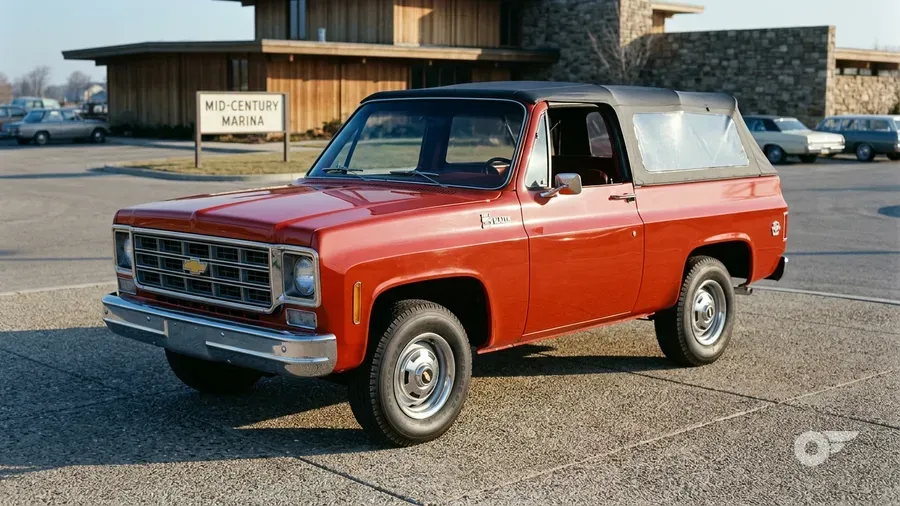
Chevrolet arrived eight years after International and three after Ford, and took the segment anyway, because it worked out that it did not need to design a vehicle at all. The K5 Blazer of 1969 is a C/K pickup chassis shortened to a 104-inch wheelbase with the roof and the back of the cab removed, and the entire top, front and rear, lifts off. Development cost almost nothing next to Ford's bespoke Bronco, and the result was bigger inside, easier to live with and cheaper to build. The first-year truck was uncompromising in a way that is hard to imagine now: part-time four-wheel drive only, and passenger seats on the option list. Buyers took 4,935 in 1969. Three years later they took 44,266, by which point a two-wheel-drive version existed, GMC was selling the same vehicle as the Jimmy, and Ford was working on a full-size answer. Only 77,948 of these short-run trucks were built before the 1973 redesign, which makes the Action Line Blazer the rare one in a family that later sold in the hundreds of thousands.

Distinctions

The defining attributes and collector status that make this car garage-worthy.

Octane Files Select
Renowned for its history, engineering, or cultural weight.

Collectibility scorecard

Rated 1 to 10 on the traits that matter for owning, driving, and holding on to a car like this.

Desirability
8/10
Rarity
6/10
Driving thrill
5/10
Investment trajectory
7/10
Usability
5/10
Ease of restoration
7/10
Cultural impact
6/10
Electronic dependence
Fully analogHeavily electronic

There is nothing electronic on this truck beyond a coil, a distributor, an alternator and the fuses. Fuelling is a carburettor, the throttle is a cable, the transfer case is engaged by a floor lever and the four-wheel drive is part-time, which means the driver decides everything. Nothing measures anything or corrects anything. The only accommodation to the era is the emissions plumbing that arrived at the end of the run. Owners commonly fit a later electronic distributor and it is a reversible change, but as built this is a fully mechanical vehicle.

Market data

Demand tier, price trend, and typical values by condition, based on recent sales data.

Demand tier
EntrySolidHighBlue-chip

Strong, sustained collector demand. Good examples never wait long for a buyer.

Value trajectory
AppreciatingStableCooling

Values are climbing. The market wants more of these than exist.

Price by condition
Driver
$25k
Excellent
$50k
Concours
$88k

Four model years and 77,948 trucks against 829,878 for the generation that followed, and every one of them has a fully removable top. Those two facts are what separate first-generation prices from the far more common 1973-1991 cars, and the gap has widened as good examples with original tops have thinned out. The band describes a 1972 350 four-wheel-drive truck; 1969 cars and factory hardtops sit above it.

Values as of August 2026.

Buyer's guide

What anyone seriously considering this car should know first.

Why it's worth it
The full-size 4x4 that beat Ford and International by not being designed from scratch
Callout
In 1969 the passenger seats were an option
What to watch for
Start at the back of the cab. The seam where the removable top meets the body is where water sat for fifty years, so check the rear quarters inside and out, the wheel arch lips, the tailgate bottom and the floor under the rear seat if it has one. Then the cab corners, the rockers, the cowl and the front floor pans, all of which rot from the inside. The frame is the same shortened pickup rail as the pickups and rots at the rear crossmember. The top matters more than anything else you will look at: original steel hardtops are scarce, expensive and easily damaged at the corners, and a truck missing its top is a much cheaper truck for a reason. Check that it actually fits and that the bolt holes have not been elongated. Mechanically there is little to fear. The 350 and the TH350 are as well understood as any powertrain in existence. Confirm what you are buying, though, because a 1970 to 1972 truck can be two-wheel drive, and a converted one is not the same thing.

The Story

Driving character

This is a truck and it does not pretend otherwise. The wheelbase is 104 inches, ten shorter than the pickup it came from, and it rides accordingly: firm, busy on a broken surface, and quick to move around under braking. The steering is slow and vague on centre, which is normal for the era and immediately forgotten once the pavement ends. The 350 is the reason to have one. It pulls from idle with the easy unstressed shove that made small-block Chevrolets the default American engine, and paired with the TH350 it turns the Blazer into something you can genuinely drive across a state. With the top off there is nothing behind the seats but air and a roll of the wind, and the vehicle changes character completely; sixty feels like a lot, conversation is over, and nobody minds. Part-time four-wheel drive means locking the hubs and pulling a lever, which is the correct amount of ritual. Nothing about it is quick and everything about it is willing.

Design

The Blazer is the C/K pickup with two ideas applied to it. The first is the cut: everything behind the front doors is a single lift-off unit, so the vehicle can be a closed wagon on Friday and an open one on Saturday, and there is no B-pillar interrupting the line. The second is restraint. The 1967-1972 GM truck body was already the cleanest thing in the class, with a shallow beltline, a shoulder crease that runs the full length of the flank and a simple horizontal grille, and the Blazer benefits by leaving it alone. Bill Mitchell ran GM design from 1958 to 1977 and the Action Line trucks are among the least fussy work produced under him. The proportions are what makes it: short overhangs, a lot of glass and a body that sits square over the wheels rather than perching on them. Chevrolet never styled it as a lifestyle object, which is precisely why it has aged better than the things that were.

Motorsport pedigree

No factory Blazer competition programme is documented. Chevrolet built this vehicle to a cost, as a way of selling a pickup chassis twice, and a works desert team would have cost more than the development of the truck itself. The industry backdrop matters too: the Automobile Manufacturers Association had banned factory-supported racing in 1957 after the Le Mans disaster and the 1957 NASCAR grandstand crashes, and while Ford walked away from that agreement in 1962, General Motors stayed conspicuously out of official motorsport into the 1970s. So while Ford's Bill Stroppe Broncos were winning the Baja 1000 outright in 1969, 1971 and 1972, and an International SSII was taking production four-wheel-drive honours in 1977, no comparable factory Blazer result exists to put beside them. What the Blazer got instead was privateers, who found exactly what Chevrolet had: a cheap, strong, endlessly repairable pickup chassis. The competition history here belongs to owners, not to the manufacturer, and it is written in trail damage rather than trophies.

In culture

The first-generation Blazer's cultural life is mostly a working one. These were the trucks of forest services, ski patrols, ranches and rural fire departments, and that is where most Americans of a certain age first saw one, which is a different kind of fame from a film credit. What has happened since is more interesting. The 1967-1972 GM truck body has become the most collected American pickup shape of its era, and the Blazer has been carried along with it into a restoration and custom scene that treats these trucks the way the Ford world treats an early Bronco. The Action Line Blazer now turns up in advertising as visual shorthand for outdoor competence, usually in a colour Chevrolet never offered. There is no famous film car and no hit song, and the page is not going to invent one. Its standing comes from having created the American full-size two-door 4x4 wagon as a mass-market product, and from the fact that nearly every rival spent the following decade copying the formula.

Owning One

Why collectors want it

Scarcity is the argument, and it is unusual for a General Motors truck to have one. The first generation ran four model years and 77,948 units, against 829,878 for the generation that followed. The 1969 cars alone account for 4,935 of that, they are four-wheel drive only, and they are the ones people hunt. Then there is the roof. Every 1969 to 1972 Blazer has a full-length removable top, hardtop or soft, and Chevrolet took that away in 1976; a truck you can genuinely open to the sky is a different object from a half-cab, and the market has understood that for a decade. Add the shape, which belongs to the 1967-1972 GM truck body that has quietly become the most admired American pickup design of its era, and you have a vehicle wanted by two crowds at once. Survivors are the problem. These were used hard and they rusted, and an honest unrestored Action Line Blazer with its original top is genuinely difficult to find.

Which one to look for

The 1969 truck is the collector's one. It is four-wheel drive only, it is the smallest production year at 4,935, and the base specification is famously stark. From 1970 there is a rear-wheel-drive Blazer, which is worth knowing about mainly so you can identify one, and the GMC Jimmy, which is the same vehicle with different badges and is generally cheaper to buy. On the roof, a factory steel hardtop is worth real money over a soft top and both are worth far more than a truck that has lost its top altogether. For engines, the 350 is the one to have and the one most were built with; the 307 is the forgotten V8 and perfectly pleasant; the 292 six is the oddity, a long-stroke truck engine that is slow, tireless and quite charming if you are not in a hurry. The 1972 cars are the most refined and the most numerous, which makes them the sensible buy if you want to drive rather than collect.

1969 Four-Wheel Drive · 1969

The first model year, four-wheel drive only, with passenger seats on the option list. The rarest and most collected version of the first generation.

Removable Hardtop · 1969-1972

The full-length steel top, lifting off in one piece from the back of the windscreen to the tailgate. Scarce, expensive and the single biggest value item on the vehicle after the body itself.

Soft Convertible Top · 1969-1972

The folding alternative to the steel top, and the version that most obviously explains what Chevrolet thought it was selling.

Two-Wheel Drive · 1970-1972

Added for 1970 alongside the GMC Jimmy badge. The same body without the transfer case, and worth identifying rather than seeking out.
What owning one is like

These trucks were bought to be used and they were used, so the honest ones have all been apart at least once. Rust is the recurring bill: rear quarters, cab corners, rockers, floors and the seams around the removable top, and the top itself corrodes at the corners where the seals hold water against steel. Doors sag on worn hinge pins. Steering boxes develop play, and on a vehicle this tall the play is more noticeable than it is dangerous. The powertrains are the easy part; small-block Chevrolets and TH350s are the most forgiving combination in the American hobby and they will take neglect for years before complaining. What owners talk about is not reliability but weather. The removable top leaks somewhere on almost every truck, the heater is optimistic and the cabin is loud at speed. None of that stops anyone, because the compensation is a vehicle you can strip to the waist on a summer afternoon and then drive up a mountain.

Upkeep & parts

This is one of the cheapest classics in the catalog to keep running and one of the more expensive to keep straight. Mechanical parts are effectively free: every service item for a 350, a TH350 or an SM465 is on a shelf somewhere within an hour of you, and the aftermarket for 1967-1972 GM trucks is enormous because the pickups drive the volume. Sheet metal is reproduced, including floors, cab corners, rockers and quarter panels, which means bodywork is a labour bill rather than a fabrication project. Where the money goes is the top and the trim. Original steel hardtops, tailgate hardware, correct interior pieces and the chrome specific to the Blazer rather than the pickup are all harder to find than the panels around them, and prices reflect that. Budget for a full body-off if the frame has sat wet. blazerforum.com carries a dedicated full-size K5 section covering 1969 to 1991 and is the practical starting point for most jobs.

Country of origin
USA
Class
Off-Road
Production years
1969–1972
Units built
77,948
Marque
Model
K5 Blazer
Nickname
No nickname ("Squarebody" names the 1973-1991 second generation, not this one)
Body
SUV
Layout
Front-engine, 4WD / RWD
Engine
250ci I6, 292ci I6, 307ci V8, 350ci V8
Transmission
3-speed manual, SM465 4-speed manual, TH350 3-speed automatic
Designer
Bill Mitchell (GM Design direction)