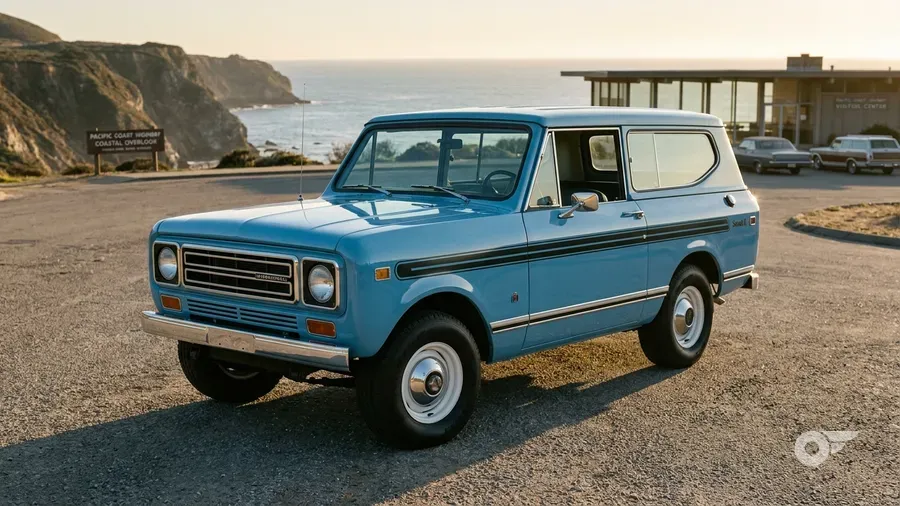
International Harvester Scout II
USA·Off-Road·1971–1980

The defining attributes and collector status that make this car garage-worthy.

Rated 1 to 10 on the traits that matter for owning, driving, and holding on to a car like this.
Demand tier, price trend, and typical values by condition, based on recent sales data.
Values as of August 2026.
What anyone seriously considering this car should know first.
Cars from the same manufacturer family, like platform siblings or shared-era relatives.
Cars from other manufacturers that competed for the same buyers when new.
A turbocharged version of the 152ci four at 111 horsepower, against 93 for the standard engine. An unusual thing to sell a farmer in the 1960s and the connoisseur's oddity of the row.
A white body, a red interior, a full-length headliner, floor mats and a silver-plated Custom medallion, marking the hundred-thousandth Scout. Every US dealer received one for promotional use.
The original. Removable sliding side windows on 1960-1961 cars and some very early 1962s, a fold-down windshield, vacuum wipers mounted on top of the glass and the International logo in the centre of the grille and the tailgate.
Bucket seats, proper instrumentation and a redesigned dashboard. The Scout becomes something you could commute in, and from March 1967 it could be ordered with the 266ci V8.
More comfort options, a heavier rear axle and the quieter Dana 20 transfer case. Mechanically the best of the pre-Scout II cars.
Minor cosmetic updates and a very short life, because the Scout II was already finished and waiting. The scarcest series in the row.