Octane Files
Browse CarsToyota Land Cruiser 60 Series

Toyota Land Cruiser 60 Series

Overview

This is where the Land Cruiser becomes comfortable, and Toyota was explicit about why: the 60 Series was designed to compete in what it correctly identified as an emerging sport utility market. So the 1980 car arrived with air conditioning, a rear heater and an interior that was not simply painted metal, which sounds trivial until you remember that power steering had only become optional on the FJ40 the year before. What did not change is the important part. Underneath sat the same ladder frame, the same live axles on leaf springs at both ends, and the same two-speed transfer case, and the engine was the 4.2-litre 2F carried straight over from the 40 Series. North America kept that carburetted six until 1987, when the fuel-injected 3F-E arrived at 155hp and the FJ62 badge with it. That is the whole story of the generation in one detail: a vehicle with 1950s engine architecture and 1980s fuel injection, still riding on cart springs, sold to families. It ran until 1990.

Distinctions

The defining attributes and collector status that make this car garage-worthy.

Octane Files Select
Renowned for its history, engineering, or cultural weight.

Collectibility scorecard

Rated 1 to 10 on the traits that matter for owning, driving, and holding on to a car like this.

Desirability
7/10
Rarity
5/10
Driving thrill
5/10
Investment trajectory
8/10
Usability
7/10
Ease of restoration
7/10
Cultural impact
6/10
Electronic dependence
Fully analogHeavily electronic

Two rather than one, because this generation spans the change. From 1980 to 1987 in North America it is a carburetted 2F six with a distributor and points, mechanically identical in principle to a 1960 FJ40. From 1987 the 3F-E brings electronic fuel injection with a proper engine control unit, oxygen sensing and the emissions plumbing that goes with it, which is the first computer ever fitted to a Land Cruiser sold in America. Everything else stays mechanical: no anti-lock brakes, no traction control, no electronic transfer case, and levers rather than buttons for four-wheel drive and low range.

Market data

Demand tier, price trend, and typical values by condition, based on recent sales data.

Demand tier
EntrySolidHighBlue-chip

A dependable market. Well-kept cars hold their value and find ready buyers.

Value trajectory
AppreciatingStableCooling

Values are climbing. The market wants more of these than exist.

Price by condition
Driver
$14k
Excellent
$32k
Concours
$55k

This generation has been climbing quietly for a decade and shows no sign of stopping, for a straightforward reason: it is the cheapest way into a vintage Land Cruiser you can actually use every week, and the supply of unmodified ones is shrinking every year. The FJ62 with the fuel-injected 3F-E carries a clear premium over the carburetted FJ60, and both are worth substantially more unmolested than lifted. Rust sets the floor, since a clean southwestern truck and a northeastern one of the same year are not in the same market. The band below describes an honest, unmodified United States-market FJ60 or FJ62. Imported diesels trade separately and unpredictably, and the growing restomod trade sits well above everything here.

Values as of August 2026.

Buyer's guide

What anyone seriously considering this car should know first.

Why it's worth it
The generation that turned the Land Cruiser from a working vehicle into a family one
Callout
Toyota built it, in its own words, for an emerging sport utility market
What to watch for
Establish which engine you are looking at before anything else, because it changes the vehicle. North America kept the carburetted 4.2-litre 2F until 1987; the fuel-injected 4.0-litre 3F-E arrived for 1987 and 1988 at 155hp, and those are the FJ62 cars. The 3F-E is the easier vehicle to live with and the carburetted 2F is the easier one to fix at the roadside. No diesel 60 Series was sold new in the United States, so any 3B, 2H or 12H-T here is a later private import and its parts supply is a different problem entirely. Then look at rust, which is what actually ends these: rear wheel arches, the tailgate and its lower lip, the sills, the floors under the rear footwells, the battery tray and the frame around the rear spring hangers. Check for a lifted suspension and re-gearing, and price accordingly, because reversing that work costs more than the discount. Head gaskets on hard-worked 3F-E engines are a known expense. Service history matters more than mileage on a vehicle designed for 300,000 miles.

The Story

Driving character

The 60 Series is the first Land Cruiser you can drive for four hours without needing a lie down, and it achieves that without changing anything fundamental. The wheelbase and the leaf springs are still doing the work, so it still leans, still floats over dips and still lets you know exactly what the road surface is made of, but the seats, the sound deadening and the taller gearing turn all of that from an ordeal into character. The 2F is the same low-revving torque engine it always was, unhurried and a little breathless above 3,000rpm, and it suits the vehicle. The 3F-E in the FJ62 is the transformation: it pulls cleanly from cold, holds 65mph without drama and makes the whole thing feel a decade newer than it is. Steering is power-assisted and still slow. Off road nothing has been lost, because the low range, the ground clearance and the axle articulation are all straight out of the utility vehicles, which is why so many of these ended up modified.

Design

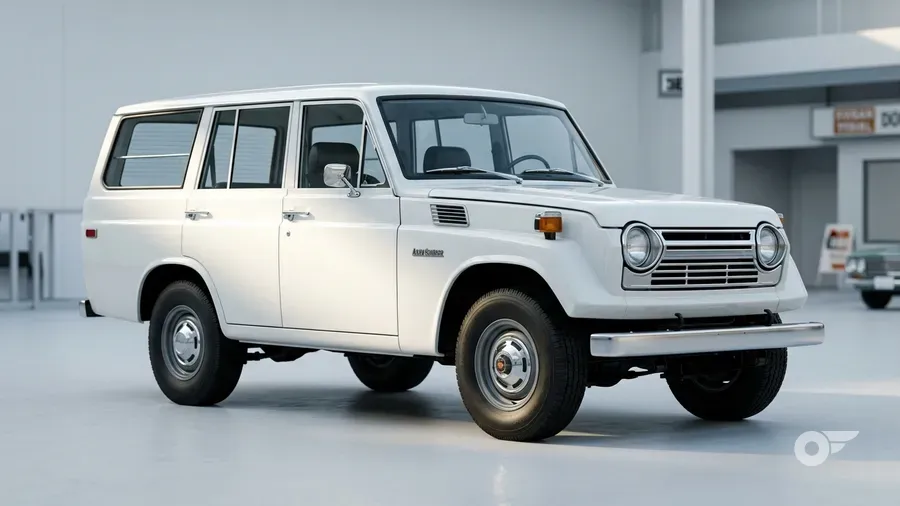
Toyota drew a box and made it a good one. The 60 Series is all straight lines and flat surfaces, with a deep glasshouse and thin pillars, and the whole thing looks designed to be seen out of rather than looked at. That is the 1980s Japanese idea of a wagon and it has aged extraordinarily well, largely because there is no decoration on it to date. The brief shows in the shape. Toyota drew this one to compete in an emerging sport utility market, which meant a vehicle that looked at home outside a house and not only outside a mine, and it is the first Land Cruiser where that was the starting point rather than an afterthought. The five-door layout comes straight from the FJ55, and so does the idea of a wagon body on utility running gear, but where the Iron Pig was slab-sided and heavy in the jaw this is upright and light on its feet. A high-roof body arrived in 1981, adding rear headroom without disturbing the profile. Inside is where the generation actually lives: a real dashboard, air conditioning and a rear heater, in a family that still offered a fold-down windscreen the year before.

Motorsport pedigree

No factory competition programme existed for the 60 Series, and by the 1980s the reason had hardened into policy. Toyota's motorsport spending in this decade went to rallying and to sports car racing with the Celica, both of which sold cars to private buyers, while the Land Cruiser sold to governments, fleets and families who did not read results. So the generation has no works record. The contrast with its rivals is stark and worth stating: Land Rover took the outright car classification at the first Paris-Dakar in 1979 and again in 1981, right as the 60 Series launched, and Range Rovers and Land Rover 90s and 110s carried the Camel Trophy through the decade. Toyota's own first Dakar car-category win did not arrive until 2019, with a Hilux. What the 60 Series has instead is combat and expedition use on a scale no rally could demonstrate, most of it recorded nowhere but in the places it happened, and a standing among privateers that made it a default choice for African and Australian desert crossings.

In culture

The 60 Series is the vehicle that made the Land Cruiser familiar to American suburbs, and it is also the one with the hardest evidence behind its reputation. The Chadian-Libyan war of 1986 and 1987 is known as the Toyota War because Chad fought it from around 400 Toyota pickups and Land Cruisers carrying MILAN anti-tank missiles, and destroyed roughly 800 Libyan tanks and armoured vehicles with them. That is not a marketing story and Toyota has never used it as one. In the same decade the vehicle became the default across East and West Africa for aid agencies, mining companies and anyone whose life depended on the vehicle starting, and in Australia it consolidated a position the model had held since the Snowy Mountains scheme in 1959. In Venezuela, where assembly continued to 1992, it was sold as the Samurai. Its American cultural footprint is quieter and more domestic: this is the Land Cruiser that a generation of children was driven to school in, and the reason the name still means something in the United States.

Owning One

Why collectors want it

The 60 Series is the usable one, and that is now its market. It is old enough to be simple and new enough to drive on a motorway without planning your day around it, which puts it in a narrow band that has been filling with buyers priced out of FJ40s. Values have been climbing steadily rather than spiking, and the split within the generation is clear. FJ62s from 1988 to 1990, with the fuel-injected 3F-E, are the ones most people want, because they start reliably, hold highway speeds and pass emissions testing without argument. Earlier carburetted FJ60s are cheaper and more mechanically pure, and the enthusiasts who care about that are a real constituency. Unmolested examples carry a strong premium over lifted, re-geared and re-engined trucks, of which there are many, because this generation spent thirty years as the affordable capable four-wheel drive and was modified accordingly. Original paint, an intact interior and no aftermarket suspension are worth more than low mileage.

Which one to look for

North American buyers get a simple choice and the rest of the world gets a complicated one. The FJ60, from 1980 to 1987 in the United States, runs the carburetted 4.2-litre 2F and is the purist's pick: mechanically identical in principle to an FJ40, cheaper to buy, and repairable anywhere. The FJ62, from 1988 to 1990, runs the 4.0-litre 3F-E with electronic fuel injection at 155hp and is the one to buy if you intend to use it, since it starts properly cold, holds highway speeds and has none of the carburettor's altitude sulks. Outside North America the range is far richer and all of it arrives in America privately. The FJ61 took the carburetted 3F from 1984. The BJ60 ran the 3.4-litre 3B diesel four from 1980, the HJ60 the 4.0-litre 2H diesel six from 1982, and the HJ61 the direct-injection 12H-T turbodiesel from 1985, which is the connoisseur's engine in this generation and the one Australian and African owners talk about. A high-roof body arrived in 1981.

BJ60 · 1980–1986

Diesel from launch, using the 3.4-litre 3B four at around 90hp. Slow, economical and the version that took the 60 Series into fleet and agricultural use where petrol was expensive or unreliable.

FJ60 · 1980–1987

The launch car and the one North America bought for seven years. Carburetted 4.2-litre 2F six carried straight over from the FJ40, four-speed H41F or H42F manual, air conditioning and a rear heater as part of the point of the vehicle. A high-roof body arrived in 1981 and a five-speed in 1982.

FJ61 · 1984–1988

The carburetted 4.0-litre 3F six, introduced in 1984 for markets outside North America. A modernised engine with a shorter stroke than the 2F, but still fed by a carburettor rather than injection.

FJ62 · 1988–1990

The one most buyers want. The 4.0-litre 3F-E with electronic fuel injection, rated at 155hp in United States trim, which transforms cold starting, highway cruising and emissions testing without changing anything else about the vehicle.

HJ60 · 1982–1990

The 4.0-litre 2H naturally aspirated diesel six at around 105hp. Smoother and better suited to sustained work than the 3B four, and the standard diesel wagon across Africa, the Middle East and Australia for most of the decade.

HJ61 · 1985–1990

The connoisseur's engine in this generation: the 12H-T, a direct-injection turbocharged 4.0-litre diesel six introduced in 1985. The fastest and most sought-after 60 Series among owners who can get one.

What owning one is like

These are among the easiest old four-wheel drives to live with, which is most of their appeal. The 2F and 3F-E sixes are the same understressed cast-iron architecture that routinely passes 300,000 miles, the gearboxes and transfer cases are heavy and simple, and the axles are the same ones that survived the utility vehicles. What does go wrong is predictable. Rust takes the rear arches, the tailgate lip, the sills, the floors under the rear seats and the frame around the rear spring hangers, and a clean-looking truck from a salted state deserves a proper look underneath. Head gaskets are the known weakness on hard-worked 3F-E engines and the repair is straightforward but not cheap. Carburetted 2F cars can be temperamental with altitude and cold starts, and the emissions plumbing on 1980s Japanese engines is a maze that many owners have simplified badly. Beyond that: front axle joints need repacking on a schedule, steering boxes wear, and the interior plastics have had forty years of sun. Nothing on the list stops anybody.

Upkeep & parts

Support is excellent and unusually complete for a vehicle this age. Specter Off-Road has been supplying Land Cruiser parts since 1983, the wider specialist trade is deep, and a good deal of the mechanical stock is shared with the 40 and 55 Series, so engine, gearbox, axle, brake and suspension parts are ordinary purchases rather than searches. Body panels are harder than mechanical parts, as always, and interior trim and the specific 3F-E emissions components are the two things people struggle to find. The IH8MUD forum's 60 Series Wagons section is the technical archive for this generation and covers every common failure in detail; the Toyota Land Cruiser Association, running since 1976, publishes Toyota Trails and organises events across the country. Budget for fuel above everything else, since a 4.0 or 4.2-litre six pushing a brick returns what you would expect, and for a head gasket at some point on an FJ62. Otherwise the running costs are closer to those of an old pickup than an old collector car.

Country of origin
Japan
Class
Off-Road
Production years
1980–1990
Units built
~400,000
Model
Land Cruiser
Nickname
No nickname ("Samurai" was the 60 Series' model name in Venezuela, not an owner nickname)
Body
SUV, Wagon
Layout
Front-engine, 4WD
Engine
4.2L 2F OHV I6 petrol, 4.0L 3F OHV I6 petrol, 4.0L 3F-E EFI I6 petrol (155hp US spec), 3.4L 3B I4 diesel, 4.0L 2H I6 diesel, 4.0L 12H-T turbodiesel I6
Transmission
4-speed H41F/H42F manual, 5-speed H55F manual, 4-speed A440F automatic
Designer
Toyota in-house; no individual stylist credited. The 60 Series is where the Land Cruiser was styled as a passenger vehicle rather than equipment with seats.