Octane Files
Browse CarsLand Rover Defender 90/110

Land Rover Defender 90/110

Overview

In 1983 Land Rover finally gave the utility vehicle what the Range Rover had been running since 1970. The One Ten arrived on coil springs instead of leaf springs, with permanent four-wheel drive taken from the Range Rover, a taller one-piece windscreen and an interior that acknowledged the existence of the person sitting in it. The Ninety followed in 1984 on a 92.9-inch wheelbase, and the One Two Seven in 1985. Thirteen years after the Range Rover had proved the point, the working Land Rover stopped riding like a cart.

The Defender name arrived later and for a specific reason. The Discovery launched in 1989 and suddenly Land Rover had three products, only two of which had names. Land Rover became the marque, and in 1990 the Ninety, One Ten and One Two Seven became Defender 90, Defender 110 and Defender 130. Anything built before 1990 is not a Defender, whatever the internet says.

It then ran, almost unchanged in shape, until 29 January 2016, through Tdi, Td5 and Ford Duratorq diesels and thirty-three years of tightening regulation. The last one built was the 2,016,933rd Land Rover of the Series and Defender line since 1948.

Distinctions

The defining attributes and collector status that make this car garage-worthy.

Legend
A car that transcended the hobby, known far beyond the people who drive them.
Octane Files Select
Renowned for its history, engineering, or cultural weight.

Collectibility scorecard

Rated 1 to 10 on the traits that matter for owning, driving, and holding on to a car like this.

Desirability
8/10
Rarity
3/10
Driving thrill
5/10
Investment trajectory
8/10
Usability
6/10
Ease of restoration
7/10
Cultural impact
8/10
Electronic dependence
Fully analogHeavily electronic

This generation spans almost the whole scale, which is why it lands in the middle rather than at either end. A 1984 Ninety is as analogue as a Series III: carburettor or a mechanical injection pump, no engine management, and a loom you can trace with a test lamp. The 200Tdi and 300Tdi of the 1990s are mechanically injected turbodiesels that will run with the battery disconnected. From 1998 the Td5 changed that, with a full engine ECU and electronically controlled unit injectors, and it is the point at which a Defender starts needing a diagnostic tool. The 2007 Ford Duratorq cars add emissions control, a modern fuel system, ABS and airbags. Underneath all of them the important parts stay mechanical: levers for the gearbox and transfer case, and no electronic aid that decides where the vehicle goes.

Market data

Demand tier, price trend, and typical values by condition, based on recent sales data.

Demand tier
EntrySolidHighBlue-chip

Strong, sustained collector demand. Good examples never wait long for a buyer.

Value trajectory
AppreciatingStableCooling

Values are climbing. The market wants more of these than exist.

Price by condition
Driver
$32k
Excellent
$55k
Concours
$90k

The American market is a special case and it dominates the numbers. Only two runs of Defenders were sold new in the United States, the 525-unit 1993 batch of 110 County and the 1994 to 1997 Defender 90s, and NAS cars trade far above anything in the band below, which describes an imported Tdi 90 or 110 in honest condition. Everything else in the US arrived under the 25-year import rule, so the supply grows by one model year every year and the market re-prices constantly as later cars become legal. Original, unmodified vehicles with galvanised chassis and service history carry a clear premium over the very large number of rebuilt and re-engined trucks. No auction comparables were reachable this session, so the band is an editorial judgment anchored to published sterling guide prices.

Values as of August 2026.

Buyer's guide

What anyone seriously considering this car should know first.

Why it's worth it
Thirty-three years in production, ended by airbag and emissions rules rather than by demand
Callout
Not a Defender until 1990: the Ninety, One Ten and One Two Seven were renamed only after the Discovery arrived
What to watch for
The chassis is the vehicle. It is box-section steel and it rots from the inside, so a rail that looks solid can be paper. Check the rear crossmember, the outriggers and the spring turrets, and look for the tidy weld line of a galvanised replacement, which is a plus rather than a warning. Classic and Sports Car's own summary is that rust in the chassis and bulkhead can be a killer, and that is the whole guide in one sentence. The bulkhead is second and more expensive per inch. It rots at the footwells, the door pillars and the top corners, and reaching it means taking the front of the vehicle apart. Third, look where alloy meets steel: door bottoms, hinge pillars, cappings and the screen surround, where the panels turn to white powder against steel fittings. Then the engine era. The early 2.25 and 2.5-litre units are immensely durable and often go 250,000 miles before a rebuild. Tdi engines need a cambelt every 60,000 miles and the receipt matters. Ford Duratorq cars can cost over two thousand pounds if the fuel pump fails. Finally, check the suspension is factory rather than aftermarket, and assume any vehicle with a lift kit has been used hard.

The Story

Driving character

A Defender is honest about what it is within about thirty seconds. You sit high and slightly off-centre, with the pedals offset and the door against your right shoulder, and you steer a vehicle that leans early, settles, and then holds on far longer than the lean suggested. The coil springs did not make it a car. They made it comfortable enough to drive for four hours instead of one. The Tdi cars are the ones people love. There is turbo lag, then a big shove of torque from around 1,800rpm, then not much above 3,000, so you drive on the middle of the rev range and change gear early. The noise is agricultural in the best sense, a hard diesel clatter that never pretends otherwise. The Td5 is smoother and pulls further. The V8s are quick, thirsty and quite unlike the rest. Off the road it makes sense of everything. Permanent four-wheel drive, a lockable centre differential, short overhangs and enormous articulation mean it walks over terrain that stops most things, at a speed that feels almost boring. That calm is the whole design.

Design

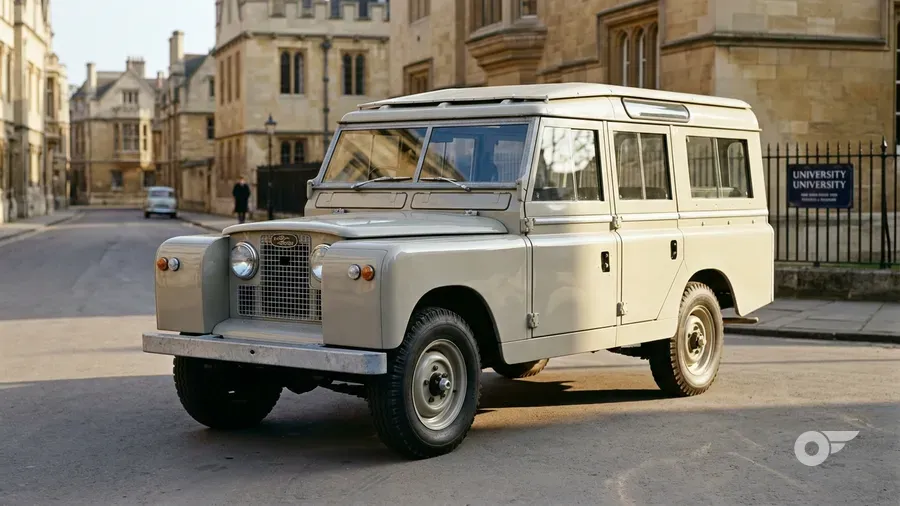
The Defender's shape is not designed so much as inherited. The barrel-curved sides and cill panels are David Bache's from 1958, the headlamps in the wings arrived on the late Series IIA, and the 1983 car added a taller one-piece windscreen, wheelarch eyebrows to cover the wider track, and a front end borrowed in spirit from the Range Rover. Almost nothing after that is new. What changed was the detail, and the details are how you date one. The pre-1990 Ninety and One Ten wear their names in script on the bonnet or wing. Defenders from 1990 carry the badge on the grille. From 2007 the bonnet gains a bulge to clear the Ford engine and the front wings gain vents, which is the fastest way to spot a late car at a distance. The interior tells the same story of grudging progress: wind-up windows from 1984, a proper dashboard, then heated screens and air conditioning, and at the end a car-derived facia in a vehicle whose door apertures were drawn before the Suez crisis. It never stopped being a box, which is why it never dated.

Motorsport pedigree

The Defender has a genuine competition record and it belongs to the Camel Trophy. Land Rover took over the event in 1981 with the Range Rover, and from 1984 to 1989 it ran on Land Rover 90 and 110, the coil-sprung trucks in their first years of production. The Camel Trophy was not a race in the ordinary sense, it was a week of winching, rafting and rebuilding vehicles through jungle and mud, and the 90 and 110 did it in front of an international audience every year for six years. That period is why a sand-yellow Defender with a roof rack reads as an expedition vehicle to anyone over forty. There was never a factory racing programme beyond that, and the reason is straightforward. The Defender is a commercial vehicle built to a price, sold to armies, farmers, utilities and aid agencies. Land Rover's motorsport money went where the marketing was, which by 1990 meant the Discovery in the Camel Trophy and later the Freelander. The Defender's competitive life happened instead in the Dakar support convoys, in trials, in rally recovery and in military service, none of which produces a trophy and all of which sold vehicles.

In culture

No vehicle carries British institutional life quite like this one. The Defender is the Army's, the police's in Northern Ireland for over forty years, the mountain rescue teams', the coastguard's and the National Trust's. It is also the Royal family's, in a way that produced one of the most affecting images of the last decade: Prince Philip's coffin was carried to the West Steps of St George's Chapel on a custom-built Defender hearse in Edinburgh green, on a Td5 chassis, which the Duke had helped design himself. Elsewhere it is the default vehicle of the safari film, the aid convoy and the field expedition, and the Camel Trophy years put it into six annual televised events across the 1980s. Its ending got the attention its life never quite did. When the last one was built on 29 January 2016, the story ran everywhere, because a vehicle whose basic shape dated to 1948 had finally been beaten by pedestrian-impact and emissions rules rather than by anyone preferring something else. Land Rover marked the seventieth anniversary in 2018 by building 150 Works V8s with a 400bhp Jaguar engine and a price starting at £150,000.

Owning One

Why collectors want it

The Defender is the last mass-produced vehicle of its kind and everybody knew it before it stopped. Production ended on 29 January 2016 because a shape drawn in 1948 could not be made to pass modern pedestrian-impact and emissions rules, not because the market had moved on, and buyers spent the final years bidding for what was left.

The hierarchy is unusually clear. In the United States the North American Specification cars sit at the top by a wide margin, because there were so few of them: one batch of 525 Defender 110 County in 1993, then Defender 90 only from 1994 to 1997, when new airbag and side-impact rules ended it. Those are the only Defenders sold new in America and they trade accordingly.

Below them sit the imported cars, and there the currency is the engine and the paperwork. A 200Tdi or 300Tdi 110 with a galvanised chassis and honest history is the sensible buy. Late 2.2 Duratorq cars are the newest and the most usable.

The last thing worth knowing: an unmodified Defender is now rarer than a modified one, and it is worth the difference.

Which one to look for

Start with the naming, because it decides what you are looking at. 1983 to 1990 cars are Ninety, One Ten and One Two Seven. From 1990 they are Defender 90, 110 and 130. The engine eras matter more than the trim. The early 2.5 diesel and the 3.5 V8 are for people who want the 1980s vehicle. The 200Tdi from 1990 and the 300Tdi from 1994 are the sweet spot: strong, mechanically injected, simple to fix and quick enough to keep up. The Td5 from 1998 is smoother and faster and brings an engine ECU with it. The 2.4 Duratorq from 2007 and the 2.2 from the 2012 model year are the most usable and the least characterful. Two variants are routinely underweighted. The BMW 2.8i, built between 1997 and 2001 with a straight-six from an E36, ran to just 1,395 vehicles, 656 of them 90s and 739 of them 110s. And the 50th Anniversary 90 of 1998 numbered 1,071, with 385 for the UK and a further 26 built in South Africa. At the top of the American market sit the NAS cars, and above everything the 150 Works V8s of 2018.

50th Anniversary · 1998

A limited-run Defender 90 marking fifty years of Land Rover.

Defender 2.4 and 2.2 TDCi · 2007–2016

Ford Duratorq power from spring 2007, with a six-speed gearbox, a bonnet bulge to clear the engine and vented front wings. The 2.4 gave way to a 2.2 for the 2012 model year. The most usable Defenders and the last ones built.

Defender 2.8i · 1997–2001

A BMW M52B28 straight-six petrol Defender, built largely for South Africa. The variant almost nobody counts and the one an engine enthusiast should.

Defender 200Tdi · 1990–1994

The engine that made the Defender genuinely usable on a road. 107hp and 195lb ft from a mechanically injected 2.5-litre turbodiesel, arriving the same year as the Defender name.

Defender 300Tdi · 1994–1998

A refined development of the 200Tdi with the same output and better manners. Widely considered the sweet spot of the whole generation: strong, simple and fixable anywhere.

Defender Td5 · 1998–2007

A 2.5-litre five-cylinder turbodiesel with a full engine ECU and electronic unit injectors. Smoother and faster than the Tdi, and the point at which a Defender started needing a diagnostic tool.

NAS Defender 110 County · 1993

The only Defender 110 sold new in North America. 3.9-litre V8, LT77 five-speed, LT230 transfer case, external roll cage and factory air conditioning, all Alpine white bar one.

NAS Defender 90 · 1994–1997

The North American Specification 90, with the 3.9-litre V8 for 1994 and 1995 and a 4.0-litre with a four-speed automatic for the final 1997 year. Ended by 1998 airbag and side-impact rules that the Defender could not economically meet.

Ninety · 1984–1990

The short-wheelbase version, 92.9 inches, from 1984, with wind-up windows from the start. Renamed Defender 90 in 1990.

One Ten · 1983–1990

The car that broke with leaf springs. Coil springs, permanent four-wheel drive taken from the Range Rover, a taller one-piece windscreen and a modernised interior, on a 110-inch wheelbase. Renamed Defender 110 in 1990.

One Two Seven · 1985–1990

The 127-inch crew-cab chassis, available from 1985, built for utilities and the services. Became the Defender 130 at the 1990 rename despite keeping its 127-inch wheelbase.
What owning one is like

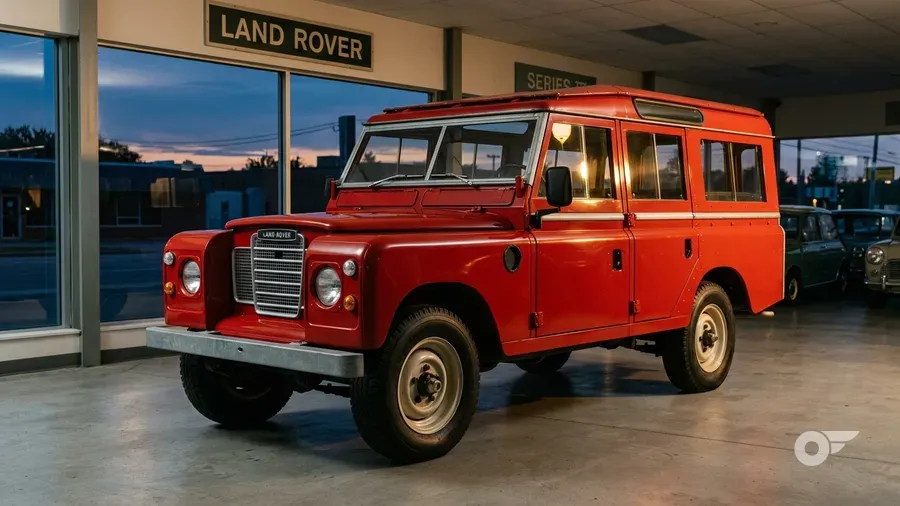
A Defender is easy to own and impossible to ignore. It leaks, it drums, it is noisy at 70mph and the driving position will annoy anyone taller than about six foot two, and none of that is a fault so much as a specification. What actually needs money is the steel: the chassis rots from inside its box sections and the bulkhead rots at the footwells and screen corners, and both are common enough that a galvanised replacement is a normal part of a Defender's life rather than a disaster. The alloy body corrodes where it touches steel, so door bottoms and hinge pillars bubble. Doors sag on their hinges and stop sealing, which is why so many of these vehicles let water in. Mechanically it is tough in a way modern vehicles are not. The 2.25 and 2.5 engines commonly reach 250,000 miles before a rebuild. Tdi cambelts are a strict 60,000-mile item. Td5 cars need a diagnostic tool and can suffer wiring loom and injector harness trouble. Late Duratorq cars are the most refined and the most expensive to fix, with fuel pump failure running past two thousand pounds.

Upkeep & parts

Nothing in the classic world is easier to keep running. Every panel, every chassis, every bulkhead and almost every mechanical component is available new, from Land Rover's own parts operation and from an aftermarket that is effectively an industry. A galvanised replacement chassis is a normal purchase, and a well-executed one is a selling point.

Because the body bolts together, most repairs are unbolt-and-replace rather than cut-and-weld, which puts a lot of the work within reach of a competent owner with a socket set and a manual.

Budget accordingly. Chassis replacement and bulkhead work are the two specialist jobs and they are labour-heavy. Tdi cambelts are cheap and non-negotiable. Td5 electronics need someone with the right tool. Duratorq fuel systems are the modern expense.

The Dunsfold Collection is the reference archive for the marque, LandyZone carries a dedicated 90, 110 and 130 forum plus separate engine forums for the Td5 and the TDCi Puma cars, and Classic and Sports Car's buyer's guide is a good sanity check before viewing. Parts availability is the reason a rough Defender is always worth saving.

Country of origin
UK
Class
Off-Road
Production years
1983–2016
Units built
~775,000
Model
Defender
Nickname
No nickname (Puma names the 2007-on Ford-engined cars specifically, not the generation)
Body
SUV, Pickup, Wagon
Layout
Front-engine, 4WD
Engine
2.25-litre petrol I4, 2.5-litre petrol I4 (83hp, from 1985), 3.5-litre Rover V8 (114hp), 3.9-litre Rover V8, 4.0-litre Rover V8 (1997 North American Specification), 2.8-litre BMW M52B28 petrol I6 (1997-2001), 2.5-litre naturally aspirated diesel I4 (68hp), 2.5-litre Turbo Diesel I4 (85hp), 2.5-litre 200Tdi turbodiesel I4 (107hp), 2.5-litre 300Tdi turbodiesel I4, 2.5-litre Td5 turbodiesel I5 (from 1998), 2.4-litre Ford Duratorq turbodiesel I4 (from 2007), 2.2-litre Ford Duratorq turbodiesel I4 (from the 2012 model year)
Transmission
LT77 5-speed manual, R380 5-speed manual, ZF 4HP22 4-speed automatic, GFT MT-82 6-speed manual
Designer
Land Rover in-house; no individual credited for the 1983 revision. The body is David Bache's 1958 Series II design, revised with a raised roofline and one-piece windscreen.