Octane Files
Explore CarsPagani Huayra

Pagani Huayra

Overview

The Zonda's replacement had one job nobody outside Pagani would have guessed at: it had to move air. The Huayra appeared online on 25 January 2011 with four aerodynamic flaps, two at the front and two at the rear, each operating independently under a dedicated control unit that reads speed, yaw rate, lateral acceleration, steering angle and throttle position off the ABS and the engine ECU. Front ride height moves too. The flaps lift on the inside of a corner to load that side of the car, and both rear flaps rise under braking to stop the nose diving. Horacio Pagani says the drag coefficient varies between 0.31 and 0.37 depending on what the car has decided it needs.

Underneath sits a 6.0-litre twin-turbo V12 that Mercedes-AMG built specifically for this car, with smaller turbochargers, a different intercooler layout and its own ECU calibration, all specified by Pagani to kill lag rather than chase a headline number.

The name is Quechua, after Wayra Tata, a wind god. Pagani names his cars after winds. This is the first one he built to work with them.

Distinctions

The defining attributes and collector status that make this car garage-worthy.

Legend
A car that transcended the hobby, known far beyond the people who drive them.
Poster Car
The car on the bedroom wall, the one people dreamed about before they could drive.
Octane Files Select
Renowned for its history, engineering, or cultural weight.

Collectibility scorecard

Rated 1 to 10 on the traits that matter for owning, driving, and holding on to a car like this.

Desirability
9/10
Rarity
9/10
Driving thrill
9/10
Investment trajectory
8/10
Usability
5/10
Ease of restoration
3/10
Cultural impact
7/10
Electronic dependence
Fully analogHeavily electronic

The active aerodynamics alone put the Huayra well up the scale: a dedicated control unit adjusts four flaps and the front ride height continuously, taking speed, yaw rate, lateral acceleration, steering angle and throttle position from the ABS and engine ECU. Engine management is Bosch, the gearbox is electro-hydraulically actuated with carbon synchronisers, and the carbon-ceramic brakes have electronics behind them. What keeps it off the top of the scale is what it does not have. There is no hybrid system, no adaptive damping and no torque vectoring, and the steering is hydraulic. Switch the driver aids off and a mechanical car is still underneath.

Market data

Demand tier, price trend, and typical values by condition. Our own assessment, not a quoted valuation.

Demand tier
EntrySolidHighBlue-chip

The proven elite. Values are established, liquid, and defended at every auction.

Value trajectory
AppreciatingStableCooling

Values are climbing. The market wants more of these than exist.

Price by condition
Driver
$2.6M
Excellent
$3.2M
Concours
$3.8M

The band covers the 100 coupes and the 100 Roadsters and nothing above them. Public results are now frequent enough to trust. The lowest recorded is 1,925,000 dollars for a 2014 car in January 2025, and by 2026 two separate houses had set their own records with standard cars: 3,327,500 dollars at Mecum Kissimmee in January and 3,190,000 dollars at Barrett-Jackson Palm Beach in April, the latter the top seller of that entire auction at 2,331 miles. A Roadster took 3,415,000 dollars at RM Sotheby's Miami in the same year. Above the band the numbers stop being comparable: CHF 4,476,875 for a Roadster BC at Zurich in 2025, and 8,035,000 dollars for the one-off manual Roadster Executor at Monterey in August 2026.

Values as of August 2026.

Buyer's guide

What anyone seriously considering this car should know first.

Why it's worth it
AMG built its twin-turbo V12 for Pagani alone, and capped the coupe at 100
Callout
Four aerodynamic flaps, each moving independently, reading yaw and steering angle continuously
What to watch for
Two things separate a good Huayra from an expensive one, and neither is mileage. The first is the gearbox. Pagani chose a single-clutch Xtrac automated manual over a dual-clutch because a DCT would have added more than 70 kg, and the transmission as fitted weighs 96 kg. That was the right engineering call and it produces a distinctly old-fashioned pause on every upshift. Reviewers who expected a bang describe it as jerky. Drive one before deciding that matters, because plenty of owners find it suits the car. The second is the aero system. Four flaps, their actuators, the sensors feeding them and the control unit are all things that live outside the engine and all things a general workshop cannot address. Verify they work on the move, not in a showroom. Otherwise, use the factory. Pagani Puro runs more than 400 checks against the company's own build record for that specific chassis and issues a certificate signed by Horacio Pagani, on any car of any year. On a car that has passed through several hands and possibly a re-specification, that document is the cheapest thing in the transaction.

The Story

Driving character

The engine shapes everything else. AMG's M158 makes 1,000 Nm from 2,250 rpm and is essentially finished by 5,500, so the Huayra pulls in a way reviewers keep reaching for diesel comparisons to describe: a huge, flat, immediate shove rather than a climb towards a crescendo. Pagani specified small turbochargers precisely so it would arrive without a wait. Against that, the gearbox. One clutch, seven ratios, and a pause between them that some people never forgive and others come to like, on the grounds that a car making this much torque benefits from a moment to breathe. Then there is the part you cannot feel directly and would only notice if it stopped. The flaps work continuously, adding load to the outside of the car through a corner and to the front under braking, while the nose lifts to fight weight transfer. The result is that a 1,350 kg car with 740 PS behaves with unusual composure at speeds where composure is not the default, and the driver is never told any of it is happening.

Design

Two ideas fight each other on the Huayra and both win. One is aerodynamic: the flaps, the arch in the bonnet that extracts radiator air at an angle chosen not to disturb the flow over the body, the low-pressure zones behind the front wheels doing downforce work a wing would otherwise have to. The other is jewellery. The gearshift linkage is exposed and polished. The switchgear is machined from solid. The instrument binnacle reads like a chronograph, and Pagani's specials division is literally called Grandi Complicazioni, which is watchmaker's language for the difficult parts. The titanium exhaust, built by MHG with Inconel silencers, weighs under 10 kg complete and is finished as though it will be looked at, which it will. The coupe's gullwing doors are the signature, and the Roadster's conventional ones are an honest admission that gullwings could not be made light enough without a roof to hang them from. The 2022 Codalunga stretched the tail after the long-tail racers of the 1960s, among them the Porsche 917, Horacio Pagani's favourite car.

Motorsport pedigree

There is no competition record here at all, and the reason is deliberate rather than an oversight. Pagani has never run a works programme. The marque's only period race entries belong to the Zonda GR, a privateer conversion that retired from Sebring and Le Mans in 2003 and then spent years failing to reach a grid, once because its homologation papers were missing. The Huayra R is the interesting case. It carries a 6.0-litre naturally aspirated V12 called the V12-R, designed from a blank sheet by HWA, the German firm that ran Mercedes' DTM cars, making 850 PS at 8,250 rpm and revving to 9,000. Thirty were built. It is faster than the road cars by a wide margin, and it is homologated for nothing. There is no series it can enter, no class it fits and no championship it will ever be classified in. That is the position, and it is not an accident. Pagani builds track cars for owners to use at track events, not for sanctioning bodies to approve, and prices them accordingly at 2.6 million euros before tax.

In culture

Top Gear magazine named the Huayra its Hypercar of the Year for 2012, which for a car from a firm that had built a few hundred vehicles in total put it directly against the Veyron and the Aventador in the same sentence. Games came first, though. Electronic Arts secured exclusive video-game rights to the Huayra in 2011, so for that year it existed only inside Shift 2: Unleashed and Need for Speed: The Run. The licence expired on 31 December 2011 and the car spread everywhere afterwards, which is a small and specific example of how a manufacturer with no advertising budget reaches anybody at all. Then Hollywood. A red and black Huayra plays Stinger in Transformers: Age of Extinction, the 2014 film, cast as a human-built Decepticon designed to imitate the hero car. That is an oddly fitting role for a machine whose entire existence is an argument about who is allowed to build a supercar. The pronunciation, roughly WHY-rah, remains the most argued-about thing about it online.

Owning One

Why collectors want it

The coupe's number is the starting point: 100 cars, and the cap came from Mercedes-AMG as a term of the engine supply agreement rather than from a marketing department. They sold out by February 2015 and the last one entered production in April 2018. What happened next tells you how Pagani works. The Roadster followed at another 100, then the Roadster BC at 40, the Imola at five customer cars, the Tricolore at three, the Codalunga at five, the Imola Roadster at eight, the Codalunga Speedster at ten and the R at 30 for track use only. The Huayra did not end so much as branch.

For a collector that produces a clear hierarchy. The standard coupe and Roadster are the accessible entries, if the word survives contact with the price. The BC cars are the hard-edged ones. The Imola, Tricolore and Codalunga are effectively coachbuilt, priced millions above the standard car, and were sold before most people saw them. The one-offs, Lampo, Epitome and the manual Roadster Executor, sit in a market of their own.

Which one to look for

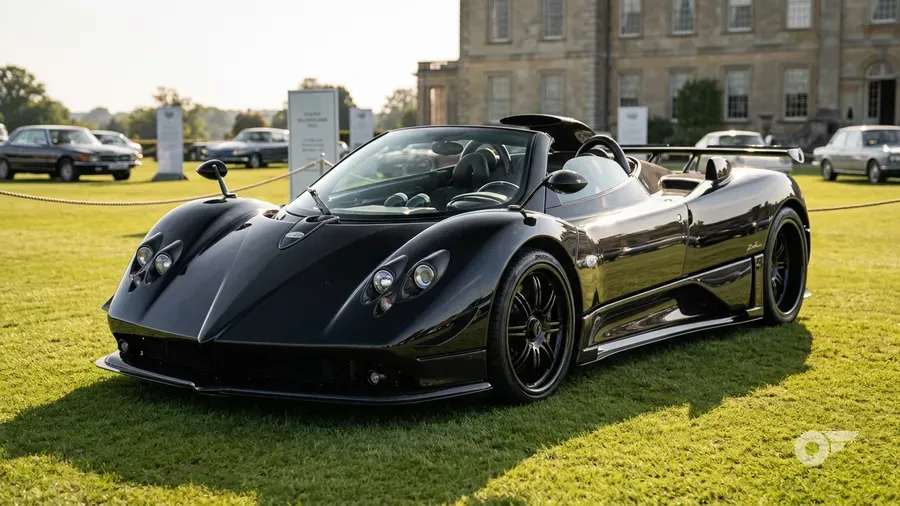
The 100 coupes are the reference point, and the gullwing doors belong to them alone. The Roadster could not carry gullwings at its weight target, so it uses conventional doors and, unusually, came out 70 kg lighter than the coupe at 1,280 kg dry. The BC is the one to understand. Named for Benny Caiola, Pagani's first customer, it uses carbon triax that Pagani claims is 50 per cent lighter and 20 per cent stronger than plain carbon fibre, drops to 1,218 kg and makes 764 PS. Pagani announced 20 cars and then built more, which irritated some early buyers. Wikipedia's production table records 29 and its own body text says 30. The company has never published a final number. Above the BC the cars stop being variants and start being commissions. The Imola, named for the circuit where it covered 16,000 km of testing, was five customer cars and a prototype at 838 PS. Three Tricolores. Five Codalungas at around 7 million euros each, drawn after the long-tail racers of the 1960s. Eight Imola Roadsters. Then the Huayra R: 30 cars, no road use at all.

BC · 2017–2019

Named for Benny Caiola, Pagani's first ever customer. 764 PS, 1,218 kg dry using carbon triax that Pagani claims is 50 per cent lighter and 20 per cent stronger than plain carbon fibre, titanium exhaust, stripped interior, Avional aeronautical-grade wishbones and Pirelli P Zero Corsa tyres using 12 rubber compounds.

Codalunga · 2022

A Grandi Complicazioni project paying homage to the long-tail racers of the 1960s, the Porsche 917 among them. 840 PS, stretched tail, minimal ornament.

Codalunga Speedster · 2025–present

Roofless Codalunga, over 193 inches long, offered with a three-pedal manual as an alternative to the seven-speed automated manual. 852 hp.

Huayra · 2011–2018

The coupe, with gullwing doors and the 5,980cc Mercedes-AMG M158 twin-turbo V12 at 740 PS and 1,000 Nm from 2,250 rpm. Seven-speed Xtrac single-clutch automated manual, 1,350 kg dry, four independently operating aero flaps and adjustable front ride height.

Imola · 2019–2021

Named for the circuit where it covered 16,000 km of high-speed testing. 838 PS and 1,100 Nm, 1,246 kg dry, seven-section diffuser, roof scoop, shark fin and a fixed rear wing with an integrated stoplight. The most powerful street-legal Pagani at launch.

Imola Roadster · 2023–2026

Open Imola, styled with cues from the Huayra R. Same AMG twin-turbo V12 at 850 PS and 1,100 Nm, 1,260 kg dry.

One-offs · 2017–present

Single commissions outside the numbered runs: the Lampo of 2017, built with Lapo Elkann's Garage Italia and inspired by the 1954 Fiat Turbina; the Epitome of 2024, the first Huayra with a seven-speed manual at 852 hp; and the Roadster Executor of 2025, a manual roadster specified after Darth Vader's flagship and delivered in California.

R · 2021–2026

Track-only, and the successor to the Zonda R. The Pagani V12-R is a 5,987cc naturally aspirated V12 designed from scratch by HWA over more than two years: 850 PS at 8,250 rpm, 750 Nm, 9,000 rpm redline. Six-speed sequential, 1,050 kg dry, butterfly doors.

R Evo / R Evo Roadster · 2025–2026

Longtail and open-top evolutions of the track-only R, retaining the naturally aspirated HWA V12 and raised to 900 PS. 1,060 kg dry.

Roadster · 2017–2020

Conventional doors rather than gullwings, which could not be made light enough without a roof. 764 PS and, unusually, 70 kg lighter than the coupe at 1,280 kg dry. Carbon triax construction and Pirelli P Zeros with an F1-style white sidewall stripe.

Roadster BC · 2019–2022

Track-focused Roadster at 802 PS, on a carbo-titanium HP62 G2 and carbo-triax HP62 monocoque with tubular steel subframes front and rear. Fixed rear wing plus the active flaps, and exhaust flaps in the catalytic converters that divert gas over the underfloor like an F1 blown diffuser.

Tricolore · 2020–2022

Roadster-only tribute to the 60th anniversary of the Frecce Tricolori. Roadster BC bodywork, unpainted under clear blue lacquer with the Italian tricolour along the top of the car, and a working pitot tube on the nose. 840 PS.
What owning one is like

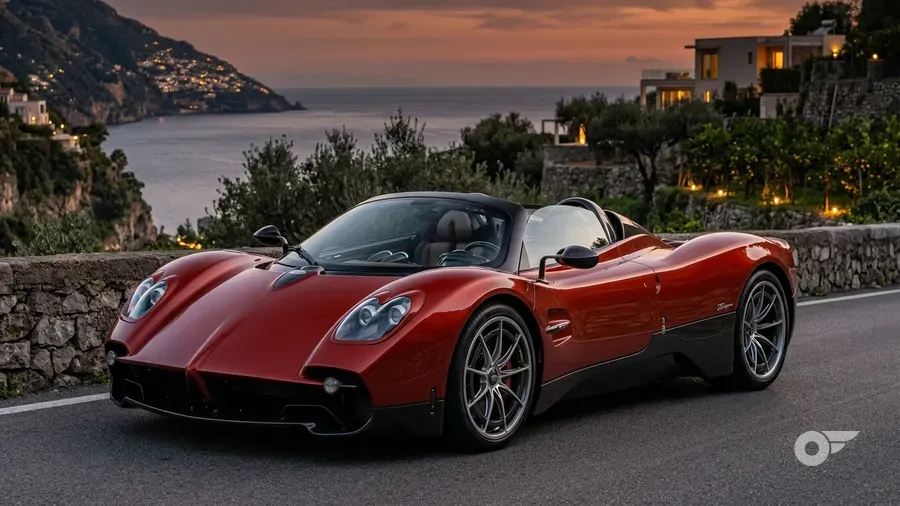
The engine is the easy part. The M158 is a Mercedes-AMG V12 built in Affalterbach, dry-sumped, and it is neither delicate nor mysterious. Its architecture is shared with an engine family that has run in Mercedes saloons for years, which is not something you can say about most cars at this price. The parts that need attention are the ones that make the car what it is. The active aero system has actuators, sensors and a control unit, and it is not something a general workshop diagnoses. The single-clutch gearbox is hydraulically actuated and software-dependent, and the clutch in a car driven hard is a wear item like any other. The bodywork is carbo-titanium finished as a visible surface, so a scrape is a lay-up and finishing job, and matching the weave is skilled work. None of that is a warning. Pagani keeps the build record of every car and will certify, service, restore or re-specify any of them at any age, which is a level of manufacturer commitment owners of much larger marques do not get.

Upkeep & parts

Everything routes back to San Cesario sul Panaro or to a dealer centre staffed by Pagani-certified mechanics. That is the whole network, and it is deliberate.

The three programmes worth knowing are Puro, Rinascimento and Unico. Puro is certification and warranty: over 400 checks against the factory's own database of every car built in Modena, a warranty extension covering every component, and a Puro Book carrying an authenticity certificate signed by Horacio Pagani. Rinascimento is full restoration to as-delivered condition using original drawings and materials. Unico redesigns a pre-owned car reversibly, and is the route by which a number of Huayras and Zondas have changed specification without losing their identity. All three are open to any Pagani of any year.

The practical costs are the ones nobody advertises. Tyres are Pirelli-specific, the Brembo carbon-ceramic discs are 380 mm and priced to match, and involved work usually means shipping the car to Italy. The owner community is the factory's own invitation-only Raduno, which has run at Circuit of the Americas, in California and across New Mexico.

Country of origin
Italy
Class
Exotic
Production years
2011–present
Units built
In production
Model
Huayra
Nickname
No nickname
Body
Coupe, Roadster
Layout
Mid-engine, RWD
Engine
5,980cc Mercedes-AMG M158 twin-turbocharged 60-degree V12 (740 PS, Huayra; 764 PS, BC and Roadster; 802 PS, Roadster BC; 838 PS, Imola; 840 PS, Tricolore and Codalunga; 850 PS, Imola Roadster; 852 hp, Epitome), 5,987cc naturally aspirated Pagani V12-R built by HWA (850 PS, Huayra R; 900 PS, R Evo)
Transmission
7-speed Xtrac 1007 automated manual (single clutch), 7-speed Xtrac 1007 manual (Epitome, Executor, Codalunga Speedster), 6-speed sequential manual (Huayra R and R Evo)
Designer
Horacio Pagani