Octane Files
Explore CarsPagani Utopia

Pagani Utopia

Overview

Pagani spent six years and eight complete prototypes on the car that follows the Huayra, and the thing everyone talks about is a gear lever. The Utopia was shown at the Teatro Lirico in Milan on 12 September 2022 under the factory code C10, carrying a seven-speed Xtrac gearbox with an exposed gated linkage and a clutch pedal, at a point when Ferrari and Lamborghini had dropped the manual entirely and nobody else at this level was even arguing about it. The rest of the car follows the same logic. The engine is the familiar 5,980cc Mercedes-AMG twin-turbo V12, now at 864 PS, with no hybrid assistance and none planned. The monocoque is Carbo-Titanium HP62-G2 and Carbo-Triax HP62 with tubular steel subframes front and rear. The instruments are analogue, the switches are milled aluminium, and there is no infotainment touchscreen. Horacio Pagani framed the brief as simplicity, lightness and the pleasure of driving, which would read as marketing if it had not cost so much engineering to build a road-car manual that survives 1,100 Nm. A Roadster followed on 30 July 2024, engineered alongside the coupe rather than adapted from it.

Distinctions

The defining attributes and collector status that make this car garage-worthy.

Poster Car
The car on the bedroom wall, the one people dreamed about before they could drive.
Octane Files Select
Renowned for its history, engineering, or cultural weight.

Collectibility scorecard

Rated 1 to 10 on the traits that matter for owning, driving, and holding on to a car like this.

Desirability
9/10
Rarity
9/10
Driving thrill
9/10
Investment trajectory
8/10
Usability
5/10
Ease of restoration
3/10
Cultural impact
6/10
Electronic dependence
Fully analogHeavily electronic

The driver interface is deliberately mechanical and the chassis underneath it is not. Most Utopias have a clutch pedal and a gated seven-speed linkage you can watch working, analogue dials, milled toggles and no infotainment touchscreen beyond a small display ahead of the driver. Underneath sit full ECU management on a twin-turbo V12, ABS, stability and traction control, an electro-mechanical differential, semi-active TracTive dampers with four selectable modes, electro-hydraulic power steering and two rear aero flaps that move independently under electronic control. Choosing the manual removes the gearbox actuation and nothing else. Pagani's own position, restated at CES in January 2026 when it showed a Utopia running a centralised electronic gateway, is that the electronics should be invisible rather than absent.

Market data

Demand tier, price trend, and typical values by condition. Our own assessment, not a quoted valuation.

Demand tier
EntrySolidHighBlue-chip

The proven elite. Values are established, liquid, and defended at every auction.

Value trajectory
AppreciatingStableCooling

Values are climbing. The market wants more of these than exist.

Price by condition
Driver
Excellent
Concours

Almost every Utopia is still with its first owner, so there is very little public evidence to price against. One verified public result exists: chassis 12 of 99, an early coupe with the Xtrac automated manual and 48 km from new, sold for CHF 3,267,500 at RM Sotheby's in Zurich in October 2025, against a coupe list price of USD 2.19 million. One sale is not a market, so no price band is stated here, the same call this catalogue makes on the Zonda. The direction is not really in doubt. The coupe run was allocated before the reveal, the 130-car Roadster went the same way at USD 3.4 million, and the manual take rate means the paddle-shift cars will end up the scarce ones. What nobody can yet call is how the market will separate the 99 coupes from the 130 Roadsters, and both from the bespoke cars Pagani will keep building alongside them.

Buyer's guide

What anyone seriously considering this car should know first.

Why it's worth it
The hypercar that put the clutch pedal back, and found most of its buyers wanted it
Callout
Three quarters of Utopia buyers ordered the gated manual, in a class where nobody else offers one
What to watch for
Almost nobody buys a Utopia the ordinary way. Pagani allocates cars rather than selling them, roughly three quarters of Utopia buyers were already Pagani owners, and the factory deliberately holds back a small number of slots for new clients and new markets. That makes the secondary market the practical route in, and it is thin: cars leave San Cesario slowly and the early ones have surfaced at auction with delivery mileage. The first question on any of them is the gearbox. The manual is the car most people want and the automated manual is the scarcer specification, so do not assume a paddle car is cheap on rarity grounds. Ask for the build documentation and the original specification sheet, because almost every Utopia differs from the next in trim, exposed weave and switchgear, and that is most of what separates one car's value from another's. Check the recall history too. Pagani filed a US recall covering eight cars over a passenger-side dashboard panel whose carbon mould left residue on the airbag frame, and at least one auction car went back to its dealer for a factory transmission recall after the sale. Puro certification, which the factory offers on any car it has built, is the cleanest way to verify a chassis before committing.

The Story

Driving character

The gearbox is the event, and it is not something you tolerate for the sake of the principle. First is across and back, dogleg style, and seven ratios in that pattern take a while to learn. Once you have it, the shift is lighter and faster through the gate than a mechanism carrying 1,100 Nm has any business being, the lever self-centres with a spring bias that tends to park you on the second and third plane in the lower gears, and the linkage clacks where you can see it happening. The clutch is light enough for traffic, which was not true of gated supercars a generation ago. The engine is not a screamer. Peak power arrives at 6,000 rpm against a 6,700 rpm red line, so the V12 works as a wall of torque from 2,800 rpm rather than a climb to a crescendo, with respiratory chuffs and gurgles on the transitions in the harder modes. The electro-hydraulic steering is quick enough that you end up moving your turn-in points, and it filters the surface gently instead of reporting every ridge. With the TracTive dampers soft, a 1,280 kg car with 852 hp is remarkably relaxed until you ask it not to be.

Design

The brief was downforce without appendages, and the Utopia is the first modern Pagani that does not wear its aerodynamics on the outside. There is no fixed wing. Two flaps sit in the tail and move independently of each other, half the number the Huayra used, and the rest of the load comes from the body form and the diffuser. The wheels are turbines, drawing hot air off the brakes while cutting turbulence under the car, and the mirror stalks are aerofoil sections that came out of wind tunnel work. Horacio Pagani has pointed at 1950s objects as the reference, Vespa headlamps and Riva speedboat detailing among them, and the stacked round tail lights are a deliberate callback to the original Zonda. Inside, the maximalism is the point: exposed weave, milled brightwork, periscope air vents, a crescent instrument binnacle with portholes that show the mechanism behind the dials, and a gearshift that rises from the tunnel as visible linkage. The steering wheel is machined from a 43 kg aluminium billet down to 1.6 kg over 28 hours of five-axis work. Even the Pirelli tyres carry the car's silhouette in the sidewall.

Motorsport pedigree

The Utopia has not raced and there is no sign that it will. Pagani has never fielded a works team, and unlike the two model lines before it the Utopia has not spawned a track-only sibling: as of August 2026 there is no Utopia R, and the marque's competition-adjacent output is still the Huayra R programme. The car's own specification argues against it anyway. No GT or prototype rulebook has accepted an H-pattern manual in decades, and a 1,280 kg road car with 864 PS and no hybrid system fits nothing currently written. What the Utopia does carry is a racing supplier's fingerprints. The gearbox comes from Xtrac of Thatcham, sole transmission supplier to IndyCar since 2000, to NASCAR from 2022 and to the LMDh prototype category, and Pagani went there specifically because building a road-car manual that survives 1,100 Nm is a competition engineering problem rather than a road-car one. The unit is mounted transversely to help the centre of gravity, the way a racing car would do it. The engineering is motorsport. The intent never was.

In culture

The Utopia landed as an argument rather than a product launch. Pagani took the Teatro Lirico in Milan in September 2022, and the coverage that followed was almost entirely about the gear lever: the enthusiast press treated a clutch pedal in a two-million-dollar car as a moral position, and the company has been happy to let that stand. It reached the toy aisle fast, with Hot Wheels castings in the HW Exotics line in 2024 and Peak Pursuit in 2025, and it is drivable in The Crew. Its stranger second life is as a technology demonstrator. At CES in January 2026 Pagani showed a Utopia running a centralised automotive gateway developed with STMicroelectronics, the hardware housed in a hand-made carbon case, with Horacio Pagani arguing that technology must serve the human experience rather than overpower it. That is the same company that refused to fit a touchscreen, which is less contradictory than it first sounds. The position was never anti-electronics. It was against electronics you have to look at.

Rivals

Cars from other manufacturers that competed for the same buyers when new.
Owning One

Why collectors want it

Every Utopia was spoken for before most people had seen one. Pagani allocated the entire first coupe series to existing clients, and by mid-decade the factory was quoting a manual take-up of 75 per cent. That figure is the collectible fact here, not the power output: it means fewer than 25 coupes will exist with the automated gearbox, and it means the three-pedal cars are the normal ones rather than the curiosity. The hierarchy inside the run is still forming. The coupe is capped at 99 cars excluding the development prototypes, the Roadster at 130, and Pagani has already delivered at least one bespoke Utopia that answers to neither description, which is how the marque has always worked. Beyond the car itself the argument is about what it represents. The M158 V12 is a Mercedes-AMG engine built for a single customer, in a regulatory climate that will not produce another one. No other maker at this price is still selling twelve cylinders, no electric assistance, a set of dials and a clutch pedal in the same car, and the order book suggests Pagani read the room correctly.

Which one to look for

Two descriptions and one option decide everything here. The coupe came first, capped at 99 cars excluding the eight development prototypes, and was fully allocated before the public reveal. The Roadster followed on 30 July 2024, capped at 130 and unusual in Pagani's history for having been engineered alongside the coupe from the start of the C10 project rather than adapted afterwards: identical 1,280 kg dry weight, and three roof states, a carbon hard-top, a soft-top that packs into a case, or nothing at all. Neither body is the connoisseur's choice on its own. The option that matters is the gearbox, and the take-up moved as the run progressed, from more than 60 per cent manual quoted in 2022 to more than 70 per cent in 2024 and 75 per cent by the time Pagani spoke at Goodwood. The automated manual will therefore end up the genuinely scarce specification even though the manual is the car the whole project was designed around. Above both sit the bespoke builds: at least one Utopia has been delivered to a single client's brief with exposed Huayra R style headlight projectors, and there will be more.

Utopia Coupe · 2022–present

The car the C10 project was built around. Butterfly doors, 5,980cc Mercedes-AMG M158 twin-turbo V12 at 864 PS and 1,100 Nm, 1,280 kg dry, Carbo-Titanium HP62-G2 and Carbo-Triax HP62 monocoque with tubular CrMo steel subframes, two independently moving rear aero flaps and a choice of seven-speed Xtrac gated manual or Xtrac automated manual. Analogue instruments, milled aluminium switchgear and no infotainment touchscreen.

Utopia Roadster · 2024–present

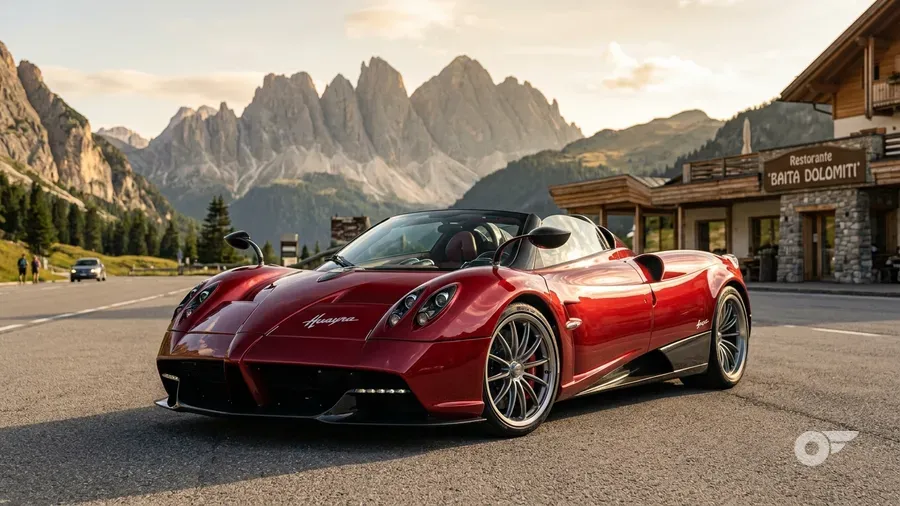
Revealed on 30 July 2024 and, unusually for Pagani, engineered alongside the coupe from the start of the C10 project rather than adapted from it. Same 864 PS V12, same 1,280 kg dry weight as the coupe, an entirely redesigned monocoque stiff enough to need no added reinforcement, and three roof states: carbon hard-top, a soft-top that stows in a case, or fully open. Butterfly doors retained.

What owning one is like

Owning a Utopia is a relationship with San Cesario more than with a car. Pagani builds a handful of cars a month across its whole range and deliveries have run years behind the order, with cars specified in 2021 and 2022 arriving in 2026. Everything routine goes through the factory or a certified dealer centre. There is no independent specialist network and there will not be one while the composite formulations are patented and every build record lives on Pagani's own database. Early cars have had the teething trouble any low-volume run has: Pagani recalled eight US Utopias over a passenger dashboard panel whose carbon mould left residue on the airbag frame, fixed with Kevlar strips that were then adopted for every car still to be built, and at least one car has been called back for a factory transmission recall. On the road it is 2,037 mm wide across the mirrors, which is a real consideration in an Italian town or an English lane. None of that is what keeps them in garages. What keeps them in garages is that most owners have several cars and this is the one they waited four years for.

Upkeep & parts

Budget for the fact that almost nothing here has a part number you can look up. The brakes are Pagani-specification Brembo CCM-R carbon ceramics, 410 mm front and 390 mm rear with monobloc six and four-piston calipers, and the tyres are bespoke Pirelli P Zero Corsas on 21-inch front and 22-inch rear forged monolithic wheels: one supplier, one specification, no cheaper alternative. The monocoque is Carbo-Titanium HP62-G2 and Carbo-Triax HP62, formulations Pagani patented and does not license out, so structural damage is a factory job by definition rather than by preference. Against that, Pagani supports its cars better than almost any low-volume maker. The Puro certification programme runs more than 400 checks against the company's own build record for every car it has made and carries a warranty extension, and the Rinascimento restoration service already exists for cars far older than this one. There is no independent Pagani owners club; the factory runs its own invitation-only Raduno gathering instead, and the museum and works at San Cesario sul Panaro are the marque's centre of gravity. Assume the car goes back to Modena at some point.

Country of origin
Italy
Class
Exotic
Production years
2022–present
Units built
In production
Model
Utopia
Nickname
No nickname
Body
Coupe, Roadster
Layout
Mid-engine, RWD
Engine
5,980cc Mercedes-AMG M158 twin-turbocharged 60-degree V12 (864 PS / 852 hp at 6,000 rpm, 1,100 Nm from 2,800 to 5,900 rpm)
Transmission
7-speed Xtrac transverse manual with gated H-pattern shift and dogleg first, 7-speed Xtrac transverse automated manual with paddle shift
Designer
Horacio Pagani