Octane Files
Explore CarsRimac Nevera

Rimac Nevera

Overview

Mate Rimac converted a BMW E30 to electric drive as a hobby project in 2007, aged nineteen, and the attention that car attracted brought the investors who became a company. Fourteen years later that company handed car number one of a 150-car run to a Formula 1 world champion. The Nevera is what the trajectory produced. Four motors, one at each wheel, each driving through its own single-speed gearbox, fed by a 120 kWh pack Rimac designed and builds itself. There is no engine and no gearbox in the sense either word usually carries, which is why the layout row on this page is blank rather than filled in with something convenient. Wikipedia calls the arrangement individual-wheel drive and nothing shorter is honest. What it bought was 412 km/h at Papenburg in November 2022, a 7:05.298 Nordschleife lap in August 2023, and a Guinness world record for going backwards at 275.74 km/h. By May 2024 Mate Rimac said fewer than a third of the 150 had been delivered, which tells you how hard the last few per cent of this car turned out to be.

Distinctions

The defining attributes and collector status that make this car garage-worthy.

Octane Files Select
Renowned for its history, engineering, or cultural weight.

Collectibility scorecard

Rated 1 to 10 on the traits that matter for owning, driving, and holding on to a car like this.

Desirability
8/10
Rarity
9/10
Driving thrill
8/10
Investment trajectory
3/10
Usability
6/10
Ease of restoration
2/10
Cultural impact
7/10
Electronic dependence
Fully analogHeavily electronic

Every input on this car reaches the road through software. There is no engine, no gearbox and no mechanical connection between the four wheels: each motor is commanded independently, and the torque vectoring that makes 2,300 kg change direction is a calculation rather than a differential. Throttle, the blend between friction braking and regeneration, stability control and drive modes are all electronic, and the car carries sensor hardware for SAE Level 4 autonomy against a future software update. Nothing here has an analogue fallback. A 5 is not a criticism, it is a description.

Market data

Demand tier, price trend, and typical values by condition. Our own assessment, not a quoted valuation.

Demand tier
EntrySolidHighBlue-chip

Strong, sustained collector demand. Good examples never wait long for a buyer.

Value trajectory
AppreciatingStableCooling

Values are softening. Patience buys better cars for less.

Price by condition
Driver
Excellent
Concours

List price was about 2.4 million dollars and production is capped at 150 cars, of which Mate Rimac said more than 50 had been delivered by May 2024. Public trading is close to nonexistent and what there is has been unkind. The Classic Valuer records a single sale, a 2023 Time Attack on Bring a Trailer in June 2026 at roughly 1.25 million pounds, against two cars offered and not sold on the same platform in April 2025 and April 2026, a sell-through of one in three. No price band is published here because three data points, two of them failures and the third a twelve-car special edition, do not make one. The pattern is normal for a new marque with a new technology and no established residual, and it is compounded by the question nobody can answer yet, which is what a decade-old 120 kWh pack will be worth. Set against that, 150 cars is a very small number and the engineering has aged well so far. The tier is High on the strength of the record and the rarity, not on the current money.

Buyer's guide

What anyone seriously considering this car should know first.

Why it's worth it
The first electric car to beat the combustion hypercars on their own numbers
Callout
Guinness world record for driving in reverse: 275.74 km/h, or 171 mph
What to watch for
Almost every Nevera is a nearly new car, which changes what you are looking for. Mileage is not the number that matters; battery history is. Ask how the car has been stored and at what state of charge, whether it has lived on a charger at 100 per cent, and how often it has been run to the top of its performance envelope, because the pack is the single most expensive component and there is no aftermarket for it. Get the service record from Rimac rather than from a dealer, and confirm the car is current on software, because the drivetrain behaviour, the torque vectoring and the drive modes are all software and an out-of-date car is a different car. Establish which of the three it is: a standard Nevera, one of the twelve Time Attacks, or a 2024 R. The R is substantially different and the distinction is worth money. Check where the nearest Rimac service point actually is before you buy rather than after. Deliveries only began in August 2022 and the network is small, so a car in the wrong country is a logistics problem before it is a mechanical one.

The Story

Driving character

The number that gets quoted is 1.74 seconds to 60 mph. The number that explains the car is 2,300 kg. Rimac's answer to the weight is not to hide it but to compute around it: four motors commanded individually thousands of times a second, so the car turns by driving the outside wheels harder rather than waiting for a differential to work it out. That is why something this heavy changes direction like something much lighter. Acceleration arrives without any of the theatre that normally precedes it, no rising note and no gear to find, which reviewers have consistently described as more unsettling than exciting the first few times. Road and Track put the step between quite fast and so fast it makes breathing difficult as the thing that stays with you. It is not silent either; the motors and the air make their own noise and it builds with speed. Top Gear gave a pre-production car nine out of ten and flagged the brakes as the part that takes learning, which is the usual price of running friction and regenerative braking through one pedal. Rimac claims two consecutive Nordschleife laps with negligible drop-off, and the 7:05 lap suggests that is not marketing.

Design

Adriano Mudri drew the exterior, and the brief was aerodynamic before it was anything else. The surfacing is all channel and duct, the doors are butterflies, and the car reads lower and wider than its 1,208 mm height and 1,986 mm width suggest, because there is no engine bay to package and the mass sits in the floor. What lifts it above competent is the detail nobody notices until it is pointed out. Sculpted into the aerodynamic bodywork on each door is the shape of a necktie. Rimac chief program engineer Matija Renić explained it at the car's American debut: Croatian soldiers arriving in France in 1680 wore wide bands of silk and lace at the collar, the French named the garment after them, and cravat is a corruption of Croat. The car itself is named for the sudden lightning storms that come off the Adriatic, and interior plates name Zagreb as its birthplace. That is three pieces of national identity built into a car with no badge history to lean on, which is precisely the problem a new marque has and a neat answer to it.

Motorsport pedigree

There is no racing record, and the reason is structural rather than a want of ambition. Nothing in international motorsport has a class for a 2,300 kg, 1,914 PS road-legal electric car: Formula E runs a spec chassis, GT racing is written around combustion balance-of-performance tables, and endurance rules have no category the Nevera could be homologated into without being rebuilt into a different vehicle. What Rimac did instead was chase timed records, which is the discipline the car actually suits. Papenburg for top speed, 412 km/h in November 2022. Papenburg again on 17 May 2023 for 23 acceleration and braking records in one day. Goodwood in July 2023, fastest production EV up the hill at 49.32 seconds. The Nürburgring on 18 August 2023, 7:05.298 with Martin Kodrić driving, still the production EV benchmark. Then July 2025, when the Nevera R took 24 more records at Papenburg including 0 to 400 to 0 km/h in 25.79 seconds. Rimac's competition history is written in stopwatches rather than trophies, and given how many of those marks came off Koenigsegg, it counts.

In culture

The Nevera carries a fire extinguisher in the back, held down by a leather strap embossed with the words in case of hill climb, extinguish fire. It is a joke about Richard Hammond, who crashed a Rimac Concept One during a hill climb, watched it burn, and walked away with a broken leg. That a company would build the joke into a 2.4 million dollar car says something about how Rimac wanted to be seen: unbothered, and confident enough to name the worst day in its history out loud. The rest of the car's public life has been reviews rather than films. Car and Driver called it the moment a battery-powered car toppled the Bugatti Chiron, and suggested the internal combustion engine may never catch up. Top Gear scored a pre-production car nine out of ten. Nico Rosberg took delivery of car number one in August 2022. And the reverse record has done more for the car's fame than any of the forward ones, because 171 mph backwards is the kind of fact that escapes the car world entirely and turns up in conversations that have nothing to do with cars.

Rivals

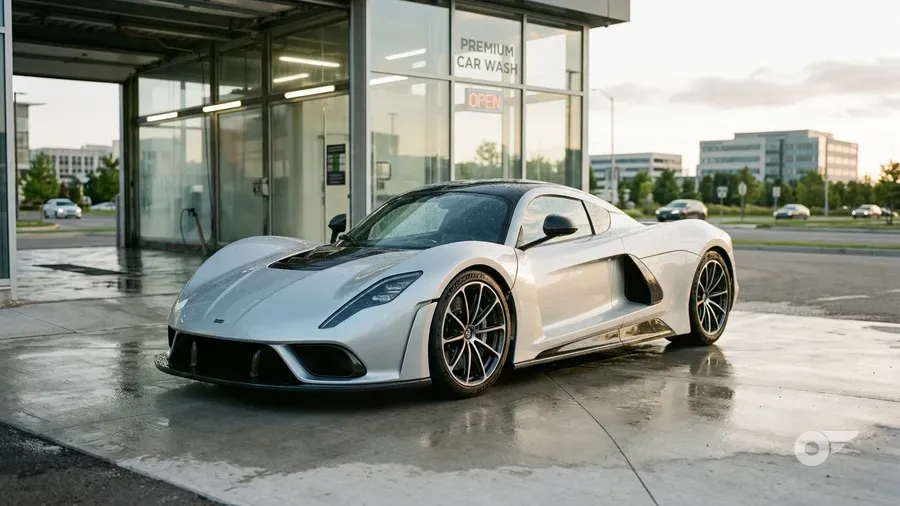
Cars from other manufacturers that competed for the same buyers when new.
Owning One

Why collectors want it

A hundred and fifty cars, and a genuine argument for why this one matters rather than merely costs a lot. The Nevera is the point at which an electric car stopped being a curiosity in hypercar company and started setting the numbers everyone else measured themselves against. Rimac was not buying that credibility either. The same firm builds battery systems and drivetrains for Aston Martin, Koenigsegg and Pininfarina, so the hardware in the Nevera is the hardware the establishment already trusts. Inside the run there is a clear order. The 2024 Nevera R sits at the top, with 2,107 PS, a fixed wing and a 0 to 400 to 0 km/h record of 25.79 seconds taken back from Koenigsegg. Below it the Time Attack, one of twelve, built to mark the Nürburgring lap. Then the standard car. The awkward part is worth saying plainly: early cars have resold well under the 2.4 million dollar list, which is normal for a new marque and a new technology, and it is exactly why the entry point is more interesting now than it was in 2022.

Which one to look for

Three cars wear the name and they are not interchangeable. The standard Nevera is the one the records were set with: 1,914 PS, 2,360 Nm, 412 km/h, and the 23 performance marks Rimac took in a single day on 17 May 2023, among them 0 to 60 mph in 1.74 seconds and a quarter mile in 8.25. The Nevera Time Attack is one of twelve, announced on 18 August 2023 alongside the 7:05.298 Nürburgring lap and built to commemorate it. It is the collector pick for the reason limited runs usually are, and so far the only Nevera to have sold publicly at auction. Above both sits the Nevera R of August 2024: 2,107 PS, around 35 kg lighter, a fixed rear wing, larger diffuser and new front bumper for 15 per cent more downforce, Michelin Cup 2 tyres, more negative camber and revised torque vectoring that Rimac says cuts understeer by a tenth. It reaches 430 km/h and took the 0 to 400 to 0 km/h record back from Koenigsegg at 25.79 seconds. Whether R cars come out of the 150 or sit beside them has never been stated.

Nevera · 2022–2024

The standard car and the one every record was set in. Four permanent-magnet motors, one per wheel, for 1,914 PS and 2,360 Nm, a 120 kWh pack and 490 km of WLTP range. 412 km/h at Papenburg in November 2022, 23 performance records in a single day on 17 May 2023, and 7:05.298 round the Nordschleife that August.

Nevera R · 2024–present

The higher-output car, unveiled 17 August 2024. 2,107 PS, roughly 35 kg lighter, a fixed rear wing, larger diffuser and new front bumper for 15 per cent more downforce, Michelin Cup 2 tyres, more negative camber and revised torque vectoring. 430 km/h, and 0 to 400 to 0 km/h in 25.79 seconds on 10 July 2025, taking that record back from Koenigsegg.

Nevera Time Attack · 2023

A commemorative edition premiered on 18 August 2023, the same day the car set its Nürburgring record, and built to mark it. Mechanically the standard Nevera.

What owning one is like

Owning one is closer to owning a piece of consumer electronics with a chassis attached than anything at this price has been before, and that cuts both ways. The good part is that there is very little to go wrong in the traditional sense. No engine, no gearbox, no clutch, no exhaust, no oil. What wears is tyres, brake pads and suspension bushes, and 2,300 kg makes short work of the first two if you use the car as intended. The part that needs thought is the battery. It is a 120 kWh pack of Rimac's own design and, financially speaking, it is the car. Charging behaviour matters, storage state of charge matters, and nobody yet has ten years of data on what a pack like this does over that time. Software is the other adjustment. Drive modes, torque vectoring and the regenerative braking blend all update, and a car that has missed updates behaves differently from one that has not. None of it is difficult. It is simply a different set of habits from the ones hypercar owners have spent thirty years learning.

Upkeep & parts

There is no independent specialist network and for the foreseeable future there will not be one. Rimac services the Nevera itself through a small number of appointed points, and getting a car to one of them is the first line of any budget. Rimac is not a fragile company, which matters here: Bugatti Rimac is 55 per cent Rimac Group and 45 per cent Porsche, and Rimac Technology supplies battery systems and drivetrains to Aston Martin, Koenigsegg and Pininfarina, so the engineering that made the car is still funded and still in the building. Routine costs are genuinely low by hypercar standards. Consumables are tyres, pads and coolant, and the Michelin fitment is expensive without being exotic. The real numbers sit at the other end: a pack replacement or a structural repair goes through Rimac at Rimac prices, and there is no salvage market to soften either. Insurance and transport are the recurring items most owners underestimate. Budget for a car that is stored and charged properly rather than driven hard and parked wet, and the running costs stay unremarkable.

Country of origin
Other
Class
Exotic
Production years
2022–present
Units built
150
Model
Nevera
Nickname
No nickname (C_Two was the concept's project name, not a nickname for the production car)
Body
Coupe
Layout
AWD
Engine
Four permanent-magnet synchronous electric motors, one at each wheel, 1,914 PS (1,888 hp) and 2,360 Nm combined; 120 kWh lithium manganese nickel battery
Transmission
Single-speed gearbox at each wheel
Designer
Adriano Mudri (exterior)