Octane Files
Explore CarsBugatti W16 Mistral

Bugatti W16 Mistral

Overview

Bugatti never planned an open Chiron. Emilio Scervo, chief technical officer at Bugatti Rimac, put it plainly: the Chiron family was never intended to have a roadster model, so the W16 Mistral had to start afresh. What that produced is a car on the Chiron's 2,711 mm wheelbase, running the Chiron Super Sport's quad-turbo W16, wearing bodywork of its own on a monocoque reshaped and re-homologated to stand up without a roof. Bugatti showed it at Monterey on 19 August 2022 with all 99 cars already sold at five million euros net, then spent two years engineering it. One prototype covered 32,000 km of the test programme before the first customer cars left Molsheim in February 2025, and the ninety-ninth was finished in July 2026. In between, in November 2024, one of them ran 453.91 km/h at Papenburg with nothing over the driver's head. It is the last Bugatti model built around the W16 that arrived with the Veyron in 2005, and the question of whether that makes it a car in its own right or a Chiron with the lid off is the most interesting thing about it.

Distinctions

The defining attributes and collector status that make this car garage-worthy.

Octane Files Select
Renowned for its history, engineering, or cultural weight.

Collectibility scorecard

Rated 1 to 10 on the traits that matter for owning, driving, and holding on to a car like this.

Desirability
9/10
Rarity
9/10
Driving thrill
9/10
Investment trajectory
8/10
Usability
3/10
Ease of restoration
2/10
Cultural impact
6/10
Electronic dependence
Fully analogHeavily electronic

Everything between the driver and the road here is mediated by software. The W16 runs drive-by-wire throttle and electronically managed two-stage turbocharging, the seven-speed dual clutch and the all-wheel-drive split are electronically controlled, and the driver chooses between five programmes that physically change the car: Lift, EB, Autobahn, Handling and Top Speed, with front ride height stepping from 125 mm down to 80 mm. Top Speed mode is a software state entered with a second key, not a mechanical setting. The clearest proof of how much is code is the record itself, which was reached by deleting the 420 km/h limiter rather than by touching the engine.

Market data

Demand tier, price trend, and typical values by condition. Our own assessment, not a quoted valuation.

Demand tier
EntrySolidHighBlue-chip

The proven elite. Values are established, liquid, and defended at every auction.

Value trajectory
AppreciatingStableCooling

Values are climbing. The market wants more of these than exist.

Price by condition
Driver
$8M
Excellent
$8.6M
Concours
$9.5M

The band rests on two verified public sales, both during Monterey week in August 2026 and both of 2025 cars with delivery mileage. Broad Arrow sold one at The Quail for 8,805,000 dollars: Matt Argent over exposed black carbon, 652 miles, roughly 650,000 dollars of personalisation, against an 8 to 10 million estimate. RM Sotheby's sold another for 8,310,000, chassis VF9SM3V3XSM795096, Italian Red over Nocturne, 321 miles, one owner, against a 7.5 to 9.5 million estimate. Both landed well clear of the five million euro list. Two results are a thin dataset and neither car had really been used, so the band describes a delivery-mileage example rather than a driven one. The one-off World Record Car, reported at fourteen million euros, is excluded. The trajectory reads as appreciating for now, on last-of-the-W16 scarcity rather than on anything the car does.

Values as of August 2026.

Buyer's guide

What anyone seriously considering this car should know first.

Why it's worth it
The last Bugatti model built around the W16 engine
Callout
453.91 km/h with nothing over the driver's head, the fastest open-top car ever measured
What to watch for
There is nothing to inspect for decay yet, so buying a Mistral is an exercise in paperwork and specification. Start with the options sheet, because the spread is wide: the car RM Sotheby's sold at Monterey in 2026 carried roughly 325,000 dollars of factory options, and the Broad Arrow car that made more money the same week carried nearly 650,000. Establish the chassis number and where it falls in the run, since the 99 were assembled between late 2024 and July 2026 and the closing cars carry dedication detailing the early ones do not. Confirm the emergency soft top is with the car, along with the cover, battery tender, tool kit and books, because these arrive as a set and get separated. Ask about storage and use rather than mileage alone: a 300-mile car kept covered in a climate-controlled room is a different proposition from one that has simply sat. Check warranty status and service history through Bugatti's own network, since there is no other route. And be clear which car you are being offered, because the one-off World Record Car and the porcelain-trimmed Blanc Eternel are single commissions, not specifications anybody could order.

The Story

Driving character

The W16 sits directly behind your head with nothing over it, and the two ram-induction scoops that feed it rise on either side of the headrests, so the intake noise arrives from beside your ears instead of through a bulkhead. Andy Wallace, describing the record run, talked about hearing the engine echo off the scoops beside him while taking the full force of the wind. Underneath the theatre the car behaves like the Chiron it shares a wheelbase with: 2,040 kg by Bugatti's own figure, 2.4 seconds to 100 km/h, 5.6 to 200 and 12.1 to 300, all of it delivered without drama because four driven wheels absorb the violence. What is genuinely different is how much the car changes shape around you. Five driving programmes step the front ride height from 125 mm down to 80 mm, and Top Speed mode, unlocked with the second key, flattens the car and releases it to 420 km/h. Every car was run up to 300 km/h at the Colmar airfield before delivery, which tells you where Bugatti thinks the useful part of that range begins. There is a soft top on board for rain, and it is better understood as an apology than as a roof.

Design

Frank Heyl drew the exterior with Florian Westermann under design director Achim Anscheidt, and the brief was harder than it sounds: make the last W16 car read as an occasion without borrowing the Chiron's face. The headlights are the tell. Each is a four-light signature, a deliberate nod to four turbochargers and four driven wheels, and the three-dimensional surface is functional, funnelling air through the lamp and out through the wheel arch. The horseshoe grille was made deeper and wider so the high-temperature radiator could be fed from that one intake alone, which freed the side intakes to serve only the intercoolers. At the back, the X motif in the tail lights doubles as ducting for the side oil coolers. The windscreen wraps around the A-pillars into a visor. The scoops behind the headrests, which look like pure styling, are bespoke carbon structures engineered to carry the car's full weight in a rollover. Bugatti names two ancestors: the 1934 Type 57 Roadster Grand Raid for the roadster idea and the launch car's colours, and the Veyron 16.4 Grand Sport for the scoops. The cabin is the Chiron's, apart from the gear selector, where Rembrandt Bugatti's dancing elephant sits in amber.

Motorsport pedigree

The Mistral has never raced, and there is no category that would take it. Bugatti Rimac runs no competition programme, and a two-tonne all-wheel-drive roadster making 1,600 PS fits no rulebook written since the war. What it contested instead was a record in a class nobody governs, which is the more interesting position to be in. On 9 November 2024 Andy Wallace, a Le Mans winner and Bugatti's official test driver, ran 453.91 km/h on the Papenburg oval in a customer car with the speed limiter deleted, its panel gaps masked and its suspension adjusted, timed by SGS-TUV Saar. The run was made in one direction only, so it does not meet the two-way requirement Guinness applies and appears in no record book. Nor is there agreement on what it beat. Bugatti cites its own Veyron Grand Sport Vitesse, while Hennessey's Venom GT Spyder ran 427.4 km/h at Lemoore in March 2016, also one way, timed by Racelogic. Fastest open-top car turns out to be a title with two claimants and no referee, which is exactly why the number gets repeated more often than it gets explained.

In culture

The Mistral exists to be a farewell and Bugatti staged it as one. The reveal was at Monterey in August 2022, the car was named for the wind that runs down the Rhone valley to the Mediterranean, and in December 2024 the company brought its four world record cars together for the first time, all of them by then in a single collection. The public verdict arrived at Monterey four years after the reveal, when two 2025 cars sold in the same week for 8,805,000 and 8,310,000 dollars and made the W16's send-off the strongest market signal the engine has produced. The last of the 99, completed in July 2026, carries a plate reading The last of its kind. One footnote for anyone searching the name: Maserati got there first, calling a 1960s grand tourer the Mistral after the same wind, and the two cars have nothing else in common. No verified film or video-game appearance has turned up for the Bugatti, which is not surprising. At 99 cars and four years old, its cultural life is still mostly happening in auction rooms.

Rivals

Cars from other manufacturers that competed for the same buyers when new.
Owning One

Why collectors want it

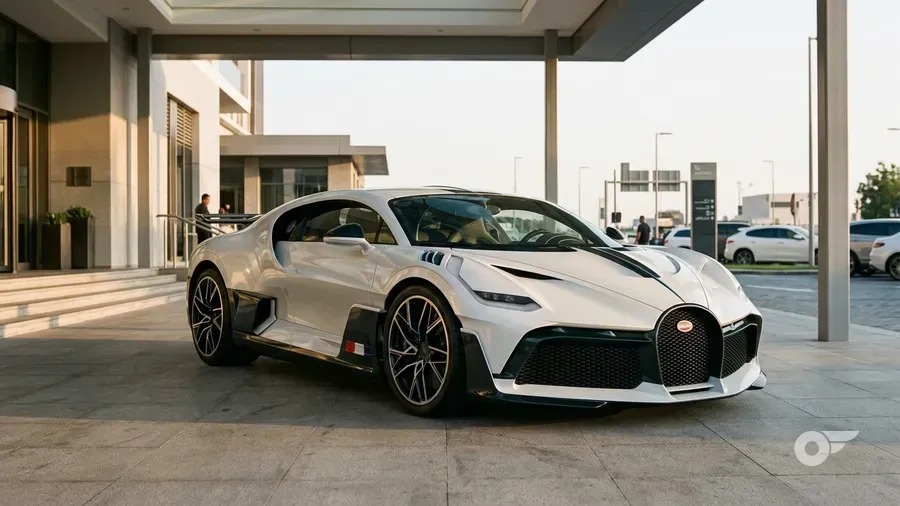
Ninety-nine cars, and the W16 does not come back. That is the whole argument, and the market accepted it quickly. Two 2025 Mistrals crossed the block during Monterey week in August 2026, at 8,805,000 and 8,310,000 dollars, against a list price of five million euros net. Cars barely a year old do not normally do that. Within the W16 hierarchy the Mistral sits in an unusual spot: rarer than the Chiron by a factor of five, more numerous than the Divo or the Centodieci, and the only one of them you drive with the sky overhead. It is also the structure Bugatti chose to keep working with once the Chiron run closed. Both cars of the Programme Solitaire, the Brouillard coupe of 2025 and the F.K.P. Hommage of 2026, are built on the Mistral rather than on the car it descends from, which is a quiet vote of confidence in what the engineers did to that monocoque. The counterweight is honest: this is a very new car, and the market has not yet had to price a W16 that nobody is servicing under factory warranty. The last-of-the-line status is not in doubt. How much of it stays in the price is.

Which one to look for

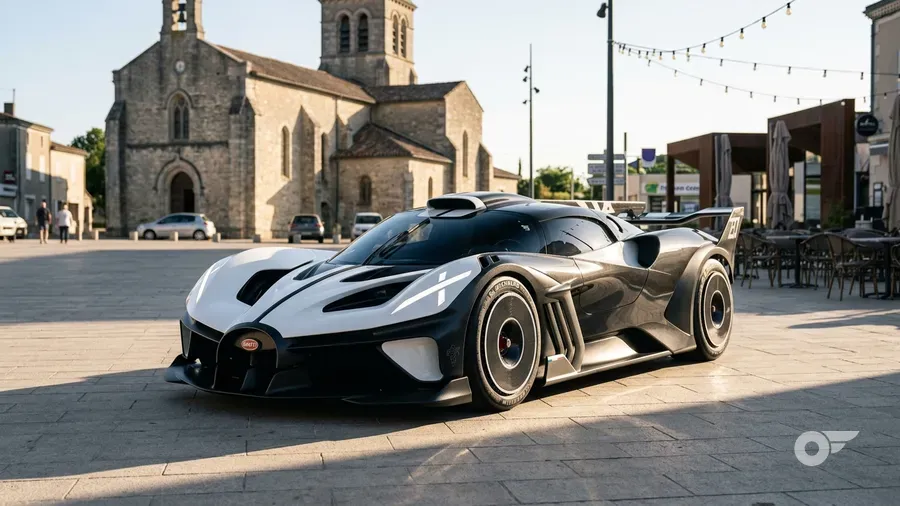
All 99 Mistrals are mechanically the same car, so the hierarchy here is one of commissions rather than trims. Every one was specified individually through Bugatti's Sur Mesure department, and the money follows the order sheet: paint, exposed carbon, leather and stitching account for six-figure differences between two otherwise identical roadsters. Three cars sit outside the ordinary run. The W16 Mistral World Record Car is the one that ran 453.91 km/h, finished in visible black carbon with Jet Orange accents, bought by a collector who already owned Bugatti's three earlier record cars and reported to have cost fourteen million euros. The Blanc Eternel of July 2026 was built with Koenigliche Porzellan-Manufaktur Berlin, using fired porcelain for the EB emblem, filler caps, engine-cover inlays and the gear selector, and revisiting the Veyron Grand Sport L'Or Blanc collaboration of fifteen years earlier. Then the two that are not roadsters at all: the Brouillard coupe of 2025 and the F.K.P. Hommage of 2026, the first two Programme Solitaire commissions, both built on the Mistral and both outside the 99. Among the ordinary cars, the ones whose specification says something will age best, starting with the launch palette of warm black, truffle brown and yellow drawn from the 1934 Type 57 Roadster Grand Raid.

Brouillard · 2025

The first car of Bugatti's Programme Solitaire, a coachbuilding scheme limited to no more than two commissions a year. Built on the Mistral but bodied as a closed coupe, and named after one of Ettore Bugatti's own horses. It uses the same 1,600 PS quad-turbo W16 and all-wheel drive as the roadster, and it keeps the structural layout of the Mistral's carbon and aluminium chassis. Shown publicly at The Quail during Monterey Car Week in August 2025.

F.K.P. Hommage · 2026

The second Programme Solitaire commission, named for Ferdinand Karl Piech and honouring the original Veyron, specifically chassis 001. Wikipedia describes it as based on the Mistral's chassis and body, heavily redesigned toward Veyron proportions with new headlights and exhausts, and it runs the same 1,600 PS W16 that the Mistral and the Chiron Super Sport share. The cabin carries a circular Bauhaus-style wheel echoing the Veyron's, a centre console machined from solid aluminium, and a 41 mm Audemars Piguet Royal Oak Tourbillon set into the dash and wound by the car's own movement. Revealed in January 2026 and shown at Retromobile in Paris.
What owning one is like

The defining fact of Mistral ownership is that there is no roof. Bugatti supplies an emergency soft top that stows on board, and it is exactly what the name says: something to fit when the weather turns, not a feature. Beyond that, these cars arrive in a state most owners never see behind them. Every W16 Mistral covered a minimum of 400 km before sign-off, including a 350 km route through Alsace chosen for the work each part of it does: cobbled village streets to expose chassis noise, country roads for steering, autoroute for stability, mountain passes to load the powertrain at altitude, and airfield sessions at Colmar up to 300 km/h. Around nine tenths of that assessment is three specialists looking, listening and feeling, dictating what they find as they go, with telemetry making up the rest. Anything flagged is corrected and then re-tested over another 50 km or more until the car comes back clean. What an owner actually manages is exposure. An open car with a Chiron-derived interior wants covered, climate-controlled storage, and the trim is the part that shows neglect first.

Upkeep & parts

Mechanically the Mistral is the most straightforward of the limited-run W16 cars to keep, because so little of it is unique. The engine, the seven-speed dual clutch, the differentials, the 420 mm front and 400 mm rear brakes and the running gear are all shared with a car built 501 times, so the parts stream and the technicians' experience already exist. The bodywork is the opposite. The outer panels, the doors, the windscreen and the load-bearing intake scoops are Mistral-only carbon made in tiny numbers, and a damaged one is a conversation with the factory rather than a repair quote. Every job goes through Bugatti's own network; there is no independent specialist, and servicing is scheduled by time rather than distance, which is the trap for a car that will cover 300 miles a year. The advantage of buying the last car of an era is that Molsheim is still working on this platform. Both Programme Solitaire commissions use it, so the tooling, the documentation and the people are current rather than being wound down. Treat warranty transfer as the single largest variable between two otherwise identical cars.

Country of origin
France
Class
Exotic
Production years
2024–2026
Units built
99
Model
W16 Mistral
Nickname
No nickname
Body
Roadster
Layout
Mid-engine, AWD
Engine
8.0-litre (7,993 cc) quad-turbocharged W16 with two-stage turbocharging, 1,600 PS (1,578 hp) and 1,600 Nm
Transmission
7-speed DSG dual-clutch automatic
Designer
Frank Heyl (exterior), Florian Westermann (styling, under design director Achim Anscheidt)