Octane Files
Explore CarsBugatti Veyron

Bugatti Veyron

Overview

Ferdinand Piech set the brief as three numbers and would not move on any of them: 1,000 horsepower, 400 km/h, and a price around a million euros. Volkswagen had bought the Bugatti name in May 1998 and needed something worth doing with it. What came back took seven years. The engine is an 8.0-litre W16, effectively two narrow-angle V8s sharing a crankshaft, breathing through four turbochargers and cooled by ten separate radiators. Making it work delayed the car repeatedly, and the first roadworthy prototype did not appear until August 2003. On 19 April 2005 at Ehra-Lessien, Volkswagen's own lead driving instructor Uwe Novacki ran one past 408 km/h with TUV Sud measuring in both directions. Bugatti entered 407 in the type approval papers, one better than the 406 km/h that Piech's own Porsche 917 had managed at Le Mans. Four hundred and fifty were built over the next decade, 300 coupes and 150 open cars, starting at 1.16 million euros. Bernstein Research later estimated Volkswagen lost millions on every one, a claim Bugatti called implausible and has never answered with a figure of its own.

Distinctions

The defining attributes and collector status that make this car garage-worthy.

Legend
A car that transcended the hobby, known far beyond the people who drive them.
Poster Car
The car on the bedroom wall, the one people dreamed about before they could drive.
Octane Files Select
Renowned for its history, engineering, or cultural weight.

Collectibility scorecard

Rated 1 to 10 on the traits that matter for owning, driving, and holding on to a car like this.

Desirability
9/10
Rarity
8/10
Driving thrill
8/10
Investment trajectory
8/10
Usability
5/10
Ease of restoration
2/10
Cultural impact
9/10
Electronic dependence
Fully analogHeavily electronic

Nothing on this car happens without a processor agreeing to it. The W16 runs drive-by-wire throttle, direct injection and four turbochargers under electronic management, the seven-speed dual clutch is computer controlled, and the all-wheel-drive torque split, stability control and ABS all sit on the same network. The aerodynamics are active: above 220 km/h the hydraulics drop the body and deploy the wing, and under braking the wing snaps to 55 degrees in four tenths of a second. Even top-speed mode is a software gate, entered with a second key while stationary and released only once the car has run its own checklist. There is no mechanical fallback anywhere, which is what a 407 km/h road car requires.

Market data

Demand tier, price trend, and typical values by condition. Our own assessment, not a quoted valuation.

Demand tier
EntrySolidHighBlue-chip

The proven elite. Values are established, liquid, and defended at every auction.

Value trajectory
AppreciatingStableCooling

Values are climbing. The market wants more of these than exist.

Price by condition
Driver
$1.4M
Excellent
$1.9M
Concours
$2.4M

The band covers the 16.4 coupe, 252 of the 450 cars and the one most buyers meet. The trend is unambiguous. Bugatti's own August 2019 release traced auction averages of 620,000 euros in 2011 and 730,000 in 2013, with nothing under 1.3 million by 2019. Recent public results build on that: a 2006 coupe on Bring a Trailer at the end of 2025 marked the driver end, Broad Arrow sold a 2008 car in March 2026 and Mecum another in May, and RM Sotheby's took 2,232,500 dollars for an 8,641-mile 2008 coupe at Monterey in August 2026. Roadsters are a separate and dearer market, with a 2011 Grand Sport making 3,305,000 dollars at Broad Arrow's Quail sale in 2026. Super Sports, Vitesses and the named specials sit above both. Sell-through runs around 64 percent, so reserves are not always met and individual results move the conversation more than the volume of them justifies.

Values as of August 2026.

Buyer's guide

What anyone seriously considering this car should know first.

Why it's worth it
The car that made 1,000 horsepower a production-car number and 253 mph a road-car number
Callout
The first production car certified past 400 km/h, at 407
What to watch for
Condition is rarely the issue on a Veyron. History is. These cars want a full fluid change every year whether they move or not, and the most valuable document in the file is an unbroken run of Bugatti service invoices. The 2008 coupe that sold at Monterey in 2026 came with 540,000 dollars of warranty and repair work recorded between 2021 and 2025, and that paperwork is a large part of why it made the money it did. Check tyre dates rather than tread, because the tyres are replaced on a calendar and not on wear, and old rubber on a car this fast is not a bargaining chip, it is a bill. Three recalls were issued in 2016 and are worth confirming as done: a fuel gauge that could read high on 2006 to 2010 cars, a positive battery cable that could corrode at the alternator on thirteen early examples, and aluminium underbody panels needing resealing on eighty-seven cars. Ask whether the car has been through Bugatti's own La Maison Pur Sang for certification. Cars that have sat are the ones to look at hardest, and most of them have sat.

The Story

Driving character

The Veyron is two cars and you choose between them with a key. In normal use it is startlingly civil, riding firmly but without punishment, with steering that evo found genuinely talkative and a gearbox that swaps ratios in under 150 milliseconds without ever announcing it. Then you take the second key, put it in the slot beside your seat at a standstill, and the car runs a checklist, retracts the spoiler, closes the front diffusers and drops itself to 65 millimetres off the ground. That ritual is the point of the car. What arrives after it is not violence so much as an absence of resistance. Two hundred miles an hour comes up the way a hundred does in an ordinary fast car. The W16 makes a hard, layered wall of noise rather than a tune, and the brakes are as remarkable as the engine, with carbon silicon carbide discs pulling 1.3 g and the wing standing to 55 degrees as an air brake. Top Gear lapped a standard car in 1:18.3 and a Super Sport in 1:16.8, which was then the fastest time on its board.

Design

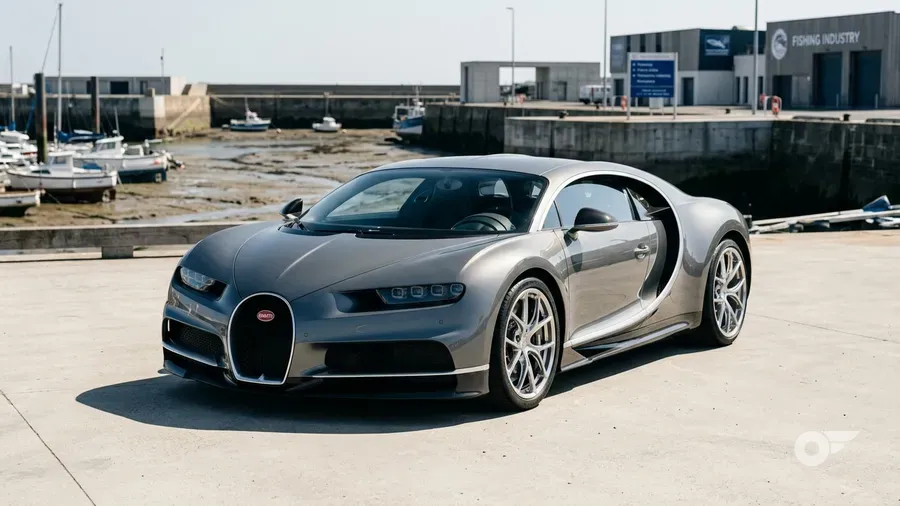
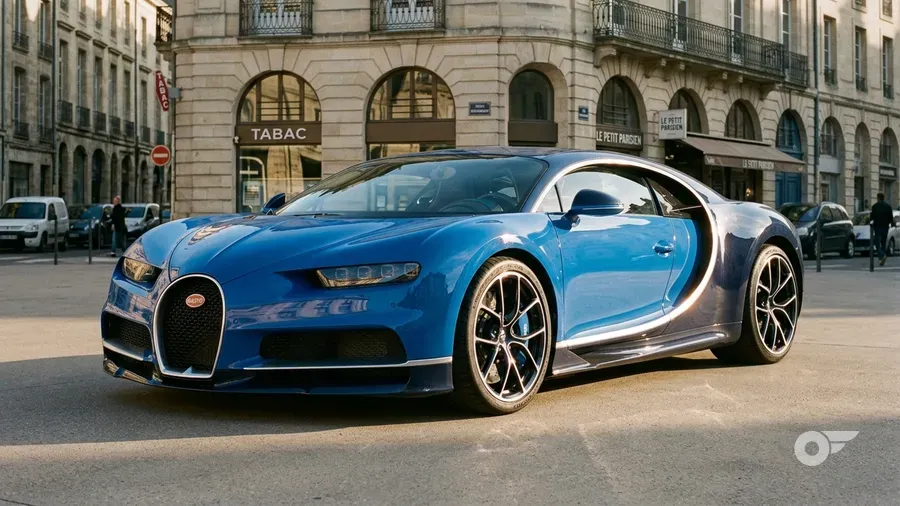
The shape is Jozef Kaban's, drawn under chief designer Hartmut Warkuss, and it exists because Warkuss decided to stop outsourcing. Volkswagen's first four Bugatti concepts, the EB 118, the EB 218 and the 18/3 Chiron, were Giugiaro designs carrying an 18-cylinder engine. The EB 18/4 Veyron shown in Tokyo in October 1999 was the first done in house, and the EB 16/4 that followed in 2000 brought the W16 with it. Warkuss even commissioned a proposal from Walter de Silva at SEAT and then rejected it in favour of his own. What reached production is compact and deliberately undramatic, a squat two-box form with an enormous horseshoe grille at the front and the engine visible behind the cabin under a low cover. The two-tone split along the flank is the signature, borrowed from pre-war coachwork and used on almost everything Molsheim has built since. Nothing about it chases theatre. It is a shape drawn around a cooling problem, ten radiators worth of one, and it looks like exactly what it is.

Motorsport pedigree

The Veyron never raced and was never meant to. There is no class anywhere for a two-tonne, all-wheel-drive, 1,001 PS road car, Volkswagen ran no factory programme under the Bugatti badge, and the money that would have funded a campaign went into the engine instead. What the car has is a name and a substitute. Pierre Veyron was a Bugatti development engineer, test driver and works racer who, with Jean-Pierre Wimille, won the 1939 24 Hours of Le Mans in a supercharged Type 57C Tank, the second and last Le Mans victory the marque ever took. The competition the modern car did enter was against a clock at Ehra-Lessien, and it was treated seriously: TUV measurement in both directions, Guinness observers present, and a driver in Pierre-Henri Raphanel who had raced in Formula One and won at Le Mans. That is the closest a Veyron has come to a grid, and given what the car was built to prove, it is the right substitute.

In culture

No car of the 2000s was discussed more and understood less. Top Gear made itself the Veyron's chief interpreter and kept returning to one comparison: James May called it our Concorde moment, Jeremy Clarkson called it the greatest car ever made and reached for the same aircraft, and the programme voted it Car of the Decade at its end-of-2010 awards. May drove one past 407 km/h at Ehra-Lessien himself, then repeated the exercise in a Super Sport. Richard Hammond raced one against a Eurofighter Typhoon and lost, and against a McLaren F1 over a mile in Abu Dhabi and won, going past the older car somewhere between 200 and 300 km/h without using launch control. Gordon Murray, who designed that McLaren, had called the Veyron the most pointless exercise on the planet while it was still in development, then drove one and revised his verdict to a huge achievement. Martin Roach wrote an entire book in 2011 on the premise that the car had become a celebrity in its own right.

Owning One

Why collectors want it

For ten years the Veyron was the answer to the question of what the fastest car in the world is, and nothing has taken that association away from it. It is also the last hypercar built without a business case underneath it, since Volkswagen was never trying to make money and by every outside estimate did not. That combination has moved the market steadily. Bugatti's own valuation release in August 2019 traced the arc: an average of 620,000 euros at auction in 2011, 730,000 in 2013, and by 2019 nothing available under 1.3 million. It has kept climbing since, with a 2008 coupe making 2,232,500 dollars at RM Sotheby's in Monterey in August 2026. The hierarchy inside the run is clear and worth knowing before you shop. The 252 standard coupes are the volume car and the entry point. The 150 open cars carry a premium, and the 1,200 PS Super Sport and Vitesse sit above them. The named specials, the five Pur Sangs, the five World Record Editions and the eight Vitesse World Record Cars, occupy their own territory. Buy the story you actually want, because the ordinary coupe tells most of it.

Which one to look for

Four cars, and the order matters. The 16.4 coupe is where to start, at 252 built, 1,001 PS, and everything the Veyron is famous for. The Grand Sport, from 2009, is the targa version with a substantially reinforced tub, two removable roofs including an emergency umbrella arrangement, and 58 built. The Super Sport of 2010 is the connoisseur's pick and the historically important one: 1,200 PS, revised aerodynamics, 48 built, and the car Pierre-Henri Raphanel took to 431.072 km/h. Customer Super Sports are limited to 415 km/h to protect the tyres, except the five World Record Editions in orange over bare carbon, which are not. The Grand Sport Vitesse, 92 cars from 2012, is the Super Sport with the roof off, and its eight World Record Car editions mark the 408.84 km/h open-top run. Above all of them sit the named specials: the five Pur Sangs wearing no paint at all, Sang Noir, Fbg par Hermes, the racing-legend Vitesses of 2013, and finally La Finale, chassis 450.

Veyron 16.4 · 2005–2011

The car the reputation is built on. 8.0-litre quad-turbo W16, 1,001 PS and 1,250 Nm certified by TUV Sud, seven-speed Ricardo dual clutch, all-wheel drive, ten radiators. Normal top speed 343 km/h; the second key unlocks the 407 km/h mode after the car has run its own checklist. The volume car and the entry point to the model.

Veyron 16.4 Grand Sport · 2009–2015

The targa. Same 1,001 PS drivetrain with a substantially reinforced tub to compensate for the missing roof, plus small changes to the screen and running lights. Two removable tops, the second an emergency umbrella arrangement good for 130 km/h. Roof on, it matches the coupe; roof off, it is limited to 369 km/h.

Veyron 16.4 Grand Sport Vitesse · 2012–2015

The Super Sport with the roof off, and the fastest open car of its era. 1,200 PS at 6,400 rpm and 1,500 Nm, 0 to 100 km/h in 2.6 seconds, electronically limited to 375 km/h on the road. Unveiled at the 2012 Geneva Motor Show and later shown at Beijing and Sao Paulo.

Veyron 16.4 Grand Sport Vitesse La Finale · 2015

Chassis 450, the last Veyron built. Finished in red and black carbon fibre, a reversal of the red and black scheme worn by the first Veyron, and displayed alongside that first car at the Geneva Motor Show in March 2015.

Veyron 16.4 Grand Sport Vitesse World Record Car · 2013

The Vitesse in record specification, marking the open-top production-car speed record. Sold at 1.99 million euros.

Veyron 16.4 Pur Sang · 2007

The first Veyron sold with no paint at all, showing bare carbon fibre and polished aluminium bodywork. Announced in September 2007 and the template for every exposed-carbon Bugatti since.

Veyron 16.4 Super Sport · 2010–2011

The important one. Larger turbochargers take the W16 to 1,200 PS at 6,400 rpm and 1,500 Nm, with a revised aerodynamic package. Customer cars are limited to 415 km/h to protect the tyres. This is the car that set the production-car speed record and the model most collectors put at the top of the range.

Veyron 16.4 Super Sport World Record Edition · 2010–2011

The Super Sport in record trim, finished in exposed black carbon with orange detailing and orange wheels, and the only version sold with the electronic speed limiter deactivated. Unveiled at The Quail in 2010 and shown again at the Monterey Historic Races and Pebble Beach.

What owning one is like

A Veyron is a more robust thing than its reputation suggests, and the honest headline is that its problems are logistical rather than mechanical. The recalls show where the weak points were rather than that the car is fragile: a fuel gauge that could read high, thirteen early cars with a battery cable that corroded where it met the alternator, and eighty-seven needing underbody panels resealed and riveted. Beyond that, the failure mode owners actually meet is disuse. Ten radiators and a great deal of plumbing means a car left standing will seep somewhere, and heat cycling turns a small leak into a large one quickly. The dual-clutch gearbox is strong but expensive to be wrong about, so harsh shifts or a warning light are worth investigating straight away rather than living with. Tyres age out on a calendar regardless of mileage. None of this is mysterious and none of it stops anyone, but a Veyron rewards being driven, serviced and kept warm far more than it rewards being stored.

Upkeep & parts

Everything about keeping a Veyron runs through Molsheim, and the sooner you accept that the easier it gets. Bugatti wants every fluid changed annually whether the car has moved or not, which on an engine with sixteen drain plugs is a full day's work and a five-figure invoice; owners publishing their bills have put it around 25,000 dollars. Tyres are replaced by date, roughly every two to three years, and reported set prices cluster in the thirty to forty thousand dollar range, with the added wrinkle that they can only be fitted to the wheels in France. Wheels themselves are a scheduled item at around 10,000 miles. A replacement gearbox is a little over 120,000 dollars. The genuinely useful development is La Maison Pur Sang, the heritage and restoration arm Bugatti launched at Retromobile in 2020, which strips a car, matches every component against factory records and issues a certificate of authenticity. Its first modern subject was a Veyron Grand Sport, restored over four months to launch specification.

Country of origin
France
Class
Exotic
Production years
2005–2015
Units built
450
Model
Veyron
Nickname
No nickname
Body
Coupe, Targa
Layout
Mid-engine, AWD
Engine
8.0-litre (7,993 cc) quad-turbocharged W16, 1,001 PS (987 hp) and 1,250 Nm (16.4, Grand Sport); 1,200 PS (1,184 hp) and 1,500 Nm (Super Sport, Grand Sport Vitesse)
Transmission
7-speed Ricardo dual-clutch automatic
Designer
Jozef Kaban (exterior design), under chief designer Hartmut Warkuss