Octane Files
Explore CarsLamborghini Reventón

Lamborghini Reventón

Overview

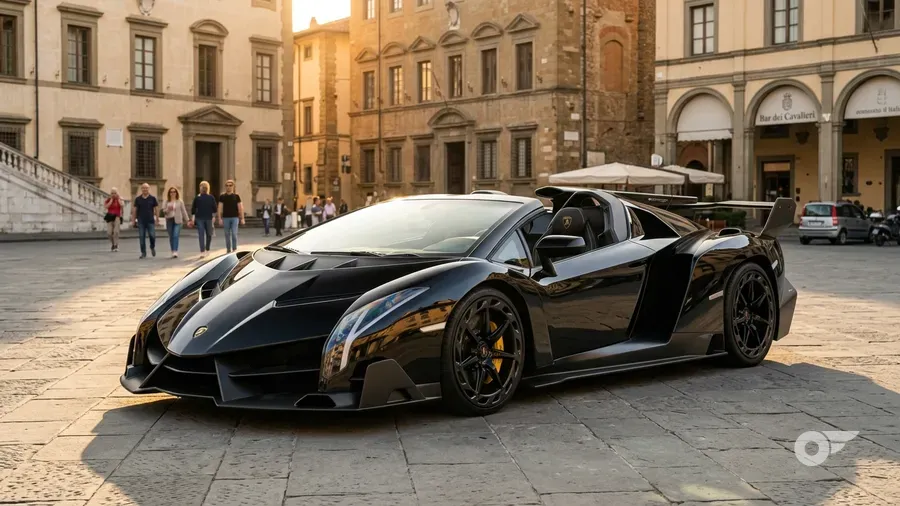
In September 2007 Lamborghini did something it had never done before and has now done four more times: it took the flagship already in production, changed nothing underneath, and sold twenty of them at roughly a million euros each. The Reventón is a Murciélago LP 640 in a carbon-fibre suit, and Sant'Agata never pretended otherwise. What made it work was that the suit was genuinely new. Filippo Perini's team drew the shape from aviation rather than from the Murciélago, all knife creases and flat planes, and finished it in a matte grey the factory mixed specially and named after the car. Where the dials had been there were now three TFT screens, one of them a g-force meter, in housings milled from solid aluminium. All twenty customer cars were spoken for before the Frankfurt stand opened. Lamborghini built a twenty-first, numbered 00/20, and kept it. Fifteen roadsters followed with the 670 PS engine. That transaction, a body and a build number sold at several times the price of the donor car, became the template for the Sesto Elemento, the Veneno, the Centenario and the Sián. Every limited-run Lamborghini since starts here.

Distinctions

The defining attributes and collector status that make this car garage-worthy.

Poster Car
The car on the bedroom wall, the one people dreamed about before they could drive.
Octane Files Select
Renowned for its history, engineering, or cultural weight.

Collectibility scorecard

Rated 1 to 10 on the traits that matter for owning, driving, and holding on to a car like this.

Desirability
8/10
Rarity
10/10
Driving thrill
8/10
Investment trajectory
7/10
Usability
4/10
Ease of restoration
3/10
Cultural impact
7/10
Electronic dependence
Fully analogHeavily electronic

A 2007 car built on 2001 architecture, so it is electronic where the industry then was and mechanical where it still could be. Engine management, drive-by-wire throttle and the hydraulically actuated e-gear single-clutch gearbox all depend on their control units, and the three TFT instrument screens replace physical dials entirely, which was the car's headline novelty. Against that, the all-wheel-drive system is a viscous coupling rather than an electronically apportioned one, there is no active aerodynamics, no adaptive damping and no drive-mode matrix beyond the gearbox settings. Nothing here reacts to the road surface on your behalf.

Market data

Demand tier, price trend, and typical values by condition. Our own assessment, not a quoted valuation.

Demand tier
EntrySolidHighBlue-chip

Strong, sustained collector demand. Good examples never wait long for a buyer.

Value trajectory
AppreciatingStableCooling

Values are holding steady. What you pay today is what it's worth tomorrow.

Price by condition
Driver
$1.5M
Excellent
$1.8M
Concours
$2.2M

The Reventón is the most liquid car in Lamborghini's few-off family, which at this level means eight documented public results rather than none. The record runs from about £879,000 in August 2015 to about £1.6 million in September 2019, with a median near £1.44 million, and roughly half of the cars offered publicly have failed to sell. The most recent verified result is a 2010 Roadster with 4,102 km that made 1,580,000 euros at RM Sotheby's in Milan in May 2025. Read together, those results describe a market that rose hard to 2019 and has moved sideways since rather than one that is still climbing, which is why the trajectory here is stable rather than appreciating. The band below describes a coupé; roadsters generally ask and achieve more, on the strength of fifteen cars against twenty-one. Original list was around a million euros before local taxes, so the car has roughly doubled in nineteen years, which is respectable rather than spectacular for something this scarce.

Values as of August 2026.

Buyer's guide

What anyone seriously considering this car should know first.

Why it's worth it
The car that invented Lamborghini's rebodied-flagship formula
Callout
Twenty customer coupés sold before the Frankfurt stand opened, plus a twenty-first, numbered 00/20, kept by the factory
What to watch for
Buy the paperwork and the panels; the mechanical side is a known quantity. Every car carries a build number, so confirm it on the car and in the documentation, and establish where the car sat in the delivery sequence, since that is what the market prices. The matte Grigio Reventón finish is the single biggest ownership variable. It cannot be polished, machine-corrected or spot-blended the way gloss paint can, so swirl marks, wax residue and amateur detailing are permanent until a panel is refinished, and refinishing a car whose body panels exist in thirty-six sets is a factory conversation. Look hard at the leading edges and the lower body for stone damage. Mechanically it is a Murciélago LP 640, which means the clutch is the item that matters: ask for a clutch-wear readout, ask when the last one was done, and price the next one in. E-gear cars with hesitant or jerky low-speed shifts usually have a tired hydraulic actuator rather than a broken gearbox. Confirm the service history is with a Lamborghini specialist, because a car this scarce with an anonymous history is a harder sell than a car with miles on it.

The Story

Driving character

No independent road test of a Reventón has ever been published, which is its own fact about how thirty-six cars get used. What is knowable is the machinery, and it is a Murciélago LP 640's throughout. The 6.5-litre V12 makes 650 PS at 8,000 rpm with no turbochargers anywhere, so response is proportional to how far your foot has moved and how far the needle has climbed, and the noise is a hard mechanical shriek rather than a boom. The gearbox is Lamborghini's e-gear, a single-clutch automated manual worked by paddles, and it behaves the way that layout always does: decisive and quick when you are committed and in the sharper modes, hesitant and lurchy when you are crawling. Drive goes to all four wheels through a viscous coupling, which is why these cars feel planted in a straight line and unfussed in the wet. At 1,665 kg it is not light, and it does not pretend to be. Everything the Reventón changes is in front of your eyes: three screens, a g-force readout, and a windscreen framing a shape nobody else has.

Design

The brief was aeronautical and Lamborghini said so, describing the design as drawn from the fastest aircraft. Writers have spent nearly two decades naming the specific machine, usually the F-22 Raptor, occasionally the F-15, and the factory has never confirmed either, so the useful description is the language rather than the aircraft. It is all flat planes meeting at hard creases, with almost no compound curvature anywhere on the car, a nose that reads as a radome, intakes cut as sharp-edged slots rather than blended scoops, and a tail treated as an exhaust section with the lights buried in it. Grigio Reventón, the matte grey mixed for the car, is doing structural work in that argument, because matte paint refuses to show reflections and reflections are what soften a shape. The interior follows: three TFT displays with a g-force meter, aluminium billet housings, carbon casings. The important afterlife is that the Reventón, not the Murciélago, is the visual ancestor of the Aventador that arrived in 2011. Sant'Agata's whole modern design language starts on a car it built thirty-six of.

Motorsport pedigree

The Reventón never raced and there was never a plan for it to. Lamborghini's competition programme in this period ran through Squadra Corse and the V10 cars, the Gallardo Super Trofeo one-make series and later the Huracán GT3, and a twenty-car V12 special had no class to enter anywhere in the world. What the Reventón has instead is the closest thing to a race that a car like this ever gets. In November 2007, at the Ghedi military airbase near Brescia, Lamborghini put a Reventón and a test driver on a 3,000-metre runway alongside a Panavia Tornado of the Italian Air Force and ran them against each other for the international television crews. The Lamborghini led off the line, which its 3.4-second 0-100 km/h time made likely, and the Tornado took it back and left the ground. The genuine competition connection belongs to the car underneath: the Murciélago was campaigned as the R-GT in GT1 racing, which is the closest this platform came to a grid.

In culture

The Reventón arrived at the exact moment when a supercar's fame stopped depending on magazines. It landed in racing games almost immediately, and a generation who could never see one in person learned the shape from a screen, which is how a thirty-six car model became instantly recognisable to people who could not name a Murciélago. The jet race did the rest. Shot for international broadcast rather than for a magazine, it gave the car a piece of television that is still circulated, and it made the aviation story literal in a way a press release never could. Since then its public life has been the ordinary one for cars this scarce: concours appearances, the occasional auction catalogue, and the factory's own car, 00/20, which has spent its life on display at Sant'Agata Bolognese rather than on a road. What the Reventón really changed was commercial rather than cultural. It proved that a manufacturer could sell design and scarcity as a product in their own right, and every limited-run hypercar reveal since has followed its script.

Rivals

Cars from other manufacturers that competed for the same buyers when new.

Koenigsegg CCX

Koenigsegg CCX

Sweden·Exotic·2006–2010

Owning One

Why collectors want it

Thirty-six cars, and the argument is not really about the mechanicals, because those are a Murciélago's and a Murciélago can be bought for a fraction of the money. What you are buying is the first of the breed and a shape that exists nowhere else. The hierarchy inside the run is clear and the market follows it: fifteen roadsters against twenty-one coupés, so the open car generally carries the premium, and Lamborghini's own 00/20 sits outside the market entirely. Within the coupés, build number does real work, with low numbers and first-delivery cars attracting the attention. Documented sales have run since 2015 and the car has never had a soft patch: eight results are on the public record, sell-through sits near half, and cars that fail to sell simply go away rather than getting cheaper. The deeper case is historical. The Reventón is the point where Lamborghini learned that scarcity and design, sold separately from engineering, are a product. Every seven-figure few-off the company has built since is a refinement of a lesson it learned with these thirty-six cars.

Which one to look for

Three cars are worth separating. The customer coupé, twenty built in 2007 and 2008, is the one that carries the story: 650 PS, matte Grigio Reventón, a numbered plaque, and the whole aviation exercise as delivered. The Roadster, fifteen cars from 2009, is the rarer and usually the more expensive one, with the engine lifted to 670 PS and a top speed quoted at 330 km/h rather than the coupé's 340-plus, because an open car pays for its own drag. Then there is 00/20, the twenty-first coupé, which Lamborghini built for itself and has never sold; it is why the coupé count reads twenty-one in some places and twenty in others, including on Lamborghini's own history page. If you are choosing, the roadster is the scarcer object and the coupé is the purer one, since the design's flat planes and the fighter-canopy silhouette read better with the roof in place. Neither is a driving decision. Both are the same car underneath.

Coupé · 2007–2008

The original car, shown at the 2007 Frankfurt Motor Show. Carbon-fibre body over Murciélago LP 640 mechanicals, 650 PS at 8,000 rpm, 0-100 km/h in 3.4 seconds, top speed over 340 km/h. Matte Grigio Reventón paint mixed specially for the model, three TFT instrument displays with a g-force meter, and a numbered plaque.

Roadster · 2009–2010

Open version with no fixed roof, engine lifted to 670 PS. Same 3.4-second 0-100 km/h time as the coupé and a lower quoted top speed of 330 km/h, the usual cost of open-car drag. The scarcer of the two body styles and generally the more expensive.

What owning one is like

Living with a Reventón is living with a Murciélago that you cannot repair casually. The mechanical package is well understood and genuinely durable, and independent Lamborghini specialists have been servicing this V12 for two decades. The clutch is the recurring event: the e-gear system is harder on it than a manual would be, life varies enormously with use, and replacement means the engine comes out, which is around forty hours of labour before parts. A hydraulic actuator that has worn internally shows up as jerky shifts or a refusal to engage, and it is a known, fixable item rather than a mystery. What is genuinely different from a Murciélago is everything you can see. The carbon bodywork exists in thirty-six sets, the matte finish cannot be polished or spot-repaired, and both facts push owners towards covered transport and controlled storage. The cars are driven less than they deserve, so fluids, batteries and tyre dates matter more than the odometer. None of this is a reason to hesitate, but it does mean a Reventón wants an owner with a plan rather than a parking space.

Upkeep & parts

The good news is that everything that turns is a Murciélago LP 640's, and that car has a mature specialist network in Europe, the Middle East and the United States. Clutch replacement is the budget item to plan for rather than fear: independent specialists have quoted the job in the region of 8,000 to 10,000 euros all in, main dealers materially more, and the labour dominates because the engine has to come out. Suspension, brakes, cooling and electrics are all shared with a car built in the low thousands, so parts exist. Bodywork is the opposite situation. Panels, lights and glass are specific to the run, so a kerbed splitter is a lead-time question for Sant'Agata rather than a body-shop booking, and the matte paint means even a stone chip is a panel-level decision. Budget for correct storage and covered transport as a permanent line item, not a luxury. Community support is real: Lamborghini Club USA, the International Lamborghini Registry and the Lamborghini Talk forum all carry owners who have solved these problems already.

Country of origin
Italy
Class
Exotic
Production years
2007–2009
Units built
36
Model
Reventón
Nickname
No nickname
Body
Coupe, Roadster
Layout
Mid-engine, AWD
Engine
6.5-litre (6,496 cc) V12, 650 PS (641 hp) at 8,000 rpm (coupé); 6.5-litre V12, 670 PS (661 hp) (Roadster)
Transmission
6-speed e-gear automated manual
Designer
Filippo Perini (Centro Stile Lamborghini)