Octane Files
Explore CarsKoenigsegg CCR

Koenigsegg CCR

Overview

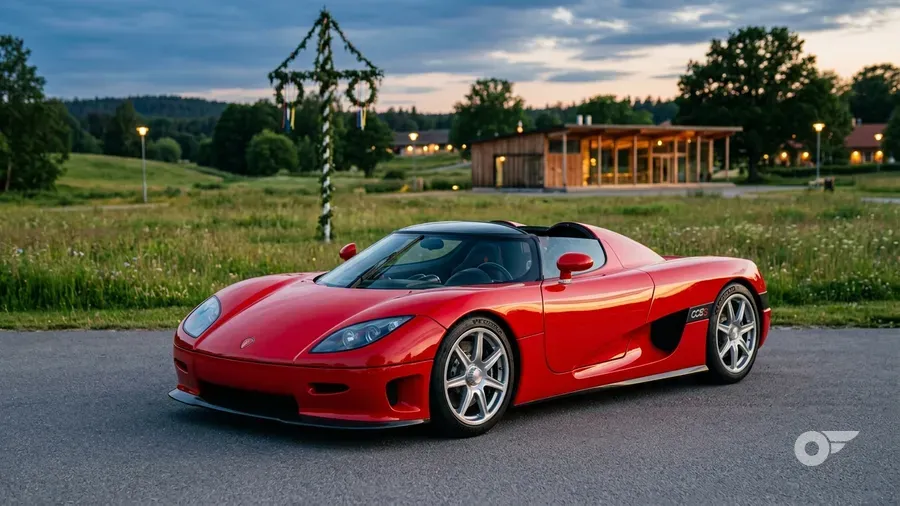
The CCR exists to answer one question, and the company was open about which one. Koenigsegg took the CC8S, replaced its supercharging with a pair of Rotrex units, and pushed output from 655 hp to 806 hp, which took the Guinness production engine record straight off its own predecessor in 2004. Bigger brakes and wheels, a fixed rear wing and revised aero came with it. Then on 28 February 2005 the company took a CCR to the Nardo bowl in southern Italy, put Loris Bicocchi in it, and recorded 387.87 km/h, which made a Swedish firm that had delivered fewer than ten cars the builder of the fastest production car in the world. It held that for about two months. Bugatti had a Veyron prototype past 400 km/h in April and a production car at 408.47 km/h soon after, and the modern record lists exclude the Nardo run anyway because it was made in one direction. Fourteen CCRs were built, plus one CC8S that came back to the factory and left as a CCR. It is the smallest, angriest chapter in the marque's history.

Distinctions

The defining attributes and collector status that make this car garage-worthy.

Octane Files Select
Renowned for its history, engineering, or cultural weight.

Collectibility scorecard

Rated 1 to 10 on the traits that matter for owning, driving, and holding on to a car like this.

Desirability
8/10
Rarity
10/10
Driving thrill
9/10
Investment trajectory
8/10
Usability
2/10
Ease of restoration
2/10
Cultural impact
7/10
Electronic dependence
Fully analogHeavily electronic

The CCR runs full electronic engine management on a supercharged V8 and has ABS, and that is close to the whole electronic story. Boost comes from two belt-driven Rotrex superchargers, which are mechanical devices with no electronic wastegate strategy to arbitrate; the gearbox is a hand-shifted CIMA six-speed; the steering is hydraulic; the dampers are passive. There is no traction control, no stability control, no drive modes and nothing between the driver and 806 hp except judgement. It scores mid-scale rather than low only because the engine management making that output survivable is genuinely sophisticated for 2004. Everything a driver touches is a linkage.

Market data

Demand tier, price trend, and typical values by condition. Our own assessment, not a quoted valuation.

Demand tier
EntrySolidHighBlue-chip

The proven elite. Values are established, liquid, and defended at every auction.

Value trajectory
AppreciatingStableCooling

Values are climbing. The market wants more of these than exist.

Price by condition
Driver
$1.8M
Excellent
$2.4M
Concours
$3M

Fourteen cars, and public sales are close to nonexistent: the only auction result this session could verify is a 2004 CCR sold by RM Sotheby's in June 2021 for 686,419 pounds. Broker and dealer asking prices in mid-2026 sit around 2 to 3 million dollars, and the band below reflects those asks tempered by how far ahead of verified transactions Koenigsegg asking prices tend to run. Elsewhere in the marque a CCX advertised at 3.7 million dollars had last changed hands for 1,215,000, which is the gap to keep in mind. The case for appreciation is straightforward: fourteen cars, a genuine world record, the last supercharged Koenigsegg, and a manual gearbox. The case against a higher band is simply that nobody has tested the ceiling in public.

Values as of August 2026.

Buyer's guide

What anyone seriously considering this car should know first.

Why it's worth it
Took the production car speed record off the McLaren F1, and lost it to Bugatti within months
Callout
387.87 km/h at Nardo on 28 February 2005, the fastest production car in the world
What to watch for
Ask which chassis, then ask what the chassis has been through. Chassis 026 is the converted CC8S and its history is a genuine part of its interest rather than a problem, but it needs to be disclosed and understood rather than discovered later. The Rotrex superchargers are the defining service item: they are belt-driven traction-drive units with their own fluid and their own service schedule, and neglect shows up as noise and lost boost rather than as a warning light. Koenigsegg's upgrade programme offers a revised engine management system specifically for the CCR, so establish which calibration a car is running and who installed it, because a mapped car with no paperwork is a car with an unknown history. Confirm the removable hardtop is present, undamaged and sealing. Then look at use: these cars are frequently stored for years, and a CCR that has covered a few hundred kilometres in a decade needs fluids, belts, hoses and tyres before it is driven hard, not after. Have an official dealer inspect it, and expect that inspection to involve the factory, since Angelholm holds the build records for every chassis it has made.

The Story

Driving character

Two centrifugal superchargers give the CCR a different character to a turbocharged hypercar and to its own supercharged predecessor. Boost rises with revs rather than arriving in a step, so 806 hp builds relentlessly rather than detonating, and the 920 Nm peak at 5,700 rpm sits high enough that the car rewards using the whole range. At 1,180 kg dry there is very little mass to move. The soundtrack is the reason people remember driving one: a hard-edged V8 with the Rotrex drive whining over the top of it, gaining pitch all the way to the limiter. The six-speed manual is heavy and deliberate and asks to be driven with intent. There is no traction control, so second and third gear in the wet are a matter of restraint rather than electronics. The company quoted a theoretical top speed of 395 km/h and then went and recorded 387.87 km/h in the real world, which tells you the car was built around high-speed stability first and everything else second. It is stable, serious and completely without a safety net.

Design

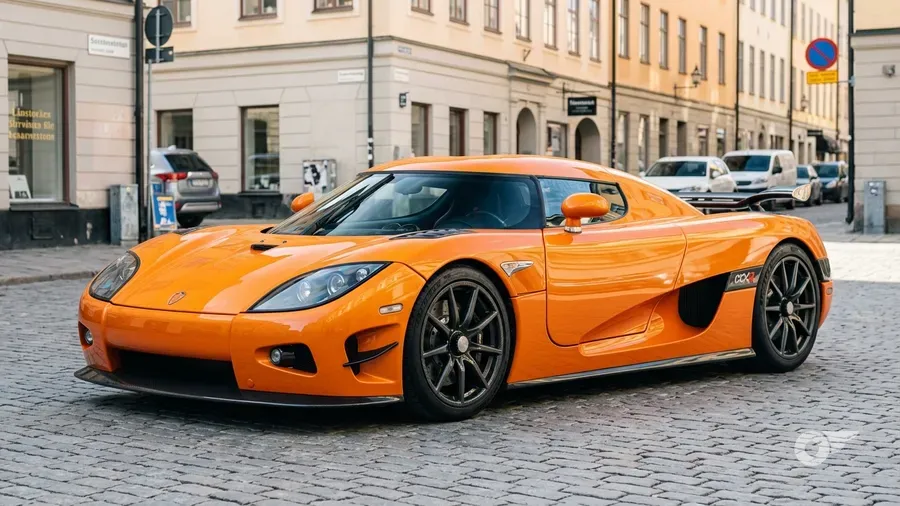
Sven-Harry Akesson joined the design effort for the CCR, and the result is the CC8S shape sharpened rather than replaced. The visual signatures are the fixed rear wing, larger wheels and brakes, revised intakes to feed two superchargers and their coolers, and a front end reworked for the downforce a 380 km/h car needs. The dihedral synchro-helix doors and the detachable hardtop that stows in the front boot carry over unchanged, because both were right the first time. The CCR is also where the marque's visual identity became complete, since it was the first Koenigsegg to wear the ghost badge on its flanks. That emblem arrived with the company's move into a fighter jet hangar at a disused Swedish air base, and it belongs to the squadron that flew from that field rather than to the car company. Inside, the CCR remains a car of its moment: analogue dials, a mechanical shifter, and none of the screen real estate the Agera generation would bring. It looks like what it is, a late-1990s idea executed to a 2005 standard.

Motorsport pedigree

Koenigsegg has never entered a race series, and the CCR is the clearest example of what the company did instead. Its competition was a single run on a single day: the Nardo bowl, 28 February 2005, 387.87 km/h, with Loris Bicocchi driving. Bicocchi is the connecting thread through this entire class of car, having developed the Bugatti EB110 and the first Pagani Zonda before seeing the CC8S prototype at the 2000 Paris show and moving to Sweden to work for a company that then had two engineers and a handful of mechanics. The run has an asterisk and the company has never hidden it: modern production car speed record lists exclude the CCR because the speed was recorded in one direction rather than as a two-way average. That standard did not exist as an enforced convention at the time, and it took Koenigsegg twelve years and a different car to satisfy it. No CCR was campaigned in any series, for the simple reason that no series existed that a fourteen-car manufacturer could enter.

In culture

The spring of 2005 was one of the strangest moments in the modern car business, and the CCR was at the centre of it. For roughly two months a company operating out of a Swedish hangar held the production car speed record, and then the Volkswagen Group arrived with the Veyron and took it away with an engineering budget that made the comparison absurd. Both records carry footnotes, which is the honest and more interesting story. The McLaren F1 figure the CCR beat, 240.1 mph, was set with the rev limiter raised from 7,500 to 8,300 rpm, and a standard F1 is gear-limited around 221 mph. The CCR's own number is excluded from the modern lists for being a single directional run. Depending on which asterisk you accept, the title changed hands two or three times in eighteen months. What the episode really did was establish Koenigsegg in the public mind as the small firm that turns up with a stopwatch, a reputation the Agera RS would confirm twelve years later.

Rivals

Cars from other manufacturers that competed for the same buyers when new.

Owning One

Why collectors want it

Fourteen cars, and a record that belongs to the model rather than to a special edition of it. That matters here: the CCR was not a stripped homologation run or a numbered anniversary series, it was simply what Koenigsegg sold between 2004 and 2006, so any of the fourteen is a car from the model that beat the McLaren F1. The population is really fifteen bodies and fourteen new builds, because chassis 026 began life as CC8S 003 and was rebuilt to CCR specification, which is worth knowing before anyone quotes you a number. Mechanically it is the end of a line. This is the last Koenigsegg engine derived from an outside block and the last to be supercharged rather than turbocharged, and it is a manual, which the CCX also was but the Agera never would be. Values have lagged the car's significance because so little of it trades: one public auction sale in recent years against fourteen cars in existence is not a market, it is an anecdote.

Which one to look for

There are no trims. Fourteen cars were built to a single specification over three model years, and the variation is in individual commissions rather than factory versions: colour, interior, wheels and detailing were specified per customer. The car to understand is chassis 026, which is a CC8S returned to the factory and rebuilt as a CCR, and which is why chassis tables for the model list fifteen entries against a production figure of fourteen. Buyers sometimes confuse the CCR with the CCX that replaced it, and the distinction is fundamental rather than cosmetic: the CCR uses the CC8S generation of engine, derived from an outside block and supercharged, while the CCX introduced Koenigsegg's own engine designed for American fuel and emissions. If originality is the priority, look for a car on its factory engine calibration with its record-era specification intact. If usability is the priority, the same upgrade programme that serves the CC8S will bring a CCR forward without disguising what it is.

What owning one is like

A CCR is a mid-2000s hypercar built by a company that then had a few dozen employees, and it owns up to that. The powertrain is the robust part: a well-understood block, two Rotrex superchargers that are serviceable units rather than sealed mysteries, and a CIMA gearbox with known internals. Everything bespoke around them is the work. Trim, switchgear and looms were made in tiny batches, so a failed switch or a chafed harness becomes a fabrication job rather than a parts order, and turnaround depends on the factory's schedule. The superchargers want their fluid changed on time and their belts inspected, and both jobs get expensive if they are deferred. Carbon bodywork does not rot but it does crack if something hits it, and repairs are specialist. As with every Koenigsegg, the real enemy is disuse, since fourteen cars spread across the world's collections do not accumulate mileage. The compensation is that the factory still knows this car intimately, holds its build records, and will still work on it, which is not something most 2005 supercars can offer.

Upkeep & parts

Servicing runs through Koenigsegg's own network of factory-trained technicians, with official dealers across Europe and in the United States, and remote cars are often handled by sending a technician to the car. Parts are made to order in Angelholm; there is no aftermarket and no independent specialist trade to speak of. What is unusual, and useful, is that the factory keeps improving cars it sold twenty years ago: the official upgrade programme lists a new engine management system for the CCR specifically, alongside carbon wheels, parking sensors and interior work available across the early models. Budget for the supercharger service intervals and for tyres, which are a bespoke fitment rather than a shelf size, and expect any significant job to be scheduled around Sweden rather than around you. There is no owners club, because a global population in the low hundreds across all models cannot support one. The unofficial Koenigsegg Registry tracks chassis histories and is the closest thing to a community record, and it is where verification of any CCR should start.

Country of origin
Sweden
Class
Exotic
Production years
2004–2006
Units built
14
Model
CCR
Nickname
No nickname
Body
Targa
Layout
Mid-engine, RWD
Engine
4.7 L V8 with twin Rotrex superchargers (806 hp / 817 PS at 6900 rpm)
Transmission
6-speed manual (CIMA)
Designer
Sven-Harry Akesson, Christian von Koenigsegg, David Crafoord