Overview
Koenigsegg's first customer car took eight years to arrive and very nearly did not arrive at all. Christian von Koenigsegg was 22 when he founded the company in 1994, having decided as a boy watching the Norwegian stop-motion film The Pinchcliffe Grand Prix that he would build a supercar one day, and he raised roughly SEK 60 million to try. The engine was the recurring problem. A supply deal for Audi V8s collapsed. So did the plan that followed it, built around a stock of Subaru 1235 flat-twelve Formula One engines, when the Italian firm that made them went bankrupt. What finally reached a paying customer was the CC8S, carrying a heavily reworked 4.7 litre supercharged V8 that Guinness certified in 2002 as the most powerful engine in a series production car at 655 hp. Six were built. In February 2003 a production building burned, and the company answered by buying a disused air base and moving into one of its fighter jet hangars. Nearly everything the marque is known for now, the carbon tub, the dihedral doors, the roof that stows in the nose, was on this car or arrived within months of it.
Distinctions
The defining attributes and collector status that make this car garage-worthy.
Collectibility scorecard
Rated 1 to 10 on the traits that matter for owning, driving, and holding on to a car like this.
A 2002 supercar with electronic engine management and very little else. The supercharged V8 runs a full ECU with sequential injection, and there is ABS, but the driver's side of the car is mechanical throughout: a CIMA six-speed manual shifted by hand, hydraulically assisted steering, passive dampers, and no traction control, no torque vectoring, no drive-mode menu and no electronically managed chassis of any kind to catch a mistake. Nothing about the car adapts to you. That places it squarely mid-scale, more electronic than a 1980s supercar because of the engine management it needs to make 655 hp reliably, and far less electronic than the Agera that followed eight years later.
Market data
Demand tier, price trend, and typical values by condition. Our own assessment, not a quoted valuation.
The proven elite. Values are established, liquid, and defended at every auction.
Values are climbing. The market wants more of these than exist.
Koenigsegg built six CC8S, and that number is the whole market. There is no price band on this page because there is nothing to build one from. No CC8S has appeared in a verified public auction result, and the transactions that have happened were private and sporadic. What can be stated is where the car started. The CC8S launched at roughly 586,000 to 600,000 dollars. In 2002 that made it one of the most expensive new cars on sale, and it bought the most powerful engine then certified in a series production car. Everything quoted since is an asking price, and in this marque the distinction matters more than usual. A CCX advertised at 3.7 million dollars had last changed hands at 1,215,000. Applying that spread to a car with six examples and no sales record would produce a number with nothing behind it. The scarcity here is of an unusually hard kind. Not a limited edition, simply all that was ever built, and one of the six was later converted to CCR specification. Values move with the marque's standing rather than with comparable sales, and anyone buying one is negotiating in private against no public reference at all.
Buyer's guide
What anyone seriously considering this car should know first.
The Story
Driving character
At 1,175 kg dry with 655 hp and two superchargers, the CC8S does not build power so much as release it. There is no turbo lag to wait through and no step in the delivery, just an immediate shove that keeps stretching to the 7,250 rpm limiter, with 750 Nm arriving at 5,000 rpm and a supercharger whine sitting on top of a deep American-derived V8 bass. The CIMA six-speed is a mechanical, deliberate shift rather than a quick one, and it suits the car; nothing here is trying to be effortless. Steering is hydraulic and talkative, the car is narrow by modern hypercar standards, and visibility out of it is unusually good for the type. What is missing is any electronic safety net, so 655 hp in a car of this weight asks for a clear head and a dry road. Lift the hardtop out and stow it in the nose and the noise arrives properly. It is an analogue supercar with a modern power figure, which is a combination that stopped being available almost immediately after.
Design
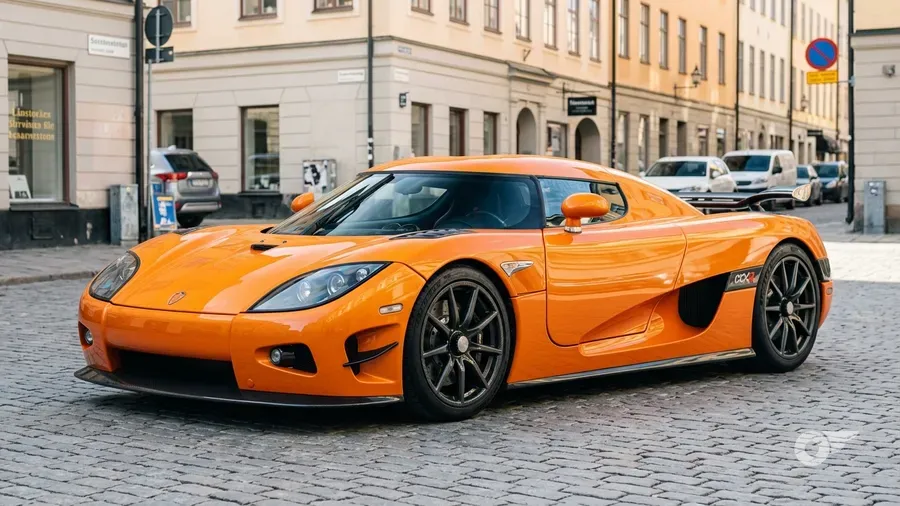
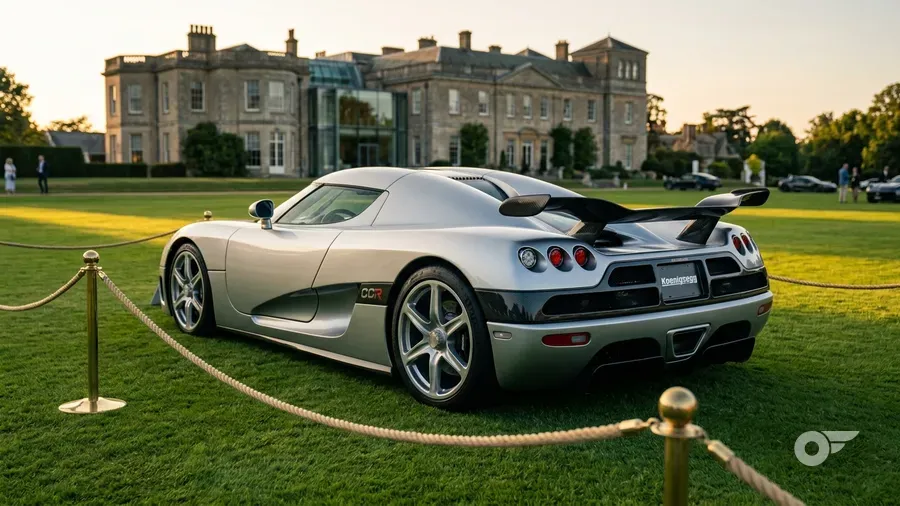
The shape came out of Christian von Koenigsegg's own sketches, which David Crafoord turned into a 1:5 scale model that was then scaled up to cut the plug for the first prototype. The doors are the signature: dihedral synchro-helix, rotating out and forward on a single arm rather than lifting scissor-fashion, a mechanism the company has kept on every car since. The roof follows the same logic of doing more with less, a detachable hardtop that stows under the front lid so the car is a coupe and a targa without carrying two structures. Underneath sits a kevlar-reinforced carbon semi-monocoque with a steel front subframe and an aluminium rear, with venturi tunnels running out the back; the finished car has a frontal area of 1.825 square metres and a drag coefficient of 0.30. The shield on the nose is the von Koenigsegg family coat of arms, drawn up in 1994 by Jacob Laftman. The ghost badge everyone associates with the marque is not on this car. It arrived with the move into the fighter jet hangar in late 2003, borrowed from the Swedish Air Force squadron that flew from that field, and the CCR was the first car to wear it.
Motorsport pedigree
The name says Competition Coupe and the car never competed. There was no factory race programme, no series that a six-car Swedish manufacturer could contest, and no realistic homologation route for a carbon-tubbed two-seater built in single figures. What the CC8S got instead of a race career was a runway. The disused air base the company moved into in 2003 came with a military strip that became Koenigsegg's own high-speed test facility, and it is still used for shakedown and top-end running today, which is why so much of this marque's competitive record is set against a clock rather than a grid. The firm's one serious attempt at racing came later and with a different car, and it ended before it started. For the CC8S, the closest thing to competition was the Guinness certification of its engine output, a record its own successor took away two years later.
In culture
Guinness gave a company nobody had heard of a line in the record books in 2002, and that single certification did more for Koenigsegg's credibility than any amount of press material could have. The car arrived at Geneva in March 2003 as a genuine unknown: a Swedish supercar, from a country with no supercar tradition, built by a man in his early thirties, claiming a production record over Ferrari and Lamborghini. The origin story helped, because it is a good one. The whole company traces to a Norwegian animated film about a bicycle repairman who builds a racing car in his workshop, which is roughly what happened. Culturally the CC8S sits in an odd position now. It is the car that made the marque possible and the one the general public never learned, because the fame arrived later with record runs and video games. Its clearest cultural echo is the CC850 of 2022, when Koenigsegg marked twenty years by rebuilding this silhouette on modern hardware and sold every one of the 70 cars.
Related cars
Cars from the same manufacturer family, like platform siblings or shared-era relatives.


Koenigsegg CCR

McLaren F1
Rivals
Cars from other manufacturers that competed for the same buyers when new.

Saleen S7

Mercedes-Benz SLR McLaren

Ferrari Enzo

Pagani Zonda
Owning One
Why collectors want it
Six cars, chassis 001 to 006, four left-hand drive and two right-hand drive. That figure overstates the population slightly, because chassis 003 went back to the factory and came out as a CCR, which means the number of CC8S bodies still wearing CC8S specification is smaller than the production total. Everything Koenigsegg has done since is traceable to this car: the kevlar-reinforced carbon tub, the synchro-helix doors, the detachable hardtop under the front lid, the habit of building an engine rather than buying one. Collectors treat it as the marque's founding document, and it behaves like one in the market, which is to say it almost never appears in public. When Koenigsegg wanted a twentieth-anniversary statement in 2022 it did not revisit the Agera or the CCX, it built the CC850 around this shape and sold all of them. The CC8S is the least famous car the company has made and the one the rest of the catalogue is standing on.
Which one to look for
There are no factory variants. Six cars were built to one specification and differ only in the way individual commissions differ: two of the six are right-hand drive, and colour, trim and detail were specified per customer. The one genuinely distinct car is chassis 003, which returned to the factory and was rebuilt as a CCR, taking chassis number 026 in the process. Two cars are frequently confused with the CC8S and are not it. The original CC prototype of 1994 to 1996 is a single car that was never sold, first driven publicly at Anderstorp in 1996 and shown at Cannes in 1997. The CC850 of 2022 is a modern tribute built on current hardware, 70 cars, and shares the CC8S silhouette rather than its engineering. What to look for, if the chance ever comes: an unconverted car with its original manual gearbox, its hardtop, and ownership documented from new.
What owning one is like
Six cars, all accounted for, and none of them is a machine you keep casually. The mechanical hardware is the least of it: the supercharged V8 traces to a Ford Modular block and its architecture is understood, the CIMA gearbox is a known Italian unit, and the carbon tub does not corrode or fatigue the way a steel structure would. What demands attention is everything bespoke around them. Early-2000s switchgear, displays and looms were made in tiny numbers by a company that had never built a car in volume, so an electrical fault is a fabrication job rather than a parts order. Seals, hoses and rubber age on the calendar rather than the odometer, and the hardtop's seals are a known place for water to find its way in. Standing still is the real enemy, because these cars do stand still. The compensation is that Koenigsegg has never walked away from anything it built: the factory still services this car, still holds the drawings, and will retrofit later technology if you ask. Very few 24-year-old supercars can say the same.
Upkeep & parts
There was no dealer network when this car was new, which is why the factory built one. Koenigsegg cars are now serviced by factory-trained technicians through official dealers in Sweden, Germany, Spain, Poland, Switzerland and Bulgaria, and in the United States at Newport Beach, Dallas, Charlotte and Florida, with work on remote cars arranged by sending a technician to the car rather than the car to a workshop. Parts come from Angelholm, made to order, and there is no aftermarket to fall back on. The upside for an owner of the oldest car in the range is the upgrade programme: official dealers will fit later engine management, carbon wheels, parking sensors and revised interior hardware to a CC8S, so the car does not have to stay in 2002 unless you want it to. There is no owners club as such, because a few hundred cars worldwide do not sustain one. The unofficial Koenigsegg Registry is where chassis histories live and is worth reading before any purchase. Nothing here is casual: tyres are bespoke, consumables ship from Sweden, and service work is booked around the factory's calendar.