Octane Files
Explore CarsBugatti Centodieci

Bugatti Centodieci

Overview

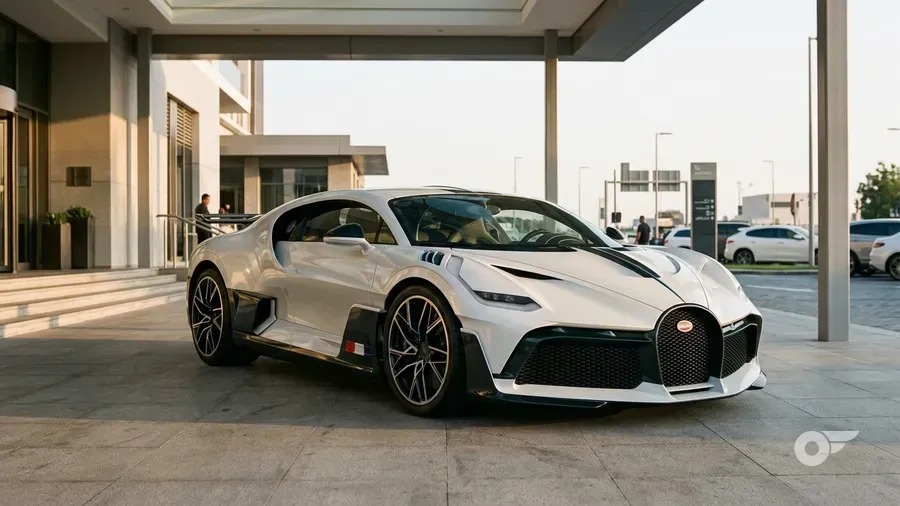
For most of its modern life, Bugatti behaved as though the EB110 had not happened. The 1990s Italian Bugatti was a different company in a different country, built at Campogalliano under Romano Artioli, and Molsheim's official story ran from Ettore's cars straight to the Veyron. The Centodieci is where that changed. Ten cars, eight million euros each, revealed at The Quail in August 2019 on the marque's 110th anniversary, and shaped as a deliberate reading of the EB110 Super Sport: the wedge, the flat surfaces, the five round intakes per side, the glass panel over the engine. Underneath it is a Chiron, but a sharpened one. The W16 makes 1,600 PS rather than 1,500, the car is 20 kg lighter, and top speed is held to 380 km/h. Getting there was not a styling exercise. An EB110-shaped body has far less intake area than a Chiron, so the whole cooling package had to be reworked, and the car covered more than 50,000 km of endurance testing and ran to minus 20C in a climate chamber before the first customer took delivery in June 2022. The tenth and last was handed over that December.

Distinctions

The defining attributes and collector status that make this car garage-worthy.

Octane Files Select
Renowned for its history, engineering, or cultural weight.

Collectibility scorecard

Rated 1 to 10 on the traits that matter for owning, driving, and holding on to a car like this.

Desirability
9/10
Rarity
10/10
Driving thrill
8/10
Investment trajectory
7/10
Usability
4/10
Ease of restoration
2/10
Cultural impact
5/10
Electronic dependence
Fully analogHeavily electronic

Identical in principle to any Chiron-derived car, and therefore at the top of the scale. Four turbochargers, drive-by-wire throttle, direct injection, several engine control units, a seven-speed dual-clutch, electronically apportioned all-wheel drive, stability and traction control and active aerodynamics all have to agree before the car moves at all. The Centodieci adds an electronic dependence of its own: with far less intake area than a Chiron, its cooling package is worked harder and managed more actively, so thermal control is doing constant work behind the styling.

Market data

Demand tier, price trend, and typical values by condition. Our own assessment, not a quoted valuation.

Demand tier
EntrySolidHighBlue-chip

The proven elite. Values are established, liquid, and defended at every auction.

Value trajectory
AppreciatingStableCooling

Values are holding steady. What you pay today is what it's worth tomorrow.

Price by condition
Driver
Excellent
Concours

There is no price band here because no verified sale exists. What is on the record: an eight million euro net list price in 2019, ten cars built, and one public attempt to sell. RM Sotheby's offered a 437 km example in Paris in February 2025 against an estimate of ten to fifteen million euros and it did not sell. Asking prices since have run from about 12.5 million pounds in the UK to 60 million dirhams in Dubai, and those are advertisements rather than transactions, so they are not used here. With ten cars and owners who have no need for liquidity, expect years between public results and treat any single one as thin evidence.

Buyer's guide

What anyone seriously considering this car should know first.

Why it's worth it
The car that made the Italian EB110 part of Bugatti's official story
Callout
Ten cars at eight million euros each, and every one was sold before the first was built
What to watch for
With ten cars in existence, buying one is a matter of access rather than inspection. Every example is known chassis by chassis, and any approach runs through a dealer who specialises at this end of the market or through Molsheim itself. What still needs checking is the documentation, because the value sits there. RM's Paris car came with its original purchase contract, the build specification sheet, TUV paperwork, German registration and factory warranty running to September 2026, and that is the standard to hold a car to. Ask when the warranty expires and whether it can be extended, because out-of-warranty W16 work is priced differently. Ask what servicing has actually happened: the Paris car had never had a service appointment, which is normal for the run and still something to price in rather than admire. Confirm the specification against the build sheet, since a repaint or retrim on a coachbuilt car with unique panels is not a cosmetic decision. And check where the car is registered, because moving one across a border at this value is an expensive exercise of its own.

The Story

Driving character

On the move the Centodieci is a Chiron with the volume up slightly and the mass down slightly, which sounds modest until you use it. The extra 100 PS arrives at 7,000 rpm and the 20 kg comes off everywhere, so the car reaches 100 km/h in 2.4 seconds, 200 in 6.1 and 300 in 13.1, and it is the last of those numbers that reframes the other two. The W16 delivers the way it always has, one seamless and largely silent shove with four turbochargers hiding their own handovers and the seven-speed dual-clutch shifting without event. The limiter arrives at 380 km/h and stays there, which is a fair summary of the car's priorities: this is the show car of the coachbuilt run, not the record car. What it gains over a standard Chiron is a slightly firmer, more urgent feel through the steering, and a cabin where a glass panel puts the W16 on display directly behind your head.

Design

Achim Anscheidt and Nils Sajonz had six months and an awkward brief: make a Chiron look like an EB110 without copying one. The reading is clever rather than literal. The nose drops far lower than a Chiron's, the horseshoe grille is reinterpreted at EB110 proportions, and the slab headlamps of the 1991 car become slim LED units. The roofline and profile are new, the surfaces flattened into planes that catch light in the Bauhaus manner the original used. The signature move is the C-line, reshaped so each flank carries five round cooling ports arranged as a diamond, a direct quotation of the EB110's intakes. Air goes in there, passes over the engine under a glass cover borrowed conceptually from the Italian car, and leaves at the tail. That glass panel is the detail people remember, because it makes the W16 part of the exterior design. The work was done in CAD and virtual reality rather than by the traditional route, which is a quiet irony for a car whose whole argument is a tribute to 1991.

Motorsport pedigree

The Centodieci itself has never turned a competitive wheel and never will. Bugatti runs no racing programme, and a ten-car coachbuilt hyper sports car has no class to enter anywhere in the world. The racing in this story belongs to the car it honours. The EB110 was campaigned in period, and the Italian company built two factory EB110 LM race cars with the V12 lifted to around 660 PS, which ran at Le Mans in 1994 while Campogalliano was already in financial trouble. That effort is part of why the EB110 matters, and part of what the Centodieci is acknowledging. Molsheim's own modern competition life is demonstration rather than competition: cars taken to circuits and hill climbs, historic Bugattis run at speed events, and a serious racing record that belongs entirely to the pre-war company. The Centodieci is a monument to a race car, built by a manufacturer that no longer races, and there is nothing dishonest in that as long as nobody pretends otherwise.

In culture

The Centodieci's cultural weight comes from an act of corporate reconciliation. For years the EB110 sat outside the official Bugatti narrative, an Italian interruption between Molsheim's pre-war cars and Volkswagen's Veyron, and Bugatti's own literature simply skipped over it. Building a ten-car tribute at eight million euros a copy, then publishing a photo essay of a Centodieci parked beside an EB110, settled the argument in the most expensive way available. The reveal itself, at The Quail in August 2019 on the marque's 110th anniversary, was pure modern Bugatti: a car shown to an audience that already owned the last one. Beyond that its public life is small by design. It appears in Bugatti's own films and at concours events, and it has been produced as a LEGO Speed Champions set, which is how most people under fifteen have encountered it. Ten cars in private hands generate very little else, and that scarcity of coverage is itself part of what the buyers were paying for.

Rivals

Cars from other manufacturers that competed for the same buyers when new.

Lamborghini Sián FKP 37

We haven’t profiled this car yet. Request to add

Lamborghini Centenario

We haven’t profiled this car yet. Request to add

Owning One

Why collectors want it

Ten cars is the whole argument, and it is a strong one. Bugatti's coachbuilt run had already established that these cars sell out privately, but the Centodieci compressed the idea into single figures and attached it to the most interesting orphan in the marque's history. There is no internal hierarchy to learn: every car has the same 1,600 PS drivetrain, the same body and the same aerodynamics, so what separates them is colour, trim and story. The final car, in Quartz White over black carbon with light blue leather and matching calipers, delivered on 19 December 2022, carries an obvious extra layer for anyone who cares about last-of-the-line. What the market has not done yet is establish a number. The only Centodieci to reach public auction, a 437 km example offered by RM Sotheby's in Paris in February 2025 against an estimate of ten to fifteen million euros, did not sell. In a ten-car run where nobody has to sell, that is less a verdict on demand than evidence of how rarely one moves at all.

Which one to look for

There are no variants, and that is worth saying plainly because coachbuilt Bugattis usually invite the question. All ten Centodieci are mechanically and aerodynamically identical: 1,600 PS, 1,976 kg, 380 km/h, one body. The variation is entirely colour and trim, chosen car by car with Bugatti's bespoke department, and at this money those differences are worth understanding properly. Two cars are documented well enough to name. The first delivery, in June 2022, opened the run and went to a customer who had ordered from the queue that formed the day the car was shown in 2019. The tenth and final car, handed over on 19 December 2022, was finished in Quartz White with a black carbon lower body, light blue sport leather with symmetrical quilting, and light blue brake calipers and rear wing logo. If you are ranking them, the first and last carry the story, and the rest are ranked by how well the original owner chose.

What owning one is like

Living with a Centodieci means accepting that you own coachwork as much as a car. Mechanically it is a Chiron, which means it is well understood, thoroughly developed and supported by a factory that will send people to you. The body is not a Chiron, and that is where the thinking has to change: the panels, the lights, the glass engine cover and the reshaped C-line exist in ten sets, so a stone chip or a kerbed splitter becomes a conversation with Molsheim rather than a trip to a body shop. Owners behave accordingly. The car offered in Paris in 2025 had covered 437 km in almost three years and had never had a service appointment, which is the norm rather than an outlier. Cars that sit need their fluids, batteries and tyres tracked by date. The rest is administrative: insurance, storage, transport and customs paperwork are permanent features of ownership at this level, and none of them is a reason not to drive the car, only a reason to plan the drive.

Upkeep & parts

The drivetrain is the easy part. It is the same W16 and dual-clutch Molsheim has been servicing since 2016, with a scheduled annual service regardless of mileage and a heavier interval every four years, and Bugatti's service network reaches the car rather than the other way around. Budgeting is predictable within the usual hyper sports car brackets, and the factory warranty on these cars ran into 2026, so several are only now coming out of cover. What is not predictable is bodywork. Every exterior panel on a Centodieci is unique to ten cars and Bugatti's bespoke department is the only source, which means lead times measured in months and prices quoted rather than listed. The same applies to the glass over the engine and to interior leather specified once, years ago, and now needing a match. The sane approach is prevention: covered transport, a controlled space, paint protection applied properly, and enough regular use to keep the car exercised without exposing it to car parks.

Country of origin
France
Class
Exotic
Production years
2022–2022
Units built
10
Model
Centodieci
Nickname
No nickname
Body
Coupe
Layout
Mid-engine, AWD
Engine
8.0-litre quad-turbocharged W16, 1,600 PS (1,578 hp) at 7,000 rpm
Transmission
7-speed dual-clutch automatic
Designer
Achim Anscheidt (design direction), Nils Sajonz