Octane Files
Explore CarsToyota Celica GT-Four ST205

Toyota Celica GT-Four ST205

Overview

The ST205 is the most developed Celica GT-Four and the least successful, and those two facts are connected only by accident. It arrived in February 1994 on the new T200 shell: 255 PS in Japan, Super Strut front suspension, four-channel anti-lock brakes, a larger turbocharger, and on the homologation cars a water spray bar for the intercooler, water injection and the plumbing for an anti-lag system. Toyota built 2,500 of those during 1994 to satisfy Group A and kept 2,100 of them in Japan.

Then 1995 happened. The car won once, on the Tour de Corse in May. At Rally Catalunya in October, scrutineers took the turbo restrictor apart and found it could be bypassed. At an extraordinary World Motor Sport Council on 3 November, Toyota Team Europe was excluded from the championship, every driver point was taken back, and the team was banned for twelve months.

Toyota returned in 1997 with a Corolla. The works Celica never rallied again. What remained was a road car that stayed on sale in Japan until June 1999 and a reputation nobody has managed to settle in the thirty years since.

Distinctions

The defining attributes and collector status that make this car garage-worthy.

Homologation Special
Built for the road only because racing rules demanded it.
Poster Car
The car on the bedroom wall, the one people dreamed about before they could drive.
Octane Files Select
Renowned for its history, engineering, or cultural weight.

Collectibility scorecard

Rated 1 to 10 on the traits that matter for owning, driving, and holding on to a car like this.

Desirability
8/10
Rarity
7/10
Driving thrill
7/10
Investment trajectory
8/10
Usability
5/10
Ease of restoration
3/10
Cultural impact
8/10
Electronic dependence
Fully analogHeavily electronic

This is the step up, and it is a real one. The ST205 adds a computer-managed centre differential, four-channel anti-lock brakes with a G-sensor, and on the homologation cars the plumbing and control hardware for an anti-lag system and an intercooler water spray, all on top of the electronic fuel injection and ignition management the family has always had. That is a meaningful amount of decision-making handed to a computer for a car of 1994. What holds it below the top of the scale is everything the driver actually touches: a cable throttle, hydraulically assisted steering, a mechanical handbrake, and the complete absence of traction control or any stability system.

Market data

Demand tier, price trend, and typical values by condition. Our own assessment, not a quoted valuation.

Demand tier
EntrySolidHighBlue-chip

A dependable market. Well-kept cars hold their value and find ready buyers.

Value trajectory
AppreciatingStableCooling

Values are climbing. The market wants more of these than exist.

Price by condition
Driver
$14k
Excellent
$26k
Concours
$45k

The widest spread of any car in this family, and it is a paperwork market rather than a rarity one, because Toyota has never published a GT-Four production total. Tracked sixth-generation four-wheel-drive sales run from $5,625 in August 2022 to $31,250 for a 1994 car in June 2026. Above that, documented cars have been reported clearing $50,000, and British specialists quote up to £50,000 for exceptional low-mileage WRC Editions while ordinary UK cars sit at £7,000 to £10,000. The band below describes an honest imported ST205 in sorted condition with a maintained Super Strut front end. A verified WRC Edition with the water injection and anti-lag hardware intact belongs well above it, and a car with a neglected front end belongs below it by roughly the cost of the parts.

Values as of August 2026.

Buyer's guide

What anyone seriously considering this car should know first.

Why it's worth it
The most developed GT-Four, and the one that ended Toyota's works rally Celica
Callout
Its homologation cars left the factory with intercooler water spray, water injection and anti-lag plumbing
What to watch for
Two questions decide the price. Is it a WRC Edition, and has the Super Strut front end been looked after? The 2,500 homologation cars, all built during 1994, carry the hardware Toyota Team Europe needed made legal: a water spray bar for the intercooler, water injection, and the plumbing and control gear for an anti-lag system. Later cars, sold in Japan through to June 1999, do not. A badge is not proof. The hardware and the paperwork are. Super Strut is a multi-link front suspension rather than a MacPherson strut, and it is the single largest predictable bill on the car. More parts, all of them wearing, most of them scarce and expensive. A knock over bumps, uneven front tyre wear or vague steering means a four-figure job. A car converted to conventional struts is not ruined, but know which one you are buying and pay accordingly. Then the usual two. The Celica floor pan rots under the factory sound deadener, so lift the carpet before you look at the paint. And the 3S-GTE punishes detonation and overheating, so ask for cooling and turbo history in writing. A large share of survivors have been modified by somebody.

The Story

Driving character

The ST205 is the GT-Four at its most capable and its least playful. Two hundred and fifty-five PS in Japanese tune, Super Strut front suspension holding the front tyres upright under load, a Torsen at the back, four-channel anti-lock brakes and roughly 1,390kg of car mean the limits are high and a long way from where a public road will let you find them. The engine is the same character as before with more of it. Little happens below 3,000rpm, then the larger turbo arrives with real force and the car simply leaves, flat and hard and mostly turbo noise. The effort comes and goes quickly. It is a rally engine's power curve rather than a road engine's, and it always was. What Super Strut adds is steering. The front end resists the geometry change that makes an ordinary strut car go vague under cornering load, so the ST205 turns in with a directness the ST185 does not have and holds a line without needing correction. The cost of that shows up on an invoice rather than in the driving. The gearbox is the same short, ordinary, entirely dependable five-speed the family has always had.

Design

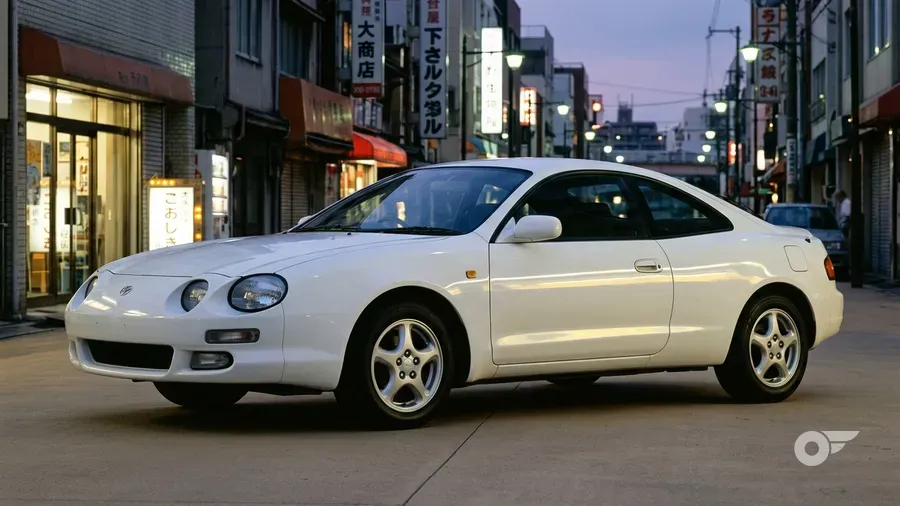
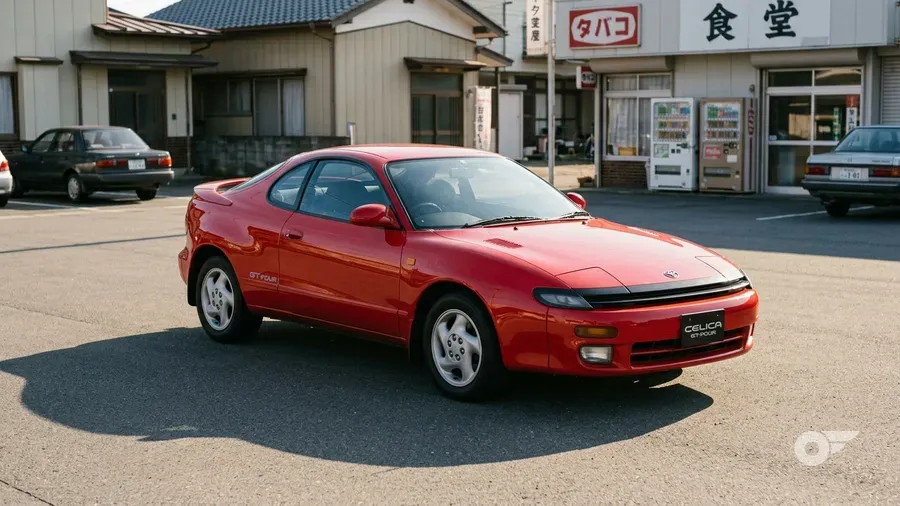
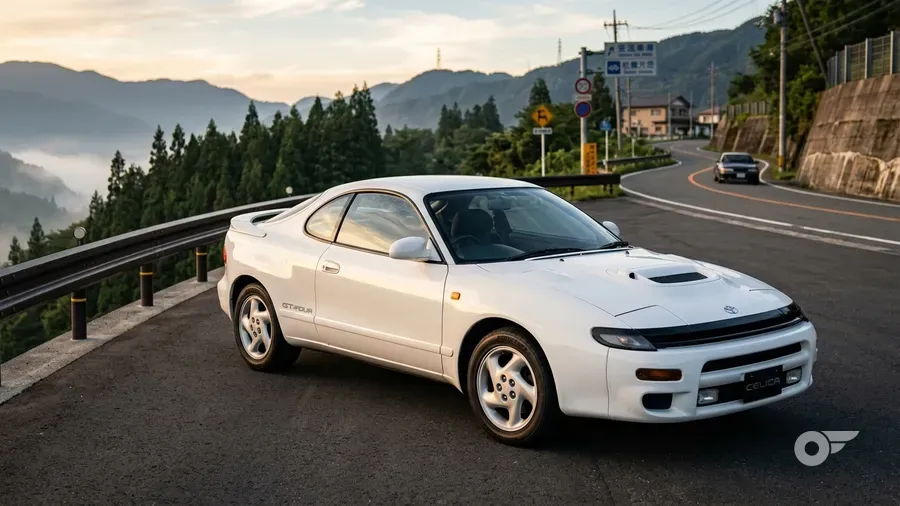
The T200 body is Takashi Okuda's work, and it is the most divisive shape Toyota ever gave the Celica: no straight lines anywhere, four separate round headlamps let into a single curved nose. The GT-Four version widens it, and every addition has a job. The bonnet carries a raised intake and vents for the intercooler. The front bumper opens up. There is a large rear wing, wider arches, and on the homologation cars a water spray arrangement a casual observer would miss entirely. The bonnet itself is aluminium, which Toyota did not advertise loudly and which is exactly the sort of decision a homologation programme forces on a production line. The wheels sit further out than on any front-drive T200 and the stance is what gives the car away from a distance. Inside there is very little theatre: a boost gauge, different seats, and a cabin otherwise shared with a Celica that cost half as much. It is a serious-looking car in a way the ST165 never was, and it had earned the look before it lost the right to use it.

Motorsport pedigree

Toyota Team Europe introduced the ST205 late in 1994 and went into the 1995 season with Juha Kankkunen, Didier Auriol and Armin Schwarz. On paper it was the strongest rally Celica yet: a twin-entry CT20B turbo, 299 bhp at 5,600rpm, 500 Nm, a six-speed gearbox no customer could buy, and 1,200kg. It won once. Auriol took the Tour de Corse from 3 to 5 May 1995. Six months later, at Rally Catalunya on 23 October, scrutineers dismantled the turbo restrictor and found an arrangement that let the engine draw air around it. The World Motor Sport Council excluded the team from the championship on 3 November, removed every driver point, and banned it for twelve months. The full technical account of the device belongs to the Celica T200 page, which carries it. What gets told less often is what happened afterwards. Privateer ST205s kept running in the 1996 and 1997 World Rally Championship seasons, and the car won the 1996 European Rally Championship, which is the only title it ever took and the only line in its record that is nobody's asterisk. When Toyota's works team returned in 1997 it came back with a Corolla, and the rally Celica was finished.

In culture

The ST205 is better known as an arcade cabinet than as a car. Sega put it into Sega Rally Championship in January 1995, in Castrol colours, months before it won anything and nine months before the FIA took its restrictor apart, and for a generation of players that white Celica simply was the rally car. That story belongs properly to the Celica T200 page. What belongs here is the consequence: the road car is recognised by an enormous number of people who have never seen one in the metal. The scandal has had the stranger afterlife. Rather than reading as cheating, the restrictor gets retold as an engineering party piece, admired for its ingenuity by people who would not defend it for a second. Toyota's own corporate history is quieter about it, moving from 1994 to 1997 without lingering. What the road car has instead is a specialist following. Tuners and importers in Britain, Australia and New Zealand have kept ST205s running for thirty years, and a documented WRC Edition now draws the kind of attention a 1990s Toyota was never designed to attract.

Owning One

Why collectors want it

Nobody buys an ST205 by accident. It is the last works-engineered rally Celica, the only one with Super Strut front suspension, and the only Toyota road car attached to a genuine scandal, which is a strange thing to be worth money and undeniably is.

The hierarchy is the widest in the family. At the bottom, a tired import with no history is used-hatchback money, and recorded sales start at $5,625 in August 2022. At the top, a documented low-mileage WRC Edition clears $50,000 and British specialists quote as much as £50,000 for the best of them, while ordinary UK cars sit at £7,000 to £10,000. In between, a 1994 car took $31,250 in June 2026.

That spread is not irrational. It is what happens when 2,500 genuinely special cars and an unknown number of ordinary ones share a badge, and no production total exists to tell them apart in aggregate. What you are really buying is condition and paperwork. An unmodified ST205 with cooling history, an honest floor pan and a Super Strut front end that has been maintained rather than ignored is the scarce object here.

Around 10,469 ST205s were built between February 1994 and June 1999. That number matters because a much smaller one gets quoted in its place: the 2,500 WRC homologation cars, of which 2,100 stayed in Japan, are a batch within the generation and not the generation itself. The ST205 sold as an ordinary catalogue model for five years beyond that run.

Which one to look for

There is one model and one edition, and the edition is what people mean. The GT-Four WRC Edition, 2,500 cars all built during 1994, is the Group A homologation batch: 2,100 to Japan, 300 to Europe, 77 to Australia and 5 to New Zealand. What it adds over a standard ST205 is not trim. It is a water spray bar for the intercooler, water injection, and the plumbing and control hardware for an anti-lag system, fitted so that the rally car could legally use them. The standard car is the one that kept selling in Japan until June 1999: 255 PS at home, 242 PS in export tune, Super Strut front suspension, four-channel anti-lock brakes and a Torsen rear differential as standard equipment rather than an option. Europe took only 300 of the homologation cars and Britain a share of those, which is why a genuine right-hand-drive WRC Edition with UK history is a car people go looking for rather than one they come across. There is no automatic. Every GT-Four ever built is a five-speed manual, and the ST205's is the E154F.

GT-Four · 1994–1999

The standard car, on sale from February 1994 and continuing in Japan until June 1999. 255 PS in Japan and 242 PS in export tune from the updated 3S-GTE, Super Strut front suspension, four-channel anti-lock brakes, a Torsen rear differential as standard and the five-speed E154F manual.

GT-Four WRC Edition · 1994

The Group A homologation model, 2,500 cars all built during 1994. Adds a water spray bar for the intercooler, water injection, and the plumbing and control hardware for an anti-lag system, none of which the later cars have. The hardware and the paperwork identify it, not the badge.
What owning one is like

Three things decide what an ST205 costs to own, and only one of them is the engine. Super Strut is the first. The multi-link front suspension is a real advantage on the road and a real liability on an invoice: more components than a MacPherson strut, all of them wearing, most of them scarce and expensive thirty years on. A neglected front end is the most common reason a good-looking ST205 drives badly. The bodyshell is the second. The factory sound deadener holds water against the floor pan and rots it from the inside, so the first sign is a damp carpet rather than a blister in the paint, and from there it works into the sills, the arches and the strut tower seams. Imported cars need the underside inspected rather than assumed. The engine is the third and the most manageable. The 3S-GTE is a strong unit with a known weakness for head gasket and rod bearing trouble if it has been overheated or boosted beyond standard without proper fuelling. Cooling system honesty matters more than power on a turbocharged car of this age, and a large share of survivors have been modified by somebody.

Upkeep & parts

Service parts are the easy half. The 3S family went into Camrys, Coronas, MR2s and Caldinas by the million, so filters, belts, water pumps, clutches and brake parts are ordinary counter stock, and the timing belt is a scheduled job rather than an unknown. Treat the cooling system as the car's most important service item and budget for it rather than reacting to it.

The hard half is everything specific to this car. Super Strut arms and links are the biggest predictable bill and there is no cheap version. GT-Four transfer cases, centre differentials and driveshafts are not shared with anything ordinary. Body panels, the four round headlamp units and interior trim are getting difficult to find undamaged, and Toyota supplies none of it.

The community carries the knowledge. gtfour.supras.org.nz holds the standing technical reference on Super Strut specifically, alltrac.net and gtfours.co.uk cover the drivetrain in more depth than a workshop manual, and GT4DC exists in Britain for owners of exactly this car. The specialist trade in Britain, Australia and New Zealand is well established and used to shipping parts internationally, which matters more on this car than on either of its predecessors.

Country of origin
Japan
Class
Sports
Production years
1994–1999
Units built
~10,469
Model
Celica GT-Four
Nickname
No nickname ("WRC Edition" names the 2,500-car homologation model specifically, not the generation)
Body
Liftback
Layout
Front-engine, AWD
Engine
2.0L 3S-GTE turbocharged DOHC 16-valve I4, 255 PS in Japan and 242 PS in export tune
Transmission
5-speed E154F manual
Designer
Takashi Okuda (Calty Design Research)