Octane Files
Explore CarsToyota Celica GT-Four ST185

Toyota Celica GT-Four ST185

Overview

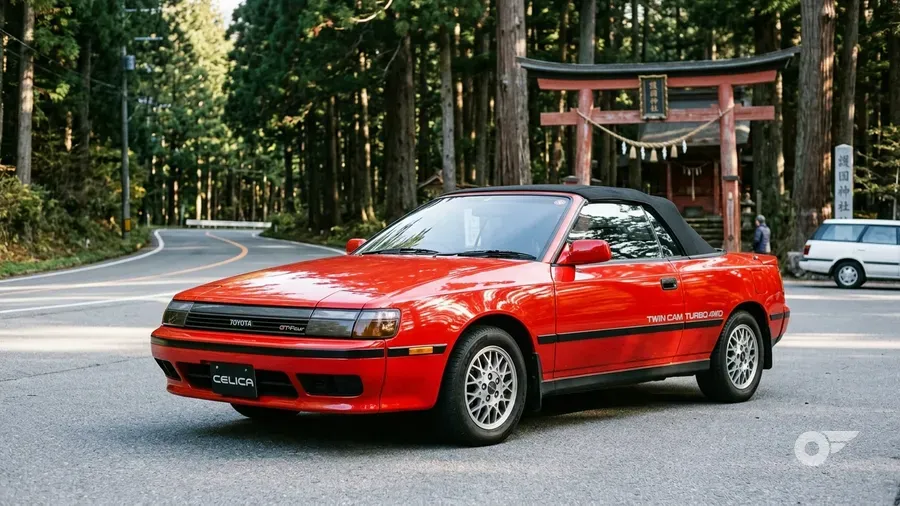
September 1989, and Toyota did the GT-Four properly the second time. The ST185 arrived on the new T180 Celica shell with the same turbocharged 3S-GTE and the same full-time four-wheel drive, but with 225 PS in Japan instead of 185 and a wide-bodied chassis built from the start to carry it.

It is the one that won everything. Between 1992 and 1994 the ST185 took three drivers' championships in a row, Carlos Sainz, Juha Kankkunen and Didier Auriol, and two manufacturers' titles. The 1993 one made Toyota the first manufacturer from outside Europe to win the World Rally Championship since the series began in 1973.

The road car exists because of a rule. Group A demanded 5,000 examples, so from August 1991 Toyota built exactly that number of a homologation model: the GT-Four RC in Japan, the Carlos Sainz Limited Edition in Europe, the Group A Rallye in Australia and New Zealand. What separated them from an ordinary GT-Four was a water-to-air intercooler, and Toyota Team Europe asked for it because it was easier to develop than the standard unit.

Everything Toyota ever needed from a Celica, it got from this one.

Distinctions

The defining attributes and collector status that make this car garage-worthy.

Homologation Special
Built for the road only because racing rules demanded it.
Poster Car
The car on the bedroom wall, the one people dreamed about before they could drive.
Octane Files Select
Renowned for its history, engineering, or cultural weight.

Collectibility scorecard

Rated 1 to 10 on the traits that matter for owning, driving, and holding on to a car like this.

Desirability
8/10
Rarity
6/10
Driving thrill
7/10
Investment trajectory
8/10
Usability
6/10
Ease of restoration
4/10
Cultural impact
8/10
Electronic dependence
Fully analogHeavily electronic

The same architecture as the first GT-Four and more of it. The 3S-GTE runs Toyota's own electronic fuel injection and ignition management with a knock sensor, which is what allows 225 PS from two litres with a factory warranty in 1989, and anti-lock brakes were on the options list. Nothing else on the car is electronic. The throttle is a cable, the steering is hydraulically assisted, the centre differential is a viscous coupling making up its own mind with no computer involved, many cars add a mechanical Torsen at the rear, and there is no traction control and no stability system anywhere in the range.

Market data

Demand tier, price trend, and typical values by condition. Our own assessment, not a quoted valuation.

Demand tier
EntrySolidHighBlue-chip

A dependable market. Well-kept cars hold their value and find ready buyers.

Value trajectory
AppreciatingStableCooling

Values are climbing. The market wants more of these than exist.

Price by condition
Driver
$12k
Excellent
$22k
Concours
$38k

No production total exists for this car, so the market prices condition and paperwork rather than rarity. Tracked fifth-generation four-wheel-drive sales average $23,830, running from $4,275 for a 1991 car in March 2026 up through the twenties for a sorted one. In Britain the specialist press puts a Carlos Sainz Limited Edition with reasonable mileage at £15,000 to £20,000. One recorded $112,500 result in February 2025 is an ex-works rally car and has nothing to do with what a road car is worth; it is excluded from the band below, as is homologation-special money generally. The band describes an ordinary imported GT-Four in sorted condition, which is what most buyers will actually be looking at, and the RC and Sainz cars sit clearly above it.

Values as of August 2026.

Buyer's guide

What anyone seriously considering this car should know first.

Why it's worth it
Three drivers' titles and two manufacturers' titles in three seasons
Callout
5,000 homologation cars, split 1,800 to Japan, 3,000 to Europe, 150 to Australia and 25 to Singapore
What to watch for
Work out first whether you are looking at a homologation car or an ordinary one, because the badge is not proof. An RC or Carlos Sainz car has the water-to-air intercooler, no sunroof, and a deliberately plain specification, because its job was to be legal rather than to be pleasant. Ordinary GT-Fours run the air-to-air intercooler and got the comfort equipment instead. Both are good cars. Only one is the car people mean, and only paperwork settles which you have. Then the shell, from the inside out. The Celica floor pan rots under the factory sound deadener, which holds water against the metal and gives you a damp carpet long before a bubble in the paint. Lift it before you look at anything else. Then the sills, the arches, the strut tower seams, and on a Japanese import the whole underside. Then the engine, with a specialist. The 3S-GTE is strong and unforgiving of detonation and overheating, and a car chipped or boosted without care can be sitting on a tired head gasket or worn rod bearings. Ask for cooling and turbo history in writing, and treat an unmodified car as the rare object it has become.

The Story

Driving character

The step from the first GT-Four to this one is not subtle. Forty more PS in Japanese tune, a stiffer wide-bodied shell and four seasons of Toyota Team Europe's homework produce a car that feels engineered rather than adapted. The 3S-GTE still does its work in one movement. Very little happens below 3,000rpm, then the boost arrives in a lump and the car goes, hard and flat and slightly monotone, all the way to the limiter. It is not a musical engine. It is an effective one, and most of what you hear is turbo and induction rather than exhaust. What you notice on a road is how little it asks of you. Full-time four-wheel drive through a viscous centre coupling, a Torsen at the back on many cars, and a chassis with a wide margin built into it mean it grips, understeers gently when it finally runs out, and never does anything sudden. In the wet it flatters everybody. On a dry mountain road it is fast without being lively, which is the honest trade a Group A homologation car makes. The gearchange is short and completely unremarkable, which from a Toyota of this period is a compliment.

Design

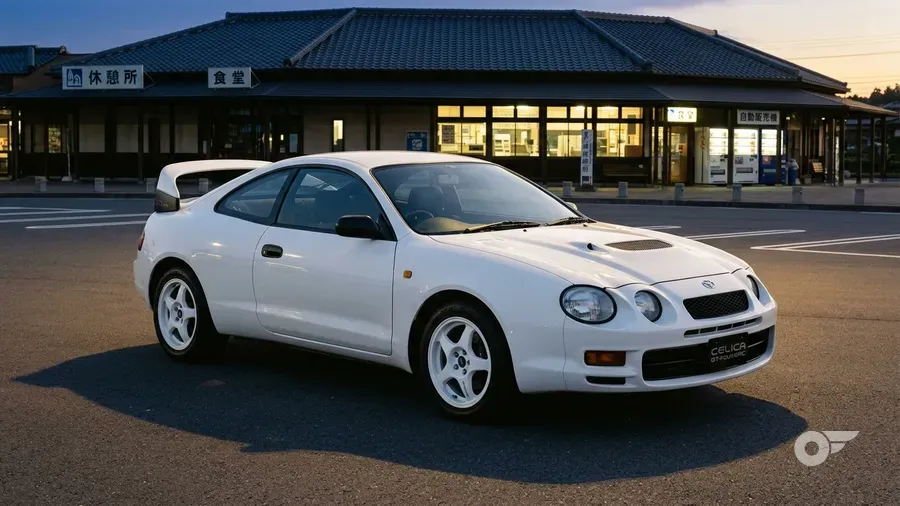
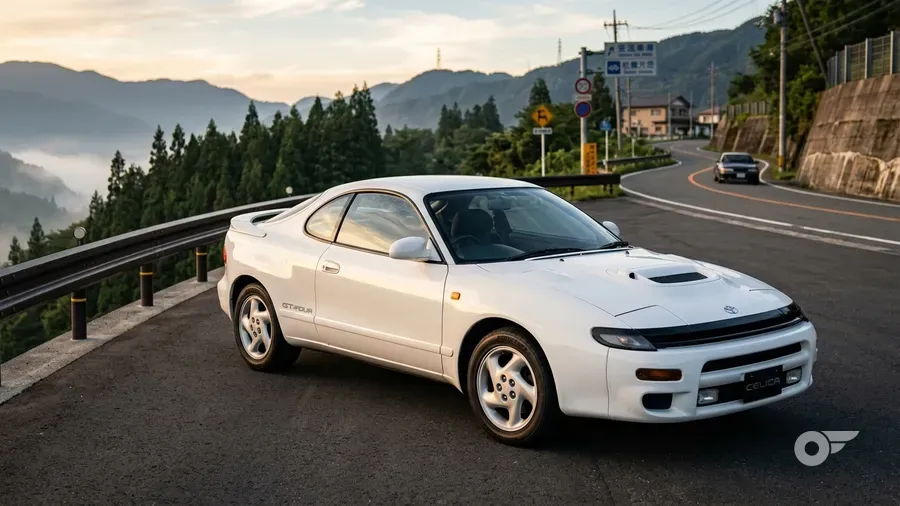
Toyota called the T180 shape Super Round and made an engineering argument for it: continuous curvature, no straight edges, panels stiffened by their own form. The GT-Four takes that body and adds what a rally car needs, which is why it looks more serious than the ST165 ever did. The wide body is the main change. Flared arches front and rear, shared with the front-drive GT-S, put the wheels where a rally car wants them. A bonnet scoop feeds the intercooler, the front bumper opens up, and most cars carry a rear spoiler. The pop-up headlamps are worth noticing because this is the last Celica generation to have them. On the homologation cars the differences are functional and slightly austere. The RC and Carlos Sainz cars carry the bonnet arrangement for the water-to-air intercooler, no sunroof, and a specification stripped of anything that adds weight without adding speed. In Europe those cars were sold under a driver's name, which is a piece of marketing Toyota has rarely repeated and which tells you how much the rally programme mattered to the company in 1991.

Motorsport pedigree

The competition car and the road car are closer here than the badge suggests, and the influence ran in the direction people do not expect. The water-to-air intercooler on the 5,000 homologation cars is there because Toyota Team Europe wanted it, on the grounds that it was easier to develop than the air-to-air unit the ordinary GT-Four used. TTE then built on it a rally car making 295 bhp at 5,700rpm and 459 Nm through a twin-entry CT26 turbo, none of which any customer could buy. The results ran three deep. Carlos Sainz took the drivers' championship in 1992, the year the car debuted at Monte Carlo and won first on the Safari in April. Juha Kankkunen took the title in 1993 along with Toyota's first manufacturers' championship, clinched at Rally Australia. Didier Auriol took both again in 1994. The ST185 won 16 world championship rallies in all. Two things are worth holding on to. The 1993 makers' title was the first won by a manufacturer from outside Europe since the championship began in 1973. And the 1994 double is the last clean season Toyota's works rally Celica ever had, which is a sentence the ST205's page has to finish.

In culture

The image this car left behind is a livery. Castrol white with the green and red flash, wide arches, headlamps taped, mud to the door handles: for anyone who watched rallying between 1992 and 1994 that is what a Toyota looks like, and it is why the road car sells partly on association with something most owners never saw in person. Britain got a specific version of the story. Roughly 440 Carlos Sainz cars came here. They were expensive when new, cheap for twenty years afterwards, and the enthusiast press has been running rediscovery pieces on them since values started moving, with sorted examples now quoted at £15,000 to £20,000. Toyota's own UK media site still keeps a dedicated ST185 page, which it does not do for most thirty-year-old models. North America met the car twice, under two names. Toyota sold the four-wheel-drive Celica there as the All-Trac Turbo rather than the GT-Four, and then stopped selling it at all. Since the mid-2010s the 25-year import rule has been quietly delivering right-hand-drive Japanese cars into the same market, wearing the badge the rally car actually raced under.

Rivals

Cars from other manufacturers that competed for the same buyers when new.
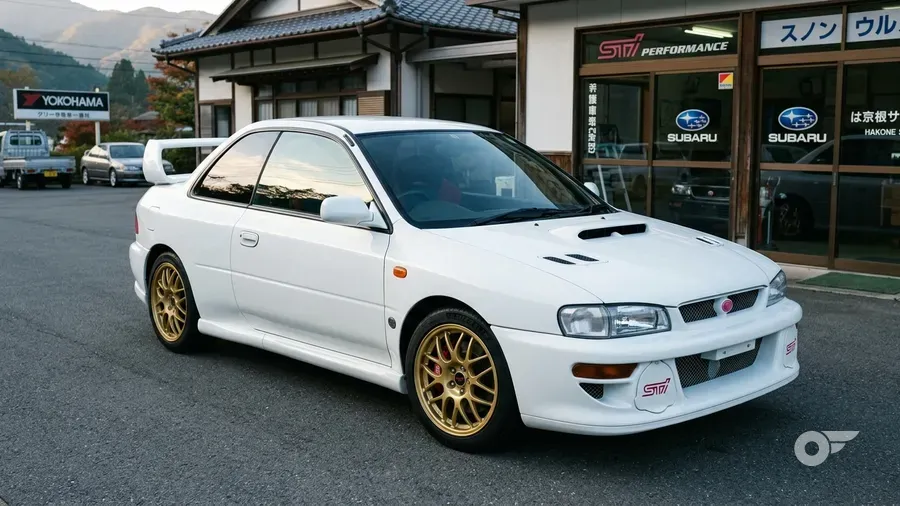
Subaru Impreza WRX STI GC8

Subaru Impreza WRX STI GC8

Japan·Sports·1992–2000
Mitsubishi Lancer Evolution I

Mitsubishi Lancer Evolution I

Japan·Sports·1992–1994
Lancia Delta HF

Lancia Delta HF

Italy·Sports·1986–1994

Ford Escort RS Cosworth

We haven’t profiled this car yet. Request to add
Mitsubishi Lancer Evolution II

Mitsubishi Lancer Evolution II

Japan·Sports·1994–1995

Mitsubishi Galant VR-4

We haven’t profiled this car yet. Request to add

Owning One

Why collectors want it

Four world championships in three seasons is a record no other Toyota road car can point at, and unusually for a homologation story it is legible in the car you can actually buy. The 5,000 RC and Carlos Sainz cars were built in a six-month window between August 1991 and February 1992, they carry a water-to-air intercooler the ordinary car does not, and Toyota split them 1,800 to Japan, 3,000 to Europe, 150 to Australia and 25 to Singapore. Around 440 of the European cars came to Britain.

That is the top of the market and it behaves like one. Below it, an ordinary imported GT-Four is still cheap. Tracked fifth-generation four-wheel-drive sales average $23,830 and cars still turn up in the four to eight thousand range, which is hot-hatch money for a car with four world titles behind it.

The thing to understand is that scarcity is not the argument here, because Toyota has never published how many GT-Fours it built. What is scarce is an unmodified one with cooling history and a floor pan that has not rotted from underneath, and that is what the money is chasing.

Production figures for the ST185 are genuinely contested. The most detailed account puts it around 21,000 cars between October 1989 and August 1993, while other sources say closer to 15,000, and no factory figure exists to settle it. What is not in doubt is the 5,000-car GT-Four RC, sold as the Carlos Sainz Limited Edition in Europe, which is a batch inside that run rather than a separate model.

Which one to look for

One car, three homologation names, and a market split worth memorising. Between August 1991 and February 1992 Toyota built 5,000 cars to satisfy Group A: the GT-Four RC in Japan, the Carlos Sainz Limited Edition in Europe and Singapore, and the Group A Rallye in Australia and New Zealand. The allocation ran 1,800 to Japan, 3,000 to Europe, 150 to Australia and 25 to Singapore, and roughly 440 of the European cars reached Britain. They all share the water-to-air intercooler, and that is the entire point of them. Below that sits the standard GT-Four, which is the better road car and the less interesting one: air-to-air intercooler, more equipment, sunroofs and leather available, 225 PS in Japan and 200 horsepower in export tune. North America bought it as the Celica All-Trac Turbo again. There is no automatic anywhere. Every GT-Four Toyota built, in all three generations, is a five-speed manual. If you are buying to drive, the ordinary Japanese-market car is the value. If you are buying the story, it has to be an RC or a Sainz, and the paperwork matters as much as the metal.

All-Trac Turbo · 1990–1993

The North American version, sold as the Celica All-Trac Turbo rather than the GT-Four, with the export 200-horsepower tune. Toyota kept the All-Trac name it had used on the previous generation, which is why the model's American following and its rally record are filed under different names.

Carlos Sainz Limited Edition · 1991–1992

The European and Singapore name for the same homologation model, sold under the name of the driver who had won Toyota its first world title. 3,000 cars went to Europe and 25 to Singapore, and roughly 440 of the European allocation came to the United Kingdom.

Group A Rallye · 1991–1992

The Australian and New Zealand name for the homologation model. 150 cars went to Australia, making it the rarest of the three names by a wide margin.

GT-Four · 1989–1993

The standard car, on sale from September 1989 with the 2.0-litre 3S-GTE rated at 225 PS in Japan and 200 horsepower in export tune. Air-to-air intercooler, viscous-coupling centre differential, wide body shared with the front-drive GT-S, and a five-speed manual. Sunroofs and leather were available.

GT-Four RC · 1991–1992

The Japanese name for the Group A homologation model. A water-to-air intercooler in place of the standard air-to-air unit, requested by Toyota Team Europe because it was easier to develop, and a deliberately plain specification with no sunroof. 1,800 of the 5,000-car batch went to Japan.
What owning one is like

Two problems dominate and both are manageable if you go in knowing about them. The first is the bodyshell, and it is the reason so few good ones are left. The factory sound deadener holds water against the floor pan and rots it from the inside, so the first symptom is a damp carpet rather than a blister in the paint. From there it works outward into the sills, the rear arches and the strut tower seams. Japanese imports arrive with an underside that has spent thirty years in a climate nobody photographed. The second is the engine's tolerance for enthusiasm. The 3S-GTE is a strong unit with a known weakness for head gasket and rod bearing trouble if it has been overheated, run lean or boosted beyond standard without proper fuelling. Cooling system honesty matters more than power on a turbocharged car of this age, and a large share of survivors have been modified by somebody. After that it is the ordinary tax of a 1980s Japanese coupe. Pop-up headlamp motors wear, interior plastics have gone brittle, and Celica-specific trim that nobody expected to need is what turns a running project into a stalled one.

Upkeep & parts

The mechanical side is cheap, which surprises people. The 3S family went into Camrys, Coronas, MR2s and Caldinas by the million, so filters, belts, water pumps, clutches and brake parts are ordinary counter stock. The timing belt is a rubber one, so a car with no belt history has a job already queued rather than an unknown. Budget for the cooling system properly and treat it as the car's most important service item rather than its least interesting.

What costs money is everything specific to this car. GT-Four transfer cases, centre differentials and driveshafts are not Camry parts, body panels and lamps are getting hard to find undamaged, and the trim is gone from Toyota entirely.

The community is where those parts actually live. Alltrac.net covers the four-wheel-drive Celicas in more depth than any workshop manual, gtfours.co.uk is the standing technical reference, and GT4DC in Britain exists for owners of exactly this car. Celica-Club UK covers the model more broadly. Join one before you buy rather than after, because the useful knowledge on which import to take on is held by people rather than published.

Country of origin
Japan
Class
Sports
Production years
1989–1993
Units built
~21,000
Model
Celica GT-Four
Nickname
No nickname ("Carlos Sainz Limited Edition" names the 5,000-car homologation model specifically, not the generation)
Body
Liftback
Layout
Front-engine, AWD
Engine
2.0L 3S-GTE turbocharged DOHC 16-valve I4, 225 PS in Japan and 200 hp in export tune
Transmission
5-speed E150F manual, 5-speed E151F manual, 5-speed E152F manual
Designer
Calty Design Research