Octane Files
Explore CarsPorsche 911 G-Series

Porsche 911 G-Series

Overview

American bumper law wrote the first draft of this car. From August 1973 the 911 wore telescopic bumpers with concertina bellows at each end, able to absorb an 8 km/h impact without damaging the body, and Anatole Lapine's studio integrated them so completely that the face went unchanged for fifteen years. What sits behind them is not one car but four. The 2.7-litre cars of 1974 to 1977 are the lean-running, hot-running ones. The 911 SC of 1978 to 1983 is the tough one: 3.0 litres, a galvanised body, and an engine built to be used. The Carrera 3.2 of 1984 to 1989 is the developed one, with Bosch engine management and, from 1987, the Getrag G50 gearbox that finally made the shift good. Running alongside from 1975 is the 930 Turbo. The 911 also gained its first Cabriolet in 1983, and it outlived the 928 that was meant to make it unnecessary. Porsche built 196,397 G-Series cars across sixteen model years, more than any other 911 generation, and for most of that time nobody thought much of them.

Distinctions

The defining attributes and collector status that make this car garage-worthy.

Legend
A car that transcended the hobby, known far beyond the people who drive them.
Poster Car
The car on the bedroom wall, the one people dreamed about before they could drive.
Octane Files Select
Renowned for its history, engineering, or cultural weight.

Collectibility scorecard

Rated 1 to 10 on the traits that matter for owning, driving, and holding on to a car like this.

Desirability
7/10
Rarity
3/10
Driving thrill
7/10
Investment trajectory
8/10
Usability
7/10
Ease of restoration
7/10
Cultural impact
8/10
Electronic dependence
Fully analogHeavily electronic

The generation crosses a real line. The 2.7 and the SC run Bosch K-Jetronic, a continuously flowing mechanical injection system metered by a fuel-distributor plate rather than by a computer, with an electric pump and breakerless ignition behind it. From 1984 the Carrera 3.2 runs Bosch Motronic, a genuine engine management computer deciding fuelling and ignition together, with an oxygen sensor in emissions markets. Everything else stays mechanical throughout: unassisted steering, a cable throttle, no anti-lock brakes, no traction control, and nothing on the car that can be adjusted from the cabin.

Market data

Demand tier, price trend, and typical values by condition. Our own assessment, not a quoted valuation.

Demand tier
EntrySolidHighBlue-chip

Strong, sustained collector demand. Good examples never wait long for a buyer.

Value trajectory
AppreciatingStableCooling

Values are climbing. The market wants more of these than exist.

Price by condition
Driver
$45k
Excellent
$85k
Concours
$140k

The cheap 911 for thirty years, and no longer. Tracked sale averages sit near $61,000 for a 911 SC coupe, with Carrera 3.2 coupes averaging well above that and the 1987-89 G50 cars leading the normal range. The 930 Turbo, the Club Sport, the SC/RS and the 1989 Speedster each trade in their own market and are excluded from the band below, as are 2.7 cars needing engine work.

Values as of August 2026.

Buyer's guide

What anyone seriously considering this car should know first.

Why it's worth it
The 911 that outlived its own intended replacement, and gave the world the 930 Turbo
Callout
Sixteen model years and 196,397 cars, the longest run of any 911 generation
What to watch for
Work out which of the four cars you are looking at before anything else, because they need different questions. A 1974-77 2.7 needs its cylinder-head studs inspected, since the lean emissions engines ran hot and steel studs pull out of a magnesium crankcase. Porsche's answer was the Dilavar stud, in production engines from 1977 and improved again for the 1980 SC, and case savers are routine in any rebuild. An SC or an early Carrera 3.2 needs its chain tensioners checked, and if they are the original items, budget for the pressure-fed Carrera conversion. Any pre-1987 car has the Type 915 gearbox, whose second-gear synchro wears and whose shift goes vague when tired; the G50 from 1987 is stronger and better and worth the premium asked for it. Rust is a smaller story here than on a longhood but not a non-story, because galvanising protects panels rather than seams: check the sunroof drains, the screen surround, the front of the floorpan and the battery area. On paperwork, the market now cares whether the engine is original to the car, and whether a wide Turbo-look body was fitted in Zuffenhausen or afterwards.

The Story

Driving character

An SC or a 3.2 Carrera feels like a tool rather than an heirloom, and that is the appeal. The steering is unassisted and still light, because there is nothing over the front wheels. The pedals are floor-hinged and offset to the left. The driving position asks you to sit closer to the wheel than feels natural, and then stops feeling odd after an hour. Power arrives in a long, even, faintly gruff swell rather than a rush: 204 PS in a late SC or 231 in a European 3.2 is modest arithmetic now, but the car weighs around 1,200kg and pulls cleanly from 2,000rpm to the limiter. The noise is the reward, a hard flat-six thrash laid over fan whine that improves the harder you work. The gearbox is the great divide. A tired 915 turns second gear into a negotiation and has put more people off this generation than any other single thing; a G50 car shifts with weight and precision and changes the whole character. Lift-off oversteer is real but not the trap folklore claims, at least until you are in a 930.

Design

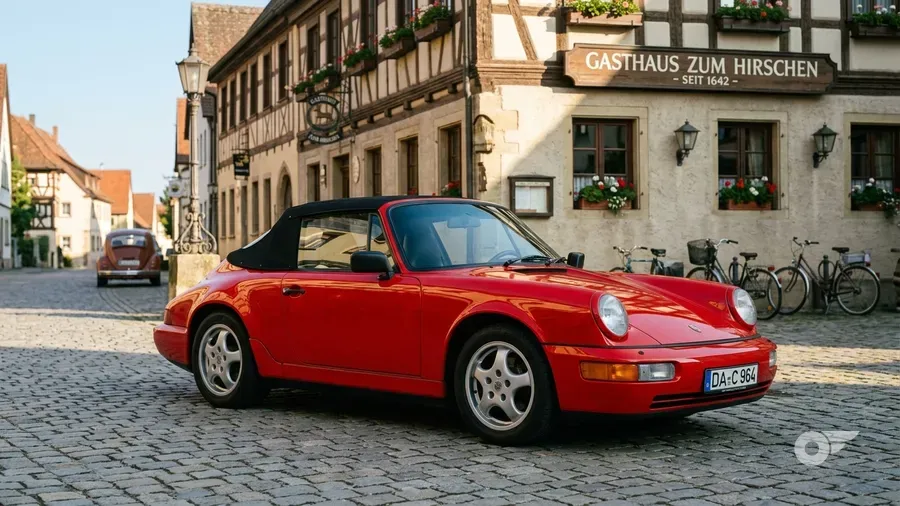
The G-Series is a regulatory solution that turned into a style. The bumpers are alloy beams on collapsible mounts, faced with body-coloured covers and closed at each end by black concertina bellows, and the reason the car still reads as whole is that Lapine's studio lifted the front luggage lid and the rear valance to meet them rather than bolting them on. He also took the chrome away: matt black window frames, matt black door handles, and eventually black trim nearly everywhere, which is why a mid-1980s 911 looks darker and heavier than a longhood. The rear arches grew to cover wider wheels. From 1974 a one-piece reflector panel runs between the tail lights carrying the Porsche script, the clearest single identifier of the era. The 930 Turbo added the whale tail, then the tea tray, and the wide arches that half this generation has since been given by its owners. The Cabriolet of 1983 gave the 911 a proper folding roof after eighteen years of Targas, and the 1989 Speedster ended the run with a raked screen and a double-bubble cover.

Motorsport pedigree

This is the generation in which a 911 derivative won Le Mans outright. The 930's turbocharged flat six underpinned the Group 4 934 and the Group 5 935, and on a wet weekend in June 1979 a Kremer Racing 935 K3 driven by Klaus Ludwig and the brothers Don and Bill Whittington beat the prototypes by eight laps, with 935s filling the podium. By Porsche's own account it is the only production-based car to win Le Mans outright since 1952. The other half of the story happened on sand. The Rothmans-liveried Porsche 953, a four-wheel-drive 911 built on 911 SC/RS underpinnings, won the 1984 Paris-Dakar outright with Rene Metge and Dominique Lemoyne, taking nine stage wins over nearly 10,000km in an event where only 98 of 313 starters reached the finish, with Jacky Ickx sixth. Around twenty road-going 911 SC/RS cars were built to homologate it for Group B. Between those two poles sat an enormous privateer record in IMSA, the Deutsche Rennsport Meisterschaft and national GT racing, which is where most 935s spent their lives and where the 911 earned its reputation for finishing.

In culture

This is the 911 that became a symbol, and not always a flattering one. The 930 Turbo, wide-hipped and whale-tailed, was the definitive 1980s success object, standing in for the decade's money in a way no Ferrari quite managed, and it earned a name the generation as a whole never did: the widowmaker, from turbo lag that arrived all at once and a chassis that punished a lifted throttle. The most-watched moment of the era belongs to a tuner rather than the factory. Alois Ruf's CTR, built on a narrow G-Series body and painted yellow, ran 211 mph at Nardo for Road and Track's 1987 top-speed test and became the Yellowbird, then made itself permanent in Faszination on the Nuerburgring, several minutes of Stefan Roser holding full-power drifts around the Nordschleife. That film has long outlived the magazine test. And when Electronic Arts locked up Porsche's video-game licence from 2000, RUF stood in for Porsche in Gran Turismo, so a generation of players learned this shape under somebody else's badge.

Owning One

Why collectors want it

For thirty years this was the cheap 911, and the market has spent the last decade correcting that. The reasons are practical rather than sentimental. From 1976 the body is fully hot-dip galvanised, so a G-Series survives in a way no longhood does. The SC and the Carrera 3.2 are the most robust engines of the air-cooled era. And with 196,397 cars built there is genuine choice, which means a buyer can hold out for the right one instead of taking what appears. The hierarchy inside the generation is now settled. The 1987-89 Carrera 3.2 with the G50 gearbox sits at the top of the normal cars and always deserved to. The earlier 915-gearbox 3.2s and the SCs are where the value is. The 1974-77 2.7 cars are the ones to inspect hardest and price accordingly. The 930 Turbo is a separate market, and the Club Sport, the Speedster and the slant-nose cars are separate again. What makes any of them worth owning is usability: this is the first 911 you could sensibly drive every day, and most of them still can be.

Which one to look for

Four normally aspirated eras, then everything else. The 1974-77 2.7 cars start at 150 PS and are the cheapest way in, with the caveat about head studs. The Carrera 2.7 of 1974-75, sold in Europe with the RS engine's mechanical injection and 210 PS, is the connoisseur's pick of the early cars. The Carrera 3.0 of 1976-77 is a short, small-volume run most buyers skip entirely. The 911 SC of 1978-83, 58,914 cars, climbs from 180 to 204 PS and is the durable everyday choice. The Carrera 3.2 of 1984-89, 76,473 cars, is the developed one at 207 PS in America and 231 in Europe, and the 1987-89 G50 cars are the ones to hold out for. Then the specials. The 930 Turbo, 2,819 of the 3.0 cars and 18,770 of the intercooled 3.3s, is why this generation has a poster. The Carrera 3.2 Club Sport, 340 built from 1987 to 1989, is the quickest normal 911 here. Around twenty 911 SC/RS were built in 1984 to homologate the Rothmans rally car. The 1989 Speedster, 2,104 cars, closed the generation.

911 2.7 · 1974–1977

The car the impact bumpers arrived on. 2.7 litres, 150 PS at launch, Bosch K-Jetronic mechanical injection, and the first 911 with the integrated bellows bumpers that would define the shape for fifteen years. The cheapest entry into air-cooled ownership, and the one that needs the closest engine inspection.

911 SC · 1978–1983

The tough one. 3.0 litres rising from 180 to 204 PS, a fully galvanised body, and an engine with a reputation for covering enormous mileages. The 911 that made the car a usable daily proposition rather than a weekend indulgence, and still the sane way into the generation.

911 SC/RS · 1984

Porsche Motorsport's Group B homologation car, built on the SC shell with aluminium panels, a 3.0-litre engine on mechanical injection and a stripped interior. The road-going basis of the Rothmans rally programme, and the rarest street-legal RS Porsche ever built.

930 Turbo 3.0 · 1975–1977

The original road-going turbocharged 911. 3.0 litres, 260 PS, a single KKK turbocharger with no intercooler, a four-speed gearbox because nothing else would take the torque, and the whale tail. Vicious lag then a wall of boost, which is the whole legend in one sentence.

930 Turbo 3.3 · 1978–1989

Bigger, intercooled and far more usable, at 300 PS and later 330 with the factory WLS performance option. Still a four-speed until the very end. Withdrawn from the US and Japan in 1980 over emissions, and its 1986 return with Cabriolet and Targa bodies is where much of the 1980s legend was made.

930 Turbo Flachbau · 1986–1989

The factory slant nose, built by Porsche's special order department with the front wings reprofiled to the 935 racing pattern and pop-up headlights in place of the upright lamps. Expensive when new, endlessly copied afterwards, and the reason any wide-bodied 911 needs its paperwork read.

Carrera 2.7 · 1974–1975

Europe only, and effectively the Carrera RS engine in an impact-bumper body: 210 PS on mechanical fuel injection, no catalyst, no compromise for American emissions law. The quickest normally aspirated 911 of the mid-1970s and the connoisseur's pick of the early G cars.

Carrera 3.0 · 1976–1977

A two-year run at 3.0 litres and around 200 PS, bridging the 2.7 cars and the SC. Small volumes and low profile mean it is regularly overlooked, which is exactly why people who know the generation seek one out.

Carrera 3.2 · 1984–1989

The developed G-Series. 3.2 litres, Bosch Motronic engine management, 207 PS in America and 231 in Europe, and from model year 1987 the Getrag G50 five-speed that fixed the gearshift and added a hydraulic clutch. The 1987-89 G50 cars are the ones the market chases.

Carrera 3.2 Club Sport · 1987–1989

A factory lightweight built for people who intended to drive hard. Sound deadening, rear seats, air conditioning and electric accessories deleted, a blueprinted engine allowed to rev higher, and stiffer damping. The quickest normally aspirated 911 of the generation and now the rarest of the ordinary cars.

Speedster · 1989

The last G-Series, and a deliberate throwback: a raked, shortened windscreen, a manual hood hidden under a glassfibre double-bubble tonneau, and no pretence at weather sealing. Most were built on the wide Turbo-look body. A closing statement rather than a serious sports car.
What owning one is like

The good news is structural. Bodies from 1976 are hot-dip galvanised, so the panel rust that eats earlier 911s largely does not happen here, and an SC or a 3.2 kept dry and driven is a genuinely durable car. The rest is a list of known items with known answers. Chain tensioners on pre-1984 engines are the classic one, and the pressure-fed Carrera conversion is what owners fit before it becomes an emergency. The 1974-77 2.7 engines pull cylinder-head studs when they overheat, which is why the market prices them where it does, and why case savers and Dilavar studs are standard practice in a rebuild. The 915 gearbox on pre-1987 cars wears its second-gear synchro and will eventually want rebuilding. Oil leaks are constant and mild rather than dramatic, usually from the valve covers and the chain housings. Where galvanising does not reach, water still finds a way: sunroof drains, screen surrounds, the battery area. None of it is exotic, and the running costs of a sorted SC sit closer to an old sports saloon than to a supercar.

Upkeep & parts

This is the best-supported air-cooled 911 to own, which is much of why values have moved. Porsche Classic still supplies factory parts, the independent specialist trade is deep in every market, and the consumables are cheap. A valve adjustment every few thousand miles is the ritual, and it is a job an owner can learn rather than farm out. Budget realistically for three things. Chain tensioners on a pre-1984 car, done properly with the oil-fed conversion. A 915 gearbox rebuild if second gear has given up, which is specialist work. And a clutch, which means dropping the engine and gearbox and is therefore the moment to do everything else down there at once. A full engine rebuild on an SC or a 3.2 is well mapped and well priced by air-cooled standards. The Porsche Club of America and Porsche Club Great Britain both run large G-Series communities, Rennlist carries thirty years of accumulated diagnosis, and Pelican Parts publishes step-by-step procedures for most of what the car will ask for.

Country of origin
Germany
Class
Sports
Production years
1973–1989
Units built
196,397
Model
911
Nickname
No nickname ("Widowmaker" names the 930 Turbo specifically, not the generation)
Body
Convertible, Coupe, Targa
Layout
Rear-engine, RWD
Engine
2.7L air-cooled flat-six (150-210 PS), 3.0L air-cooled flat-six (Carrera 3.0, 200 PS), 3.0L air-cooled flat-six (911 SC, 180/188/204 PS), 3.2L air-cooled flat-six (Carrera 3.2, 207 PS US and 231 PS Europe), 3.0L turbocharged flat-six (930 Turbo, 260 PS), 3.3L turbocharged flat-six (930 Turbo, 300 PS, 330 PS with the WLS option, 286 PS for the US from 1986)
Transmission
4-speed manual, 5-speed manual (Type 915), 5-speed manual (Getrag G50, from 1987), Sportomatic semi-automatic, 4-speed manual (930 Turbo to 1988), 5-speed manual (930 Turbo, 1989)
Designer
Anatole Lapine (design direction) on Ferdinand Alexander Porsche's original body