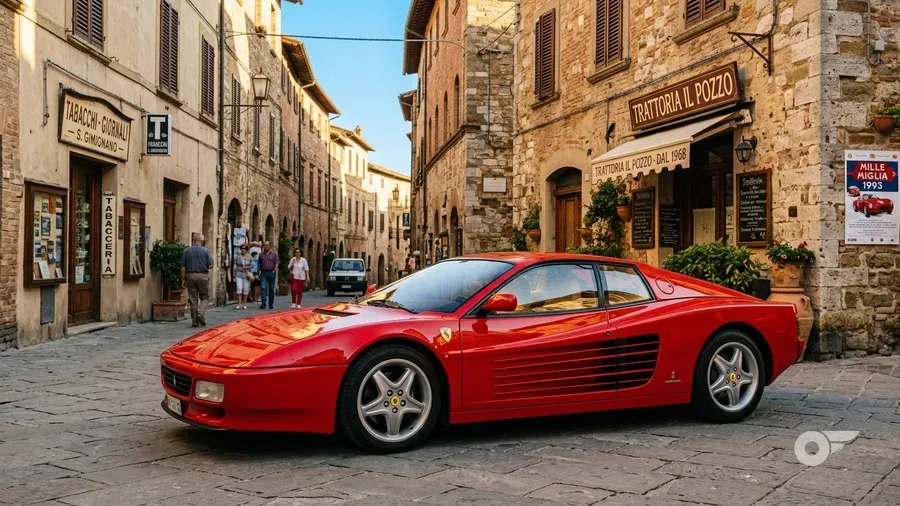
Ferrari 512 TR
Italy·Exotic·1992–1994

The defining attributes and collector status that make this car garage-worthy.


Rated 1 to 10 on the traits that matter for owning, driving, and holding on to a car like this.
Demand tier, price trend, and typical values by condition. Our own assessment, not a quoted valuation.
Values as of August 2026.
What anyone seriously considering this car should know first.
Cars from the same manufacturer family, like platform siblings or shared-era relatives.
Cars from other manufacturers that competed for the same buyers when new.
Not a factory model name but the market's name for the earliest cars, and the one specification collectors chase. Monospecchio means single mirror: one high-mounted door mirror on the driver's A-pillar, which gave a fine view rearward and a large blind spot toward oncoming traffic. These cars are also monodado, single nut, running centre-lock magnesium five-spoke wheels, the very first of them on metric Michelin TRX tyres that are now scarce and expensive. Mechanically identical to a later Testarossa apart from the wheels and, on the earliest cars, the tyre standard. Auction houses put the designation in their lot titles, and it prices accordingly.
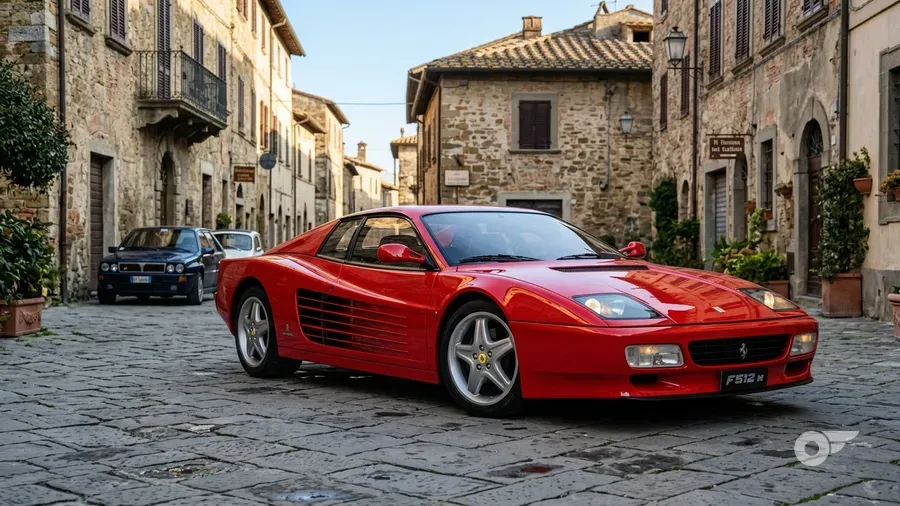
The production coupe, and effectively the only way the car was sold. One engine, one gearbox, no performance options: a 4.9-litre Tipo F113 flat-12 with four valves per cylinder, 9.2:1 compression and Bosch mechanical injection, rated at 390hp at 6,300rpm on the European figure and 380hp at 5,750rpm in catalysed US and Japanese form, driving through a five-speed dogleg manual with a twin-plate clutch and a limited-slip differential. Tubular chassis, 2,550mm wheelbase, 1,976mm wide, 1,506kg dry, ventilated discs of 315mm front and 310mm rear with no ABS offered at any point. Ferrari claimed 290km/h; Car and Driver measured 176mph and 5.0 seconds to 60mph on a US car in 1985.
A coachbuilt open Testarossa, never a catalogue model. The definitive one is chassis 62897, commissioned from Pininfarina in 1986 as a gift to Fiat chairman Gianni Agnelli marking twenty years in the chair, and fitted with a Valeo transmission whose automatic clutch let it be driven without a clutch pedal. Pininfarina separately converted a run of Testarossas to open bodywork for Brunei. Later private roof removals exist and are a different thing entirely, so provenance is everything on any open car offered as a Spider.