Overview
The F512 M is where the Testarossa story ends, and Ferrari made sure the ending mattered. Introduced at the 1994 Paris Salon as the final development of the car launched a decade earlier, it dropped the pop-up headlights for fixed units under glass, swapped the slatted rear grille for round F355-style taillights, and lost the Testarossa badge from the engine lid entirely. Under that lid the flat-12 grew stronger rather than larger: titanium connecting rods and a lightened crankshaft took nearly 40 pounds off the engine, compression rose to 10.4:1, and power climbed to 440hp, enough to make the F512 M the quickest car this engine family ever produced. It also finally got ABS, something no Testarossa or 512 TR before it had carried. Only 501 were built before production stopped in 1996, and none of Ferrari's flat-12 line ever got a fourth chance: this is the last one, the final car in a lineage that started with the 365 GT4 BB concept in 1971, before Ferrari returned to a front-mounted V12 with the 550 Maranello.
Distinctions
The defining attributes and collector status that make this car garage-worthy.
Collectibility scorecard
Rated 1 to 10 on the traits that matter for owning, driving, and holding on to a car like this.
Fuel injection and ignition are managed electronically through a Bosch-derived engine management system, the same basic approach the 512 TR introduced, so this is not a fully mechanical car the way the original K-Jetronic Testarossa was. What's new on the F512 M is ABS: servo-assisted, cross-drilled ventilated discs with four-piston calipers and separate front and rear hydraulic circuits, the first anti-lock system this family ever received. Steering remains entirely unassisted, the five-speed gearbox is a manual dogleg pattern with no electronic control of any kind, and there is no traction control, no stability control and no drive-by-wire anything. The electronics that exist are limited to engine management and brakes.
Market data
Demand tier, price trend, and typical values by condition. Our own assessment, not a quoted valuation.
The proven elite. Values are established, liquid, and defended at every auction.
Values are climbing. The market wants more of these than exist.
The F512 M is priced as the family's halo car, and the numbers back that up. classic.com's tracked average sits at $516,984, well above either the Testarossa or the 512 TR, and The Classic Valuer's own data puts an average-condition car at roughly 383,000 pounds, placing it among the more expensive 2 percent of collector cars by their measure. 2025 alone produced a wide spread of real results: $428,000 at Worldwide Auctioneers in April, $912,500 at RM Sotheby's Monterey in August, and $528,000 at Mecum Indy. One result, $1,210,000 for a 1995 car in January 2026, stands well above the rest and is named here as a single top result rather than folded into the working band. With only 501 built and demand for the whole flat-12 family climbing, the market has been moving up rather than settling, consistent with how the Testarossa and 512 TR have both traded in recent seasons.
Values as of August 2026.
Buyer's guide
What anyone seriously considering this car should know first.
The Story
Driving character
This is the flat-12 formula at its most resolved. The engine still sits behind your shoulders, the titanium connecting rods and lightened crank let it spin to its power peak a fraction more eagerly than the 512 TR's, and 440hp arrives with the same metallic, mechanical intensity every flat-12 Ferrari has had since the 365 GT4 BB. The dogleg five-speed asks for the same deliberate, cold-baulking first-to-second habit every car in this family has, and the unassisted steering still loads up properly rather than staying light, which most drivers of this era's supercars come to prefer once they adjust to it. What's genuinely different is stopping: the servo-assisted, cross-drilled brakes with ABS give the car a margin of confidence nothing earlier in this lineage had, closing the one real gap between how fast the engine can make the car go and how confidently a driver can slow it back down again. It is the version of this car with nothing left to apologise for.
Design
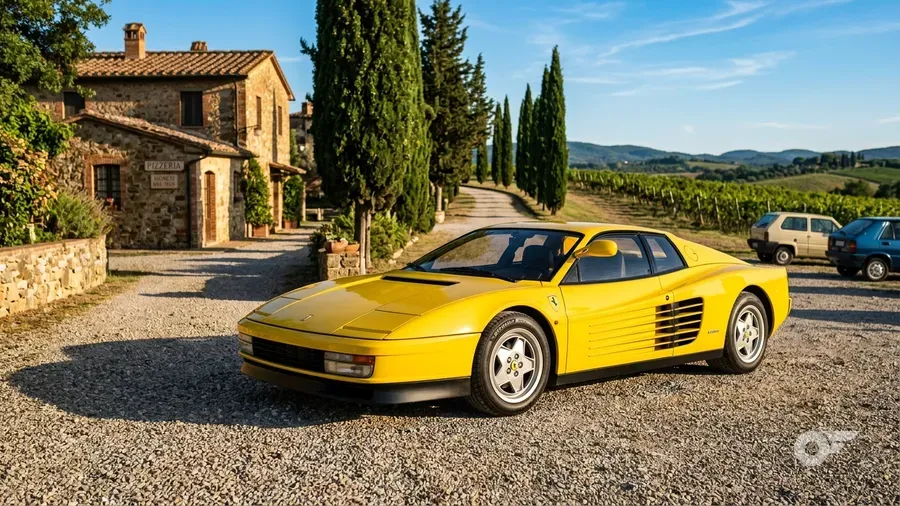
Lorenzo Ramaciotti led the F512 M's restyling at Pininfarina, and the brief was clearly to modernise without starting over. The pop-up headlights that every Testarossa and 512 TR had worn since 1984 disappeared, replaced by fixed homofocal units under glass, a shape change that alone makes the F512 M instantly identifiable at a glance. An oval grille filled the front bumper, and small NACA ducts appeared on the front lid to feed a revised air conditioning system. At the back, the wide slatted grille that had hidden the taillights on every earlier car gave way to twin round units either side of a smaller louvred panel, borrowing the same round-taillight language Ferrari had just put on the 355. The engine lid itself lost its raised, satin-black-painted section along with the Testarossa badge, becoming a single body-coloured panel. The side strakes stayed, because the flat-12's width and the flank-mounted radiators that demanded them never went away. This was a facelift in the truest sense: the same body in a newer suit, on a car whose engine and mechanicals were also being finished at the same time.
Motorsport pedigree
There is no competition history for the F512 M, and none for the Testarossa or 512 TR either. The flat-12's own racing chapter closed years before any of these three road cars existed: the 512 BB LM, built in small numbers from 1979, raced at Le Mans through the early 1980s and took its best result, fifth overall and a class win, with the Pozzi team's entry in 1981. By the time the Testarossa launched in 1984, Ferrari's competition attention had already moved to turbocharged Formula 1 and prototype programmes, and neither the Testarossa, the 512 TR nor the F512 M was ever developed into a racing car of any kind, works-backed or privateer. The F512 M's real achievement is entirely a road-car one: taking the flat-12 layout to its final, most powerful form and closing out a 25-year production line on its own terms rather than being succeeded mid-development or quietly discontinued.
In culture
The F512 M's cultural footprint is smaller than its siblings', and that is mostly a function of timing. The Testarossa had Miami Vice and an entire 1980s of poster-wall fame; the F512 M arrived in 1994, after that particular cultural moment had passed, sold in far smaller numbers, and never had a comparable screen or game moment attached to it specifically. What it does carry is the weight of being an ending: every retrospective on Ferrari's flat-12 era, from the 365 GT4 BB's 1971 debut through the Boxers to the Testarossa and its descendants, uses the F512 M as the closing chapter, the car built after Ferrari already knew the layout's replacement, the front-engined 550 Maranello, was coming. That kind of fame accrues slowly rather than arriving on release, built through decades of enthusiast writing rather than a single splashy moment, and it is a real part of why interest in the car has grown steadily as more people learn what it actually represents.
Related cars
Cars from the same manufacturer family, like platform siblings or shared-era relatives.
Rivals
Cars from other manufacturers that competed for the same buyers when new.
Owning One
Why collectors want it
The F512 M closes out three separate stories at once, and each one is worth money on its own. It is the last and best-developed version of the flat-12 layout Ferrari introduced in the 365 GT4 BB in 1971, the rarest of the three Testarossa-era cars at only 501 built against the Testarossa's 7,177 and the 512 TR's roughly 2,261, and the quickest of the three by Ferrari's own numbers. That combination of scarcity, mechanical superiority within its own family, and genuine historical closure has made it the most expensive of the three cars to buy today, and demand has kept climbing rather than settling: classic.com's own tracked average sits well above either of its siblings, and 2025 alone produced multiple results north of $400,000 with one car reaching $912,500 at Monterey in August. Buyers of flat-12 Ferraris increasingly treat the F512 M as the one to have if you can only have one, precisely because there will never be another.
Which one to look for
There is one specification, and the whole point of it is that Ferrari stopped changing things and simply finished the car. The styling updates, fixed headlights, new taillights, a body-colour engine lid, an oval front grille, arrived all at once at launch rather than accumulating across model years the way they did on the Testarossa, which went through several distinct running changes across its own seven-year life. The meaningful choice for a buyer today is really just left-hand or right-hand drive: 501 were built in total, of which 75 are right-hand drive, and both are equally accepted as original factory configurations rather than one being a rarer curiosity. There is no cabriolet, no factory-lightened competition version and no notable one-off the way earlier flat-12 Ferraris sometimes got. The F512 M is the rare halo Ferrari whose entire desirability comes from being the one specification Ferrari considered finished, not from a hierarchy of trims within it, which makes shopping for one simpler than shopping for either of its siblings.
What owning one is like
The F512 M shares its family's known issues with a rarer, pricier car's stakes attached. Cambelt service on the calendar interval is the big one, and on this family it means the engine, transaxle and subframe come out through the top of the car, a job specialists quote at several thousand dollars done properly with all 48 valves adjusted and every camshaft degreed. The dogleg five-speed baulks into second when cold and needs a deliberate hand until it warms through, which is normal rather than a fault. The soft-touch coating Ferrari used on 1990s interior switchgear and console trim degrades to a tacky film over time, and a full retrim is a real expense worth budgeting for rather than a detail to skip. Standing for long periods dries fuel in the injection system's metering components and causes hard starting, so cars that sit need a specialist's attention before they get driven again, not just a fresh battery.
Upkeep & parts
Parts and specialist knowledge for the F512 M run through the same small community that supports the Testarossa and 512 TR, since all three share most of their running gear, and that shared parentage means the pool of people who genuinely understand this engine is larger than the F512 M's own 501-car production run would suggest on its own. Budget for annual servicing even on a car that covers little distance, since Classic & Sports Car's own guide for this family puts general upkeep at several thousand dollars a year regardless of mileage, on top of the periodic cambelt job. Ferrari Classiche certification carries real weight on a car this rare and this expensive, both as an authenticity check and as a value factor, and it is worth pursuing if a car does not already have it. Seek out a specialist with specific experience on this generation's Motronic engine management and ABS system, not just a generalist Ferrari mechanic.