Ferrari Testarossa
Italy·Exotic·1984–1991

The defining attributes and collector status that make this car garage-worthy.


Rated 1 to 10 on the traits that matter for owning, driving, and holding on to a car like this.
Demand tier, price trend, and typical values by condition. Our own assessment, not a quoted valuation.
Values as of August 2026.
What anyone seriously considering this car should know first.
Cars from the same manufacturer family, like platform siblings or shared-era relatives.
Cars from other manufacturers that competed for the same buyers when new.
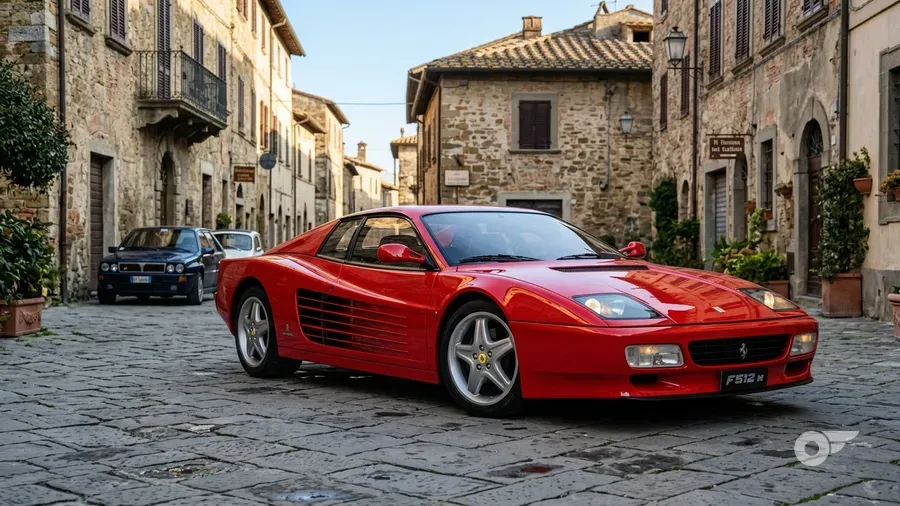
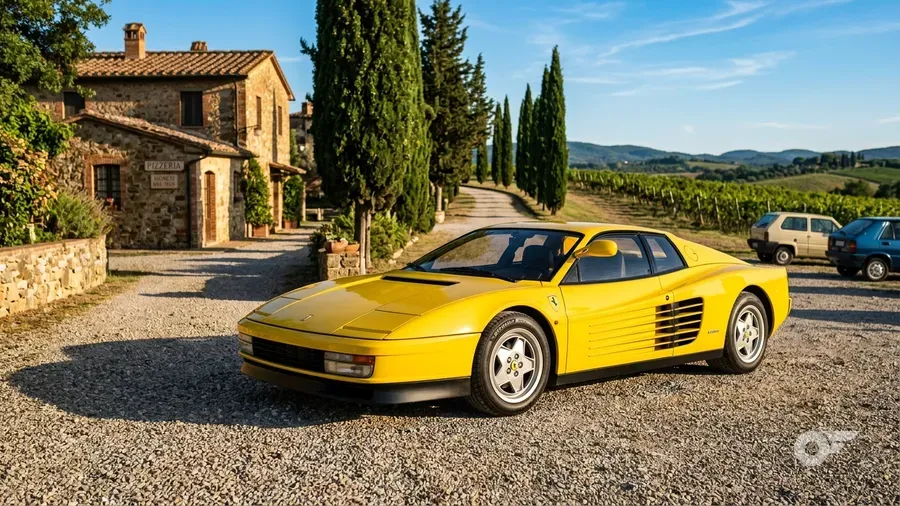
The production coupe, and effectively the only way the car was sold. One engine, one gearbox, no performance options: a 4.9-litre flat-12 with redesigned four-valve heads, Nikasil liners, 10.0:1 compression and Bosch Motronic M2.7, rated at 428hp on the European figure, driving through a five-speed dogleg manual with a twin-plate clutch. The chassis is the F110 HB with 13 percent more torsional rigidity than the Testarossa's, carrying the engine and gearbox 30mm lower, on 18-inch five-spoke Speedline wheels. Later cars are the mechanically stronger ones, and ABS turns up only near the end of the run on a small minority.
A factory special-order series built for the Japanese market by Ferrari's Special Projects department, and the rarest series-built 512 TR. Finished in a dark wine red metallic with a beige leather interior and Castoro carpet, wearing Scuderia Ferrari shields on the front wings and three-piece modular Speedline wheels. Inside there is a steering wheel embossed with the 512 TR logo, an alloy gear knob and sport pedals, and sill plates reading 512 TR Speciale Cornes 15th. Mechanically it is a standard 512 TR; the appeal is the specification and the count.
A coachbuilt open version, not a factory catalogue model. Ferrari supplied reinforced chassis to Pininfarina's Special Projects team, which cut the roof off and reworked the bodywork into an aperta, after which the cars went back to Maranello to have their mechanical parts and interior trim fitted. Commissioned through Hong Seh Motors of Singapore, Ferrari's Southeast Asia distributor, for the Royal Family of Brunei. One car exists in the triple blue combination, and one right-hand-drive example was never delivered to Brunei and stayed in the distributor's own collection.