Octane Files
Explore CarsPorsche 959 1st Gen

Porsche 959 1st Gen

Overview

The 959 was built to satisfy a rulebook that no longer existed by the time it went on sale. Helmuth Bott began the project in 1981 with an idea for an all-wheel-drive 911, and it became Porsche's Group B car, which meant building at least 200 road versions to homologate it. Group B was then cancelled outright, and Porsche was left holding the most technically advanced road car anyone had built. The specification still reads like a list of firsts: a 2.85-litre flat six with air-cooled cylinders and water-cooled four-valve heads, twin turbochargers arranged to work in sequence rather than together so the engine had usable response at low revs, computer-controlled all-wheel drive that could vary the split and send up to 80 per cent of the power rearward, adjustable ride height and damping, and tyre pressure monitoring built into the wheels. It made 450 PS and ran to 317 km/h. Porsche charged DM 431,550 for it and lost money on every car, and the 959 went on to preview, item by item, how supercars would be built for the next thirty years.

Distinctions

The defining attributes and collector status that make this car garage-worthy.

Legend
A car that transcended the hobby, known far beyond the people who drive them.
Homologation Special
Built for the road only because racing rules demanded it.
Poster Car
The car on the bedroom wall, the one people dreamed about before they could drive.
Octane Files Select
Renowned for its history, engineering, or cultural weight.

Collectibility scorecard

Rated 1 to 10 on the traits that matter for owning, driving, and holding on to a car like this.

Desirability
10/10
Rarity
9/10
Driving thrill
8/10
Investment trajectory
8/10
Usability
5/10
Ease of restoration
2/10
Cultural impact
9/10
Electronic dependence
Fully analogHeavily electronic

At the top of the scale, and it earned that position in 1986 rather than through gradual accumulation. The engine runs Bosch Motronic management with the two turbochargers sequenced electronically so the second only comes online at higher load. The PSK all-wheel drive is computer controlled, varying the torque split according to load, throttle and grip and offering driver-selectable programmes, and the car reads wheel behaviour to do it. Ride height and damper settings are adjustable on the move through hydraulics. The wheels carry a built-in tyre pressure monitoring system, which no other road car of the period had. Anti-lock brakes are standard. What the 959 does not have is drive-by-wire or a modern stability program: the throttle is still cable operated and the steering is unassisted rack and pinion, which is part of why it still feels like a driver's car rather than a simulation.

Market data

Demand tier, price trend, and typical values by condition. Our own assessment, not a quoted valuation.

Demand tier
EntrySolidHighBlue-chip

The proven elite. Values are established, liquid, and defended at every auction.

Value trajectory
AppreciatingStableCooling

Values are climbing. The market wants more of these than exist.

Price by condition
Driver
$1.3M
Excellent
$1.8M
Concours
$2.4M

Blue-chip and still climbing, with the market treating the 959 as an engineering milestone rather than merely a rare Porsche. A 1988 Komfort sold for $1,795,000 on Bring a Trailer in March 2024, and Komfort cars have appeared at RM Sotheby's Monterey and Arizona sales and at Gooding's Amelia Island auction in the seasons since. The Sport cars are far rarer and trade well above the band. What supports values is that the technology story keeps getting more relevant, not less: sequential turbocharging, computer-managed all-wheel drive and tyre pressure monitoring are now ordinary, and this is the car that introduced them. The band describes a Komfort with normal history.

Values as of August 2026.

Buyer's guide

What anyone seriously considering this car should know first.

Why it's worth it
The Group B homologation car whose rules were cancelled, and the template for the modern supercar
Callout
Porsche sold it for less than half what each car cost the company to build
What to watch for
A 959 is bought on provenance, specification and service history, in that order, and almost never on condition, because these cars have generally not been abused. Establish which of the three groups a car belongs to: a customer Komfort, one of the small number of Sport cars, or one of the eight assembled from spare parts in 1992 and 1993. Then go through the systems that make the car special, because they are also the ones that are hardest to put right. The sequential turbocharging, the hydraulic ride height adjustment and the PSK all-wheel drive are unique to this model, and the electronics that manage them were built once, in tiny numbers, and are not shared with anything else Porsche made. Confirm that the car has been maintained by one of the very small number of specialists Porsche recognises for it, and that the hydraulic and electronic systems have been exercised rather than left standing. In the United States, check the import paperwork carefully: the 959 was never federalised, so a legally imported car will be here under the Show or Display provision with its mileage restrictions.

The Story

Driving character

The 959's party trick is that it is calm. It arrived in a period when a fast car meant a Countach or a Testarossa, machinery you drove around rather than through, and instead the 959 does 317 km/h while behaving like something you could take to work. The sequential turbochargers are the reason: instead of the on-off detonation of a contemporary 930, the smaller turbo does the work early and the second joins in as the load builds, so the engine picks up cleanly from low revs and then delivers 450 PS in one continuous rising surge rather than a hit. All-wheel drive means it simply goes when you ask, in weather that would have a rear-drive 911 of the same era sideways. auto motor und sport measured 318 km/h and 3.7 seconds to 100 km/h, which was extraordinary then and is still fast now. The steering is unassisted and heavy at low speed, the driving position is pure 911, and the car is smaller than photographs suggest. It is the first supercar that did not require bravery, and that was the whole design brief.

Design

The 959 is a 911 in the way a rocket is a firework, and the family resemblance is deliberate. The greenhouse, the doors, the windscreen and the basic proportions are recognisably 911, and everything else is grafted on to do a job. The 1983 Gruppe B concept that previewed it, developed under Anatole Lapine, achieved a drag coefficient of 0.32, and the production body kept that discipline: a smooth polyurethane nose with integrated lamps and no visible bumper, a flat undertray, and enormous flared arches over the wide track that flow into the doors rather than sitting on them. The rear is dominated by a full-width shelf spoiler that houses the engine cooling outlets, and the whole tail is a single moulded shape. The panels are exotic for the period, mixing aluminium, aramid composite and polyurethane over a steel structure. The hollow-spoke magnesium wheels carry the tyre pressure sensors and are a piece of engineering in their own right. Nothing on the car is decorative, and that is precisely why it has aged so well.

Motorsport pedigree

The 959's competition record is short, spectacular and almost accidental, because the category it was designed for died first. Group B rallying required 200 road cars for homologation and the programme was cancelled before the 959 was ready, so the car went looking for somewhere else to prove itself and found the desert. In January 1986 Porsche entered three 959s in the Paris-Dakar and finished first and second, Rene Metge winning with Jacky Ickx behind him and the third car sixth, in an event where a heavily engineered four-wheel-drive supercar was an absurd entry and won anyway. That result did more for the car's reputation than any circuit could have. The same year the 961, the racing derivative, took first in class and seventh overall at the Le Mans 24 Hours, which remains the only serious circuit result for the type. After that the technology went where it was always going to be more useful: the all-wheel-drive thinking reappeared in the 964 Carrera 4 and the twin-turbo installation in the 993 Turbo, and the car itself retired into legend.

In culture

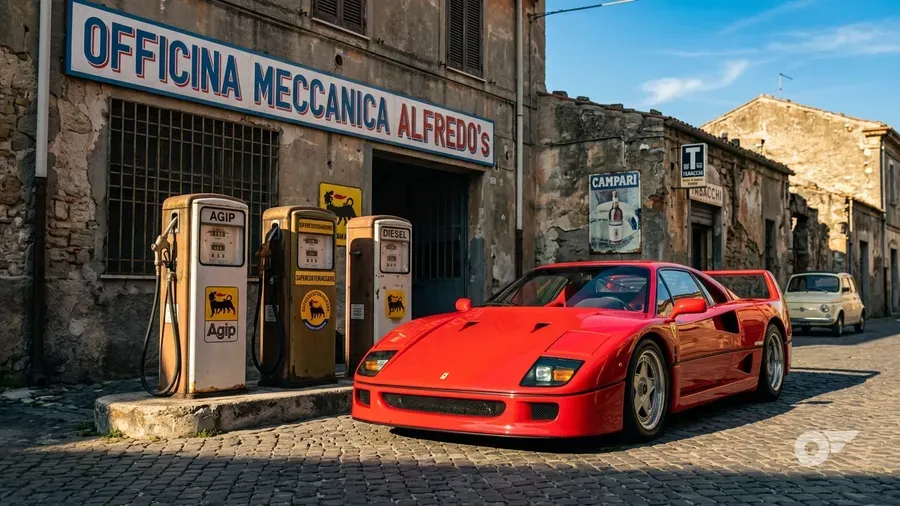
The 959 was the poster on the wall for a specific generation, arriving as the fastest production car in the world and being immediately measured against Ferrari's F40 in every magazine that mattered. It is one of the few cars whose specification sheet was itself the entertainment: schoolchildren who could not have identified a Weissach axle could recite the top speed and the fact that the tyres told the driver their own pressures. Its strangest legacy is legal. Porsche never certified the 959 for the United States and declined to surrender cars for destructive crash testing, so the model could not be sold or imported there. Bill Gates bought one in 1988 and US Customs impounded it, where it sat for thirteen years. The lobbying that followed produced the Show or Display provision, which came into force on 13 August 1999 and allowed historically significant vehicles into the country under mileage restrictions. Every grey-market exotic legally imported into America since owes something to a Porsche sitting in a warehouse.

Rivals

Cars from other manufacturers that competed for the same buyers when new.
Owning One

Why collectors want it

Very few cars can claim to have changed how an entire class of machine is engineered, and the 959 is one of them. Sequential turbocharging, computer-managed all-wheel drive, adjustable ride height and tyre pressure monitoring were all on a road car in 1986, and the ideas ran directly into the 964 Carrera 4 and the 993 Turbo and out into everything since. Only 337 cars exist in total, of which 292 were customer road cars, and Porsche's own accounting says the price never came close to the cost. The market has followed: a 1988 Komfort took $1,795,000 on Bring a Trailer in March 2024, and the marque's flagship auctions have carried a 959 almost every season. Inside the range the split is between the comfort-equipped Komfort, which is the overwhelming majority, and the stripped Sport cars, which are far rarer and command a substantial premium. The eight cars assembled from spare parts in 1992 and 1993, four red and four silver, are their own footnote. This is a car whose value rests on engineering history rather than on rarity alone, which is a rare and durable basis.

Which one to look for

Two specifications, and one very small third group. The Komfort accounts for the overwhelming majority of the 292 customer cars and is the version almost everybody has seen: air conditioning, electric windows, full trim, the adjustable ride height and damping, and rear seats. The Sport is the point of the exercise stripped back, with the comfort equipment removed, no rear seats, fixed suspension in place of the adjustable system and a lighter kerb weight; sources disagree on exactly how many were built, but they are a small fraction of the total and are priced accordingly. The third group is the eight cars assembled from remaining spare parts in 1992 and 1993, all Komfort, four red and four silver, sold at DM 747,500, which is roughly what a decade of hindsight had done to the price. Outside the road cars entirely is the 961, the racing version, which took a class win and seventh overall at Le Mans in 1986. It is not a variant you can buy, but it is the reason the road car's four-wheel-drive system was developed the way it was.

959 Komfort · 1986–1988

The version almost every 959 is: full trim, air conditioning, electric windows, rear seats and the hydraulically adjustable ride height and damping. Heavier than the Sport and the reason the car earned its reputation as a supercar you could actually use.

959 Komfort (1992-93 spare parts cars) · 1992–1993

Eight final cars assembled from remaining parts several years after the production run ended, four painted red and four silver, all to Komfort specification. Sold at DM 747,500, considerably more than the original list price.

959 Sport · 1986–1988

The homologation intent, stripped back: comfort equipment deleted, no rear seats, fixed suspension in place of the adjustable system, and less weight. Built in very small numbers and priced well above the Komfort today. Published counts vary.

961 · 1986

The racing derivative rather than a road variant. It took first in class and seventh overall at the 1986 Le Mans 24 Hours, and its four-wheel-drive development fed the road car directly. Never sold to customers.

What owning one is like

Owning a 959 is a specialist relationship rather than a hobby. The car itself is well built and was engineered to Porsche's own flagship standards, and nothing about it is fragile in the way a period Italian supercar can be. The difficulty is that the systems that make it remarkable were built once, in numbers under 300, and shared with nothing else. The sequential turbocharging installation, the hydraulic ride height and damper adjustment, the PSK all-wheel drive and its control electronics all need someone who has worked on them before, and there are very few such people in the world. Cars left standing are the problem: hydraulic systems seize, seals dry out and the electronics do not appreciate years of disuse, so a car that has been driven regularly is in far better shape than a low-mileage museum piece. The magnesium wheels are unique to the model and require correct handling. In the United States, Show or Display cars carry an annual mileage limit, which shapes how the car can be used. Owners generally accept all of this, because the alternative is not owning one.

Upkeep & parts

There is no ordinary parts supply for a 959 and there never was. Porsche Classic supports the car through its historic parts programme and holds the technical records, and a small international network of specialists handles everything the factory does not; between them they remanufacture what is needed, usually to order and usually with a wait. Model-specific electronics and the hydraulic suspension components are the hardest items, and owners tend to keep spares. Routine servicing costs what a hand-built flagship costs and should be scheduled rather than deferred, because exercising the systems is what keeps them working. The 959 Registry, founded in 2007, is the community point for owners and is where chassis histories, specialist recommendations and technical knowledge circulate; the Porsche Club of America provides the wider framework and event access. The practical advice from people who own these cars is consistent: budget for regular use rather than storage, and establish a relationship with a recognised specialist before you need one rather than after.

Country of origin
Germany
Class
Exotic
Production years
1986–1993
Units built
~337
Model
959
Nickname
No nickname
Body
Coupe
Layout
Rear-engine, AWD
Engine
2,849cc twin sequentially turbocharged flat six, air-cooled cylinders with water-cooled four-valve heads, 450 PS at 6,500 rpm and 500 Nm at 5,000 rpm
Transmission
Manual gearbox with five road ratios plus a low off-road gear
Designer
Anatole Lapine (design direction); Helmuth Bott (chief engineer)