Octane Files
Explore CarsFerrari F40

Ferrari F40

Overview

Group B died in 1986 and took Ferrari's competition plans with it. The 288 GTO Evoluzione, built to go rallying, suddenly had nowhere to race. Nicola Materazzi, who had run that programme, argued the hardware could still become something, and on 10 June 1986 Enzo Ferrari told his engineers to build a car that would be the best in the world and to have it ready for the company's fortieth birthday. It took thirteen months. On 21 July 1987 the F40 was shown to the press at Maranello with the 89-year-old Ferrari in the room, telling them that the car he had asked for a little over a year earlier was now here. He died the following August, which makes this the last road car he personally approved. Underneath is a tubular steel frame with composite panels bonded to it, and behind the cabin a 2,936cc twin-turbocharged V8 rated at 478PS at 7,000rpm. Ferrari claimed 201mph, a number independent testers never quite matched. The plan had been for 400 cars. Ferrari's own model records put the run at 1,311 through 1992, in the chassis range 76624 to 95317, though a figure of 1,315 circulates widely too.

Distinctions

The defining attributes and collector status that make this car garage-worthy.

Legend
A car that transcended the hobby, known far beyond the people who drive them.
Poster Car
The car on the bedroom wall, the one people dreamed about before they could drive.
Octane Files Select
Renowned for its history, engineering, or cultural weight.

Collectibility scorecard

Rated 1 to 10 on the traits that matter for owning, driving, and holding on to a car like this.

Desirability
10/10
Rarity
8/10
Driving thrill
10/10
Investment trajectory
9/10
Usability
2/10
Ease of restoration
2/10
Cultural impact
9/10
Electronic dependence
Fully analogHeavily electronic

The engine is managed electronically and almost nothing else is. Twin Weber-Marelli IAW units, one per cylinder bank, run the injection and ignition and take care of boost, which is why a sorted F40 starts and idles like an ordinary car. Past that it gives you nothing. There is no ABS, no traction or stability control, no power steering and no servo on the brakes, so pedal effort and steering weight are exactly what the linkage delivers. The throttle is a cable, the five-speed is an ordinary synchromesh manual with a metal gate (a non-synchro sport gearbox was on the options list), and the instruments are analogue in a bare composite shell with no stereo fitted. The one later addition that adds a circuit is the adjustable suspension offered from 1991, which raises and lowers the car by 20mm. Cars without it are the ones the market prefers, which tells you how this model is valued.

Market data

Demand tier, price trend, and typical values by condition. Our own assessment, not a quoted valuation.

Demand tier
EntrySolidHighBlue-chip

The proven elite. Values are established, liquid, and defended at every auction.

Value trajectory
AppreciatingStableCooling

Values are climbing. The market wants more of these than exist.

Price by condition
Driver
$2.9M
Excellent
$3.7M
Concours
$5.2M

The F40 has gone from expensive to seriously expensive in about three years, and the public record is unusually complete for a car this rare. classic.com puts the all-time average at $2,913,183, the twelve-month median at $3,702,500 across a dozen tracked sales, and the highest recorded result at $6,600,000 for a 1992 car at Mecum on 17 January 2026. The trail behind it is consistent: $5,230,000 at RM Sotheby's Miami in February 2026, €4,336,250 at RM Monaco that April, £3,605,000 for the Jean Sage car at RM's UK summer sale in July, $3,886,250 at RM Abu Dhabi in December 2025 and $3,855,000 at RM Monterey in August 2025. The Classic Valuer counts 134 recorded sales at a 79 percent sell-through with a median of £2,040,234, an all-time figure that now reads low against the current run. classic.com's lowest recorded sale is $1,411,250, from November 2022, and that gap is the whole story. The band below describes a standard road car; the Michelotto competition cars are a separate market, one of which made $11,005,000 in August 2025.

Values as of August 2026.

Buyer's guide

What anyone seriously considering this car should know first.

Why it's worth it
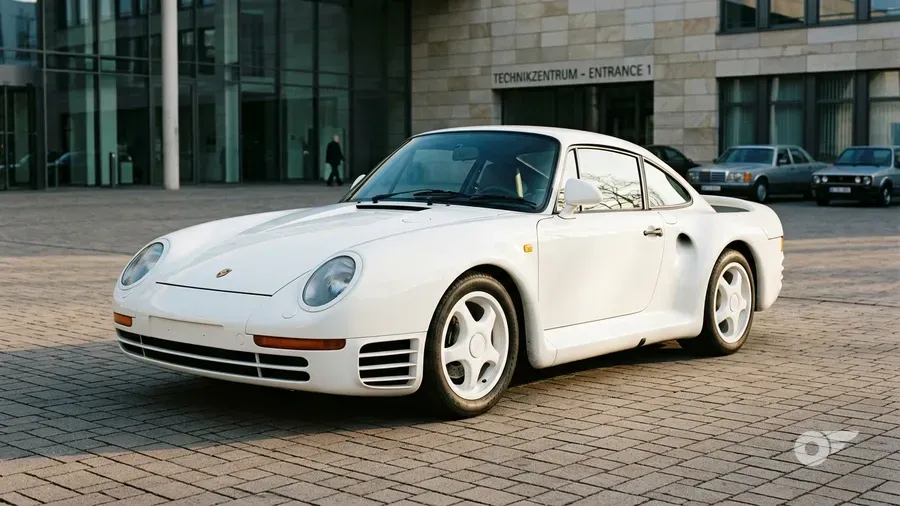
The last road car Enzo Ferrari approved, and Ferrari's answer to the Porsche 959
Callout
Thirteen months from Enzo Ferrari's request to the unveiling
What to watch for
Establish the specification before anything else, because the market prices it precisely. Ask whether the car is cat or non-cat and whether it has the adjustable suspension offered from 1991, since 'non-cat, non-adjust' is the phrase dealers lead with for a reason, and check whether the side windows slide or wind down. Then go to the fuel system, which is this car's defining bill. European cars use rubber fuel bladders that Ferrari recommends replacing on a ten-year cycle, and UK specialists now quote in excess of £22,000 for the parts alone, with one owner recently quoted £29,000 before fitting. Aluminium tank conversions run around €8,000 to €9,000 fitted and end the cycle for good; UK trade sources say US cars left the factory with aluminium tanks already. Belts are the other scheduled item, and on this engine that means engine out, quoted between $8,000 and $15,000 depending on scope. Listen for whistle or rattle from the water-cooled IHI turbos and look for oil smoke under boost, and ask when the clutch was last replaced. Study the composite panels in good light: the paint is thin, and repairing a bonded Kevlar and carbon clam is specialist work. Ferrari Classiche certification is worth its cost here.

The Story

Driving character

There is nothing between you and it. The steering is unassisted rack and pinion and the brakes have no servo, so both are hard work at parking speed and both report exactly what the tyres are doing once you are moving. Below about 3,500rpm the twin turbos are mostly making noise. Then boost arrives, hard, and keeps building through the 426lb-ft plateau and on toward 7,000rpm, and the shove is violent enough that period testers wrote about it as an event rather than a characteristic. Get greedy with the throttle mid-corner and the car will let go, because nothing is going to catch it for you. The five-speed is a synchromesh manual in a metal gate, positive rather than delicate, and buyers who wanted it harder could order the non-synchro sport gearbox. Inside there is no carpet on the floor, no sound deadening, no stereo and a cable loop where the door handle should be, so the cabin is loud in a way that has little to do with the exhaust: turbo whistle, wastegate, gear whine and a composite shell resonating around all of it.

Design

Pininfarina drew it in the time available, which was almost none. Pietro Camardella did the body under Aldo Brovarone's supervision with Leonardo Fioravanti running the studio, and Brovarone is credited with the decision that defines the car from behind: a rear wing standing up at right angles across the full width of the tail rather than blended into it. The shape is 288 GTO underneath and nothing like it on the surface, stretched at the nose for aerodynamics and cut open wherever function demanded it, with NACA ducts in the flanks and a louvred transparent cover over the engine. The body is eleven panels of Nomex, Kevlar and carbon composite bonded and bolted to a tubular steel frame, in three main sections, and the paint is thin enough that the Kevlar weave reads through the Rosso Corsa in the right light, particularly across the front clam. Every factory car was Rosso Corsa and left-hand drive. Inside, the composite is simply left exposed, the seats are one-piece Kevlar shells trimmed in red fire-retardant cloth, and there is no glovebox and no leather anywhere.

Motorsport pedigree

Ferrari never raced the F40 itself, which is the strange part given where the car came from. The works competition budget stayed in Formula 1, so the F40's racing life was built by Michelotto in Padua and run by customers. The first competition car appeared in IMSA GTO at Laguna Seca in October 1989 with Jean Alesi driving. He led, used up his tyres, and finished third behind the four-wheel-drive Audi 90s and ahead of the factory Mercury and Nissan entries. That afternoon is still the F40's best-known race result. The larger campaign came in the BPR Global GT Series. Strandell won the 4 Hours of Vallelunga in 1994, Pilot Aldix Racing won at Anderstorp in 1995 with Michel Ferte and Olivier Thevenin, and an F40 won at Anderstorp again in 1996. Le Mans was less generous. In 1995 the Pilot Aldix F40 LM finished twelfth overall, an F40 GTE took eighteenth overall and ninth in GT1, and its sister car retired with gearbox failure after seven hours. The 1996 entries all failed to finish, by which point the McLaren F1 and then the Porsche 911 GT1 had moved the class out of reach.

In culture

The F40 is the bedroom wall. It arrived at the moment the supercar poster became a mass-market product, it was the fastest thing you could buy, and it looked like a racing car that had escaped, so a generation who never saw one in traffic could draw that rear wing from memory. Carwow's tally of the most-featured cars in video games puts it in 84 titles, and it has been a fixture of Gran Turismo since GT5 Prologue as well as of the Forza and Need for Speed series. The owner list reads like the era. Nigel Mansell had one, and a former Mansell car later made €690,000 at Bonhams; Rod Stewart's sold for $990,000; Luciano Pavarotti had one. Two went to Pink Floyd, chassis 78122 to Nick Mason, who still keeps it in his Ten Tenths collection, and another to David Gilmour. The speculation was its own cultural moment: a $400,000 list price became roughly $900,000 on the secondary market by 1990 before the bubble broke, and by 1991 Car and Driver was describing $700,000 as a bargain.

Owning One

Why collectors want it

The F40 is one of the few cars where the story, the driving and the money all point the same way. It is the last thing Enzo signed off, the last Ferrari flagship built with no assistance of any kind between the driver and the mechanicals, and the car that turned a cancelled racing programme into a road car with no carpet on the floor. The market has never wavered on it. classic.com puts the all-time average at $2,913,183 and the twelve-month median at $3,702,500, and the highest recorded result for a road car now stands at $6,600,000, set at Mecum in January 2026. The Classic Valuer counts 134 recorded sales at a 79 percent sell-through rate, which for a 1,311-car Ferrari is a great deal of public trading and a great deal of price discovery. Inside the model the hierarchy is unusually clear. Early European cars without catalytic converters and without the later adjustable suspension are the ones collectors chase, the first fifty or so with sliding Plexiglas windows sit above those, and the 213 US-specification cars carry extra federal hardware and extra weight and trade below both. Provenance sorts out the rest.

Which one to look for

There is one road car, and the ways it changed now set the price. The first fifty or so left Maranello with sliding Plexiglas windows and no door trim at all, which is the purest version and priced as such. After that Ferrari fitted wind-down glass and a simple carbon door panel. From 1991 catalytic converters arrived with the revised Tipo F120 D engine, which had different intake valve timing to cope with the back pressure and was quoted marginally above the original F120 A rather than below it, and adjustable suspension became an option giving 20mm of ride height either way. The trade shorthand is cat or non-cat and adjust or non-adjust, and non-cat non-adjust is the combination that brings the money. US cars, 213 of them, carry federal bumper mountings, side impact bars, automatic belts and roughly 115kg of extra weight, with top speed quoted down to 194mph. Above all of it sit the competition cars built by Michelotto in Padua and sold as F40 LM, F40 Competizione and later F40 GTE. Nineteen is the figure usually given for all of them together, sources disagree on how they split, and they are a separate market: an F40 LM made $11,005,000 at RM Sotheby's in August 2025.

F40 · 1987–1992

The road car, and the only one of these Michelotto did not build. Tubular steel frame, eleven composite panels, 2,936cc twin-turbo V8 at 478PS, no ABS, no power steering, no servo on the brakes. The first fifty or so had sliding Plexiglas windows and no door trim; later cars got wind-down glass and a carbon door panel. From 1991 the catalysed Tipo F120 D engine arrived along with an optional adjustable suspension worth 20mm of ride height either way. Non-cat, non-adjust is the specification the market pays most for.

F40 Competizione

The designation applied to the Michelotto competition cars built after the first pair, mechanically along the same lines as the original LM with further engine and aerodynamic development. Quoted outputs run well past 700PS. Ferrari's own model listing dates the type to 1989, but individual cars were completed and further modified over several years, some of them by outside specialists after delivery.

F40 GTE · 1995–1996

Built by Michelotto for the BPR Global GT Series GT1 class, with the V8 enlarged to 3.5 litres for 1995 and 3.6 litres for 1996, quoted at roughly 612bhp. Strandell ran one under the Ferrari Club Italia banner. At Le Mans in 1995 a GTE finished eighteenth overall and ninth in GT1 while its sister car retired with gearbox failure; the 1996 entries all failed to finish. An F40 took the win at the 4 Hours of Anderstorp in both 1995 and 1996.

F40 LM · 1989

The first competition F40, developed with Michelotto in Padua for IMSA GTO. Uprated engine, revised suspension and aerodynamics, full cage and racing interior. Debuted at Laguna Seca in October 1989 with Jean Alesi driving, leading before tyre wear dropped him to third behind the four-wheel-drive Audi 90s. An F40 LM run by Pilot Aldix Racing finished twelfth overall at Le Mans in 1995.
What owning one is like

The F40 rewards use and punishes storage, which is the first thing owners say about it. Cars that sit develop fuel, brake and clutch problems that cars in regular use simply do not. The fuel cells are the headline item: European cars carry rubber bladders in foam that degrade with age, and the recommended ten-year replacement is a planned five-figure event rather than a surprise. Belts want doing on a schedule and the engine comes out to do them, which is why the invoice covers everything else convenient at the same time. The IHI turbos are water-cooled and generally durable, but worn seals show up as oil smoke under boost and turn up more often on cars that have seen track use. Clutches are a consumable behind that much torque. Bodywork is the other reality: composite panels are light and strong and they are not steel, so repairing a bonded Kevlar and carbon clam is a specialist job at specialist prices, and the Plexiglas on the earliest cars scratches. None of it is mysterious. The F40 has been in specialist hands for three decades and every failure mode is documented somewhere.

Upkeep & parts

Parts are better than the production number suggests. Eurospares lists a full F40 catalogue, Scuderia Car Parts and the UK specialists stock genuine and remanufactured items, and body panels are available new in carbon Kevlar from more than one supplier. Fuel cells are the item to budget for first: OEM bladders now run past £22,000 in parts, with quotes around £29,000 before fitting, while aluminium tank conversions from firms such as Bell Sport and Classic and SB Race Engineering come in around €8,000 to €9,000 fitted and end the ten-year cycle for good. The engine-out belt and major service is quoted between $8,000 and $15,000 depending on scope. Owner reports of all-in annual costs on a car in regular use cluster around €7,000 to €15,000 before anything unusual happens. For knowledge, FerrariChat's 288 GTO, F40, F50 and Enzo section is the deepest public technical archive, its F40 and F40 LM registry threads are where chassis questions get settled, and barchetta.cc keeps a serial-number register of the competition cars, though it has not been updated for some years. Ferrari Classiche will certify a car in Maranello, and on an F40 that certificate earns its cost.

Country of origin
Italy
Class
Exotic
Production years
1987–1992
Units built
~1,311
Model
F40
Nickname
No nickname
Body
Coupe
Layout
Mid-engine, RWD
Engine
2,936cc Tipo F120 A twin-turbocharged 90-degree V8, 478PS at 7,000rpm and 426lb-ft at 4,000rpm; Tipo F120 D catalysed version from 1991 for US and later European cars, quoted at 484PS
Transmission
5-speed synchromesh manual with limited-slip differential; a non-synchromesh sport gearbox was offered as a factory option
Designer
Pietro Camardella at Pininfarina, under the supervision of Aldo Brovarone, with Leonardo Fioravanti as Pininfarina's chief designer