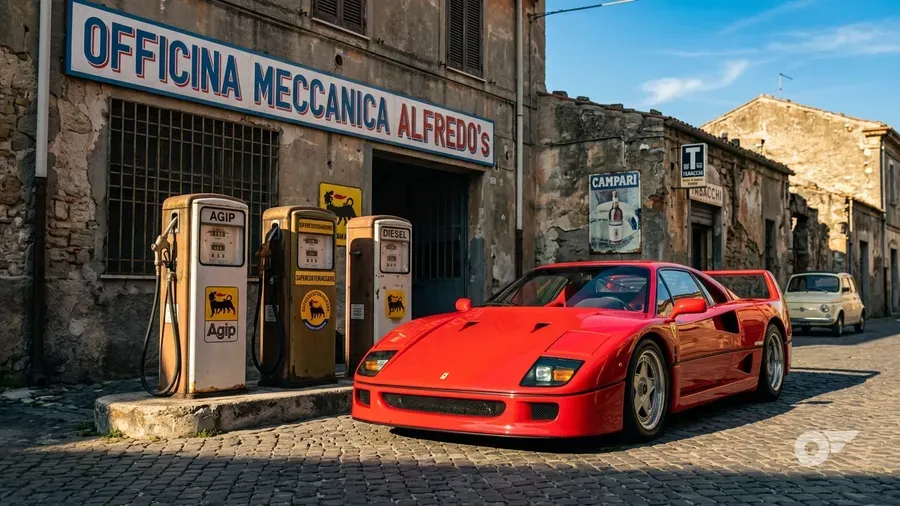
Ferrari F40
Italy·Exotic·1987–1992

The defining attributes and collector status that make this car garage-worthy.


Rated 1 to 10 on the traits that matter for owning, driving, and holding on to a car like this.
Demand tier, price trend, and typical values by condition. Our own assessment, not a quoted valuation.
Values as of August 2026.
What anyone seriously considering this car should know first.
Cars from the same manufacturer family, like platform siblings or shared-era relatives.
Cars from other manufacturers that competed for the same buyers when new.
The road car, and the only specification Ferrari sold. A 102kg carbon fibre monocoque with the 4,698cc Tipo F130B V12 bolted on as a stressed structural member, the six-speed gearbox hung off the engine and the rear suspension hung off the gearbox. 520PS at 8,500rpm, 347lb-ft at 6,500rpm, Bosch Motronic 2.7 management, electronically controlled Bilstein dampers, and no ABS, power steering, servo brakes or traction control. Targa roof, with a body-coloured hardtop plus a smaller canvas roof because the hardtop will not stow behind the seats. Options amounted to black or red fabric seat centres and a choice of five colours.
The competition car that never got a race. Developed with Dallara and Michelotto, the Padua firm behind the F40 racers, for the GT1 class. The 4.7-litre V12 was taken to roughly 750bhp at 10,500rpm with 380lb-ft at 7,500rpm, and the body gained a fixed roof, a new front spoiler and a far larger rear wing. Reported in 1996 testing as quicker than Ferrari's own 333 SP prototype. Ferrari cancelled the programme when the FIA admitted purpose-built homologation specials such as the Porsche 911 GT1 to the new FIA GT Championship, and redirected the budget to Formula 1.