Octane Files
Explore CarsFerrari 308

Ferrari 308

Overview

The 308 arrived at the Paris Salon in 1975 to replace the Dino 246, and it did the one thing the Dino never got to do. It wore the prancing horse. Enzo had refused to put his own badge on anything with fewer than twelve cylinders, which is why the 246 went out as a Dino and why the Bertone-bodied 308 GT4 spent its first years as one too. The 308 GTB was a Ferrari from the very first car, making it the first Ferrari-badged road car built around a V8. Underneath it was a 2,926cc 90-degree V8 mounted sideways behind the seats, four Weber carburettors, a five-speed gearbox and no alternative to any of it. Pininfarina got the shape back after Bertone's turn, Leonardo Fioravanti drew it, Scaglietti built the bodies, and the earliest cars came out of the mould in glassfibre. Over the following decade Ferrari built roughly 12,000 of them through carburettors, Bosch injection and four-valve heads. It became the most numerous Ferrari of its generation and the cheapest way into the marque for thirty years, and then a detective show in Hawaii turned it into the Ferrari everybody can picture.

Distinctions

The defining attributes and collector status that make this car garage-worthy.

Legend
A car that transcended the hobby, known far beyond the people who drive them.
Poster Car
The car on the bedroom wall, the one people dreamed about before they could drive.
Octane Files Select
Renowned for its history, engineering, or cultural weight.

Collectibility scorecard

Rated 1 to 10 on the traits that matter for owning, driving, and holding on to a car like this.

Desirability
7/10
Rarity
6/10
Driving thrill
8/10
Investment trajectory
6/10
Usability
7/10
Ease of restoration
5/10
Cultural impact
8/10
Electronic dependence
Fully analogHeavily electronic

Nothing on a 308 is computer controlled in the modern sense. The carburettor cars run four twin-choke Weber 40 DCNFs with a cable throttle, unassisted rack-and-pinion steering and hydraulic discs, and the only electronics aboard are the Marelli ignition. The 1980 GTBi and GTSi and the later quattrovalvole added Bosch K-Jetronic, which meters fuel mechanically through a sensor plate and plunger rather than through an ECU, plus a Marelli Digiplex MED 803A ignition with its own module and coil for each bank. That Digiplex box is the closest thing to a black box on the car. There is no ABS, no traction control, no power steering and no engine map to read.

Market data

Demand tier, price trend, and typical values by condition. Our own assessment, not a quoted valuation.

Demand tier
EntrySolidHighBlue-chip

Strong, sustained collector demand. Good examples never wait long for a buyer.

Value trajectory
AppreciatingStableCooling

Values are holding steady. What you pay today is what it's worth tomorrow.

Price by condition
Driver
$50k
Excellent
$80k
Concours
$125k

The 308 has stopped being cheap without becoming expensive. classic.com's tracked averages sit at 92,583 dollars for a GTB and 78,262 dollars for a GTS, and the European market has been broadly flat to slightly firmer since 2021, which is why this reads stable rather than climbing. The spread inside the model is wide. Classic and Sports Car's guide put restoration cases around 30,000 pounds and show cars at 85,000 pounds for a Weber car and 100,000 for a quattrovalvole, with vetroresina berlinettas at roughly double those numbers. The ceiling is set by cars that are barely 308s any more: a 1984 GT/M prototype made 1,158,125 dollars at RM Sotheby's Monaco in April 2026, and the Magnum pilot car took just under 380,000 at Barrett-Jackson the week before. The band below describes an ordinary steel-bodied car and deliberately excludes glassfibre, competition and screen history.

Values as of August 2026.

Buyer's guide

What anyone seriously considering this car should know first.

Why it's worth it
Eight seasons of Magnum P.I. made it the Ferrari everyone can picture
Callout
The first Ferrari-badged road car built around a V8
What to watch for
Rust decides the price. Ferrari did not rustproof these cars at the factory until 1984, the drain holes were badly placed, and the damage hides until it is structural. Start at the base of the A-post, then the sills where they meet the front wing, the door bottoms, the wheel arches, the buttresses and the boot floor. A glassfibre car is not exempt, because only the skin is composite: the tubular frame, sills and engine bay bulkhead underneath are steel, and they can be worse than a steel car's precisely because nothing warns you from the outside. Then buy the paperwork. Cambelts come due on time rather than on mileage, and a specialist doing them properly also does the cam seals, valve clearances and water pump while the covers are off, so a folder of belt receipts with no mention of those is half a service. Check oil pressure, roughly 40 to 45psi at idle and 85psi with revs. Expect a notchy shift and second gear balking until the oil is warm. Corroded fusebox contacts cause most of the electrical gremlins, and pop-up headlight motors fail. On any car with a claimed history, a Marcel Massini report or an F-Register letter is what turns a story into provenance.

The Story

Driving character

The engine sits sideways about a foot behind your left shoulder with almost nothing between it and you, so a 308 is loud in a way that is purely mechanical. The flat-plane V8 goes hard and thin at the top, four Webers hiss on the intake stroke, and there is gear whine and chain noise underneath all of it. The red line is 7,700rpm and the car wants all of them. Below 3,000rpm a carburettor car is lumpy and needs throttle, and it is easy to decide the thing is slow on that evidence. It is not slow, it is just out of its band. The controls are heavy and honest. The steering is unassisted rack and pinion, a genuine workout at parking speeds and beautifully weighted the moment you are moving. The lever runs through an open metal gate with an audible click, and second gear will refuse until the oil warms, which is a characteristic rather than a fault. Brakes want a firm foot. What surprises people is the size: a low scuttle, real visibility, and a car you place to the inch, which makes a 308 far less intimidating on a narrow road than the badge suggests.

Design

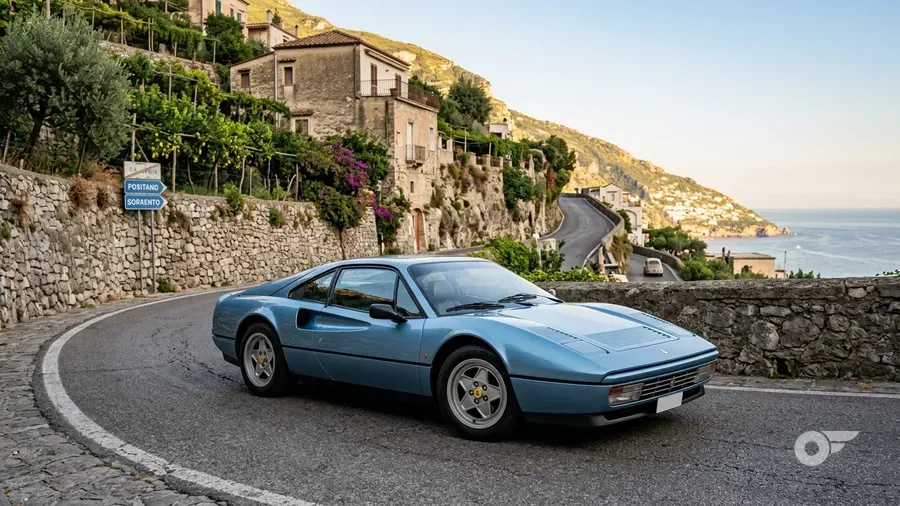
Pininfarina got the job back after Bertone's angular GT4, and Leonardo Fioravanti's answer was to draw the Dino 246 grown up. The carry-over is deliberate and obvious: the scalloped intake sunk into each door, the concave rear window dropped between two flying buttresses, the round tail lights in pairs. What is new is the wedge, a nose that falls far lower than the Dino's with pop-up headlights above it and one deep intake beneath the bumper line. Scaglietti in Modena built the bodies. The first cars were laid up in glassfibre, and the tell that separates one from a steel car is a fine indent line running between the windscreen pillar and the roof panel. From 1977 the upper body moved to steel while the lower sections and the GTS roof panel stayed composite. The targa arrived that same year, and its panel stows behind the seats rather than eating the boot, which is the detail that made the 308 a usable open car instead of a compromised one. Inside, the instruments sit in a binnacle canted at the driver and the gearlever runs in an exposed chromed gate, the two things that read as Ferrari from across a car park.

Motorsport pedigree

Ferrari did not go rallying. A Ferrari dealer did. Michelotto, in Padua, had already prepared Lancia Stratos, and at the end of the 1970s it began turning 308 GTBs into Group IV rally cars, eventually building 11 of them between 1978 and 1985 with Maranello's blessing. The recipe was Bosch Kugelfischer injection, around 375hp and, by 1982, a weight of 960kg, roughly 300kg under the road car. They won. Girardo and Co's register of the cars counts 30 outright victories between 1978 and 1982 across domestic and European events. Jean-Claude Andruet took four wins from nine starts in the 1981 European championship for Charles Pozzi's team, the Tour de France Automobile among them, then won that event again in 1982, the last time a Ferrari ever has. Tonino Tognana and Massimo De Antoni took the 1982 Italian Rally Championship for both drivers and constructors in the Jolly Club car, winning the Targa Florio rally on the way, and Antonio Zanini won in Spain. The result that outlives all of it is second on the 1982 Tour de Corse, a World Rally Championship round and the only WRC podium a Ferrari has ever taken. Four Group B cars and three GT/M prototypes followed, and the GT/M led straight to the 288 GTO.

In culture

Magnum P.I. ran on CBS from 1980 to 1988 and put a red 308 GTS in front of an American audience every week for eight years, on Hawaii plates reading ROBIN 1. Tom Selleck is six feet four, which the 308 was not designed around, so the seats were modified to fit him and a great deal of the show was shot with the targa panel off out of necessity as much as style. Roughly 15 cars were used during season one filming on Oahu alone and the production ran fresh cars through the run, which is why so many chassis carry a Magnum claim and why documentation matters more here than on almost any other car. The genuine pilot-episode car, chassis 28251, sold at Barrett-Jackson Palm Beach in April 2026 for just under 380,000 dollars, about four times what an ordinary GTS brings. It was busy elsewhere. Dean Martin and Sammy Davis Jr drove a red 308 GTS dressed as priests in The Cannonball Run in 1981, and the shape turned up through the decade on The A-Team, MacGyver and Highway to Heaven. Video games have kept it in front of people ever since.

Owning One

Why collectors want it

For thirty years the 308 was the Ferrari you bought when you could not afford a Ferrari, and the market has spent the last decade correcting that. The hierarchy inside the model is unusually clear. At the top are the glassfibre cars, the vetroresina berlinettas of 1975 to 1977, lighter and earlier and rare enough that sources still argue about how many exist: Ferrari's own factory count is 808, the figure quoted almost everywhere else is 712, and the difference is simply where you draw the line at which steel took over. Below them come the steel carburettor cars, then the quattrovalvole with its four-valve heads, and at the bottom the 1980 to 1982 GTBi and GTSi, which gave up about forty horsepower to Bosch injection and emissions plumbing and have never quite been forgiven for it. The berlinetta now carries more money than the targa-roofed GTS, the reverse of how they sold, with classic.com's tracked average at 92,583 dollars for a GTB against 78,262 for a GTS. What holds the whole thing up is that a 308 is genuinely usable, genuinely repairable, and the most recognisable Ferrari of the 1980s to anyone who owned a television.

Which one to look for

Rank them by body and by breathing. The 1975 to 1977 vetroresina berlinettas lead everything: glassfibre skin, roughly 150kg under the steel cars, and a production figure nobody agrees on, 712 by common count and 808 by Ferrari's own records. Steel carburettor cars follow, 2,185 berlinettas and 3,219 targas, and European-market examples are the ones to chase because they got dry-sump lubrication and 255hp where America, Australia and Japan got a wet sump and 240hp. The quattrovalvole of 1982 to 1985 is the sensible buy, 240hp from four-valve heads with fuel-injection manners, 748 berlinettas against 3,042 targas. The 1980 to 1982 GTBi and GTSi sit last on performance and first on affordability, though the 494-car GTBi is the rarest ordinary 308 of the lot. Two side branches are worth knowing. The Italian-market 208s used a two-litre version of the V8 to duck a tax band, and the 208 GTB Turbo of 1982 was the first turbocharged Ferrari road car, 437 built with 250 GTS Turbos after it. The Michelotto competition cars, 11 Group IV and 4 Group B, are a separate market entirely.

308 GT/M · 1984

Not a converted road car but a purpose-built competition prototype developed with Michelotto, with a circa 370hp three-litre V8. The direct engineering forerunner of the 288 GTO. One sold for 1,158,125 dollars at RM Sotheby's Monaco in April 2026, the highest price recorded for anything wearing a 308 badge.

308 GTB · 1977–1980

The steel-bodied berlinetta. Same four Weber 40 DCNF carburettors and 255hp in European trim, 240hp and a wet sump for the US, Australia and Japan. Heavier than the vetroresina but still the purest-driving 308 for most buyers, and the version that established the shape.

308 GTB Michelotto Group B · 1983

Michelotto's Group B answer, built to the regulations that forced steel bodywork back on and so around 990kg, with the four-valve quattrovalvole V8 producing about 320hp. Three of the four received the full four-valve specification.

308 GTB Michelotto Group IV · 1978–1985

Built by Michelotto in Padua, the Ferrari dealer that had prepared Lancia Stratos, with Maranello's blessing. Bosch Kugelfischer injection and around 375hp, down to 960kg by 1982. Won the 1981 and 1982 Tour de France Automobile with Jean-Claude Andruet and the 1982 Italian Rally Championship with Tonino Tognana, and took second on the 1982 Tour de Corse, the only WRC podium in Ferrari's history.

308 GTB Quattrovalvole · 1982–1985

Four valves per cylinder recovered the power lost to fuel injection: 240hp in Europe, 235hp in the US, with Bosch K-Jetronic retained. The sensible pick of the range and the rarest of the mainstream berlinettas after the GTBi.

308 GTB Vetroresina · 1975–1977

The launch car and now the one everyone wants. Glassfibre bodywork laid up by Scaglietti over the tubular frame, roughly 150kg lighter than the steel cars that replaced it, with the carburetted 2,926cc V8 and dry-sump lubrication on European examples. Identified by a fine indent line between the windscreen pillar and the roof panel.

308 GTBi · 1980–1982

Bosch K-Jetronic fuel injection replaced the Webers, along with Marelli Digiplex electronic ignition. Cleaner, easier to live with and down to 214hp in Europe, 205hp in the US. The least loved 308 on paper and, by production numbers, the rarest of the ordinary ones.

308 GTS · 1977–1980

The targa. A removable roof panel that stows behind the seats rather than in the boot, which is why the open 308 works as a usable car. Mechanically identical to the steel GTB and the version that outsold every other 308 by a wide margin.

308 GTS Quattrovalvole · 1982–1985

The final and most numerous 308, and the one that carried the model out to the 328 in 1985. Four-valve heads, injection, targa roof, and the best combination of usability and performance in the range.

308 GTSi · 1980–1983

The injected targa, and the car most people picture when they picture a 308, because it is what filled American driveways and television screens in the early 1980s. Same 214hp European and 205hp US output as the GTBi.
What owning one is like

A 308 rewards use and punishes storage, and once you accept that, the ownership makes sense. The cars with problems are the ones that sit: Weber jets gumming as fuel evaporates, cam seals drying and weeping, differentials that dislike months of stillness. Driven weekly it is an undramatic thing. The V8 is a strong unit that will cover serious mileage with belts and valve clearances kept up, and the reason it has a reputation for reliability among Ferraris is partly that there is simply less of it than a V12. The recurring bills are predictable rather than mysterious. Belts and the major service that goes with them come round on the calendar. Clutches go at around 30,000 miles and the carburettor cars have a heavy pedal in traffic. Valve guides wear and the car starts using oil, more so on one fed a diet of unleaded and short trips. Fusebox contacts corrode and produce faults that look electrical and are really just dirty. Exhausts are expensive. Rust is the one that genuinely costs, so keep the drains clear and keep the car dry.

Upkeep & parts

Mechanical parts are abundant for a hand-built Italian exotic of this age. Superformance in the UK and Ricambi America between them cover most of what a 308 wants, service kits come off the shelf, and Ferrari specialists everywhere already know the car. Hagerty's guide rates the 308 among the easiest Ferraris to work on, and eight cylinders instead of twelve keeps consumables sane. Budget around the belt service. It falls due on the calendar rather than the odometer, and the engine does not have to come out: the job is done through the wheel well and engine bay with the car on a lift. Do the water pump, cam seals and valve clearances at the same visit or you pay the same labour twice. Body and trim are where money disappears, so buy the rust problem you can see rather than the one you cannot. The reference material is unusually good. The 308 GTB Register publishes production figures and chassis ranges variant by variant, FerrariChat's 308/328 forum holds decades of documented repairs, and the Ferrari Club of America runs judging and events. Marcel Massini's history reports are the accepted authority when a car's story needs proving.

Country of origin
Italy
Class
Exotic
Production years
1975–1985
Units built
~12,143
Model
308
Nickname
No nickname, though the early glassfibre cars are universally called vetroresina
Body
Coupe, Targa
Layout
Mid-engine, RWD
Engine
2,926cc Tipo F106 90-degree V8, flat-plane crank, twin overhead camshafts per bank, four twin-choke Weber 40 DCNF carburettors, 255hp Europe and 240hp US (1975-1980); same 2,926cc V8 with Bosch K-Jetronic fuel injection, 214hp Europe and 205hp US (GTBi and GTSi, 1980-1982); 2,926cc quattrovalvole V8 with four valves per cylinder and Bosch K-Jetronic, 240hp Europe and 235hp US (1982-1985)
Transmission
5-speed manual transaxle mounted in unit with the engine (the only transmission offered)
Designer
Leonardo Fioravanti (Pininfarina)