Octane Files
Explore CarsLotus Esprit S2

Lotus Esprit S2

Overview

The Series 2 is the Esprit that had to survive, and very nearly did not. It arrived in 1978 as a sensible tidy-up of the S1: cooling ducts behind the rear quarter windows, Rover SD1 tail lights, a front spoiler folded back into thin black sills, Lotus's own 14-inch Speedline wheels, the battery moved to the tail, wider seats and a set of Smiths gauges in place of the S1's one-piece Veglia binnacle. Better car, same idea.

Then the market fell in. Lotus built 553 Esprits in 1978 and 474 in 1979. In 1980 it built 137. Not 137 of one model either: by the end of that year Hethel was producing a domestic S2.2, an export S2.2 and the dry-sump Turbo Esprit, three specifications with three chassis designs and three sets of body moulds, for a total output a Ford dealer would have moved in a fortnight.

What came out of those four years is the reason the Esprit lasted another twenty-two. The chassis was galvanised from 1980. The engine grew to 2.2 litres. Lotus turbocharged it. And in December 1982, with all of that just settled, Colin Chapman died.

Distinctions

The defining attributes and collector status that make this car garage-worthy.

Octane Files Select
Renowned for its history, engineering, or cultural weight.

Collectibility scorecard

Rated 1 to 10 on the traits that matter for owning, driving, and holding on to a car like this.

Desirability
5/10
Rarity
7/10
Driving thrill
6/10
Investment trajectory
5/10
Usability
3/10
Ease of restoration
4/10
Cultural impact
5/10
Electronic dependence
Fully analogHeavily electronic

Twin Dell'Orto carburettors on every naturally aspirated car, a distributor, unassisted rack and pinion steering, and no engine management of any kind. Even the Essex Turbo is mechanically controlled: a Garrett turbocharger, a wastegate and carburettors, with boost limited by a spring rather than a chip. There is no injection, no anti-lock and no power assistance anywhere in the generation. The electrics that exist are the windows, the pop-up headlamp motors and a great many Morris Marina switches, all of which are fixed with a test lamp.

Market data

Demand tier, price trend, and typical values by condition. Our own assessment, not a quoted valuation.

Demand tier
EntrySolidHighBlue-chip

A dependable market. Well-kept cars hold their value and find ready buyers.

Value trajectory
AppreciatingStableCooling

Values are holding steady. What you pay today is what it's worth tomorrow.

Price by condition
Driver
$22k
Excellent
$36k
Concours
$58k

classic.com's Series 2 average is $33,212, the lowest of the five Esprit generations and about 28% below a Series 1. The bottom is genuinely low: a 1979 JPS Edition sold for $14,500 in January 2024. The generation is priced as the sensible way into the Giugiaro shape rather than as a collector car in its own right, and the two exceptions prove it. An Essex Turbo, at 45 cars, and a documented S2.2, at 88, sit well above this band and are traded on rarity rather than on the S2 market. Values have been flat for several years. The galvanised chassis on later cars is the single largest swing factor within the generation.

Values as of August 2026.

Buyer's guide

What anyone seriously considering this car should know first.

Why it's worth it
The Esprit that survived Lotus's worst year, and the first one the factory turbocharged.
Callout
Lotus built 137 Esprits in the whole of 1980, in three specifications, using three separate sets of body moulds.
What to watch for
The single most useful question on an S2 is when it was built, because the chassis changed underneath the car without changing the look of it. Cars up to 1980 have a bare steel backbone. The S2.2 and everything after it are galvanised. That one fact moves a car from a restoration risk to a straightforward proposition, so establish it before anything else and tap along the spine regardless. Lotus laid felt between body and frame for noise insulation, and wet felt holds water against steel. Engine next. The 2.0 Type 907 and the 2.2 Type 912 are the same architecture, alloy head on an alloy block, and both want their cooling system genuinely right rather than merely full. Look for head gasket history. The 2.2 gives 160 lb ft against the 2.0's 140 with no more power, so it is the easier car to drive and the more desirable one. For a JPS, ask for evidence. The cars were mechanically standard 2.0s with special trim, a smaller wheel and a numbered plaque, which is a specification that has been recreated more than once. The plaque and the paperwork are the car.

The Story

Driving character

An S2 drives like a slightly civilised S1, which is exactly what Lotus intended and slightly less than what buyers wanted. The unassisted steering is still the best thing about it, quick and completely uninsulated, and the car is still light enough that you place it with your fingertips. What has gone is a little of the S1's raw edge: wider seats, better sound deadening and a proper set of Smiths gauges make it a car you can cross a country in rather than merely attack a road with. The 2.0 Type 907 remains the weak point. Willing above 4,000rpm, thin below it, and geared optimistically. The 2.2 Type 912 fitted to the S2.2 does not add power but adds 20 lb ft, and it transforms the way the car moves in third gear. The Essex Turbo is a different machine entirely. 213 PS and a dry sump turned the Esprit from quick into fast, with the sudden, laggy, all-or-nothing delivery that made turbocharged cars of 1980 exciting and slightly alarming. The Citroen transaxle shifts sweetly. The linkage never quite feels like it is connected to anything.

Design

Everything the S2 changed, it changed for a reason, and most of the reasons were cooling. The ducts behind the rear quarter windows, the feature that ends up defining the shape from the side, are there to feed air to the engine bay and the radiator. The front spoiler stopped being a bolted-on shovel and folded rearward under the nose to start the thin black sills that run the length of the car. Lotus designed its own 14-inch Speedline alloys to replace the Wolfrace wheels that had made the S1 look faintly like a kit car. The tail lights came from the Rover SD1, which is a straight upgrade on the S1's Fiat X1/9 units and, unusually for this car, a British part. Inside, the S1's one-piece binnacle gave way to individual Smiths gauges and illuminated switchgear, a lot of which came from the Morris Marina. None of it touches Giugiaro's surfaces. The wedge is untouched. What the S2 does is turn a show car that reached production into something Lotus could build repeatedly and a customer could live with.

Motorsport pedigree

No Esprit raced in this period, and the reason is money rather than ambition. Lotus in 1978 was running a Formula One team that won the drivers' and constructors' titles with the ground-effect Type 79, and there was nothing left over for a sports car programme. The road-car company was building 137 Esprits a year by 1980. It could not have supported a race team if it had wanted one. What this generation has instead is a motorsport connection stranger than any race result. The Essex Turbo Esprit exists because Essex Overseas Petroleum sponsored Team Lotus from 1979, and the road car was launched in the Royal Albert Hall in February 1980 in Essex's blue, red and chrome, with Colin Chapman, Essex's David Thieme and Roger Penske on stage together amid artificial snow. The bill was reputedly a million pounds, from a company that would build 137 cars that year. The JPS Commemorative does the same job in reverse: a road car built to sell a championship the racing team had already won. The Esprit would eventually race properly, in America, a decade later.

In culture

The S2's cultural moment is not a film, it is a party. On a February evening in 1980 Lotus took over the Royal Albert Hall to launch the Essex Turbo Esprit, at a cost reputed to be around a million pounds, with Colin Chapman, David Thieme of Essex Overseas Petroleum and the American team owner Roger Penske revealing the car on stage in a blizzard of artificial snow. Lotus built 137 Esprits that year. That single evening tells you more about Lotus at the turn of the 1980s than any road test. Thieme's sponsorship money was funding Team Lotus and now a road car in its colours; within two years Essex was gone. The DeLorean contract that Lotus had taken on for the same reason, to keep the lights on, ended in receivership in February 1982. On 16 December 1982, ten months after that, Colin Chapman died of a heart attack at home near Norwich. He was 54. The Esprit had been in production for six and a half years, and every one of the eight thousand or so that followed was built by a company he never saw.

Rivals

Cars from other manufacturers that competed for the same buyers when new.
Owning One

Why collectors want it

The S2 is the value entry into the Giugiaro wedge, and that is a genuine argument rather than a consolation prize. classic.com's Series 2 average sits at $33,212 against $46,057 for a Series 1. For a third less money you get the same folded-paper shape, better instruments, better seats and, on a post-1980 car, a galvanised chassis the S1 never had.

Then there are the two cars inside the generation that people actually chase. The JPS Commemorative marked Lotus's 1978 Formula One title in black and gold. Lotus said it built a series of 300; the registers that have counted them find roughly 150, which makes it rarer than the marketing did. And the Essex Turbo Esprit of 1980 is the first factory-turbocharged Lotus road car, 45 of them, launched with more theatre than the company could remotely afford.

The wider case is that this is the hinge. Everything the Esprit became, turbocharged, galvanised, 2.2 litres, was decided in these four years while Lotus was losing money on every front. It is the least glamorous Esprit and the one that did the most work.

Which one to look for

Four cars sit under this badge and they are not equal. The plain S2 is the 2.0-litre volume car, 1978 to 1980, and the one most examples will be. Fine, and the cheapest way into the shape. The JPS Commemorative is the one everybody knows: black and gold for Lotus's 1978 Formula One championship, mechanically an ordinary 2.0 with special seat and dash trim, a smaller steering wheel and a numbered plaque. Lotus announced a series of 300. The registers find roughly 150. Buy the paperwork as much as the car. The S2.2 is the connoisseur's pick and the rarest of the four: 88 built in a thirteen-month run from May 1980, with the 2.2-litre Type 912 lifting torque from 140 lb ft to 160 with no gain in power, and the first galvanised chassis on any Esprit. It did not get the revised chassis structure that came with the Series 3, so it is a genuine one-year-only specification. The Essex Turbo Esprit is the grail and the awkward one. 45 built, dry-sump Type 910, 213 PS, and mechanically a Series 3 sold a year early, which is where its production figures are counted.

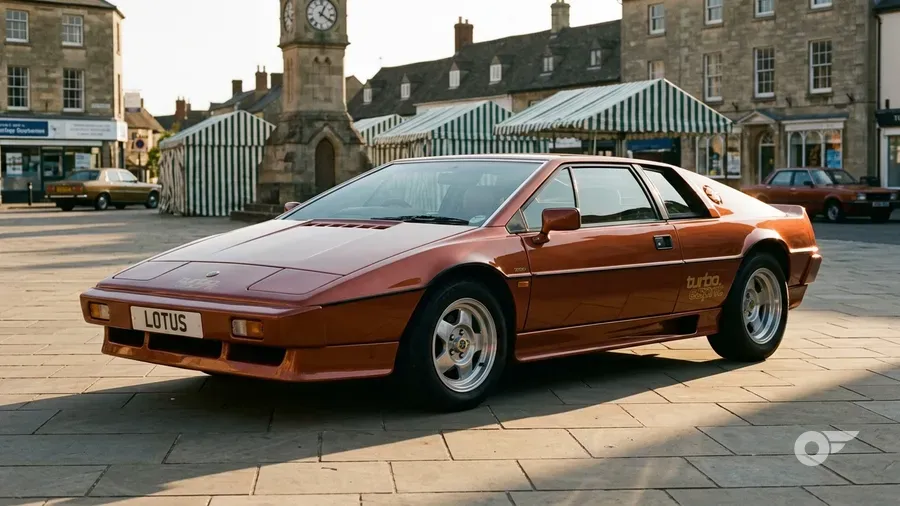
Essex Commemorative Turbo · 1980

The first turbocharged Esprit, launched at the Royal Albert Hall in February 1980 in Essex Petroleum's blue, red and silver, with Colin Chapman, Essex boss David Thieme and Roger Penske on the stage. Type 910 2.2-litre turbo, 210hp, new galvanised chassis and revised suspension.

JPS Commemorative · 1978

Black and gold, marking Lotus's 1978 Formula One title with Andretti. Mechanically an ordinary 2.0 S2 — the changes are special seat and dash trim, a smaller steering wheel and a numbered plaque. The commemorative Esprit that people actually remember, and the one whose build count nobody agrees on.

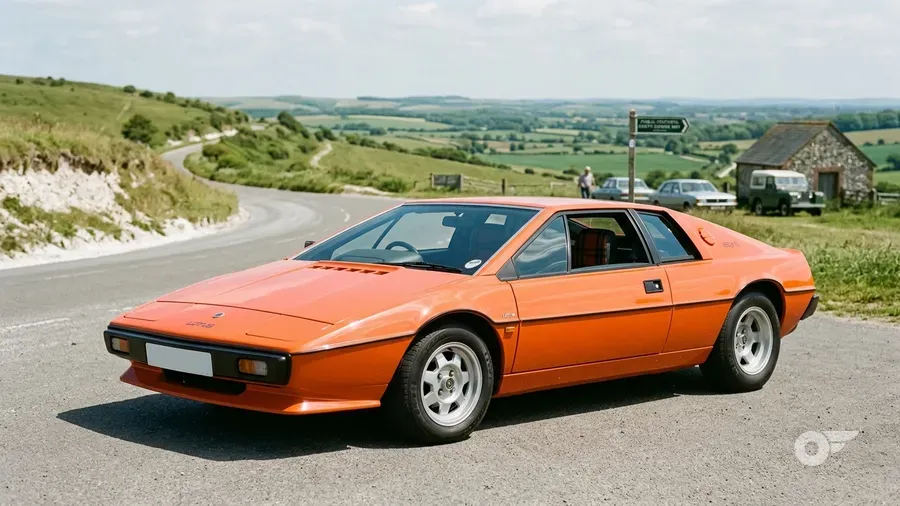
S2 · 1978–1982

Detail fixes rather than a rethink: better engine cooling through vertical intakes behind the rear quarter windows, a fully integrated wraparound front spoiler in place of the S1's chin spoiler, and tail lamps lifted from the Rover SD1.

S2.2 · 1980–1981

A stop-gap sold while the Turbo was readied. The Type 912 2.2-litre engine brought more torque rather than more power, and this is where the galvanised chassis arrives.
What owning one is like

An S2 is a straightforward car to own once you know which chassis is underneath it. On a pre-1980 example the bare steel backbone is the whole story, and the felt insulation between body and frame is where the rot begins, quietly and out of sight. From 1980 the chassis is galvanised and the conversation changes completely: visible corrosion on a later car usually means an accident repair rather than age. The glassfibre body does not rust but crazes at stress points and hides impact damage well, so uneven panel gaps and hairline splits are worth more attention than they look like they deserve. Earthing is a permanent theme, because a glassfibre shell gives nothing to earth to and every component is wired back to the chassis. One tired connection shows up as a fault somewhere unrelated. The alloy-head four wants its cam belt on interval and its cooling system properly sorted. Pop-up headlamp pods take water into their wiring. On an Essex Turbo, the dry-sump system is one more thing to maintain and one more thing a generalist will get wrong. Almost none of this is expensive. All of it is cheaper to check than to discover.

Upkeep & parts

Mechanical parts are reasonable, because the S2 shares most of its running gear with the Series 3 that followed and the Esprit range stayed in production until 2004. PNM Parts covers most of it, and replacement galvanised backbone chassis are available from Lotus specialists, which is the difference between a rotten S2 being a project and being scrap.

The scarce items are S2-specific trim. Speedline wheels, the Smiths instrument set and the JPS interior fittings were used on this generation and nothing else. Rover SD1 tail lights are the easy one, since the donor car was built in tens of thousands.

Budget for the cam belt on interval and for the cooling system as a rebuild rather than a repair. An Essex Turbo adds the dry-sump plumbing and a Garrett turbocharger to that list, and both want a specialist.

The knowledge base is unusually good for a car this rare. Lotus Esprit World holds Lotus's own production spreadsheet along with period road tests, the Esprit Fact File tracks every specification change year by year, and both The Lotus Forums and LotusTalk have owners who have done all of this before.

Country of origin
UK
Class
Sports
Production years
1978–1982
Units built
~1,148
Model
Esprit
Nickname
No nickname ("JPS" names the black-and-gold Commemorative Edition specifically, not the generation)
Body
Coupe
Layout
Mid-engine, RWD
Engine
2.0L Type 907 16-valve twin-cam inline-four, 2.2L Type 912 16-valve twin-cam inline-four
Transmission
5-speed Citroen C35 manual transaxle
Designer
Giorgetto Giugiaro (Italdesign, original body), Oliver Winterbottom (Lotus body engineering)