Octane Files
Explore CarsLotus Esprit S3

Lotus Esprit S3

Overview

These are the years the Esprit stopped being a promising idea and started being a business. The Series 3 and the Turbo Esprit arrived together in April 1981 sharing one chassis and one set of body moulds, and from 1982 to 1987 Lotus built more Esprits than in any comparable stretch before or after: 365, 427, 522, 451, 454, 462. After 137 cars in 1980, that is a company back on its feet.

The chassis is the reason. Wider box sections, new suspension pickups, an extra upper link at the rear to stop the half-shafts doing suspension work, bigger brakes and a galvanised finish carrying a five-year anti-corrosion warranty that became eight years in 1985. It is the single biggest engineering step in the car's life, and every Esprit built afterwards is a development of it.

The Turbo Esprit is what people remember. 213 PS from 2.2 litres, Giugiaro's aerodynamic kit, BBS wheels, decals along the sills, and a top speed of 150mph in 1981. It is the Esprit of the 1980s bedroom wall, and it is the one Bond drove in For Your Eyes Only.

Distinctions

The defining attributes and collector status that make this car garage-worthy.

Legend
A car that transcended the hobby, known far beyond the people who drive them.
Poster Car
The car on the bedroom wall, the one people dreamed about before they could drive.
Octane Files Select
Renowned for its history, engineering, or cultural weight.

Collectibility scorecard

Rated 1 to 10 on the traits that matter for owning, driving, and holding on to a car like this.

Desirability
7/10
Rarity
5/10
Driving thrill
7/10
Investment trajectory
6/10
Usability
4/10
Ease of restoration
6/10
Cultural impact
8/10
Electronic dependence
Fully analogHeavily electronic

Most of this generation is still carburetted, and a carburettor Turbo Esprit is a mechanical device throughout: Dell'Orto DHLA 45E carburettors, a Garrett turbocharger, a wastegate holding boost with a spring, unassisted rack and pinion steering and no anti-lock. The exception is what lifts it off 1. From 1985 the HCi, which the factory logged as HCPI, added Bosch KE-Jetronic injection and a catalytic converter for emissions markets, so a late injected car has a metered fuel system and a lambda loop where a carburettor car has jets. Still no engine computer, still no power assistance of any kind.

Market data

Demand tier, price trend, and typical values by condition. Our own assessment, not a quoted valuation.

Demand tier
EntrySolidHighBlue-chip

A dependable market. Well-kept cars hold their value and find ready buyers.

Value trajectory
AppreciatingStableCooling

Values are holding steady. What you pay today is what it's worth tomorrow.

Price by condition
Driver
$24k
Excellent
$42k
Concours
$68k

classic.com's Series 3 average is $33,643, only fractionally above the Series 2 and well under the Series 1's $46,057, which is the market pricing this generation on volume rather than on merit. Roughly three thousand cars were built and enough survive that a buyer has real choice, so condition sets price almost entirely. Within the generation the hierarchy is clear: a Turbo Esprit HC sits at the top, the plain carburettor turbo next, the injected HCi slightly behind it, and the naturally aspirated S3 at the bottom despite being far the rarest. Values have been flat for several years and the turbo cars are the ones with room to move.

Values as of August 2026.

Buyer's guide

What anyone seriously considering this car should know first.

Why it's worth it
The Turbo Esprit, and the six years when the Esprit finally sold in the numbers Lotus needed it to.
Callout
One model, the carburettor Turbo Esprit, accounts for 2,274 cars, better than a fifth of every Esprit ever built.
What to watch for
Start with which car you are looking at, because this generation contains five distinct specifications and they are not priced alike. Establish whether it is naturally aspirated or turbo, and if turbo, whether it is a carburettor car, an HC, or an injected HCi (the factory called those HCPI, and you will see both names). Chassis is easier here than on any earlier Esprit. Everything from April 1981 is galvanised, later cars carry an eight-year warranty, and visible corrosion on one of these usually means an accident repair rather than age, so treat rust as a paperwork question rather than a metallurgy one. Check the alloy rear suspension uprights instead: they corrode, and the mounting lugs snap if somebody attacks them with a hammer. The engines want cooling and cam belts. An alloy head on an alloy block does not forgive overheating, and the radiator sits low with long pipe runs behind it. Fuel tanks rust. On a turbo, check the wastegate operates and that boost is not creeping past 0.8 bar, which is where somebody has been optimistic with an adjuster.

The Story

Driving character

The naturally aspirated S3 and the Turbo Esprit share a chassis and feel almost nothing alike. The S3 is the last light Esprit, 1,120kg, unassisted, with 160bhp that arrives progressively and steering that reports the road surface in unbroken detail. It is the closest this generation gets to the S1 and it is the better-sorted car. A Turbo Esprit is a period piece in the best sense. Below 3,000rpm the Garrett is doing nothing and the car feels ordinary. Above it, boost arrives in one movement and the Esprit goes from quick to genuinely fast, with the sudden step in delivery that made turbocharging exciting in 1981 and that modern engines have engineered away. 150mph, in a Lotus, in 1981. The 1981 chassis is what makes either car worth driving hard. The extra rear upper link stops the half-shafts doing suspension work, the wider track settles the car, and the bigger brakes actually stop it. The Citroen transaxle still shifts sweetly and the linkage still feels remote. Cabin noise is half what an S2.2 produced, which is faint praise honestly given.

Design

The Turbo Esprit is where Giugiaro's clean wedge gets its 1980s clothes, and Giugiaro drew them himself: a rear lip spoiler, a prominent louvered rear hatch, substantially heavier bumpers, a deeper front airdam, ducts in the sills ahead of the rear wheels, and three-piece 15-inch wheels. Add the turbo esprit script along the nose and sills and you have the shape a generation of British teenagers could draw from memory. The S3 kept the restrained version: the new bumpers, but the simpler sill line and the glazed rear hatch carried over from the S2.2, with 14-inch JK wheels as standard and the BBS cross-spokes optional. Two quite different cars out of one set of moulds. Interior changes were about liveability rather than style. New insulation halved cabin noise against the S2.2, and the Turbo's twin-spoke steering wheel came across to the S3. The oddity that period road testers kept mentioning is that an Esprit S3 had no cigarette lighter as standard equipment, though it did have ashtrays, tucked into the door sills. In 1982, in a car costing what this one cost, that was worth a paragraph.

Motorsport pedigree

The Esprit did not race in this period and Lotus was in no position to make it. Team Lotus was in decline after Chapman's death in December 1982, and the road-car company spent these years doing engineering consultancy for other manufacturers because that was where the money was. A works Esprit race programme would have cost more than the model earned. What the generation has instead is a name built on the road. The Turbo Esprit's 150mph was a real number in 1981, quick enough that the car was credible against Porsche and Ferrari without ever needing to prove it on a circuit, and Lotus leaned on the Formula One association rather than on results. The Esprit's actual competition record starts on the next body shape and in another country. Lotus built the X180R for IMSA's Bridgestone Supercar series from 1990, took the drivers' and manufacturers' titles in 1992, and later ran the Type 114 GT1 in the 1996 BPR series. Both belong to other pages. This one is the car that made those worth attempting.

In culture

If the S1 is the Bond car people remember, the Turbo Esprit is the one they actually saw on the road. For Your Eyes Only in 1981 used two of them: a white car with red decals that is destroyed early in the film by its own anti-theft system, and a Copper Fire Metallic car with gold decals that does the driving later. Two Esprits, one film, and the white one lasts about a minute. The wider cultural work this generation did was on bedroom walls rather than on screen. Between 1982 and 1987 the Turbo Esprit was the affordable British entry in a poster market otherwise owned by the Countach and the 911 Turbo, and the decals down the sills were doing exactly the job they look like they were doing. Lotus was also becoming other people's engineering department in these years, which is why an Esprit-era Lotus badge turns up in unexpected places. That story properly belongs to what the company did next, and to the cars it did it on.

Owning One

Why collectors want it

This is the Esprit generation with the best ratio of what you get to what you pay. classic.com's Series 3 average is $33,643, barely above the Series 2 and well under a Series 1, and for that you get the chassis Lotus should have built in 1976, an eight-year anti-corrosion warranty on later cars, and, if you buy a turbo, genuine 1980s supercar performance.

The Turbo Esprit is the car that made the Esprit's reputation stick. It is quick, it is loud, it is covered in decals, and it was on more bedroom walls in Britain than anything except a Countach. It was also the Bond car in For Your Eyes Only, twice over, and the second one was Copper Fire Metallic rather than white, which is the detail that separates people who know the film from people who think they do.

The naturally aspirated S3 is the quiet argument. 763 built against 2,274 turbos, so it is much rarer, and with 160bhp in 1,120kg it is the lightest, purest-steering car of the era. Nobody wants it, which is exactly why it is worth looking at.

Which one to look for

Rank them by engine, not by year. The Turbo Esprit HC of 1986 is the one to want. 218 PS and 220 lb ft from the high-compression Type 910, on the last and best-developed version of the Giugiaro body, with BBS wheels and the full aerodynamic kit. It is the fastest, the most usable and the most wanted car in the generation. The plain carburettor Turbo Esprit that preceded it is the volume choice and no disgrace: 213 PS, 150mph, and the same shape. Buy on condition rather than on year. The HCi, which the factory recorded as HCPI, is the injected turbo built for emissions markets from 1985. Same peak power at higher revs, torque down to 274Nm, Bosch KE-Jetronic and a catalytic converter. It drives slightly softer and it is the easier car to start on a cold morning. The naturally aspirated S3 is the contrarian pick. 160bhp, 1,120kg, the best steering of the five specifications and far rarer than any turbo. The 1986 HC version lifted it to 172 PS. Any pre-1985 car predates the eight-year anti-corrosion warranty, which is worth knowing but not worth much.

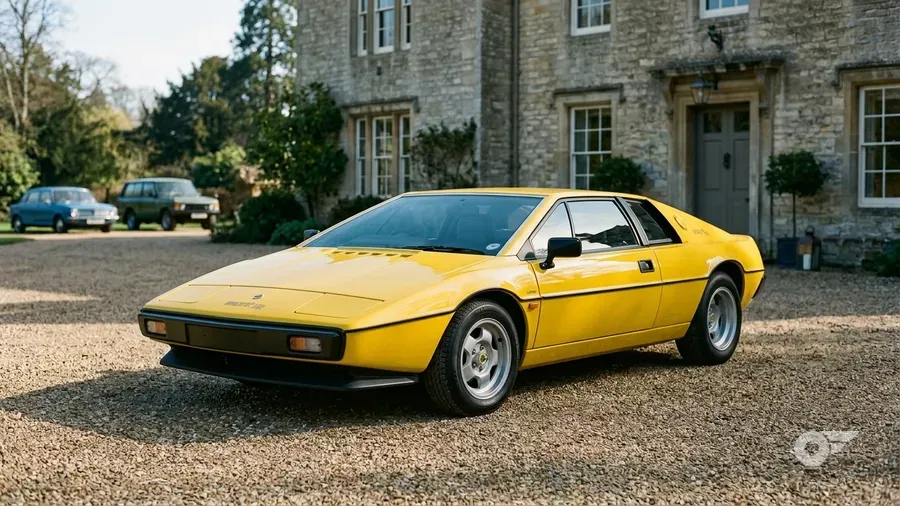
S3 · 1982–1988

The naturally aspirated car rebuilt around the Turbo's chassis, suspension and 15-inch wheels. Type 912 2.2-litre, 172 PS, and the best-driving of the non-turbo Esprits.

Turbo Esprit · 1980–1988

The Essex car in ordinary colours, and the version that made the Esprit's supercar reputation. 2.2-litre Type 910 turbo, 210hp, bodykit with side skirts and a rear spoiler. Later high-compression cars raised output again.

Turbo Esprit HC · 1986–1988

The high-compression update announced in April 1986, and the last meaningful change to the carburettor Turbo. Compression up from 7.5:1 to 8.0:1 for 218 PS and 220 lb ft — more torque, delivered lower, on the same Type 910. The naturally aspirated S3 got the same treatment, going from 9.4:1 to 10.9:1 and 172 PS.

Turbo Esprit HCi · 1985–1988

The HC engine with Bosch KE-Jetronic injection and a catalytic converter, built for emissions markets — chiefly the United States. Peak power holds but arrives higher up, and torque drops to 274Nm. The factory's own production spreadsheet heads this column HCPI, which is why the car is sometimes catalogued under that name instead.
What owning one is like

This is the easiest Esprit generation to own before the X180, and the galvanised chassis is why. Everything from April 1981 got it, later cars carried an eight-year anti-corrosion warranty, and the result is that structural rot on one of these is unusual enough to be a warning sign rather than an expectation. What does corrode is the aluminium. The rear suspension uprights suffer, and the mounting lugs are brittle enough to snap if somebody applies force to a seized fastener. Fuel tanks rust from the inside. Neither is a disaster and both are known. The engines are the same alloy-head, alloy-block four in five states of tune, and they want the same things: cam belts on interval, a cooling system that is genuinely healthy rather than merely topped up, and an owner who understands that a low-mounted radiator with long pipe runs behind it needs bleeding properly. Turbo cars add a Garrett and a wastegate to the list. The rest is glassfibre behaviour. It does not rust, it crazes at stress points, and it conceals accident repair well. Panel gaps tell you more than paint does.

Upkeep & parts

Parts support for this generation is the best of the four-cylinder Esprits, because it ran for six years, sold in the biggest numbers, and shares almost everything with the X180 that followed. PNM Parts covers most of the mechanical range, replacement galvanised chassis are available, and the engines are the same 900-series architecture Lotus used until 1999, so consumables are not exotic.

Budget for cam belts on interval and for the cooling system as a job rather than a repair. On a turbo, add the wastegate and the boost control to the annual list. Alloy suspension uprights and fuel tanks are the two items most likely to surprise you, and both are cheaper to sort at purchase than at failure.

Trim is where the money hides. BBS cross-spokes, the turbo esprit decal sets and the Giugiaro aerodynamic panels are all sourceable but none is cheap, and a car missing them looks wrong in a way that is hard to unsee.

The Esprit Fact File tracks every specification change year by year, which on a generation with five engine variants is the single most useful thing to have open while you look at cars.

Country of origin
UK
Class
Sports
Production years
1982–1988
Units built
~2,992
Model
Esprit
Nickname
No nickname ("Essex" names the 45-car Essex Turbo Esprit specifically, not the generation)
Body
Coupe
Layout
Mid-engine, RWD
Engine
2.2L Type 912 16-valve twin-cam inline-four, 2.2L Type 912 HC 16-valve twin-cam inline-four, 2.2L Type 910 turbocharged inline-four, 2.2L Type 910 HC turbocharged inline-four, 2.2L Type 910 HCi fuel-injected turbocharged inline-four
Transmission
5-speed Citroen C35 manual transaxle
Designer
Giorgetto Giugiaro (Italdesign, body and Turbo aerodynamic kit)