Octane Files
Explore CarsLotus Esprit X180

Lotus Esprit X180

Overview

Peter Stevens took the corners off, and it worked. The 1987 restyle kept Giugiaro's proportions and rounded every edge, and the car underneath changed more than the car on top: new body panels made by Lotus's own VARI resin-injection process instead of hand lay-up, Kevlar in the roof and sides for roll-over protection, and a 22% gain in torsional rigidity out of it. Giugiaro reportedly liked the result, remarking that it was perhaps too close to his own.

Then Lotus fixed the engine. The 1989 Turbo SE got Lotus and Delco multipoint injection and an air-to-water-to-air intercooler the company insisted on calling a Chargecooler, and the Type 910S went to 264hp, 284 PS on overboost, 0-60 in a claimed 4.7 seconds and over 160mph. In 1989, that was Ferrari 348 performance from a British four-cylinder.

It is also the Esprit that went racing and won. Lotus built the X180R for IMSA's Bridgestone Supercar series, and Doc Bundy took the 1992 drivers' title with the manufacturers' championship alongside it. Of the five Esprit generations, this is the one that best rewards being driven hard.

Distinctions

The defining attributes and collector status that make this car garage-worthy.

Poster Car
The car on the bedroom wall, the one people dreamed about before they could drive.
Octane Files Select
Renowned for its history, engineering, or cultural weight.

Collectibility scorecard

Rated 1 to 10 on the traits that matter for owning, driving, and holding on to a car like this.

Desirability
7/10
Rarity
5/10
Driving thrill
8/10
Investment trajectory
6/10
Usability
5/10
Ease of restoration
6/10
Cultural impact
6/10
Electronic dependence
Fully analogHeavily electronic

This is where the Esprit picks up a brain. From 1989 the SE runs Lotus and Delco multipoint injection with a GM Delco electronic control unit, on-board diagnostics and electronic management of a chargecooled turbo, which is a long way from the Dell'Orto carburettors of the year before. Anti-lock braking exists in the generation, though it arrived on the Type 105 race cars first. What keeps it off the top half of the scale is everything Lotus did not fit: the steering is still unassisted, there is no traction control, no stability system, no drive-by-wire and no electronic damping. Half the car is 1989, half of it is still 1976.

Market data

Demand tier, price trend, and typical values by condition. Our own assessment, not a quoted valuation.

Demand tier
EntrySolidHighBlue-chip

A dependable market. Well-kept cars hold their value and find ready buyers.

Value trajectory
AppreciatingStableCooling

Values are holding steady. What you pay today is what it's worth tomorrow.

Price by condition
Driver
$26k
Excellent
$44k
Concours
$72k

classic.com's X180 average is $37,568, above the Series 2 and Series 3 and below the Series 1, with the bottom of the market at $15,250 for a 1988 car in August 2021. That is a lot of car for the money and the market has not fully worked it out yet. Within the generation the hierarchy is steep: a Sport 300 at 64 cars and an X180R at 20 trade on rarity and are not part of this band at all, while a good chargecooled SE is the volume proposition. One caution on the data. classic.com carries a $380,000 result for a 1989 Turbo SE in March 2025, roughly ten times this generation's average, on an unidentified car. The band ignores it.

Values as of August 2026.

Buyer's guide

What anyone seriously considering this car should know first.

Why it's worth it
Peter Stevens rounded the wedge off, and the Esprit turned into a proper driver's car.
Callout
The Sport 300 matched a Porsche 964 Turbo 3.6 on power to weight. Lotus built 64 of them.
What to watch for
Work out which engine first, because this generation spans four of them. A naturally aspirated car (288 built, 1988 to 1990) is the rarest and the slowest. A carburettor Turbo is the transitional one. The GM-injected cars and then the 1989-on chargecooled SE are what most examples will be, and the SE is the one to aim at. Transaxles matter here more than anywhere else in the car's life. 1988 US Turbos kept the Citroen C35; almost everything else moved to the Renault UN1, which forced the rear brakes outboard. The UN1's weak points are a two-piece input shaft that steps down in diameter and a fifth gear overhung in the rear casing, so listen for noise in fifth and feel for a shift that has gone notchy. Chassis is galvanised and structural rot is rare, so visible corrosion usually means accident repair. Check the pop-up headlamp pods for water in the wiring, and check the chargecooler circuit on an SE: it is a separate cooling system with its own pump and its own capacity to be neglected.

The Story

Driving character

This is the Esprit that stops apologising. The chargecooled SE has 264hp in a car weighing about 1,270kg, and unlike the earlier turbos it delivers it in a continuous shove rather than a switch flicked at 3,000rpm, because the chargecooler keeps the intake charge dense enough for the engine to keep pulling. Lotus claimed 0-60 in 4.7 seconds. In 1989 that number belonged to cars with twice the cylinders. The steering is still unassisted, and this is the last Esprit generation where that is true. The combination of no assistance, moderate weight and a chassis Lotus had been developing since 1981 is what makes these cars worth seeking out. You can feel the front tyres losing grip through the rim, which is a sentence you cannot write about the power-assisted S4. The Renault UN1 is the compromise. It has to be, because it is the box that could take the torque, but it never shifts as sweetly as the Citroen unit it replaced and it does not love being hurried. Learn its pace and it is fine. Fight it and it will lose you time.

Design

Stevens did the hardest job in car design: change a famous shape without breaking it. He kept Giugiaro's proportions, the wedge profile, the pop-up lamps and the mid-engined stance, and rounded every edge and every intersection, and the result reads as the same car in softer light. Giugiaro is said to have liked it and to have remarked it was perhaps too close to his original, which is either a compliment or not, depending on the day. The interesting change is under the panels. Lotus replaced hand lay-up with VARI, its own patented vacuum-assisted resin injection process, and added Kevlar reinforcement through the roof and sides for roll-over protection. Body panels came out more consistent and the whole shell gained 22% in torsional rigidity, which is a bigger engineering step than the styling. The SE of 1989 added the visual signature most people picture: parallel side skirts, five ducts in the front air dam, a rear wing and Citroen CX mirrors. The tail lights, at the other end of the ambition scale, came from a 1983 to 1985 Toyota Corolla Levin AE86 and stayed on the car until 2002.

Motorsport pedigree

This is the one Esprit generation with a real competition record, and it happened in America. In 1990 Lotus built two Type 105 racers from Turbo SEs for the SCCA Escort World Challenge: plexiglass in place of glass, revised suspension geometry, Monroe dampers, AP Racing brakes, 290 PS, and the first anti-lock system ever fitted to an Esprit. They took six poles, four wins and two one-two finishes in the first season. To homologate parts for IMSA's new Bridgestone Supercar Championship, Lotus then built 20 road-going X180Rs late in 1990 and sold them in the United States at $126,000. Three further racers followed for 1991 as the Type 106, 300lb lighter and up to 305 PS. The results are the point. Robert Carradine finished second in the 1991 series. In 1992 Doc Bundy won three races and took the drivers' title on 11 October, 14 points clear of the Porsche works driver Hurley Haywood, with Lotus taking the manufacturers' championship as well. For 1993 the sanctioning body added a 300lb weight penalty and the cars were finished.

In culture

The X180 is the Esprit of American film in the early 1990s, and it got there because two other manufacturers said no. Ferrari and Porsche both declined the product placement in Pretty Woman, on the grounds that they did not want to be associated with soliciting prostitutes. Lotus took the call, supplied a silver 1989.5 Esprit SE, and the car spends the opening of one of the highest-grossing films of 1990 being driven badly through Los Angeles. Basic Instinct in 1992 used one again, in two major scenes: a highway chase and a crash that kills the driver and destroys the car. Between them, those two films put more Esprits in front of American audiences than the 779 Lotus actually sold there in 1990. There is a British thread too. Turbo Esprit, the 1986 game, and Lotus Esprit Turbo Challenge on the Amiga in 1990 put the car in front of a generation who could not have bought one, which is the same job the bedroom poster did for the Turbo Esprit a few years earlier.

Owning One

Why collectors want it

The argument for this generation is simple: it is the fastest, best-developed four-cylinder Esprit, and it is priced as though it were the middle child. classic.com's X180 average is $37,568, about $9,000 under a Series 1 and a fraction of what an equivalent Ferrari 348 costs.

What the money buys is the Chargecooler. The 1989 Turbo SE's 264hp made an Esprit genuinely quick rather than merely fast for a Lotus, and it did it with the unassisted steering and the sub-1,300kg weight still intact, which is a combination that stopped being available almost immediately afterwards.

Above the SE sit the two cars that make this generation collectible rather than just good. The X180R is the IMSA homologation special: 20 road cars, US-only, $126,000 in 1990, full roll cage, Revolution three-piece wheels. The Sport 300 is its European equivalent and the fastest four-cylinder Esprit ever built, 306 PS with a power-to-weight ratio identical to a Porsche 964 Turbo 3.6, and 64 exist.

There is also a real racing record attached, which no other Esprit generation can claim.

Which one to look for

The Turbo SE is the car to buy. From 1989 it carried the chargecooled Type 910S at 264hp with 284 PS on overboost, parallel side skirts, five ducts in the front air dam, Citroen CX mirrors and a rear wing, and 1,608 were built, which makes it both the best and the easiest to find. Everything else in the generation is either slower or much rarer. The Sport 300 is the one to want. 306 PS at 6,400rpm and 287 lb ft, a Garrett T4, a better chargecooler, larger inlet valves and 243hp per tonne, which is exactly what a Porsche 964 Turbo 3.6 managed. Autocar tested 161mph against a claimed 168. 64 built, and it is the fastest four-cylinder Esprit there has ever been. The X180R is the American equivalent and the rarest thing here: 20 road cars built late in 1990 to homologate parts for IMSA, sold only in the United States at $126,000, with a full roll cage and 16-inch Revolution wheels. Below all of them, the naturally aspirated Esprit (288 built to 1990) and the mid-range Esprit S are curiosities rather than targets.

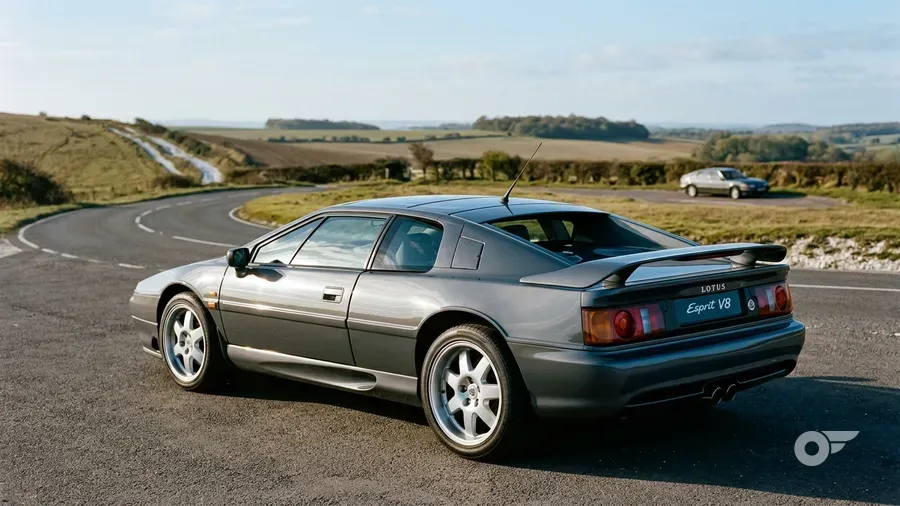
Esprit · 1988–1990

The naturally aspirated car, and the forgotten X180. Type 912 2.2 without a turbocharger in Peter Stevens's new body, sold to buyers who wanted the shape without the running costs. Dropped after 1990, which is why it is scarce and why almost nobody pictures one when the X180 is mentioned.

Esprit S · 1990–1991

A mid-range turbo slotted between the plain Turbo and the SE at 231 PS, and one of the rarest Esprits of any era. Cancelled in 1991 after barely a year, when Lotus simplified the range down to the Chargecooled SE.

Esprit Turbo · 1988–1992

The Stevens-bodied car with the carried-over Type 910 turbo, before the Chargecooler arrived. Power was unchanged from the S3 but the new body cut 0-60 from 5.6 to around 5.2 seconds and took it past 150mph. US cars kept the Citroën transaxle and Bosch injection into 1988; everything else moved to the Renault UN1.

Sport 300 · 1992–1995

The X180R made road-legal. 302hp at 6400rpm, 287 lb ft, around 80kg lighter than an S4 through extensive composite use, and 327mm ventilated front discs with racing calipers. The connoisseur's Esprit.

Turbo SE · 1989–1993

Peter Stevens body, Lotus's own water-to-air chargecooler, 264hp, and the first Esprit with a rear wing as standard, which is how you tell it from a plain Turbo. Factory claims of 4.7 seconds to 60mph and 163mph. The pick of the range for driving.

X180R · 1991

The IMSA Bridgestone Supercar racer and its road-going homologation cars. Doc Bundy won the 1992 drivers' title in one and Lotus took the manufacturers' championship the same season.
What owning one is like

The X180 is the point at which an Esprit becomes a reasonable thing to use rather than a thing to manage. The chassis is galvanised, the body is VARI-moulded and dimensionally consistent, and the shell is 22% stiffer than the car it replaced, so most of what goes wrong is service items rather than structure. The Renault UN1 transaxle is the item to know about. Its input shaft is two pieces and steps down in diameter, and fifth gear hangs off the back of the casing, so noise in fifth and a reluctant shift are the symptoms worth listening for. It is rebuildable and specialists know it well. The chargecooler on an SE is a second cooling circuit with its own pump, and it gets forgotten because it looks like part of the engine rather than a system in its own right. Neglect shows up as lost power long before it shows up as a warning. Beyond that: cam belts on interval, pop-up headlamp pods taking water into their wiring, and the usual glassfibre habit of hiding accident repair behind a decent respray.

Upkeep & parts

Parts are straightforward for the mechanical side. The 900-series four ran until 1999 and the Renault UN1 was fitted to Esprits until 2004, so consumables and rebuild parts are available, and PNM Parts covers most of the range. A UN1 rebuild is specialist work but it is well-understood specialist work.

Body panels are the awkward part, and it is worth knowing why: VARI panels are moulded, not laid up by hand, so a damaged one is replaced rather than reshaped, and used X180 panels are finite. Buy the straight car.

Budget for cam belts on interval, for the chargecooler circuit to be flushed and checked as its own job on an SE, and for the headlamp pod mechanisms, which nobody enjoys and everybody eventually does.

For an X180R, the registry at lotus-x180r.com holds chassis records and the racing history for the whole run of 25 cars, road and track, and is the first place to check a claimed car. For everything else, the Esprit Fact File tracks the year-by-year specification changes, which on a generation with four engines and two gearboxes is not a luxury.

Country of origin
UK
Class
Sports
Production years
1988–1994
Units built
~3,138
Model
Esprit
Nickname
No nickname ("X180R" names the 1991 IMSA homologation special specifically, not the generation)
Body
Coupe
Layout
Mid-engine, RWD
Engine
2.2L Type 912 16-valve twin-cam inline-four, 2.2L Type 910 turbocharged inline-four, 2.2L Type 910S chargecooled turbocharged inline-four, 2.0L Type 920 turbocharged inline-four
Transmission
5-speed Citroen C35 manual transaxle, 5-speed Renault UN1 manual transaxle
Designer
Peter Stevens