Octane Files
Explore CarsMercedes-Benz CLK GTR

Mercedes-Benz CLK GTR

Overview

Most road cars get turned into racing cars. The CLK GTR went the other way and barely pretended otherwise. Mercedes-Benz wanted back into top-flight sports car racing for 1997, the FIA GT Championship's GT1 class was where McLaren's F1 GTR and Porsche's 911 GT1 were fighting, and the rules required a GT1 car to be based on a road car. So AMG built a racing car first and built road cars afterwards to satisfy the paperwork.

The development story gets repeated because it is true. AMG bought McLaren F1 GTR chassis 11R from Larbre Compétition to use as a mule, threw away the bodywork, replaced the BMW V12 with a Mercedes one, and had a finished car 128 days later. It was homologated six days before its first race.

The Straßenversion followed. One road car was completed for the 1997 Frankfurt show and the rest were built at Affalterbach by AMG with HWA through 1998 and into the middle of 1999. Wikipedia counts twenty-eight in all: two prototypes, twenty coupés and six roadsters. They kept the race car's carbon monocoque, its suspension and its sequential gearbox, and Guinness recorded them as the most expensive production car in the world at $1,547,620.

Distinctions

The defining attributes and collector status that make this car garage-worthy.

Legend
A car that transcended the hobby, known far beyond the people who drive them.
Homologation Special
Built for the road only because racing rules demanded it.
Poster Car
The car on the bedroom wall, the one people dreamed about before they could drive.
Octane Files Select
Renowned for its history, engineering, or cultural weight.

Collectibility scorecard

Rated 1 to 10 on the traits that matter for owning, driving, and holding on to a car like this.

Desirability
9/10
Rarity
10/10
Driving thrill
9/10
Investment trajectory
8/10
Usability
1/10
Ease of restoration
1/10
Cultural impact
6/10
Electronic dependence
Fully analogHeavily electronic

This is a racing car with a short list of concessions. Engine management and ABS are the electronics that matter, and nothing in the published specification goes beyond them. The gearbox is the competition car's six-speed sequential manual and it is not synchronised, so the driver does the rev matching. The V12 is a stressed member of the chassis rather than something bolted into it. Air conditioning, a stereo and a great deal of soundproofing were added because a road car needs them. Even the fire suppression system is manual, triggered from a control beside the driver's door. Nothing here filters a driver input on its way to the rear tyres.

Market data

Demand tier, price trend, and typical values by condition. Our own assessment, not a quoted valuation.

Demand tier
EntrySolidHighBlue-chip

The proven elite. Values are established, liquid, and defended at every auction.

Value trajectory
AppreciatingStableCooling

Values are climbing. The market wants more of these than exist.

Price by condition
Driver
Excellent
Concours

The CLK GTR does not have a price curve, it has events, and there have been very few of them. Two completed public sales anchor everything. In August 2018 RM Sotheby's sold a 1998 coupé, chassis 09/25, with 1,500km recorded, at Monterey for $4,515,000, a model record at the time. In November 2023 RM Sotheby's offered a coupé and a roadster together in Las Vegas: the coupé, one of the twenty with 4,658 miles, failed to sell against an estimate of $8,500,000 to $10,000,000, while the roadster, chassis 3 of 6 with 170km, made $10,235,000. That is essentially the whole recent public record, which is why no price band is published here. A roadster is not a coupé and a SuperSport is neither, the three sit millions apart, and a band built from one 2018 coupé and one 2023 roadster would be arithmetic pretending to be a valuation. The unsold coupé is the most useful of the three data points: it says the coupé market in late 2023 sat somewhere below $8.5m, and it says nothing at all about 2026.

Buyer's guide

What anyone seriously considering this car should know first.

Why it's worth it
A GT1 racing car that had road cars built afterwards to make it legal
Callout
Guinness logged it as the world's most expensive production car at $1,547,620
What to watch for
Buying a CLK GTR is not a used car transaction and the questions are different. Start with which car it is. A coupé is not a roadster and a roadster is not a SuperSport, and the gap between them runs to millions. Twenty coupés, six roadsters, two factory SuperSports plus three later conversions to the 7.3-litre E73 engine. Chassis plates read out of twenty-five, which is the homologation minimum rather than a build count, so the plate alone will not tell you what you are looking at. Then history. These cars were assembled at Affalterbach by AMG with HWA, and the people who know them are largely the people who built them. Mechatronik in Germany staffs the work with former assembly personnel and holds parts stock. SPS Automotive in Willsbach was founded in 2003 by ex-HWA employees. A car with continuous specialist history from that world is a different proposition from one that has been standing. Finally, understand what you cannot do with it. Mercedes never federalised the car, so every example in the United States is there under Show or Display. It has ABS, air conditioning, a stereo, luggage bins under the doors and a fire suppression control by the driver's elbow, and that is as domesticated as it gets.

The Story

Driving character

Paul Frère drove one at Hockenheim for Road & Track and his verdict is more useful than any data sheet. He praised how tractable it was, which is not the word anyone expects, and credited Mercedes with genuinely trying to make it usable, including a great deal of soundproofing to keep gearbox and engine noise out of the cabin. He called it a real work of art. He also found the cockpit cramped despite the car being nearly two metres wide, and thought driving it in town was hard work, because the gearbox is unsynchronised and there is an enormous amount of torque available from very low revs. That combination is the car. The M297 V12 is a big, naturally aspirated, lightly stressed engine making its torque low down, so it does not need revs to move and it does not reward laziness either. The sequential lever wants a firm, deliberate hand and a matched throttle. The chassis is a race car's, pull-rod suspension and a bonded carbon monocoque with the engine acting as a structural member, so the car reports every detail of the surface. It feels as enormous as it is until it is going quickly, at which point it shrinks.

Design

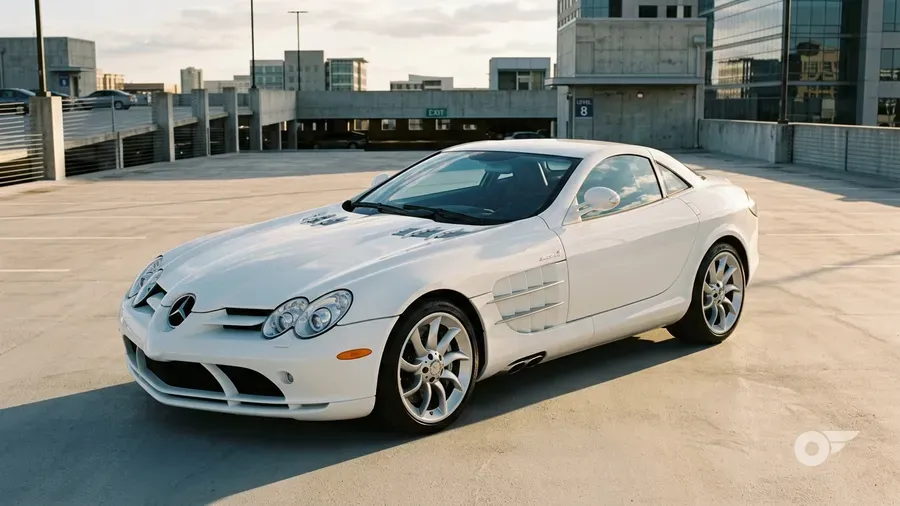
The CLK GTR shares three parts with the Mercedes-Benz CLK it is named after: the headlights, the tail lights and the grille. Everything else is a GT1 car, and the family resemblance is a legal fiction that Mercedes was entirely open about. Gerhard Ungar led the design at AMG, and the shape is aerodynamics ahead of everything. A long, low nose. A cab-forward glasshouse squeezed between the front wheels. A huge tapering tail. The roof-mounted air scoop, the NACA ducts in the sills and the flat undertray all carried over onto the road car rather than being restyled away. The doors open upwards. The monocoque is carbon fibre bonded to an aluminium honeycomb frame and was built by Lola Composites, a division of Lola Cars, which says something about where Mercedes went shopping for chassis expertise in 1996. Inside, the concessions to road use are visible and faintly comic. Leather, Alcantara or tartan to order. Four-point harnesses. An audio system. And luggage bins let into the sills under each door, because there is nowhere else on the car to put anything at all.

Motorsport pedigree

This is the part that came first, and it is the reason the road cars exist. The CLK GTR debuted at Hockenheim in 1997 having been homologated six days earlier. Bernd Schneider took pole and the fastest lap and then retired with brake trouble. It improved quickly: across thirteen races the car took eight wins, eight poles and seven fastest laps, and by the end of the year Mercedes had the 1997 FIA GT teams' title and Schneider the drivers' title, in a maiden season. Mercedes skipped Le Mans in 1997, reckoning the V12 was better suited to four-hour sprints than twenty-four hours, and built the CLK LM for 1998 instead. The CLK GTR ran the first two rounds of 1998 before handing over, and Mercedes took both titles again, with Klaus Ludwig and Ricardo Zonta driving. Then 1999, and the car that gets confused with this one. The Mercedes-Benz CLR is a different vehicle, built to Le Mans Grand Touring Prototype rules with no homologation road car behind it at all. It flipped in qualifying with Mark Webber, flipped again in the warm-up with Webber aboard, and flipped a third time in the race with Peter Dumbreck, clearing the barriers into the trees. Mercedes withdrew and left sports car racing. That was the CLR. It was not this car.

In culture

The CLK GTR's public reputation rests on two numbers and one persistent mistake. The numbers are twenty-five and $1,547,620. The first is the homologation minimum that forced the road car into existence and is stamped on the chassis plates. The second is what Guinness World Records logged as the price of the most expensive production car in the world, a title this car held until the Ferrari FXX-K arrived in 2015. The mistake is the 1999 Le Mans flips. Search for the CLK GTR and you will be shown footage of a silver Mercedes somersaulting over the barriers at the Circuit de la Sarthe. That is the CLR, a different car built to different rules two years later, and the confusion is common enough that Goodwood published a piece called "Why you're wrong about the Mercedes-Benz CLK GTR" largely to correct it. Otherwise the car lives in games, appearing across the Forza series and in Need for Speed titles, which for a car that was never legally sold in America is how most Americans have driven one. Examples sit in the Mercedes-Benz Museum, the Petersen and the Audrain.

Owning One

Why collectors want it

The CLK GTR is the purest surviving example of something that stopped existing after 1998: a manufacturer building a real racing car and then being obliged to sell you one.

It won its championship in its first season, which almost nothing does. It is the road-going member of what the sports car press calls the holy trinity of GT1, alongside the McLaren F1 GTR and the Porsche 911 GT1. And there are almost none. Wikipedia's count is twenty-eight cars, of which twenty were coupés and six roadsters, plus two prototypes. Auction catalogues and most of the press say twenty-five, which is the GT1 homologation minimum and the number stamped on the chassis plates.

The hierarchy inside that is steep. Coupes are the volume car at twenty. Roadsters are six and carry a large premium. Two chassis left Affalterbach in SuperSport specification with the 7.3-litre E73 V12 and three more received the engine and package afterwards, which puts five cars at the top of a very short list.

None of it trades often. Two were offered together at RM Sotheby's Las Vegas in November 2023 and only one of them sold. This is a market of individual events rather than a price curve.

Which one to look for

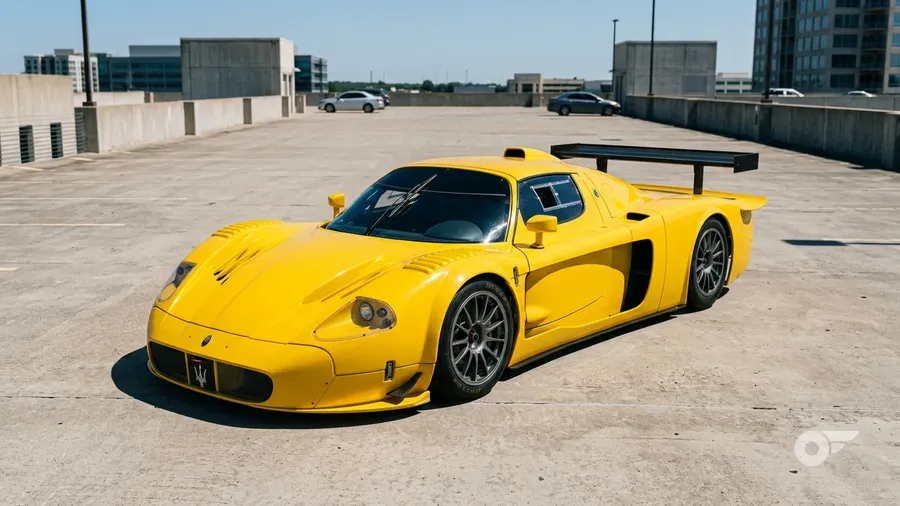
Three specifications, and working out which is which is most of the buying decision. The coupé is the standard car and the one that defines the model. The M297 E69 V12, stroked to 6,898cc by Ilmor, gives 631 PS at 6,500rpm and 731 Nm, and 0 to 62mph in 3.8 seconds. Twenty were built. The roadster came after the coupé run ended in 1999, six cars in all. It is not simply a coupé with the roof removed. The engine intake moved from the roof to the sides, the mirrors moved to the doors, a rollbar went in behind the seats, and the front grille and rear wing were redrawn, the wing closer to the fixed item on the race cars. Output is quoted at 612 PS with 775 Nm, less power and more torque than the coupé. One of the six is black and lives at Dutton Garage in Melbourne; another sits in the Petersen. At the top, the SuperSport. Two chassis left AMG with the 7,291cc E73 V12, the same engine family Pagani used in the Zonda, at 664 PS and 786 Nm, with a 400km/h speedometer and a redesigned front splitter. Three more cars received the package later, the later ones quoted at 711hp.

CLK GTR (race car) · 1997–1998

The car the whole programme was built around. Carbon monocoque on an aluminium honeycomb frame by Lola Composites, 5,987cc LS600 (GT 112) V12 at 600 PS, six-speed sequential, 1,000kg. Eight wins and eight poles from thirteen races.

Straßenversion Coupé · 1997–1999

The homologation road car and the volume version. 6,898cc M297 E69 V12 stroked by Ilmor, 631 PS at 6,500rpm and 731 Nm, 0 to 62mph in 3.8 seconds. ABS, air conditioning, four-point harnesses and luggage bins under the doors.

Straßenversion Roadster · 1998–1999

Built after the coupé run ended. Engine intake moved from the roof to the sides, door-mounted mirrors, integrated rollbar behind the seats, revised grille and a rear wing closer to the race cars'. 612 PS and 775 Nm, 1,410kg.

SuperSport · 1998–1999

The 7,291cc M297 E73 V12 in place of the 6.9, at 664 PS and 786 Nm, with a 400km/h speedometer and a redesigned front splitter. 0 to 62mph in 3.5 seconds. The same engine family Pagani used in the Zonda.
What owning one is like

Owning a CLK GTR is closer to running a historic racing car than a road car, and the way owners treat them reflects that. These are not vehicles anyone drives to work. They are stored, prepared and taken out. The specific issues are what you would expect from a 1998 competition car adapted for the street. The sequential gearbox is unsynchronised and unforgiving of casual use. The clutch is a four-plate carbon unit. The V12 is a stressed chassis member, so anything requiring it to come out is major surgery rather than a job. The bodywork is carbon and the monocoque is bonded carbon and aluminium honeycomb, which means accident damage is a specialist rebuild, not a panel. The genuinely difficult part is knowledge. Twenty-eight cars is not enough to create an ecosystem, and Mechatronik says as much in plain terms: there is virtually no experience of this car in the market. What experience exists sits in a handful of firms with a direct line back to the people who assembled them. None of that stops anyone. These cars run, they appear at Goodwood, and a properly kept one is entirely usable in the way a racing car is usable.

Upkeep & parts

Two names cover most of the real expertise. Mechatronik in Germany services and repairs the CLK GTR with staff who were involved in assembling the cars at Mercedes-Benz, holds spare parts stock for the series, and calls itself the first choice worldwide, which in this case is less of a boast than it sounds. SPS Automotive, in Willsbach, was founded in 2003 by former HWA employees and works from the same background. HWA itself, which built the road cars alongside AMG, has also serviced them.

Budget on a racing car basis rather than a road car one. One documented programme of mechanical work at DK Engineering ran past $71,000, which is not an annual figure but does show the shape of the numbers. Parts do not come from a catalogue. They come from a stockholding specialist, or they get made.

Beyond that, the marque support is ordinary Mercedes support and is useful for history rather than hardware. The Mercedes-Benz public archive holds the press material, and the Mercedes-Benz Clubs in America and the UK are worth having. The car's real registry is the small circle of people who own the other twenty-seven.

Country of origin
Germany
Class
Exotic
Production years
1997–1999
Units built
~28
Model
CLK GTR
Nickname
No nickname (Straßenversion is the factory's own suffix for the road-legal cars, not a nickname)
Body
Coupe, Roadster
Layout
Mid-engine, RWD
Engine
Race car: 5,987cc LS600 (GT 112) naturally aspirated V12, 600 PS at 7,000 rpm. Road coupé: 6,898cc M297 E69 V12, 631 PS (622 hp) at 6,500 rpm and 731 Nm. Road roadster: 6,898cc M297 E69 V12, 612 PS and 775 Nm. SuperSport: 7,291cc M297 E73 V12, 664 PS at 6,500 rpm and 786 Nm
Transmission
6-speed sequential manual, not synchronised, with a four-plate carbon fibre clutch
Designer
Gerhard Ungar (AMG)