Octane Files
Explore CarsMercedes-Benz 300 SLR

Mercedes-Benz 300 SLR

Overview

Mercedes-Benz built nine of these, won a world championship with them in a single season, then put them away and did not go racing again for thirty years.

The 300 SLR is not a 300 SL with a bigger engine, whatever the badge implies. It is the W196 Grand Prix car with the straight-eight opened out to 2,982cc, a second seat added and headlights fitted: the same brazed steel spaceframe thinking, the same desmodromic valves that are closed by a second cam lobe rather than by springs, the same Bosch direct injection, and 310 PS at 7,400rpm on ordinary 98-octane pump petrol. The bodywork is Elektron, a magnesium alloy less than a quarter the density of iron, and a roadster weighs 901kg.

In seven months it won the Mille Miglia at an average nobody has beaten since, took a 1-2-3 at the Tourist Trophy, won the Targa Florio and beat Ferrari to the championship by two points.

It was also the car in the worst accident motor racing has ever had, at Le Mans on 11 June, which was not the car's doing but was made worse by what it was made of. Both of those things are the 300 SLR.

Distinctions

The defining attributes and collector status that make this car garage-worthy.

Legend
A car that transcended the hobby, known far beyond the people who drive them.
Octane Files Select
Renowned for its history, engineering, or cultural weight.

Collectibility scorecard

Rated 1 to 10 on the traits that matter for owning, driving, and holding on to a car like this.

Desirability
10/10
Rarity
10/10
Driving thrill
10/10
Investment trajectory
9/10
Usability
1/10
Ease of restoration
1/10
Cultural impact
9/10
Electronic dependence
Fully analogHeavily electronic

Everything here is mechanical, including the parts that look as though they should not be. Bosch direct injection is driven by an eight-plunger inline pump off the engine, not metered by anything electronic. The valves are desmodromic, closed by a second cam lobe rather than a spring, because springs could not keep up. Ignition is twin magnetos, so the engine will run with the battery disconnected. The enormous inboard drums are unassisted, and the Le Mans air brake was a lever the driver pulled. On a roadster the only electrical items are the lights and the fuel pumps.

Market data

Demand tier, price trend, and typical values by condition. Our own assessment, not a quoted valuation.

Demand tier
EntrySolidHighBlue-chip

The proven elite. Values are established, liquid, and defended at every auction.

Value trajectory
AppreciatingStableCooling

Values are holding steady. What you pay today is what it's worth tomorrow.

Price by condition
Driver
Excellent
Concours

There is no price band on this page and there cannot be one. Only a single 300 SLR has ever changed hands: an Uhlenhaut Coupé, chassis 196.110-00008/55, sold on 5 May 2022 for €135,000,000, about $143 million, at an invitation-only sale RM Sotheby's ran inside the Mercedes-Benz Museum. It is the highest price ever paid for a car of any kind, beating the previous record of $75m for a Ferrari 250 GTO in a private sale, and the proceeds funded the Mercedes-Benz Fund. RM's own lot description states that no other 300 SLR exists in private hands. The second coupé and the surviving roadsters are Mercedes-Benz's own property, and nothing suggests that is changing. A band built from one sale of a unique closed car would be a fiction. Blue-chip is the standing; stable is the trajectory, because a market of one has no direction to read.

Buyer's guide

What anyone seriously considering this car should know first.

Why it's worth it
Won the 1955 world championship in seven months, then Mercedes left motorsport for three decades
Callout
One of the two coupés sold in 2022 for €135 million, the most ever paid for a car
What to watch for
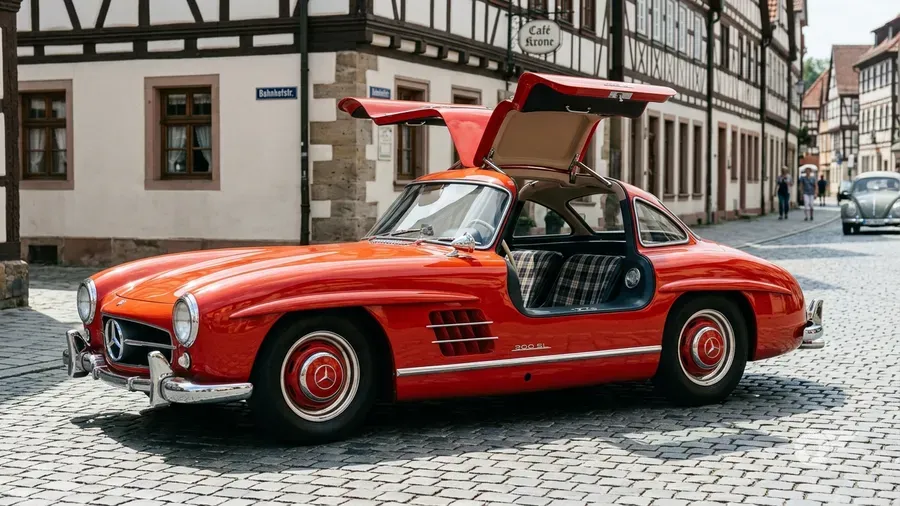
You are not buying one, so this is a guide to knowing what you are looking at. First, the name. 300 SL and 300 SLR share three letters and almost nothing else. The road car is a W198 with its own spaceframe, a single-cam three-litre six and gullwing doors. The SLR is W 196 S: a Grand Prix chassis with a desmodromic straight-eight and no relationship to the production car beyond the badge. If something is described as a road-going 300 SLR and has a six in it, it is a 300 SL. Second, the coupés. Two were built, on chassis Uhlenhaut had set aside for a Carrera Panamericana that was cancelled after Le Mans. They look like a 300 SL from a distance and are a different animal underneath, wider and lower, with the exhaust running along the sill beneath the door. Third, the tributes. A magnesium body over a Grand Prix spaceframe cannot honestly be reproduced, so what circulates are homages on other running gear. Some are beautifully made. None is the car, and because the real ones have never been for sale there has never been anything to confuse them with.

The Story

Driving character

The people who drove these in period were unusually clear about them. Moss called the 300 SLR the greatest sports racing car ever built. What they were describing is a Grand Prix car with a passenger seat. The straight-eight takes its drive from the middle of the crankshaft to keep torsional flex out of it, sits canted 53 degrees to the right so the bonnet line can stay low, and pulls to 7,400rpm with a shriek nothing else in 1955 could match. Direct injection means it answers instantly. The desmodromic valvegear exists because valve springs of the day could not. The chassis is less friendly. Swing axles at the rear, cleverly arranged with beams crossing under the car to keep the roll centre low, still let go quickly when they let go. The brakes are huge inboard drums that fade, which is precisely why Neubauer bolted a hinged aluminium flap behind the driver at Le Mans and used the air itself. Two journalists who covered more than 2,000 miles in a coupé wrote that 120mph on a quiet motorway felt like walking pace. They were not reaching for an effect. The car simply had that much more in hand than the roads did.

Design

This is engineering that happens to look extraordinary, rather than styling with engineering underneath. The proportion comes from the layout. A straight-eight is long, so it sits behind the front axle line, which pushes the cockpit back and gives the roadster its enormous bonnet and clipped tail. The bulge along the right of that bonnet is not decoration: it clears an engine canted 53 degrees to keep frontal area down, exactly as the streamlined W196 did. The material is the real story. Elektron magnesium alloy, worked over a brazed steel spaceframe, at a relative density of 1.8 against iron's 7.8. It is what made 901kg possible and it is what turned Levegh's wreck into a fire that water made worse. The coupés were drawn separately and are the better looking of the two, sitting on a slightly widened chassis with gullwing doors dictated by the height of the frame sills and side pipes exiting beneath them. They resemble a 300 SL until you park the two together, at which point the SLR looks like what it is: a racing car that has been asked to wear a roof.

Motorsport pedigree

Six championship rounds, one season, and Mercedes entered only what suited it. The Mille Miglia on 1 May was the debut. Moss ran with Denis Jenkinson reading pace notes off a roller device on the dashboard and finished the thousand miles in 10 hours 7 minutes 48 seconds, an average of 157.650km/h. Nobody has gone quicker over that course before or since. Fangio was second, driving alone, half an hour behind. Then the Eifelrennen at the Nürburgring, a Fangio and Moss walkover. Then Le Mans on 11 June, where Levegh's car was launched into the crowd at the pit straight and Levegh and more than eighty spectators were killed. The leading Mercedes were running first and third when they were called in at 1:45am and driven away. The season resumed in the autumn: a 1-2-3 at the Tourist Trophy at Dundrod, and Moss ahead of Fangio at the Targa Florio in October. The championship went to Mercedes by two points from Ferrari. The withdrawal that followed is usually told as remorse. The decision was in fact taken before Le Mans. Mercedes had proved its point in two categories at once, and stopped.

In culture

Three separate stories attach to these nine chassis, and any one of them would carry a car on its own. The first is 722. Moss and Jenkinson's Mille Miglia has been retold more than any other single drive, partly because Jenkinson wrote it up himself, partly because the record has stood for seventy years and the race that set it no longer exists in that form. The second is Le Mans, which changed the sport permanently. France, Spain, Switzerland and West Germany all suspended racing. Most lifted the ban within a year; Switzerland's lasted more than sixty. In America the AAA dissolved the board that had sanctioned racing since 1904, which is how USAC came to exist. At the Sarthe the pit straight was rebuilt and the grandstands moved back. The third is recent. In May 2022 a car that had never been for sale became the most expensive ever sold, and €135 million was a big enough number to reach news bulletins that never mention cars at all. Very few machines are famous three times over for three unrelated reasons.

Rivals

Cars from other manufacturers that competed for the same buyers when new.

Owning One

Why collectors want it

There is no market here, and that is exactly what makes the car worth explaining.

Nine chassis exist. Mercedes has kept them since new, runs them at its own events, and has sold precisely one. On 5 May 2022 it put an Uhlenhaut Coupé in front of an invited room inside its own museum with RM Sotheby's holding the gavel, and took €135,000,000 for it. That is roughly $143 million, and it is the highest price ever paid for a motor car by any route, beating the $75m a Ferrari 250 GTO had managed in a private sale. The proceeds established the Mercedes-Benz Fund, which pays for environmental-science scholarships, and the buyer agreed to keep the car available for public display.

RM's own catalogue put the position in a single sentence: no other 300 SLR exists in private hands. The second coupé stays in Stuttgart and so do the roadsters.

So this car cannot be measured the usual way. What can be said is that when one finally moved, it reset the ceiling for every car ever built, and did it in a room with no public bidding at all.

Which one to look for

Nine chassis, two shapes, and one of them is now the most valuable object on four wheels. Seven were built as open two-seat racing cars, and their identities come from what they did rather than from how they were specified. Chassis 0004/55 is the one that matters most: Moss's Mille Miglia winner carrying number 722, and later the winning car at Dundrod and on the Targa Florio as well. 0006/55 was Levegh's car at Le Mans. The rest ran as team cars, practice cars and spares through a championship that had only six rounds in it. The two coupés are the anomaly. Uhlenhaut had two chassis put aside before Le Mans for a Carrera Panamericana entry that never happened, and when the racing stopped he took one as a company car and added a silencer the size of a suitcase. They are closed, gullwing-doored, heavier at 1,117kg, good for something approaching 290km/h, and were the fastest road cars in the world by a margin nobody has properly measured since. One of the two is privately owned. The other is in the Mercedes-Benz Museum. That is the whole hierarchy.

Roadster · 1955

The racing car. Open two-seat bodywork in Elektron magnesium alloy over a brazed steel spaceframe, 901kg, with the 2,982cc M 196 S straight-eight, desmodromic valvegear and Bosch direct injection. Won the Mille Miglia, the Tourist Trophy and the Targa Florio in a single season. Fitted at Le Mans with a hinged light-alloy air brake behind the driver to spare the inboard drums.

Uhlenhaut Coupé · 1955

Two closed cars built on chassis Rudolf Uhlenhaut set aside for a Carrera Panamericana entry that was cancelled after Le Mans. Gullwing doors dictated by the height of the spaceframe sills, side pipes exiting beneath them, a slightly widened chassis, 1,117kg, and a top speed approaching 290km/h, which made them the fastest road cars in the world. Uhlenhaut used one as a company car with an added silencer.

What owning one is like

One person on earth owns a 300 SLR and everything else belongs to Mercedes-Benz, so the honest version of this section is about what looking after them involves rather than what fails on a Sunday morning. Magnesium is the first thing. Elektron corrodes readily, does not weld the way aluminium does, and will burn if it ever gets hot enough, so panel work is a specialist craft and the original panels on these cars are treated as irreplaceable, because they are. The mechanical package was designed to be stripped between races. Desmodromic valvegear needs setting to a precision no ordinary engine demands, the eight-plunger injection pump is a period Bosch racing item, and the inboard drums fade by design. None of it has been improved since 1955, because improving it would spoil the car. Mercedes-Benz Classic maintains them and still runs them at its own events, which is why machinery that raced in 1955 remains startable rather than embalmed. The one privately owned car went to its buyer with an agreement that it keeps being shown.

Upkeep & parts

Parts do not exist and cannot be bought, so upkeep here is a question of who holds the knowledge.

Mercedes-Benz Classic is effectively the whole supply chain. It holds the drawings, the archive and the people, it maintains the museum's own cars, and it is the only realistic route to anything for a W 196 S. The public archive behind it, marsClassic, is where the technical records for these cars are published, and it is worth knowing about even for a reader who will never need a part.

Independent work at this level exists but the list is very short. The privately owned coupé was restored by Tony Merrick in Britain between January and July 1986, which tells you the standard involved: one restorer, half a year, on one car.

Everything else is tyres, fluids and time. Cars valued like this are not run hard, but they are run, and the cost of that is measured in engineers rather than in invoices.

Country of origin
Germany
Class
Sports
Production years
1955–1955
Units built
9
Model
300 SLR
Nickname
No nickname ("Uhlenhaut Coupé" names the two closed cars specifically, not the generation)
Body
Roadster, Coupe
Layout
Front-mid-engine, RWD
Engine
2,982cc M 196 S straight-eight, desmodromic valves, Bosch mechanical direct injection, 310 PS at 7,400rpm
Transmission
5-speed manual transaxle
Designer
Rudolf Uhlenhaut (chief engineer)