Octane Files
Explore CarsToyota Celica T160

Toyota Celica T160

Overview

Toyota announced the fourth Celica on 20 August 1985, and it drove the wrong way round. Fifteen years of rear-drive Celicas ended in a single model change. The new car mounted its engine transversely and drove the front wheels, on the T platform it shared with the Corona and Carina rather than the A platform that had carried every Celica since 1970.

The reasoning was not subtle. Toyota's volume architecture had gone front-drive by the mid 1980s, front-drive packaged better in a car this size, and the rear-drive sporting job was already leaving: the Supra separated from the Celica name entirely a few months later. What remained for the Celica was a coupe that had to sell in numbers.

The body was the argument for it. Toyota's own launch material named the shape ryumenkei, flowing surface form, and claimed a drag coefficient of 0.31 for cars carrying the rear spoiler. Pop-up lamps, flush glass, hardly a straight line on it.

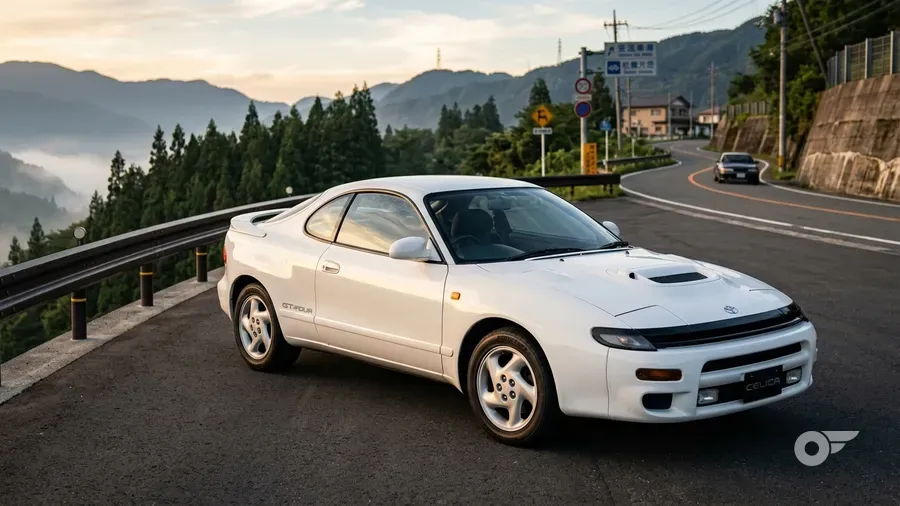
Then, fourteen months later, Toyota did something nobody expects of a front-drive coupe. In October 1986 it put a turbocharged 185 PS engine and full-time four-wheel drive into the same shell and called it GT-Four.

Distinctions

The defining attributes and collector status that make this car garage-worthy.

Octane Files Select
Renowned for its history, engineering, or cultural weight.

Collectibility scorecard

Rated 1 to 10 on the traits that matter for owning, driving, and holding on to a car like this.

Desirability
5/10
Rarity
5/10
Driving thrill
5/10
Investment trajectory
6/10
Usability
8/10
Ease of restoration
4/10
Cultural impact
6/10
Electronic dependence
Fully analogHeavily electronic

Fuel injection and engine management are standard across the range, which is the jump from every Celica before it. Toyota's TCCS system handles fuelling and ignition on the 3S engines, the pop-up headlamps run on motors, and the convertible's roof is powered. The GT-Four adds an electronically controlled locking centre differential worked from a button on the console. What stays mechanical is most of what you touch: cable throttle, hydraulic clutch and brakes, a physical handbrake, no traction control, no stability control, and anti-lock brakes only where a buyer specified them. A fault here is still diagnosed with a test light and a wiring diagram rather than a laptop.

Market data

Demand tier, price trend, and typical values by condition. Our own assessment, not a quoted valuation.

Demand tier
EntrySolidHighBlue-chip

The accessible way in. Prices still forgive mistakes, and the upside is real.

Value trajectory
AppreciatingStableCooling

Values are climbing. The market wants more of these than exist.

Price by condition
Driver
$4k
Excellent
$10k
Concours
$20k

Still priced as a used Toyota rather than as a classic, with a clear split inside the generation. Tracked sales across the fourth generation average just under $11,500, and the front-drive cars sit below that: the GT sub-market averages around $10,500, and a 1987 GT convertible changed hands for $500 in November 2023. The four-wheel-drive cars are the exception and are pulling away, averaging around $15,700, with a 1988 Turbo 4WD taking $25,312 in March 2026. The band below describes the front-drive volume car and deliberately excludes the GT-Four, which is a separate model here and a separate market.

Values as of August 2026.

Buyer's guide

What anyone seriously considering this car should know first.

Why it's worth it
The Celica that gave up rear-wheel drive and started the GT-Four rally line
Callout
Toyota's first four-wheel-drive Celica arrived fourteen months after its first front-wheel-drive one
What to watch for
Lift the carpet first. The factory sound deadener holds water against the floor pan, and a perforated floor is the most common structural failure on these cars, ahead of anything visible from outside. Then work the seams: rockers, rear quarters, the hatch aperture on a liftback, and the strut towers, which rot from water finding its way down the turret rather than up from the road. Then identify the engine, because the badge will not always tell you. American cars used the 2.0 2S-E for 1986 only before the 3S family took over, so an early US car is a different machine from a 1988 one. The twin-cam 3S-GE is the one worth having, and its known grumbles are an exhaust manifold that cracks between the first two cylinders and coolant weeping from the T-junction pipe behind the engine. Every 3S runs a rubber timing belt rather than a chain, so a car with no belt history is a car with a job already queued. On a convertible, remember the roof was cut in California by ASC after the coupe was finished, so inspect the added chassis reinforcement, the rear quarter windows and the top frame as carefully as you inspect the metal.

The Story

Driving character

The honest news first. Nothing about driving a front-drive Celica recalls a rear-drive one, and the car does not pretend otherwise. Turn in and the nose leads. Push and it washes wide long before anything at the back gets involved. Lift mid-corner and it tucks, politely. This is a competent chassis with a wide margin built into it, not a car that rewards provocation. What it does have is an engine worth revving. The 3S-GE is oversquare, twin-cam and geared to be used, and it changes note somewhere around 4,500rpm into something harder and more mechanical than a 2.0-litre Toyota has any business sounding like. The five-speed is light and accurate. Torque steer exists and stays civilised. The GT-Four rewrites all of it. Full-time four-wheel drive, a turbocharged 3S-GTE, 185 PS in Japan and 190 horsepower as sold in America, and a lockable centre differential on a button. It is heavier and it hides its speed, which is exactly the point on a wet road in February. Nothing else Toyota sold at the time covered ground the way it did.

Design

Toyota named the shape before anyone else could. The launch campaign called it ryumenkei, written 流面形 and usually rendered as flowing surface form, and the phrase stuck hard enough that Japanese owners and magazines still use it as this generation's name instead of T160. The claim behind it was aerodynamic. Toyota quoted a drag coefficient of 0.31 for cars fitted with the rear spoiler, and the body works for it: pop-up lamps to keep the nose low, glass mounted flush with the metal around it, fender blisters swelling out of the doors rather than bolted onto them, and a blacked-out rear pillar that makes the greenhouse read as one continuous pane. Three bodies came out of it. The liftback is the shape the car was drawn as. The notchback coupe is rarer and, to some eyes, tidier. The convertible is the odd one. Toyota shipped finished coupes to ASC in Rancho Dominguez, California, where the roof came off and a powered top, chassis reinforcement and new rear quarter windows went in. Japanese-market cars made the trip in both directions before being sold at home.

Motorsport pedigree

The front-drive car itself did compete, quietly. A Group A ST162 ran in the All Japan Touring Car Championship in 1987, which is a footnote rather than a record, and it is close to the whole of the front-drive Celica's competition career. The car that mattered was the one Toyota built to get around that problem. The ST165 GT-Four existed because Group A demanded a road car, and because Toyota Team Europe needed four-wheel drive and a turbocharger to be competitive at all. It made its World Rally Championship debut on the 1988 Tour de Corse. Its first win came at Rally Australia in September 1989 with Juha Kankkunen driving. In October 1990, at Rallye Sanremo, Carlos Sainz took the drivers' title in one, the first WRC championship any Toyota driver had won. That record belongs to the GT-Four's own page here, and it should. What belongs to this generation is the decision behind it. Toyota answered the loss of rear-wheel drive by building something no rear-drive Celica could have been, and it worked inside four years.

In culture

In Japan this generation has a film attached to it, and not a small one. Watashi wo Ski ni Tsuretette, released in 1987 and usually given in English as Take Me Out to the Snowland, put two ST165 GT-Fours, one white and one red, on snow-covered mountain roads at speed. It landed in the middle of Japan's ski boom and helped inflate it. Traffic on the Kan-Etsu expressway out of Tokyo became a national joke, resort stickers went on rear windows, and taking the four-wheel drive became the sensible thing to say about a weekend in the mountains. The car still carries it. Toyota's own GAZOO site has interviewed owners who went looking for an ST165 decades later specifically because of that film, and there is a national ST16 owners' meeting in Japan built around this generation. Outside Japan the reach is thinner and mostly digital. The ST165 has been in the Gran Turismo games since the second one, which is how a lot of people met the car at all. Beyond that, the badge that travelled was All-Trac rather than Celica.

Rivals

Cars from other manufacturers that competed for the same buyers when new.
Honda Prelude BA3/4/5/7

We haven’t profiled this car yet. Request to add
Lancia Delta HF

Lancia Delta HF

Italy·Sports·1986–1994
Mazda RX-7 FC

Mazda RX-7 FC

Japan·Sports·1985–1992

Owning One

Why collectors want it

For most of its life this was the Celica that got apologised for. It arrived front-drive, it sold in ordinary numbers to ordinary people, and the enthusiast line was that Toyota had traded away the thing that made a Celica interesting. Forty years on that argument has quietly reversed, because this is the generation where the interesting thing starts.

Every Celica GT-Four that ever won a rally traces back to the ST165 launched out of this shell in October 1986. The car Carlos Sainz drove to Toyota's first World Rally Championship drivers' title in 1990 is this body with a different driveline under it. Nothing else in Toyota's 1980s range makes that claim.

The hierarchy is clear and the money follows it. The ST165 GT-Four sits on top and has its own page here. Below it, the Japanese and European twin-cams with the Yamaha-developed 3S-GE head are the ones to hunt, then the American GT-S, then the ASC convertible, which sells on novelty rather than specification. Base 1.8s and automatics are bought to be driven rather than restored, and there is nothing wrong with that.

Which one to look for

Start with what Toyota sold in Japan, because that is where the good engines went. The 2000 GT-R ran the 3S-GE, a twin-cam sixteen-valve whose head was developed with Yamaha, rated at 136 PS. Below it the 1600 GT used the 4A-GE at 111 PS, the same engine as an AE86 and a livelier thing than its size suggests. The 1800 ST and SX cars are transport. In America the ladder runs ST, GT, GT-S, then the All-Trac Turbo. The GT-S is the one, because it carries the 3S-GE, the wider wheels and the better seats. Avoid the 1986-only 2S-E cars unless the price reflects what they are. Europe put the GT-i 16 badge on the 3S-GE liftback, and Australia closed the generation with a White Lightning special in 1989. The ST165 GT-Four is the grail and it is deliberately not on this page. Toyota built it as a separate model, homologated for Group A, liftback only, and it is the reason anyone still talks about a fourth-generation Celica. Look for it under Related cars.

1600 GT · 1985–1989

Coded AT160 and fitted with the 4A-GE twin-cam at 111 PS, the same engine family that made the AE86 famous. Lighter over the nose than the 2.0 cars and happy to be revved, which makes it the enthusiast's pick among the small-engined Celicas.

1800 ST / SX · 1985–1989

The base Japanese cars, coded ST160 and from May 1988 ST163. Single-cam 1.8s, the 1S-iLU at 89 PS and later the 4S-Fi, in coupe and liftback bodies. These are the cars that sold, and they are the reason the shape was everywhere in Japan for a decade.

2000 GT-R · 1985–1989

The best front-drive Celica Toyota sold at home. The 3S-GE twin-cam sixteen-valve, whose cylinder head was developed with Yamaha, rated at 136 PS at 6,400rpm. Coded ST162, liftback or coupe.

2000 ZR · 1985–1989

The 3S-FE liftback: twin-cam architecture, single-cam manners, and the economy engine of the range rather than the sporting one. A well-equipped cruiser rather than a driver's car.

GT (North America) · 1986–1989

The volume American car, on the 3S-FE, in coupe and liftback form. Better equipped than the ST and far more common than the GT-S. Most survivors in the United States are this car.

GT Convertible · 1987–1989

Finished coupes were shipped to ASC in Rancho Dominguez, California, where the roof was cut away and a powered top, chassis reinforcement, new rear quarter windows and a one-piece folding rear seat were fitted. Right-hand-drive cars for Japan made the same round trip.

GT-i 16 (Europe) · 1986–1989

The European badge for the 3S-GE liftback, sold alongside 1.6 ST and 1.6 GT cars. Same engine as the Japanese GT-R, tuned and equipped for European roads.

GT-S (North America) · 1986–1989

The one to look for in America. It carries the 3S-GE twin-cam, wider wheels and tyres, firmer suspension and the better seats. The closest thing a US buyer could get to the Japanese GT-R without an import.

ST (North America) · 1986–1989

The American entry car. For 1986 only it used the 2.0 2S-E, an older single-cam engine carried over from the previous generation, before the 3S-FE replaced it. Worth identifying before you buy, because the two are not the same ownership proposition.

What owning one is like

Two different cars again, and this time the split is body against everything else. The 3S engines are ordinary Toyota, which is to say they run for a very long time on oil changes and indifference. They do have habits. The twin-cam 3S-GE cracks its exhaust manifold between the first two cylinders, coolant seeps from the T-junction pipe where it is awkward to see and worse to reach, and valve cover gaskets harden and weep down the block. The timing belt is rubber and it is a scheduled job, not a lifetime part. Rust is what ends these cars. It starts under the sound deadener on the floor, which means the first sign is usually damp carpet rather than a bubble in the paint, and it works outward into the rockers, the rear quarters and the strut towers. Then there is the 1980s tax. Pop-up headlamp motors and their linkages wear, interior plastics have gone brittle, and trim for a car nobody expected to keep is the thing that turns a running project into a stalled one.

Upkeep & parts

Mechanically this is one of the cheapest 1980s coupes to keep running. The 3S engine family went into Camrys, Coronas, MR2s and Caldinas by the million, so gaskets, water pumps, timing belt kits, clutches and sensors are ordinary stock rather than specialist orders, and any workshop that has seen a 1990s Toyota can service one.

Body and trim is the other story, and it is where the owner community does the real work. ST162.net and the fourth-generation boards on Celica Hobby and Toyota Celica Forum are where used panels, lamps and interior parts actually change hands. Jack's 4th Gen Lab collects factory wiring diagrams and how-to documentation for this generation. ImportArchive holds the 1986 to 1989 paint codes and brochures, which is what you want before anyone quotes you for paint. In Britain, Celica-Club UK covers the model and GT4DC covers the GT-Four cars specifically.

Budget the way you would for any Japanese car of this age: little for mechanicals, a lot for metalwork, and an open-ended figure for trim. Owners in Japan name hoses and rubber parts as the genuine constraint, not engine components.

Country of origin
Japan
Class
Sports
Production years
1985–1989
Units built
Not recorded
Model
Celica
Nickname
Ryumenkei (流面形)
Body
Coupe, Liftback, Convertible
Layout
Front-engine, FWD
Engine
Japan and export: 1.6L 4A-F, 1.6L 4A-GE DOHC (111 PS), 1.8L 1S-iLU (89 PS), 1.8L 4S-Fi (from May 1988), 2.0L 3S-FE, 2.0L 3S-GE DOHC (136 PS), 2.0L 3S-GTE DOHC turbo (185 PS, GT-Four ST165). North America: 2.0L 2S-E (1986 only), 2.0L 3S-FE, 2.0L 3S-GE, 2.0L 3S-GTE turbo (190hp, All-Trac Turbo)
Transmission
5-speed manual, 4-speed automatic
Designer
Data unverified, not shown