Octane Files
Browse CarsRolls-Royce Silver Shadow I

Rolls-Royce Silver Shadow I

Overview

Rolls-Royce had built cars the same way since before the war. A separate chassis went out to a coachbuilder, the body was made by hand, and the price assumed you had somewhere to keep a chauffeur. The Silver Shadow ended all of that at once. Launched in October 1965 under the works codename SY, it was the first Rolls-Royce built as a monocoque, the first with four-wheel disc brakes, the first with independent suspension at both ends, and the first offered only as a finished motor car with no rolling chassis on the price list. The period press led on how much smaller it was than the Silver Cloud III it replaced, which is not a sentence anyone had expected to write about a Rolls-Royce.

The brakes and the self-levelling rear suspension ran on high-pressure hydraulics licensed from Citroen, a detail that still surprises people who assume Crewe invented everything itself. Under the bonnet sat the aluminium L410 V8, 6230cc at first and 6750cc from 1970, with an output the company declined to publish on the grounds that it was adequate.

Crewe built 16,717 standard saloons and 2,780 long-wheelbase cars, which made this the most successful Rolls-Royce of the twentieth century.

Distinctions

The defining attributes and collector status that make this car garage-worthy.

Legend
A car that transcended the hobby, known far beyond the people who drive them.
Octane Files Select
Renowned for its history, engineering, or cultural weight.

Collectibility scorecard

Rated 1 to 10 on the traits that matter for owning, driving, and holding on to a car like this.

Desirability
6/10
Rarity
3/10
Driving thrill
4/10
Investment trajectory
4/10
Usability
6/10
Ease of restoration
3/10
Cultural impact
8/10
Electronic dependence
Fully analogHeavily electronic

Nothing on a Shadow is managed by a computer. Fuel comes from twin SU carburettors, the throttle is a rod, and ignition ran on contact breakers until electronic ignition arrived in 1975. What lifts it clear of the fully analog end of the scale is everything around the driveline: a large Lucas system running electric windows, electric seat adjustment, central locking and air conditioning that was standard from 1968, plus dash warning lights wired to the two hydraulic circuits. It is a mechanical car carrying a heavy 1960s luxury wiring loom, and the loom is what usually misbehaves.

Market data

Demand tier, price trend, and typical values by condition, based on recent sales data.

Demand tier
EntrySolidHighBlue-chip

The accessible way in. Prices still forgive mistakes, and the upside is real.

Value trajectory
AppreciatingStableCooling

Values are holding steady. What you pay today is what it's worth tomorrow.

Price by condition
Driver
$12k
Excellent
$30k
Concours
$60k

Prices have been close to flat in real terms since 2020, following a long slide, and with 16,717 saloons built the supply of average cars is not going away. The money has separated instead: sorted, documented examples and the coachbuilt two-doors have pulled clear, while neglected cars change hands for less than a hydraulic overhaul costs.

Values as of August 2026.

Buyer's guide

What anyone seriously considering this car should know first.

Why it's worth it
The first monocoque Rolls-Royce, and the most successful the company built in the twentieth century
Callout
Nearly launched as the Silver Mist, until someone checked what Mist means in German
What to watch for
Two systems decide whether a Shadow is a bargain or a project, and neither of them is the engine. The first is the body. Corrosion lives in the lowest six inches of the car: sills at both ends, the front wings where they meet the sills, the rear wheel arches worst of all, the valances, the inner wings around the front suspension mounts, the rear spring seats and the boot floor. Chrome bumpers hold water in their curves. Plenty of cars wear an Everflex vinyl roof, and running a hand over it tells you more than looking at it. The second is the hydraulics. Braking and self-levelling run at very high pressure through nitrogen-charged accumulators fed by twin pumps driven off the camshaft, and the system wants a full overhaul roughly every 48,000 miles whether or not it currently feels fine. Ten flexible hoses perish from the inside, swell shut and lock a caliper on. Both dashboard pressure warning lights should go out the instant the engine catches. Then the paperwork. Ask for the chassis records before you ask about the mileage, and get a marque specialist to pressure-test the hydraulics before you agree a price.

The Story

Driving character

The Shadow does not feel fast and was never trying to. It feels absent. The V8 is isolated so thoroughly that at a steady cruise the loudest things in the car are the tyres and the clock, and acceleration arrives as a change of scenery rather than as an event. There is no drama in the gearbox either, whether it is the early four-speed Hydra-Matic that Crewe built under GM licence or the three-speed Turbo-Hydramatic 400 that replaced it, which changes gear so quietly you often cannot say when it happened. The steering is the odd part. Recirculating ball, very light, and it asks for a firm hand and no expectation of feel. The rack-and-pinion fitted to the Shadow II from 1977 is the single biggest driving improvement of the whole run, and it is the one thing a Shadow I owner genuinely misses. The brakes are the opposite surprise. The hydraulics do the work, so the pedal needs no shove, and a healthy car stops far better than its size and its 1965 birthday suggest. But the ride is the point. Self-levelling keeps the tail flat whatever is in the boot, and a sorted Shadow crosses broken tarmac in a way that still embarrasses much younger cars.

Design

John Blatchley had drawn the Silver Cloud, and the Shadow is the same hand working under completely different rules. There were no coachbuilders left to hand a chassis to, so for the first time the shape of a Rolls-Royce was settled entirely inside the factory and had to work as a single pressed structure. What came out is slab-sided and formal rather than flowing, upright where the Cloud was sculpted, and small enough that British reviewers made the size the story. It ages in a very specific way, and one date does most of the work. Wider tyres in 1974 brought flared wheel arches, so flat arches place a car before 1974 at a glance. Everflex vinyl roofs were fitted to a great many Shadows and are now as much a period signature as a maintenance liability. Blatchley's last design for Rolls-Royce was the two-door that became the Corniche, and it stayed in production until 1995, twenty-six years after he walked out of the Crewe gates in March 1969 with no ceremony at all. The next new body Crewe put on this platform, the Camargue, was drawn by Pininfarina in a language that owed him nothing.

Motorsport pedigree

Rolls-Royce did not go racing, and by 1965 that was settled policy rather than an accident of budget. The company had bought the bankrupt Bentley in 1931, closed its racing programme, and turned a marque with five Le Mans wins into a radiator grille. No factory Bentley raced again for roughly seventy years. A Silver Shadow was therefore never going to be homologated for anything, and nothing in the brief suggests anyone at Crewe wanted it to be. Which is why the one exception is better than a long list of club results would have been. In April 1970 Bill Bengry entered a Silver Shadow in the Daily Mirror London to Mexico World Cup Rally, roughly 16,000 miles from London to Mexico City by way of Europe and South America. Car 52 ran with its exhausts routed up over the roof for ground clearance, a large animal bar across the nose, and the self-levelling suspension and air conditioning stripped out in the name of reliability. Bengry, with co-driver Ray Richards and mechanic David Skeffington, kept it moving on running repairs until the rear suspension cracked in southern Brazil. Hannu Mikkola won the event in a Ford Escort.

In culture

The Shadow is the Rolls-Royce that stopped belonging to the aristocracy. It was built in numbers Crewe had never attempted, and the people buying it were as likely to have made their money in three years as in three centuries. Paul McCartney, Elton John, Freddie Mercury, Elvis Presley and Johnny Cash all had one. So did Telly Savalas and Walter Matthau. For about fifteen years, when a film or a television series needed to say that a character had arrived, it parked a Silver Shadow outside. The screen credit that stuck is a Mulliner Park Ward drophead in On Her Majesty's Secret Service in 1969, filmed crossing the bridge over the Tagus outside Lisbon. It is also the car most people picture when they picture a Rolls-Royce of that era, which is exactly why it became the punchline in every story about a cheap luxury car with expensive habits. Both readings are earned, and the second one is the reason a generation of enthusiasts could afford the first.

Rivals

Cars from other manufacturers that competed for the same buyers when new.
Owning One

Why collectors want it

The Shadow is the cheapest way into a real Rolls-Royce, and that is both the attraction and the catch. Values have been close to flat in real terms since 2020, so nobody buys one as a bet, and an honest driver costs less than a new family hatchback. What you get for it is a car built to a standard that nothing at that money resembles.

The hierarchy inside the generation is steep for a car this common. Standard steel saloons are the floor and always will be, with 16,717 built and no shortage of tired ones. Long-wheelbase cars, 2,780 of them, carry a modest premium for the rear legroom and the division. Above those sit the coachbuilt two-doors from Mulliner Park Ward, the fixed-head saloon and the drophead coupe, built in hundreds rather than thousands and trading in a different market entirely once they took the Corniche name in 1971. Rarest of all are the fifty James Young two-doors.

For the ordinary cars, value rests on condition and paperwork rather than specification. The Rolls-Royce Enthusiasts Club holds Crewe's build records, so a Shadow's history is knowable in a way most 1960s cars' histories are not.

Which one to look for

Start with the standard steel saloon, because that is what almost every Shadow is: 16,717 of them, four doors, one wheelbase, and the car the whole reputation rests on. Within it the later cars are the better ones to use. Compliant rear suspension and radial tyres arrived in 1972, ventilated front discs in 1973, the wider tyres and flared wheel arches that visually date a Shadow in 1974, and electronic ignition in 1975. The 6750cc engine from 1970 pulls more usefully than the original 6230cc unit. The long-wheelbase saloon, 2,780 built from 1969, adds four inches between the axles and usually came with a division. Buy it if the point is being driven rather than driving. The connoisseur's cars are the coachbuilt two-doors from Mulliner Park Ward: 571 fixed-head saloons and 505 drophead coupes before the name changed to Corniche in March 1971. The drophead is the one that moved the market and it has never come back. Rarest of all is the James Young two-door, 35 as a Rolls-Royce and 15 as a Bentley. And the Bentley T, mechanically identical and far rarer, still costs less than the Rolls.

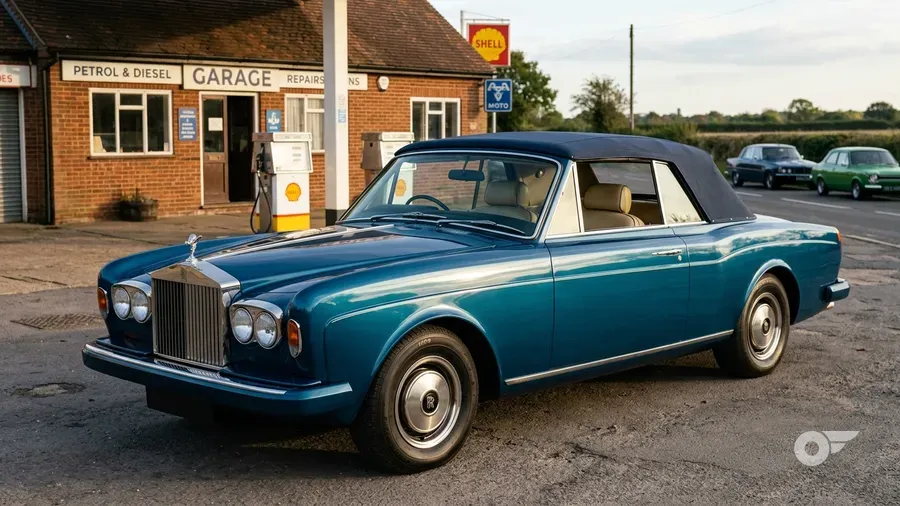
Drophead Coupe (Mulliner Park Ward) · 1967–1971

The convertible version of the Mulliner Park Ward two-door, and the variant that has always led the Shadow market. A 1968 example appears in On Her Majesty's Secret Service. Renamed Corniche alongside the fixed-head car in March 1971.

Long-Wheelbase Saloon · 1969–1976

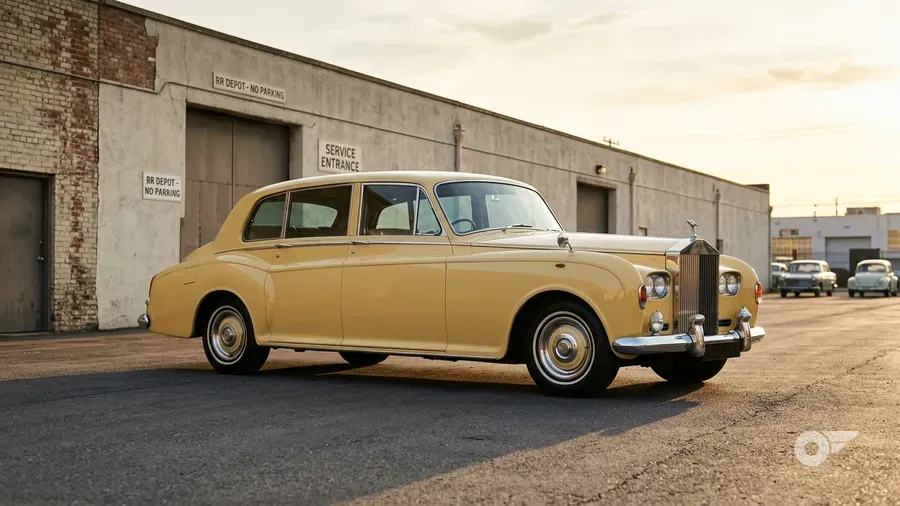
Four extra inches between the axles, almost always ordered with a division and specified by owners who intended to be driven rather than to drive. Superseded in 1977 by the Silver Wraith II rather than by a long-wheelbase Shadow II.

Standard Steel Saloon · 1965–1976

The car the reputation rests on and the one almost every Shadow is: four doors, one wheelbase, built at Crewe as a complete motor car with no coachbuilt option on the price list. Later examples are the better ones to use, having gained compliant rear suspension and radial tyres in 1972, ventilated front discs in 1973, flared wheel arches in 1974 and electronic ignition in 1975.

Two-Door Saloon (James Young) · 1966–1967

The rarest body on this platform. James Young cut and rebuilt standard saloons into two-doors with its own roofline, and the result looks distinctly different from the Mulliner Park Ward car. Production ran for barely a year.

Two-Door Saloon (Mulliner Park Ward) · 1966–1971

Coachbuilt fixed-head two-door on the Shadow floorpan, built in London rather than Crewe, with a lower roof and a shorter, more formal cabin. Renamed Corniche in March 1971, at which point the same body moved into a different market entirely.

What owning one is like

A Shadow that has been used is almost always a better car than one that has been stored, and owners will tell you so before you ask. The hydraulics are the reason. Seals in a high-pressure pumped system dry out when a car sits, so the rams and hoses that stay quiet under a car doing two thousand miles a year are the ones that weep on a car doing two hundred. The V8 is durable and is not what catches people out. Shadow I engines use oil throwers rather than a lip seal at the back of the crankshaft, so a light drip there is character rather than a rebuild. Hydraulic tappets get noisy with age and are not expensive to sort. Block corrosion is the one real engine worry, and it comes from years of topping the cooling system up with plain water. Everything electrical is Lucas and everything electrical is decades past its design life, so window motors, seat motors and central locking each take their turn. None of it is exotic. The air conditioning is the expensive exception. And the bodywork is where the money actually goes, which is why the inspection matters more than the test drive.

Upkeep & parts

Parts supply is the pleasant surprise. Flying Spares and IntroCar between them stock most of what a Shadow needs, new, remanufactured or good used, and mechanical parts cost far less than the badge on the bonnet suggests. Specialists put the honest figure for keeping one properly at somewhere near three thousand pounds a year, and that buys a car you can use rather than trailer.

The one rule nobody should break is the brake fluid. Rolls-Royce developed RR363 with Castrol after early Shadows knocked and squeaked at the rear height-control rams: it is a glycol fluid carrying a castor-derived additive that keeps the pumped hydraulics lubricated. The seals were designed around it. Filling a Shadow with ordinary DOT fluid is how a cheap job turns into a full hydraulic rebuild.

Budget for that rebuild anyway, on roughly a 48,000-mile cycle, and budget again if the air conditioning does not blow cold. Then join a club. The Rolls-Royce Enthusiasts Club holds Crewe's build records and runs a register for these cars, and the Rolls-Royce Owners Club covers every era with the technical depth a general forum cannot reach.

Country of origin
UK
Class
Luxury
Production years
1965–1976
Units built
19,497
Model
Silver Shadow
Nickname
No nickname (enthusiasts call the whole 1965-1980 Shadow, Bentley T, Corniche and Camargue family SY cars after the works project code, not this generation alone)
Body
Sedan, Coupe, Convertible
Layout
Front-engine, RWD
Engine
6230cc L410 V8 (1965-1970), 6750cc L410 V8 (1970-1976)
Transmission
4-speed GM Hydra-Matic automatic (built at Crewe under licence, to 1970), 3-speed GM Turbo-Hydramatic 400 automatic (from 1968)
Designer
John Polwhele Blatchley (chief styling engineer)