Octane Files
Browse CarsLincoln Continental 5th Gen

Lincoln Continental 5th Gen

Overview

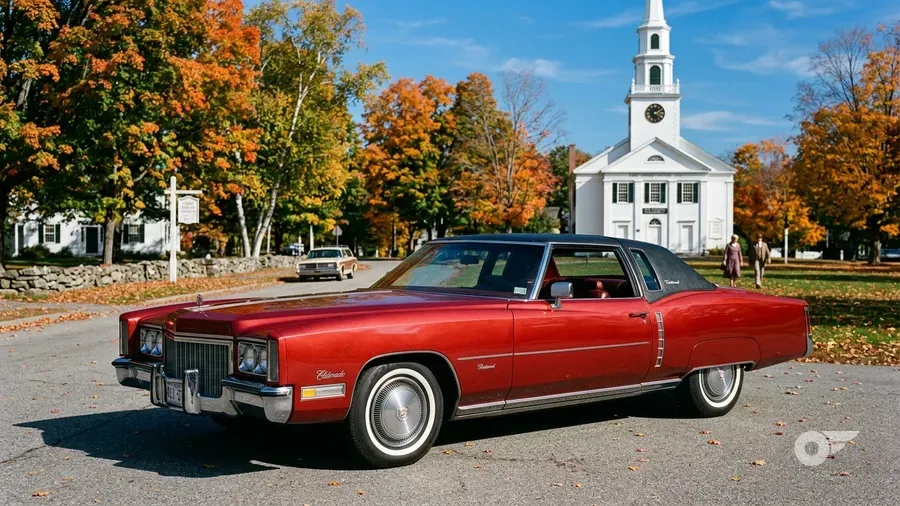
The 1970 Continental gave up the thing that made the 1961 car remarkable, then got bigger every year afterwards, which is why it is easy to dismiss and worth not dismissing. Lincoln abandoned unitised construction and put the Continental back on a separate frame, a stretched version of the Mercury Marquis chassis it now shared with the Ford LTD. The rear-hinged doors were gone. So was the four-door convertible.

What replaced the idea was quantity. The Continental grew from 225 inches long in 1970 to 233 by 1977, weighed as much as 5,400 pounds, and once 5-mph bumpers were fitted the 1977 to 1979 cars became the longest automobiles Ford Motor Company has ever built. General Motors downsized its full-size cars for 1977; Lincoln went the other way and had its best years ever, selling 95,600 Continentals that season against 31,695 in 1970.

The name that mattered arrived quietly. Town Car began as an option package in 1970 and became a permanent model in 1972, and by the end of the decade it had eaten the Continental from the inside. The car Lincoln would sell for the next thirty years starts here.

Distinctions

The defining attributes and collector status that make this car garage-worthy.

Octane Files Select
Renowned for its history, engineering, or cultural weight.

Collectibility scorecard

Rated 1 to 10 on the traits that matter for owning, driving, and holding on to a car like this.

Desirability
4/10
Rarity
3/10
Driving thrill
3/10
Investment trajectory
4/10
Usability
6/10
Ease of restoration
6/10
Cultural impact
5/10
Electronic dependence
Fully analogHeavily electronic

The powertrain has no computer anywhere in it. Fuel comes from a carburettor fed by a mechanical pump off the camshaft, the C6 automatic shifts on hydraulic pressure and a vacuum modulator, and nothing about how the engine runs is decided electrically. What pushes the score to two is everything wrapped around it. These cars carry more wiring and more vacuum plumbing than anything Lincoln had built before: automatic climate control, power windows, seats, locks and antenna, and an increasingly elaborate set of emissions devices bolted on through the decade. When one of these misbehaves it is nearly always a vacuum leak or a relay, never a sensor.

Market data

Demand tier, price trend, and typical values by condition, based on recent sales data.

Demand tier
EntrySolidHighBlue-chip

The accessible way in. Prices still forgive mistakes, and the upside is real.

Value trajectory
AppreciatingStableCooling

Values are holding steady. What you pay today is what it's worth tomorrow.

Price by condition
Driver
$7k
Excellent
$17k
Concours
$32k

These have sat at the floor of the American collector market for decades, which is what puts the tier at Entry. A 1978 Town Car brought 1,960 dollars at Bonhams' Tupelo Automobile Museum sale in April 2019, and while the best cars have moved up since, current 1979 listings run from about 8,950 to 89,900 dollars, with the top of that range being restored Collector's Series and Williamsburg cars rather than ordinary sedans. Nothing in the recorded data points in either direction, so the trajectory reads stable. What has genuinely changed is supply: honest unrestored survivors with a sound roof panel and working climate control are getting hard to find, and that is where any future movement will come from. Band figures describe a volume Town Car sedan, August 2026.

Values as of August 2026.

Buyer's guide

What anyone seriously considering this car should know first.

Why it's worth it
Lincoln answered the 1977 downsizing by building America's largest car and having its best sales year
Callout
With 5-mph bumpers fitted, the 1977 to 1979 cars are the longest automobiles Ford has ever built
What to watch for
Buy on condition and completeness, never on price, because these cars are cheap enough that a bad one costs more to fix than a good one costs to buy. That single rule explains most of the disappointment in this market. Start with the vinyl roof, which almost every car has. Water gets under it at the seams and rots the roof panel and the sail area from beneath while the surface still looks presentable, so lift the edges and check the drip rails. Then the lower body: rear quarters, wheel arches, trunk floor and the frame rails over the rear axle. Interiors are the other half of the value. Split-bench seats in velour or leather, the wood trim, the climate control head and the power window switches are all model-year specific and expensive to replace properly. Confirm the engine against the year. The 460 was fitted through 1978 but the 400 became common from 1977 and was the only engine offered in 1979, and a 1979 car advertised as a 460 has had one fitted. Anything claiming Collector's Series or Williamsburg needs paperwork.

The Story

Driving character

This is a car engineered to remove information rather than deliver it, and judged on that brief it is superb. The 460 is a long-stroke big block that makes its effort just off idle and never sounds like it is making any, so the Continental leaves a junction, reaches sixty and settles at speed with the same unbothered surge and almost no noise. The C6 automatic changes gear so gently you tend not to notice. The horsepower figures across the decade look like collapse and mostly are not. The 460 was rated at 365hp gross in 1970 and 1971 and 212hp net in 1972, and that is the same engine measured a different way after the industry changed from gross to net ratings. Real output did fall through the decade as compression and emissions equipment took their share, and the 1979 car, with only the 159hp 400 available, is genuinely slower than anything before it. Everything else is about mass. The steering is light and remote, the brakes need forethought, and the ride flattens surfaces that would unsettle almost anything else on the road.

Design

Eugene Bordinat had been Ford's design vice president since 1961 and stayed until 1980, so the same office that signed off Elwood Engel's austere 1961 car produced this one, which tells you how completely the brief changed. Restraint was over. The vocabulary here is formal roofs, thick body-colour flanks, upright grilles and vinyl. Structurally the car is honest about what it is. The sedan is a pillared hardtop, with a real frame around the door glass, and the whole body sits on a separate chassis shared in its hardpoints with the Mercury Marquis and the Ford LTD. Lincoln's job was to disguise that relationship with sheer length and detail, and it did the work: the Continental never looks like a Marquis, mostly because it is so much longer. Growth was partly legislated. Federal 5-mph bumper standards added weight and inches at both ends, and by 1977 the car measured 233 inches, which makes these the longest cars Ford has ever built. The 1979 Collector's Series is where the design language reaches its limit and knows it, a car dressed as its own commemorative edition.

Motorsport pedigree

There is no competition record, and by the 1970s there could not have been. Lincoln ran no factory programme, the Continental weighed up to 5,400 pounds, and the decade's regulatory pressure ran entirely towards emissions and fuel economy rather than performance. Even in a straight line the 1979 car with its 159hp 400 was slower than a 1970 one, which is not the profile of anything that races. The engine has the connection the car lacks. The 460 belongs to Ford's 385-series big-block family, and the same architecture carried the Boss 429 cylinder heads Ford built to homologate an engine for NASCAR against Chrysler's Hemi. The 385-series block also became a staple of American drag racing and marine competition long after the Continental stopped using it. Lincoln's own competition history is real but sits twenty years earlier, and belongs to another model. Factory Capris prepared by Bill Stroppe and Clay Smith took the first four places in the Carrera Panamericana's stock class in 1952, repeated it in 1953 and finished one-two in 1954, the race's final running.

In culture

This generation's cultural weight is institutional rather than cinematic. In 1970 the Secret Service commissioned a new presidential state car, and Ford's Special Vehicles Engineering department based it on the 1972 Continental sedan: twenty-two feet long on a 161-inch wheelbase, thirteen thousand pounds, bullet-resistant PPG glass, and protection designed in from the start rather than added afterwards. Nixon took delivery in 1974 and it stayed in service through the Ford, Carter and Reagan administrations. It sits in The Henry Ford today, not far from the 1961 convertible it succeeded. The larger legacy is a name. Town Car started here, as an option package in 1970 and a permanent model in 1972, then became its own model line for 1981 and ran until production ended in August 2011. For three decades it was the default American limousine and airport car, the black sedan that turned up at hotels, funerals and terminals without anyone needing to say what it was. That reputation was built on these cars. The Town Car's whole character, the length, the softness, the silence, was settled here and barely questioned afterwards.

Rivals

Cars from other manufacturers that competed for the same buyers when new.
Owning One

Why collectors want it

The argument is not subtle: this is the cheapest genuine period luxury car in the American market, and the supply of good ones is finally tightening. Nothing else gives you a five-thousand-pound Detroit flagship with a 460 V8, a proper interior and factory documentation for the price of a used commuter car.

It is also the end of a line, and endings hold value. The 1979 cars are the last body-on-frame full-size Continentals before the 1980 downsizing, and 1979 was the first year without the 460 at all, the 400 having to carry the whole range for emissions reasons. Lincoln knew what it was doing and sold a Collector's Series to mark it, alongside the Williamsburg package layered on top of the Town Car.

The hierarchy runs by trim and by year. A documented 1979 Collector's Series sits at the top, then Williamsburg Town Cars, then ordinary Town Cars and Town Coupes, then base Continentals. Early 1970 to 1972 cars with the 365hp gross 460 are the drivers' choice within the generation, because they are the lightest and the least strangled.

Which one to look for

The decade splits neatly in two. The 1970 to 1974 cars are the leaner ones, at 225 inches and under 5,000 pounds, and 1970 and 1971 are the only years with the 460 rated at 365hp gross, which makes them the quickest of the run by a clear margin. From 1975 the car grew again, and the 1977 to 1979 cars are the enormous ones. Trim is where the real choosing happens. The base Continental sedan and coupe are the plainest and cheapest. Town Car arrived as an option package for 1970 and became a permanent sub-model in 1972, adding the interior and roof treatment most people picture when they picture one of these; the Town Coupe followed for 1973. At the top of 1979 sit two specials worth knowing. The Williamsburg was a package layered on top of the Town Car, and the Collector's Series was Lincoln openly memorialising the end of the big cars, offered on both the Continental sedan and the Mark V. The variant most people overlook is the Town Coupe. Two doors on a 127-inch wheelbase gives it proportions the sedan cannot manage, and 21,185 coupes found buyers in 1976 alone.

Collector's Series · 1979

Lincoln openly memorialising the end of its big cars, offered for 1979 on the Continental sedan and on the Mark V. Also the year the 460 disappeared for fuel-economy reasons, leaving the 159hp 400 V8 as the only engine, so a Collector's Series is by definition a 400 car. Sits at the top of the generation's market and needs paperwork to prove itself.

Town Car · 1970-1979

The trim that ended up outliving the car. Town Car began as an option package on the Continental sedan for 1970 and became a permanent sub-model in 1972, bringing the formal roof, the upgraded interior and most of what people picture when they picture a 1970s Lincoln. It became its own model line for 1981 and ran until August 2011.

Town Coupe · 1973-1979

The two-door version of the Town Car, added for 1973. Two doors on the 127-inch wheelbase give it proportions the sedan cannot manage, and it is the body most people overlook when shopping this generation.

Williamsburg · 1979

A package layered on top of the Town Car for 1979, with its own paint, trim and interior treatment. The most decorated version of the most decorated Lincoln, and rare enough that documentation matters more than condition.

What owning one is like

The mechanical side is about as undemanding as 1970s American cars get. The 460 and the 400 are understressed cast-iron V8s, the C6 automatic is one of the toughest transmissions Ford ever built, and the separate frame means a tired body does not compromise the structure. Owners routinely drive these long distances and expect to. The car will still find ways to spend your money. Vinyl roofs trap water and rot the panel underneath, and the repair is bodywork rather than a re-cover. Vacuum lines run everywhere, and a hardened hose behind the dash will produce symptoms that look electrical and are not. Automatic climate control heads and power seat mechanisms are model-year specific and increasingly scarce. Fuel is the running cost people underestimate. Five thousand pounds and a big-block carburetted V8 means low double-digit miles per gallon on a good day, and no amount of tuning changes that. Then there is size. At 233 inches the later cars will not fit in many modern garages or parking bays, which is a real ownership consideration rather than a joke.

Upkeep & parts

Mechanically this is one of the best-supported cars in the catalog, because almost none of it is unique to Lincoln. The 460 and 400 V8s and the C6 transmission were fitted across Ford's full-size cars and trucks for years, so rebuild kits, gaskets, water pumps, starters and brake components are all cheap and immediately available. Suspension and steering parts are the same story.

Body and interior are where the specialists come in. Vinyl roof material, moulded carpet sets, seat covers, wood-effect trim and the correct model-year grilles and taillamp lenses come from a small trade in Lincoln parts, and complete cars are worth paying up for because filling gaps takes time rather than money.

The Lincoln and Continental Owners Club covers the generation and sets the judging standards, and TheLincolnForum.Net and Lincoln Forums are where the practical vacuum-diagnosis and climate-control knowledge lives.

Ford's Heritage Vault has the original brochures for every year of the run online at no cost, which is the fastest way to check whether a car really carries the Town Car, Williamsburg or Collector's Series equipment it is advertised with.

Country of origin
USA
Class
Luxury
Production years
1970–1979
Units built
~580,000
Model
Continental
Nickname
No nickname (Town Car names the top trim, which later became its own model, not the generation)
Body
Sedan, Coupe
Layout
Front-engine, RWD
Engine
460ci (7.5L) 385-series V8, 365hp gross (1970-1971) and 202-212hp SAE net (1972-1978); 400ci (6.6L) 335-series V8, 166hp SAE net (1978) and 159hp SAE net (1979)
Transmission
3-speed C6 automatic
Designer
Eugene Bordinat (Ford design vice president)