Octane Files
Browse CarsRolls-Royce Corniche I

Rolls-Royce Corniche I

Overview

Rolls-Royce launched the Corniche in the worst month of its corporate life. The parent company had been placed in receivership on 4 February 1971, sunk by the development cost of the RB211 aero engine, and in March the car division put a new name on its most expensive product. The car underneath was not new. Coachbuilt two-door versions of the Silver Shadow had been on sale since 1966, the drophead since 1967, both built at Mulliner Park Ward in Willesden. What March 1971 changed was the badge, a higher compression ratio and roughly ten percent more power, plus equipment the saloons never got: half wheel covers with stainless trim to feed air to the brakes, a three-spoke wood-rimmed wheel, and the first tachometer Rolls-Royce ever fitted as standard. The real difference was how it was made. A body took something like six months to form and trim by hand, the convertible hood alone built up over four days around a horsehair interlining, and at £12,829 the coupe sat at the top of the price list. Across seventeen years the company built 1,090 coupes and 3,239 convertibles, plus 146 more wearing Bentley badges.

Distinctions

The defining attributes and collector status that make this car garage-worthy.

Octane Files Select
Renowned for its history, engineering, or cultural weight.

Collectibility scorecard

Rated 1 to 10 on the traits that matter for owning, driving, and holding on to a car like this.

Desirability
7/10
Rarity
7/10
Driving thrill
4/10
Investment trajectory
5/10
Usability
5/10
Ease of restoration
4/10
Cultural impact
7/10
Electronic dependence
Fully analogHeavily electronic

Almost nothing here is computer-controlled. The V8 runs twin SU carburettors at launch and a single Solex four-barrel from 1977, with Bosch fuel injection arriving only on emissions-market cars late in the run, and even that is a mechanical continuous-flow system rather than an engine ECU. Ignition is conventional. What complexity exists sits in the high-pressure hydraulics that operate the brakes and the self-levelling suspension, and in a large loom of relays, motors and switches for the windows, seats, aerial and split-level air conditioning. Electrically busy, electronically almost empty.

Market data

Demand tier, price trend, and typical values by condition, based on recent sales data.

Demand tier
EntrySolidHighBlue-chip

A dependable market. Well-kept cars hold their value and find ready buyers.

Value trajectory
AppreciatingStableCooling

Values are holding steady. What you pay today is what it's worth tomorrow.

Price by condition
Driver
$30k
Excellent
$65k
Concours
$110k

Convertibles carry this market and coupes trail badly, which makes the fixed-head the value buy of the generation. TheClassicValuer records 287 Corniche I results with a median of £36,340 and a top sale of £118,652; classic.com's highest recorded Corniche I result is $148,500, a 1981 car sold in January 2025. UK guide prices run from about £7,000 for a project coupe to about £125,000 for a show convertible. The spread between a tidy driver and a properly restored car is wide enough that condition, not model year, sets the price, and a cheap car with rotten sills and tired hydraulics is the most expensive thing on the page.

Values as of August 2026.

Buyer's guide

What anyone seriously considering this car should know first.

Why it's worth it
The most expensive car on the Rolls-Royce price list, hand-built over roughly six months
Callout
Launched in March 1971, weeks after Rolls-Royce Ltd was placed in receivership
What to watch for
Start with the sills. They are the expensive rust, thousands of pounds a side before anyone has mixed paint, and along with the windscreen surround and the hood well they are where a cheap car turns into an expensive one. Damp inside the cabin is the tell. Wet carpets and soundproofing point at a failed screen seal or hood surround, and standing water takes the veneer lacquer and the electrical contacts with it. Corroded contacts are why some cars are reluctant to select a gear. Then test the hydraulics, because everything else follows from them. Both brake warning lamps should light at the ignition and go out within about thirty seconds of the engine starting, and with the engine off you should get at least forty presses of the pedal before pressure falls away. Groaning, weeping unions or a knock through the pedal means a system overhaul running to several thousand pounds. From March 1979 the cars use the later mineral-oil hydraulics; before that they run RR363, a DOT4-type fluid blended with castor oil, and mixing the two destroys seals. On a cold start, tappet rattle should quiet inside half a minute. Join the RREC before you buy: it is licensed by the factory and holds the original build records.

The Story

Driving character

Rolls-Royce never published a power figure for the Corniche, so nobody actually knows it. Estimates run between roughly 220 and 240bhp, which on a car weighing 4,816lb means the 6.75-litre V8 exists not to make speed but to make speed irrelevant. It works. Autocar recorded 60mph in under ten seconds, and Autosport's John Bolster reported the car cruising at 100mph with restful ease and reaching a genuine 120. What you notice from the driver's seat is the absence of event. The V8 is close to silent at idle and stays quiet under load, the three-speed Turbo Hydra-Matic changes gear without announcing it, and the self-levelling suspension takes the road surface out of the conversation. Pre-1977 cars steer through a power-assisted box that is light to the point of vagueness and asks you to aim the car rather than place it; the rack-and-pinion cars from 1977 are noticeably more precise without giving up any isolation. The brakes are the surprise. High-pressure hydraulics give a pedal that is short, firm and immediate on a car that otherwise does nothing quickly, and it is the one control that feels modern.

Design

The body is Bill Allen's, drawn at Mulliner Park Ward, and by his own account he thought it was a dud. Left to get on with it in John Blatchley's absence, Allen finished the wax model in six weeks and it went into production essentially unaltered. He later said it would never sell because it looked terribly old-fashioned. It stayed in production, in one form or another, until 1995. What he had drawn was a two-door with a subtle Coke-bottle flick through the hip, a wasp waist that gives the flanks a tension the Silver Shadow saloon's flat sides never had, and a roofline low enough to make the same car read as a different one. Blatchley's saloon is the sober version. Allen's is the one that photographs well on a cliff road. The details are Corniche-only: half wheel covers with a stainless rim, fitted to let air at the brakes, a three-spoke steering wheel with a wood rim, and a tachometer in the binnacle, the first Rolls-Royce ever fitted as standard. The 1977 restyle added rubber-faced bumpers, a front air dam and flared arches, and it dates a car instantly.

Motorsport pedigree

There is no competition record here, and the reason is better than a thin list of club results would be. Rolls-Royce did race, once, seriously. A works team of three Silver Ghosts contested the 1913 Austrian Alpine Trial, finished first and third, took the Archduke Leopold Cup, and the company sold a commemorative road car called the Alpine Eagle off the back of it. That was effectively the end of it. By the time the Corniche existed, competition at Rolls-Royce meant aero engines, and the aero business had just destroyed the company: RB211 development costs put the parent into receivership on 4 February 1971, weeks before the Corniche got its name. The car division was sold off separately in 1973 to a company with no motorsport budget, no series a 4,816lb hand-built drophead could have entered, and every commercial reason to stay out of a game where its cars would be beaten in public. The Corniche's job was to be seen parked, and it was extremely good at it.

In culture

The Corniche is the car the seventies and eighties reached for to signal money and nothing else about the owner. Paul McCartney, Frank Sinatra and Tom Jones all bought one. David Bowie, Michael Caine, Elton John and Dean Martin went onto waiting lists reported to run two years. On screen it worked as shorthand so reliably that it rarely needed a line of dialogue: a 1974 Corniche carried Michael Caine's con man in Dirty Rotten Scoundrels, and the car turned up across Dynasty, Beverly Hills 90210 and The Player without anyone having to explain what it meant. The other appearance worth knowing is the unflattering one. In a 2008 Top Gear old-car challenge, Jeremy Clarkson ran a Mercedes 600 Grosser against James May's 1972 Corniche coupe and dismissed it as a Ford Zephyr with a chrome nose, which is untrue and exactly the sort of remark the car has always attracted. May's Corniche went through Bonhams in 2017. That tension is the whole cultural position: nothing else looks so much like success, and nothing else is quite so easy to sneer at.

Rivals

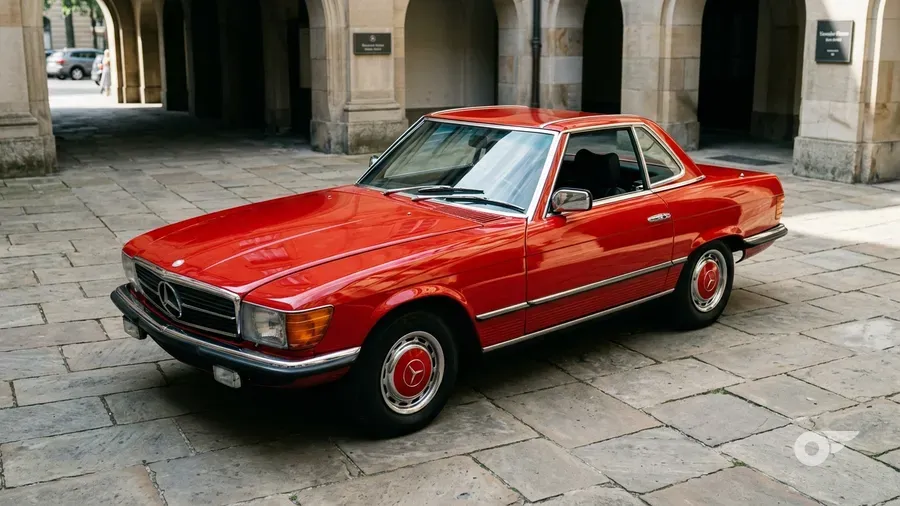
Cars from other manufacturers that competed for the same buyers when new.
Owning One

Why collectors want it

A Silver Shadow saloon is a bargain and always has been, because Rolls-Royce built 30,057 of them. The Corniche is the same mechanical package in a body that took half a year to make, and the numbers followed: 1,090 coupes and 3,239 convertibles across seventeen years. That is the whole argument, and the hierarchy inside it is steep and stable. Convertibles run at roughly two to three times the equivalent coupe in every guide and every auction sheet, which is exactly why the fixed-head is the car people quietly recommend to anyone who wants the craftsmanship without the money. Cars from the spring 1977 restyle onwards drive better and generally sell for more, though the earlier chrome-bumper cars have the cleaner shape and a following of their own. Rarest are the Bentley-badged versions, 69 coupes and 77 convertibles, which spent decades being worth less than the Rolls-Royce equivalent and no longer are. None of this is speculative money, and that is part of the appeal. The Corniche gets bought by people who want a Rolls-Royce they will actually drive, and it repays that better than anything else the company built in the seventies.

Which one to look for

Two bodies, one badge choice, and a facelift that splits the generation in half. The convertible is what the world means when it says Corniche: 3,239 built, on sale for the whole 1971 to 1987 run, and the one carrying the money. The two-door saloon, the fixed-head coupe, is the connoisseur's pick and the bargain, 1,090 built and dropped in March 1981 once the Silver Spirit arrived. It is rarer than the drophead, to plenty of eyes better resolved, worth a fraction of the price, and it has no hood to replace, which at around £7,000 a time is not a small consideration. The spring 1977 restyle is the real dividing line. Cars from then on got rack-and-pinion steering, alloy and rubber bumpers, a front air dam, flared wheelarches, an aluminium radiator, an oil cooler and split-level air conditioning, and they are the better cars to drive. March 1979 brought revised rear suspension and the mineral-oil hydraulic system. The Bentley cars are the genuinely rare ones, 69 coupes and 77 convertibles, renamed Continental in July 1984 with colour-keyed bumpers, new mirrors and a new dash.

Bentley Corniche / Continental · 1971-1987

The same two cars with a Bentley radiator and badges, sold in tiny numbers through the years when the Bentley name meant almost nothing to buyers. Renamed Continental in July 1984 with colour-keyed bumpers, revised mirrors, a new dash and improved seats. Long the cheap way into a Corniche, and no longer that.

Corniche Convertible · 1971-1987

The drophead, and the car the Corniche name really belongs to. Same 6.75-litre V8 and three-speed automatic as the coupe, in a hand-built four-seat convertible body whose hood alone took four days to assemble around a horsehair interlining. Sold for the entire run, from the March 1971 renaming to the arrival of the Corniche II, and it has always been the one the market wants.

Corniche Two-Door Saloon · 1971-1981

The fixed-head coupe, and the quiet bargain of the generation. Rarer than the convertible, structurally stiffer, no hood to rot or replace, and to many eyes the better-resolved shape because the roof completes Bill Allen's Coke-bottle flick. Dropped in March 1981 once the Silver Spirit went on sale. Trades at a fraction of drophead money.

What owning one is like

Everything an owner deals with traces back to the same fact: this car was assembled by hand, and nobody at Mulliner Park Ward was thinking about the third owner. Water gets in. Screen seals and hood surrounds leak, carpets and soundproofing hold the damp, and from there it reaches the veneer lacquer and the electrical contacts. The hydraulic system that runs the brakes and the self-levelling suspension is what sets the budget: three interlinked circuits, nitrogen accumulator spheres bolted to the side of the crankcase, and a fluid regime that punishes anyone who ignores it. Left alone, the accumulators go soft and the warning lamps stay lit. The V8 is the honest part of the car, an all-alloy engine with hydraulic tappets that will run to enormous mileages provided the coolant inhibitor has been kept up, and whose failures announce themselves slowly rather than all at once. Body rust is the one that decides whether a car is worth saving, and the sills are the expensive end of that. None of it is mysterious. It simply costs Rolls-Royce money to put right, which is the trade you accept going in.

Upkeep & parts

Parts availability is genuinely good, which surprises people who assume a coachbuilt Rolls-Royce must be unobtainable. Flying Spares and IntroCar between them stock most of what a Silver Shadow-based car needs, from accumulator spheres and valve bodies to hoses, brakes and trim, and the running gear is shared with 30,057 Silver Shadows, so nothing underneath is exotic. What costs money is anything the coachbuilder touched. A new convertible hood through an experienced Rolls-Royce trimmer runs to around £7,000. A full hydraulic overhaul is several thousand. A driveshaft CV upgrade is about £3,000. Sill repair is thousands a side. Retrimming an interior costs whatever the hides and veneer cost plus the hours, and there are no shortcuts because there were none in the first place. Service the hydraulics on a schedule instead of waiting for a warning lamp, and treat brake fluid as a replacement item rather than something to top up. The club side is unusually strong: the Rolls-Royce Enthusiasts' Club is licensed by the factory and holds the original build records for every historic Rolls-Royce and Bentley.

Country of origin
UK
Class
Luxury
Production years
1971–1987
Units built
~4,329
Model
Corniche
Nickname
No nickname
Body
Coupe, Convertible
Layout
Front-engine, RWD
Engine
6.75-litre (6,750cc) L410 OHV V8, twin SU carburettors (1971-1977), single Solex 4A1 four-barrel carburettor (from 1977), Bosch fuel injection on emissions-market cars late in the run (L410I)
Transmission
3-speed GM Turbo Hydra-Matic 400 automatic
Designer
Bill Allen (Mulliner Park Ward)