Octane Files
Explore CarsPorsche 356 B

Porsche 356 B

Overview

The 356 B is the one Porsche built for America, and America bought it. 30,963 cars in four years, more than the pre-A and the C put together, and the biggest-selling 356 by a wide margin.

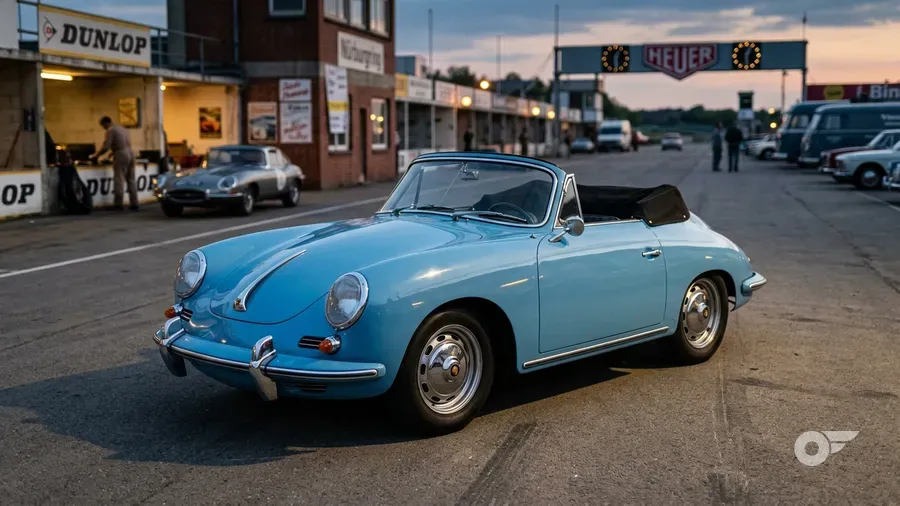
The changes announced in late 1959 were the most visible in the model's life. The headlamps moved up into taller, flatter front wings, and the bumpers rose clear of the body on vertical overriders, which opened room underneath for ducts feeding the new light-alloy drum brakes. Enthusiasts have argued about it ever since. The A is the prettier car. The B is the one you could park on an American street without losing a bumper, and it was aimed squarely at the market Max Hoffman had built.

Two body series ran through it. The T5 from late 1959, then the T6 from mid-1962, which brought twin grilles on the engine lid, an external fuel filler under a flap on the right front wing, a flatter tank with real luggage space behind it, and larger glass front and rear. Above the range sat the Super 90 and, from 1962, the four-cam Carrera 2.

Distinctions

The defining attributes and collector status that make this car garage-worthy.

Octane Files Select
Renowned for its history, engineering, or cultural weight.

Collectibility scorecard

Rated 1 to 10 on the traits that matter for owning, driving, and holding on to a car like this.

Desirability
7/10
Rarity
5/10
Driving thrill
6/10
Investment trajectory
6/10
Usability
6/10
Ease of restoration
7/10
Cultural impact
7/10
Electronic dependence
Fully analogHeavily electronic

Six volts, points ignition, a generator and nothing else. The Super 90 is the most highly tuned pushrod 356 and it gets there entirely mechanically: nine to one compression, better carburation and better breathing, 90 PS at 5,500 rpm. Even the handling fix Porsche fitted alongside it is a piece of spring steel bolted across the back of the car. The only wiring that matters runs to the lights, the wipers and the starter, and the commonest modification any B owner makes is converting the whole thing to twelve volts so the headlamps do something useful at night.

Market data

Demand tier, price trend, and typical values by condition. Our own assessment, not a quoted valuation.

Demand tier
EntrySolidHighBlue-chip

Strong, sustained collector demand. Good examples never wait long for a buyer.

Value trajectory
AppreciatingStableCooling

Values are holding steady. What you pay today is what it's worth tomorrow.

Price by condition
Driver
$60k
Excellent
$92k
Concours
$150k

The B is the value end of the 356 and the numbers say so plainly. classic.com's B average is $125,838 against $242,284 for the A, and a T6 coupe averages $76,417 against $117,024 for an A coupe. That gap is about the headlamps, not the engineering. The open cars are a separate market entirely. T5 Roadsters average $174,915 and T6 Roadsters $350,863, and the record for any 356 B is $1,160,000 for a 1962 Twin-Grille Roadster by D'Ieteren in October 2024. A 1960 T5 Roadster took $357,000 in March 2022. High rather than blue-chip, and stable. The volume B coupe has softened slightly along with the rest of the ordinary 356 market, Hagerty having moved its 356 C SC coupe guide down about ten percent over the last year, while the rare bodies have held. A good Super 90 coupe is arguably the most car per dollar in the whole model. The band below describes a 1600 or 1600 Super coupe and excludes Roadsters, notchbacks and the Carrera 2.

Values as of August 2026.

Buyer's guide

What anyone seriously considering this car should know first.

Why it's worth it
The 356 redesigned around the American market, and the volume car of the entire run
Callout
The best-selling 356 by a distance: 30,963 cars, more than the pre-A and C together
What to watch for
Establish T5 or T6 first, because it decides what you will be buying for the rest of your ownership. T5 cars run to mid-1962 and have a single grille on the engine lid with the filler under the bonnet. T6 cars have twin grilles, the external filler flap on the right front wing and bigger glass. Panels, tanks, lids and seals all differ. Then establish the engine. The B was sold as a 60 PS 1600, a 75 PS 1600 Super and a 90 PS Super 90, and the Super 90 carries both a real premium and a real trap: the case numbers are the only proof and the internals are not visible from outside. The Super 90 and the Carrera also got a rear compensating spring, a single transverse leaf bearing on the differential with its ends tied to the axle tubes, fitted to cut oversteer. Check it is there and check it is right, because a car advertised as a Super 90 without one is a car worth asking questions about. Then look at the metal, which is the next section's subject and the whole game. Get it on a lift, with someone who knows 356s, before you talk about price.

The Story

Driving character

The B drives like the A with the sharpest edge filed off, which is exactly what it was for. The seating position is a fraction higher, the glass is bigger from 1962, and the whole car feels less like a special and more like a small fast tourer that will do a long day without complaint. The Super 90 is the reason to be here. 90 PS in a 900-kilo car does not sound like much until you drive one. It pulls hard from three thousand, revs willingly to five and a half, and makes the 60 PS car feel like the different vehicle it is. Porsche fitted the Super 90 and the Carrera with a transverse compensating spring across the rear axle tubes precisely because it had made the car quick enough to need one, and the difference is real. The tail still moves, but it moves progressively instead of suddenly. Drum brakes all round to the end of the series, in light alloy and fed by those new bumper ducts. They are adequate and they fade, and every B owner learns to think one corner further ahead than they would in anything modern.

Design

Raising the headlamps and the bumpers is the most argued-about decision in 356 design, and it was made for the American market. The lamps moved up into taller, flatter wings. The bumpers moved up and out on vertical overriders, which left room for cooling ducts feeding the new alloy drums. Drag went up, from a quoted 0.31 on the A coupe to 0.398. The Porsche crest appeared pressed into the hubcaps. The T6 revision of mid-1962 is the more interesting change and Porsche barely mentioned it: twin grilles on the engine lid, a nearly straight-edged bonnet, an external fuel filler under a flap on the right front wing, a flatter tank that freed up real luggage space, and bigger front and rear glass. The company went on calling it a 356 B and changed the name only when the C's disc brakes arrived. The Karmann notchback is the outlier. Stepped roofline, thin B-pillars, a large rear window, closer to a very small saloon than to a Porsche coupe, and unmistakable in a car park full of 356s.

Motorsport pedigree

The B's competition story is a collaboration nobody expected. Porsche wanted a lighter Carrera GT for the 1960 GT class, Reutter was at capacity, and the job went to Carlo Abarth in Turin. Franco Scaglione drew a lower, slipperier aluminium body, Zagato built it, and the result was the 356 B 1600 GS Carrera GTL Abarth: about 140 kilos lighter than a road B, dry-sumped, twelve-volt, twin ignition, an 80-litre tank. The standard engine gave 115 PS at 6,500 rpm, a sports exhaust took it to 128, and the open Sebring exhaust to 135 at 7,400 rpm, good for a little over 230 km/h. Herbert Linge and Hans-Joachim Walter won their class at Le Mans in 1960 with the first one built. Twenty were made, or twenty-one depending on whether you count a car whose chassis number suggests it and whose history does not. Alongside it the works ran the 2000 GS-GT, the flat-nosed Carrera 2 the Germans nicknamed Dreikantschaber, the three-cornered scraper. In 1963 Edgar Barth and Herbert Linge took it to third overall at the Targa Florio and first of every GT car in the race.

In culture

The B is the 356 the Outlaw movement was built on, because for thirty years it was the one nobody was precious about. Gary Emory, who ran a Porsche parts business in California, started modifying 356s in the 1980s in ways the concours world disapproved of, and the word Outlaw was thrown at him as an insult. It stuck as a compliment. His son Rod founded Emory Motorsports in 1996 and turned it into a discipline: bare-metal rotisserie rebuilds of genuine steel cars, lowered stances, shaved trim, wider wheels and engines making several times what Zuffenhausen managed. The waiting list runs to years. The Porsche 356 Registry, which exists to preserve these cars, now carries a page about Outlaws on its own website. That shift matters more than it sounds. It moved the 356 off the concours lawn and back onto the road, and it is why a well-built modified B is no longer automatically worth less than a standard one. It also means the supply of cheap unmolested Bs, which is where the whole thing started, has quietly disappeared.

Owning One

Why collectors want it

The B is the 356 you can actually buy, and that is meant as a compliment. A T6 coupe averages $76,417 on classic.com against $117,024 for an A coupe and $208,302 for a pre-A, which makes it the cheapest route into a real steel Zuffenhausen 356 with the full parts and club economy behind it.

What you give up is the A's front-end proportion. What you get is a better car: usable luggage space in the T6, larger glass, a filler you can reach without opening the bonnet, and the Super 90, which is the finest pushrod engine of the era at 90 PS.

The B also holds the two most valuable 356s that are not Carreras. The Roadster, built by Drauz and then by D'Ieteren in Brussels, averages $174,915 in T5 form and $350,863 in T6, and a 1962 Twin-Grille Roadster took $1,160,000 in October 2024, the highest recorded 356 B result. The Karmann notchback, 1,747 cars with a steel roof welded over a cabriolet body, is the oddity that has quietly become collectable while nobody was looking.

Which one to look for

The Super 90 is the one to look for in a coupe. 90 PS at 5,500 rpm from 1,582cc, nine to one compression, 180 km/h, and the rear compensating spring that made it behave. It is the high point of the pushrod engine before the C's SC. The Roadster replaced the Convertible D and it is where the money is. 2,902 were built, bodies first by Drauz and then by D'Ieteren of Brussels, and the 1962 T6 cars, roughly 250 of them, are known universally as Twin-Grille Roadsters and trade at multiples of the T5. The Karmann notchback is the strange one and worth understanding properly. The 1961 T5 cars are literally cabriolets with the optional steel hardtop welded on. The 1962 T6 cars were designed as their own thing, a cabriolet rear end with the T6 coupe screen frame and a unique roof. 1,747 in total. The Carrera 2 arrives in 1962: two litres, four camshafts, 130 PS, 200 km/h and the first disc brakes Porsche ever put on a production car, 310 of them on B bodies. The Carrera GTL Abarth is a racing car, not a variant to shop for, and it belongs in the section below.

1600 GS Carrera GT · 1960–1961

The Reutter-bodied four-cam GT that the Abarth was built to replace. 1,588cc, 115 PS, aluminium panels and a stripped interior, and good for around 200 km/h. It is the last of the 1.6-litre four-cam GT line before the two-litre Carrera 2 took over as the flagship.

Carrera 2 · 1962–1963

The 356's flagship and the first series Porsche with disc brakes, a Porsche design that grips the disc from inside and carries the outer rim on a star-shaped hub. Two litres, four camshafts, 130 PS at 6,200 rpm, 162 Nm at 4,600, 200 km/h, in a car weighing 1,010kg. Coupe and cabriolet. The works GS-GT version ran alloy doors and lids, Plexiglas glazing, a 110-litre tank and up to 155 PS.

Carrera GTL Abarth · 1960–1961

A Porsche with an Italian body, built because Reutter had no capacity. Carlo Abarth took the job in Turin, Franco Scaglione drew a lower and much slipperier shape, and Zagato built it in aluminium. About 140kg lighter than a road 356 B, dry-sumped, twelve-volt, twin ignition, 80-litre tank, limited-slip differential. Herbert Linge and Hans-Joachim Walter won their class at Le Mans in 1960 with the first one built.

Karmann Notchback · 1961–1962

The oddity, and two different cars under one name. The 1961 T5 cars are literally cabriolet bodies with the optional steel hardtop welded permanently in place. The 1962 T6 cars were designed as their own thing: a cabriolet rear end, the T6 coupe windscreen frame and a unique roof. Both have a stepped roofline, thin B-pillars and a big rear window, and look closer to a very small saloon than to a Porsche coupe.

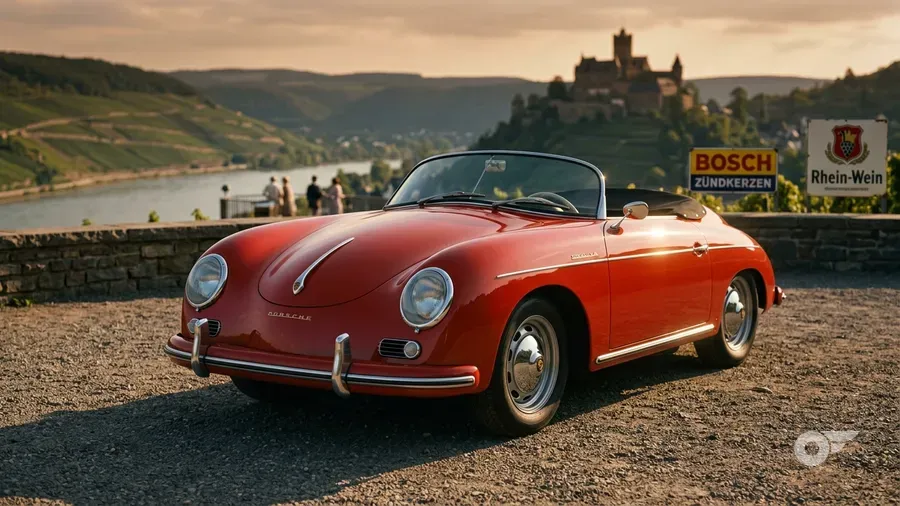
Roadster · 1959–1962

The Convertible D's replacement and the most valuable non-Carrera 356 B. Wind-up windows, a proper hood and the B's raised front end, sold as the open Porsche for people who had found the Speedster too spartan. Bodies came first from Drauz of Heilbronn and latterly from D'Ieteren in Brussels, and production stopped at the end of 1961 with the last cars built as 1962 T6 models.

Super 90 · 1960–1963

The high point of the pushrod 356 before the C's SC, and the B worth hunting. 90 PS at 5,500 rpm from 1,582cc on nine to one compression, 121 Nm at 4,300, 180 km/h. Porsche fitted it with a rear compensating spring, a single transverse leaf bearing on the differential with its ends tied to the axle tubes, because the car was now quick enough to need the oversteer taken out of it.

Twin-Grille Roadster · 1962

The last and rarest 356 Roadster, and the one collectors chase. Built by D'Ieteren of Brussels on the new T6 body, so it carries the squared bonnet, the fuel filler under a flap on the right front wing and the twin ventilation grilles on the engine lid that give it its name. Porsche went to D'Ieteren rather than overload Drauz while clearing the lines for the 356 C.
What owning one is like

Rust is the 356's defining ownership fact and the B is where most buyers meet it, so here is the anatomy. The car is a unitary steel shell with no separate chassis, and its strength comes from two box sections running front to back along each side of the floor. Those are the longitudinals. Sitting above them are the heater channels, the ducts carrying warm air from the exhaust heat exchangers into the cabin, which means they are damp with condensation for much of their lives. When those rot, the car folds. Doors stop shutting squarely and the gaps at the door and bonnet lips start to open up, and that is the tell to look for before you look at anything else. After that, in order: the battery box under the front bonnet, where acid does what water alone cannot, and where a hollow ping under flaking paint is worse news than flex. Then floor pans, door bottoms, front wing seams and the torsion bar tubes. Undercoating and fresh paint hide all of it beautifully. None of this is a reason not to buy one. It is a reason to pay a 356 specialist to put the car on a lift first, which costs a fraction of one percent of what getting it wrong costs.

Upkeep & parts

The B has the best support of any 356 for the simple reason that there are more of them. Every mechanical part is available, the Type 616 engine is understood by every air-cooled specialist in the trade, and the Super 90's internals are reproduced.

Body panels are the exception that catches people out. T5 and T6 differ in the bonnet, the engine lid, the tank, the filler arrangement and the glass apertures, and ordering the wrong series is the commonest mistake in a 356 restoration. Roadster and Karmann notchback panels, screen frames and roof structures are far harder again, and a notchback roof is effectively a fabrication job rather than a purchase.

Structural work is the real budget. A shell needing both longitudinals and both heater channels is months of specialist labour and will comfortably exceed what the finished car is worth at the bottom of the market. That is precisely why sorted Bs sell in days and cheap ones sit for months.

Join the Porsche 356 Registry first: nearly 7,000 members in 40 countries, a magazine, the 356Talk forum and the largest 356 classifieds anywhere.

Country of origin
Germany
Class
Sports
Production years
1959–1963
Units built
~30,963
Model
356
Nickname
Bathtub
Body
Coupe, Convertible, Roadster
Layout
Rear-engine, RWD
Engine
1,582cc Type 616/1 1600 flat four (60 PS), 1,582cc Type 616/2 and 616/12 1600 S flat four (75 PS), 1,582cc Type 616/7 1600 Super 90 flat four (90 PS), 1,588cc Type 692/3 and 692/3A four-cam Carrera 1600 GS/GT (115 PS), 1,966cc Type 587/1 four-cam Carrera 2 flat four (130 PS)
Transmission
4-speed Porsche ring-synchronised manual
Designer
Erwin Komenda (body, head of Porsche body design), Karmann of Osnabrück (notchback hardtop body)