Octane Files
Explore CarsAlfa Romeo Giulietta Sprint

Alfa Romeo Giulietta Sprint

Overview

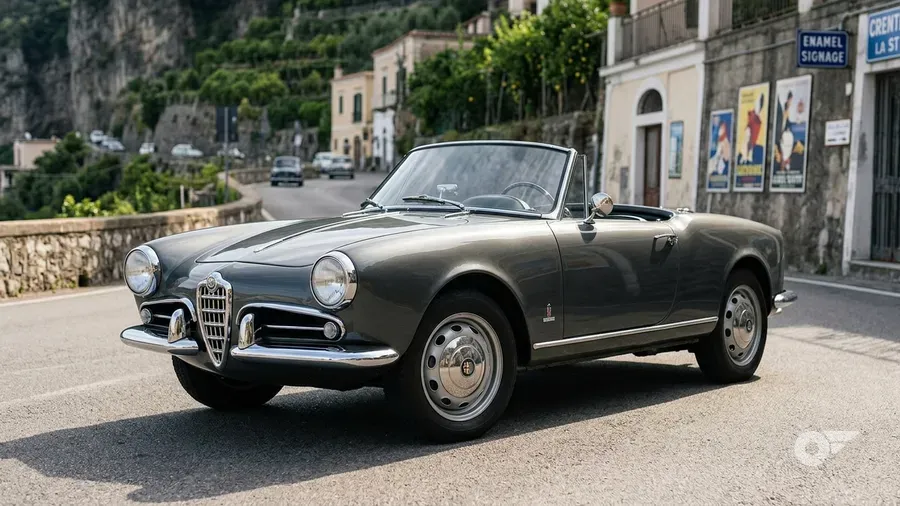
The Giulietta Sprint was supposed to buy Alfa Romeo time and instead defined it. Alfa needed something to put on its stand at Turin in April 1954 because a bond lottery had promised 200 subscribers a car, and the saloon those bonds were sold against did not exist yet. Bertone got the job, Franco Scaglione drew the body, and the coupe reached the public a full year before the Berlina it was based on.

The reaction broke the plan. Alfa's own account has roughly 2,000 orders in the first days of the show, other accounts put it above 3,000, and Classic & Sports Car records that orders had to be suspended. Alfa could not build them. So the earliest cars were assembled by hand, with bodies fabricated at Bertone, interiors and electrics supplied by Ghia, and panel work farmed out to artisan shops scattered around Turin.

24,084 Sprints followed over eleven years, with 3,158 hotter Veloces counted separately. It is the shape most people mean when they say Giulietta, and the reason a small, affordable, beautifully bodied Italian coupe became a category rather than a one-off.

Distinctions

The defining attributes and collector status that make this car garage-worthy.

Legend
A car that transcended the hobby, known far beyond the people who drive them.
Octane Files Select
Renowned for its history, engineering, or cultural weight.

Collectibility scorecard

Rated 1 to 10 on the traits that matter for owning, driving, and holding on to a car like this.

Desirability
8/10
Rarity
5/10
Driving thrill
7/10
Investment trajectory
6/10
Usability
6/10
Ease of restoration
4/10
Cultural impact
8/10
Electronic dependence
Fully analogHeavily electronic

There is nothing to fail electronically because there is nothing electronic. A standard Sprint runs a single downdraught twin-choke carburettor; a Veloce runs two horizontal twin-barrel Weber 40 DCOE3s. Ignition is coil and points through a mechanical distributor, charging is a dynamo, and the throttle is a cable straight to the linkage. Brakes are unassisted hydraulic drums on all four wheels for the entire production run, the steering has no assistance, and the only electrically driven part of the powertrain is the Bendix fuel pump on the Veloce engines. The earliest hand-built cars even used a column change. Every input the driver makes is a mechanical connection to something.

Market data

Demand tier, price trend, and typical values by condition. Our own assessment, not a quoted valuation.

Demand tier
EntrySolidHighBlue-chip

Strong, sustained collector demand. Good examples never wait long for a buyer.

Value trajectory
AppreciatingStableCooling

Values are holding steady. What you pay today is what it's worth tomorrow.

Price by condition
Driver
$30k
Excellent
$55k
Concours
$90k

The band describes the volume car, a sound Series II Sprint. theclassicvaluer's Giulietta Sprint page, covering sales since 2020, gives a median of GBP 37,846 against a GBP 6,306 low and a GBP 95,441 high, across 79 cars sold at a 59 percent sell-through, so this is a liquid market rather than a frantic one. classic.com's lowest recorded Sprint sale is $8,500, a 1961 project in April 2022. Hagerty's own guidance is that excellent Sprints have moved past entry-level pricing while Berlinas have not. Veloce money sits well above the band and is excluded from it: theclassicvaluer's Sprint Veloce median is GBP 76,239 with a GBP 178,048 high across 32 sales, and the roughly 600 Alleggeritas trade higher again as documented competition cars. One trap worth naming. classic.com's headline average for the Alfa Romeo Giulietta Sprint reads $99,930, and that figure is not this car. It is a parent category whose children include the Sprint Speciale and the Sprint Zagato, both in six-figure territory. Read the sub-model page, not the parent.

Values as of August 2026.

Buyer's guide

What anyone seriously considering this car should know first.

Why it's worth it
Franco Scaglione's 1954 coupe invented the affordable Italian gran turismo and built Bertone's next decade
Callout
The first 200 to 1,000 Sprints were hand-built: Bertone bodies, Ghia interiors, panels from artisan shops
What to watch for
Work out which car you are looking at before you look at anything else, because Giulietta Sprint covers four quite different propositions. A pre-production car from 1954 or 1955 has fabricated rather than pressed panels, minimal chassis stiffening, folded metal reinforcing the shock columns, and door construction that can vary about 10mm side to side. Those are authenticity tells, not faults, and they are also why restoring one is a fabrication job rather than a parts job. Take an expert with you. A 750-series Series I car, up to 1958, carries the chromed eyebrows either side of the grille and the earlier interior. Lovely, but 750-specific mechanical parts are the expensive ones. A 101-series Series II car, from 1959 and revised by Giugiaro, has the fine grid grille, full flanking grilles with integrated indicators, 80 PS and the stronger 1958 gearbox. It is the sane car to own. Then the shell. Sills, floors, inner arches, boot floor, lower wings, door bottoms and the suspension mounting points. Bertone-specific panels, glass and brightwork are far harder to find than the mechanicals, so buy the most complete car you can rather than the tidiest one.

The Story

Driving character

880kg, 1,290cc and four speeds, which sounds like nothing and is not. The twin cam that makes the Sprint work belongs to the whole Giulietta family and is described on the family's page. What the Sprint does with it is gear it short, wrap it in a very light body and put the driver close to the ground. A Series II car has 80 PS and will do 165km/h, which in 1959 was quicker than a great many things with twice the capacity. It wants revs and rewards them. Below 3,000rpm it is polite and slightly flat. Above 4,000 it hardens up and starts making the metallic, mechanical, faintly angry noise that is the reason people put up with everything else. A Veloce is a different car again. Two Webers, 90 PS, 180km/h, and on a Series I car sliding Plexiglas side windows that let all of that noise in deliberately. The chassis is soft by modern standards and rolls visibly, the drums need planning ahead, and the steering is light and full of information. The earliest cars used a column change, which sounds dreadful and works better than anyone expects once the linkage is sorted.

Design

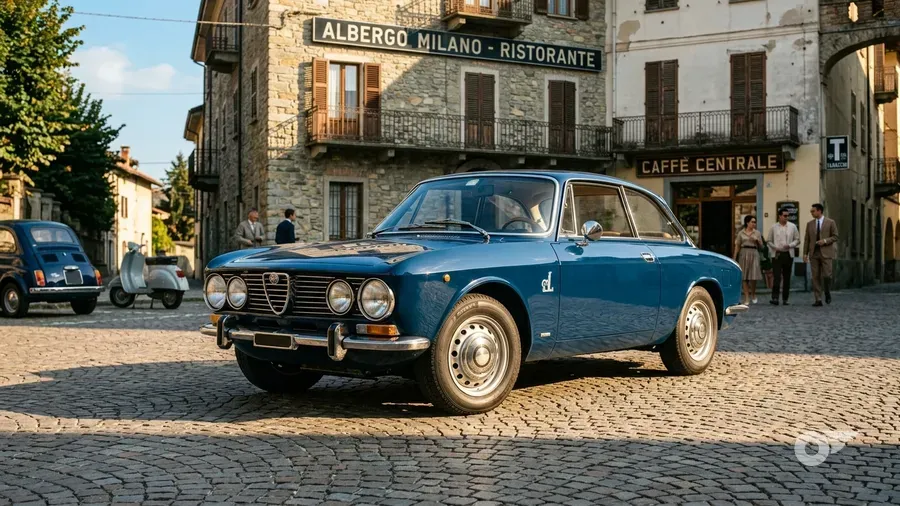
Scaglione's Sprint is a lesson in how much can be taken away. The nose is low and the shield stands proud of a plain grille. The roof is 1,320mm off the ground and falls into a heavily inclined wraparound rear window. The flanks carry one soft crease and nothing else. There is no ornament anywhere. In 1954, with Detroit adding chrome by the yard and most European coupes still one-off exercises, that restraint is what made it look modern, and it is why the car has never dated. Alfa's own heritage account credits the concept to its Centro Stile before Bertone developed it, which is a useful corrective to the idea that Scaglione worked alone. He then took the same thinking much further on the Sprint Speciale, which sits on the family page. Giugiaro, very young and newly arrived at Bertone, revised the car for the Series II shown at Monza in June 1958. The grille became a fine grid, the flanking openings gained full grilles with the indicators set into them in place of the original chromed eyebrows, and the tail lights and plate holder changed. The same car, tidied by the man who would later draw the GTV.

Motorsport pedigree

The Sprint raced hard in period, and it was the Veloce that did it. The 1956 Mille Miglia is the result everyone cites. The Sprint Veloce took the 1,300cc class, with Jo Bonnier leading home a sweep that Wikipedia puts at the first three places while Magneto and supercars.net both put it at the top six. Bonnier finished 15th overall in the whole event. He also won the Berlin Grand Prix at AVUS in August 1956 in an Alleggerita. The Alleggerita is why the record runs as long as it does. Around 600 cars with aluminium doors, bonnet and bootlid, Plexiglas side and rear glazing, stripped interiors and 780kg, sold to privateers who took them everywhere. Class wins followed at the Coupe des Alpes, the Tour de France and the Nurburgring 1000km, with results at Sebring and the Daytona 3 Hours, accumulated over years by dozens of owners rather than by a works team. That privateer weight is the point. Alfa's own factory effort of the period went elsewhere, and the Sprint Zagato took the 1.3-litre GT world class titles of 1962 and 1963 on the family page. The Sprint's record was earned by customers.

In culture

The Sprint is the reason the Giulietta name means anything outside Italy. It reached the public first, it was on the Turin stand when the orders arrived faster than Alfa could count them, and it is the shape people picture when the word is used. Price is a large part of that story. The coupe sold for more than 25 percent above an ordinary Giulietta saloon and sold anyway, which told Alfa something it had not known: there was a real market for an expensive small car if the body was beautiful enough. Bertone learned the same lesson and built a business on it. Construction of the Grugliasco plant began in 1957, it was working by 1959 with 550 staff, an operation on a scale no Italian coachbuilder had run before, and by June 1961 it had turned out the 20,000th Sprint bodyshell. Alfa marked the car's 70th birthday in 2024 through its own museum at Arese, which for a coupe originally built as a stopgap is a fair verdict on how it turned out. The family's wider place in Italian life, including the nickname it earned, sits on the Giulietta page.

Rivals

Cars from other manufacturers that competed for the same buyers when new.
Owning One

Why collectors want it

The Sprint is the one Giulietta that is a landmark on its own terms rather than as part of a range. Before it, a beautiful Italian coupe meant a one-off, or a very small run for a very rich buyer. Scaglione's body went into series production at a price a professional could reach, and every affordable Italian GT since descends from that decision.

The market has worked this out. theclassicvaluer's median for a Sprint since 2020 is GBP 37,846 against a GBP 95,441 high, and Hagerty's own guidance is that good Sprints have moved past entry-level. That is still a fraction of what an equivalently significant Ferrari or Maserati costs, for the same twin cam, the same registers and the same parts network.

Inside the model the hierarchy is clear. The hand-built pre-production cars are the historical prize and are identifiable once you know the tells. The Sprint Veloce, 3,158 cars on twin Webers, is the driver's choice, and the roughly 600 Alleggeritas above it are genuine competition cars with prices that say so. Everything below that is a usable, mechanically robust, extremely good-looking 1950s coupe.

Which one to look for

Five versions matter, and they are easy to keep straight. The hand-built pre-production cars of 1954 and 1955 are the historical ones. Somewhere between 200 and 1,000 were made and nobody has narrowed it since. Bodies fabricated at Bertone, interiors and electrics from Ghia, and endless small differences from what followed. The Series I Sprint, 750-series, ran 65 PS to 1956 and 70 PS after, with the chromed eyebrows flanking the grille. The Sprint Veloce arrived in 1956 as a competition car for the road: twin Weber 40 DCOE3s, 9.5:1 compression, 90 PS at 6,000rpm, 180km/h, sliding Plexiglas side windows in place of roll-down glass, and no chromed hubcaps. 3,158 built. Above it sit the Alleggeritas, around 600 cars from 1956 and 1957 with aluminium doors, bonnet and bootlid, down from 852kg to 780kg. The Confortevole is the Veloce for people who meant to use it, with wind-down Plexiglas in aluminium frames, hubcaps and larger headlamps. Around 200 built. The Series II from 1959 is Giugiaro's revision: 80 PS, the fine grid grille, roll-down glass for everyone. The 1300 Sprint of 1964 and 1965 is the same car brought back as a cheaper model.

1300 Sprint · 1964–1965

The Sprint's second life, and the reason this car's production span reaches 1965. The Giulietta Sprint was dropped at the end of 1962 in favour of the 1,570cc Giulia Sprint, but Alfa brought the 1,290cc car back in early 1964 as the Alfa Romeo 1300 Sprint, a lower-cost model that also suited the Italian tax system. Mechanically it is the 80 PS Series II car. It stayed in production until late 1965 and in price lists until November 1966. Externally the Giulietta and Giulia Sprints are nearly indistinguishable, the Giulia having gained a new steering wheel and dashboard.

Pre-production hand-built Sprint · 1954–1955

The cars Alfa had no way to build properly and built anyway. Demand at the 1954 Turin show outran the factory completely, so the earliest Sprints were assembled by hand: bodies fabricated at Bertone, interior and electrical components supplied by Ghia, panel work subcontracted to artisan shops scattered around Turin. They differ from later Grugliasco cars in dozens of cosmetic and mechanical ways. Classic & Sports Car's study of chassis 00024 records fabricated rather than pressed panels, minimal chassis stiffening with folded metal reinforcing the shock columns, doors whose construction varies about 10mm side to side, crude front bumper brackets and a column change. Those are authenticity tells, not defects, and they are also why restoring one is a fabrication job.

Sprint (750 Series) · 1954–1958

The original series car: 8.0:1 compression, one downdraught twin-choke carburettor, 65 PS at 6,000rpm and 160km/h, raised to 70 PS in late 1956 after the Berlina T.I. and Sprint Veloce had arrived. Identify it by the chromed eyebrows flanking the grille, which the Series II replaced with full grilles. Beautiful and historically the purer car, but 750-specific mechanical parts are the expensive and occasionally unobtainable ones, so it costs more to run than the car that replaced it.

Sprint Series II (101 Series) · 1958–1962

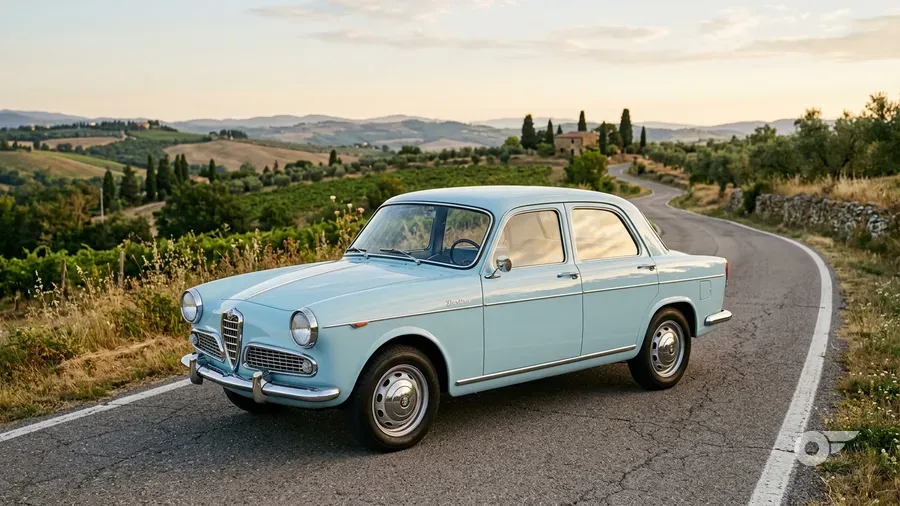
Presented at Monza in June 1958 and on sale early in 1959, with exterior revisions by a very young Giorgetto Giugiaro: a finer grid front grille, full grilles in the flanking openings incorporating the turn signals in place of the original chromed eyebrows, and modified tail lights and plate holder. Mechanically it is the better car, with compression up to 8.5:1, a re-engineered split exhaust manifold, 80 PS at 6,300rpm and 165km/h. Trim differences between Sprint and Sprint Veloce disappeared at the same time, so every car got roll-down glass and chromed hubcaps. Combined with plentiful 101-series parts and the stronger 1958 gearbox, this is the sane Sprint to own.

Sprint Veloce · 1956–1962

A competition car sold with number plates. Two horizontal twin-barrel Weber 40 DCOE3 carburettors, an electric Bendix fuel pump and 9.5:1 compression lifted output to 90 PS at 6,500rpm, with 12.0 kgm of torque at 4,500rpm and 180km/h. Weight came down from 852kg to 780kg through measures including deleting the roll-down windows and their mechanisms in favour of sliding Plexiglas, and it went without the standard car's chromed hubcaps. Alfa also published an SAE gross rating of 104 PS that turns up in period brochures. This is the driver's Giulietta Sprint and the market prices it accordingly.

Sprint Veloce Alleggerita · 1956–1957

The lightweight, and the reason the Sprint's competition record runs as long as it does. Aluminium doors, bonnet and bootlid, Plexiglas side and rear glazing, and an interior stripped of soundproofing, sun visors, trim and seat padding, for roughly 100kg saved and a kerb weight of about 780kg. Sold to privateers who then campaigned them everywhere. Jo Bonnier led the 1,300cc class at the 1956 Mille Miglia in one and won the Berlin Grand Prix at AVUS the same August. Documented cars trade far above ordinary Veloce money.

Sprint Veloce Confortevole · 1956–1958

Alfa's answer to the discovery that most Sprint Veloce buyers wanted a small gran turismo rather than a race car. It put back the civility the Veloce had stripped out: wind-down Plexiglas door windows in aluminium frames instead of the sliding panes, chromed hubcaps, and different, larger headlamps. Mechanically it is a Veloce. The June 1958 Series II made the point moot by giving every Sprint roll-down glass and hubcaps, which is what ended the distinction.

What owning one is like

The Sprint is a 1950s unitary Italian coupe, so the honest summary is that the body is the car and the mechanicals are the easy part. Rust takes the sills, floors, inner arches and boot floor first, then the lower wings, door bottoms, bulkhead and the areas around the suspension mountings. What makes a Sprint harder work than a Berlina is that Bertone-specific panels are not something you order off a shelf, so a poor shell means fabrication. Old repairs are as much of a problem as fresh corrosion. These were cheap cars for a long time and plenty were patched to whatever standard the era allowed. Second-gear synchromesh wears. Everyone learns to pause on the change and then stops noticing it. Post-1958 boxes with the Porsche-type synchromesh are meaningfully better. The engine is strong and long-lived when it is looked after, but it does leak, it does not forgive a neglected cooling system, and the timing chains want attention. Electrics are simple and not always robust, which cuts both ways. Things go wrong, and any of them can be traced with a test lamp and a wiring diagram on a Sunday afternoon.

Upkeep & parts

Establish the series first. From 1959 the 101-series engine and running-gear parts are widely available and reasonably priced. The earlier 750-series equivalents can cost several times as much and a few are not reproduced at all. It is the single biggest running-cost variable on this car.

Mechanically it is cheap to keep for something this pretty. The twin cam had a forty-year production life, so parts, machine shops and specialists all exist in quantity, and a rebuild is a known job at a known price. Gearboxes likewise.

Bodywork and trim are the real budget. Bertone glass, brightwork, bumpers, instruments and the small interior fittings are hard to find and dear when found, and Veloce items are harder still. Anyone restoring a pre-production car should assume fabrication rather than sourcing.

Support is good. Alfaholics and Highwood Alfa stock 750/101 parts in the UK, Classic Alfa supplies the family, and the registers listed below hold chassis records plus the kind of accumulated detail that tells you whether the car in front of you is what the advertisement says it is.

Country of origin
Italy
Class
Sports
Production years
1954–1965
Units built
24,084
Model
Giulietta Sprint
Nickname
No nickname ("la fidanzata d'Italia" names the whole Giulietta family, not the Sprint coupe specifically)
Body
Coupe
Layout
Front-engine, RWD
Engine
1290cc Alfa Romeo Twin Cam I4 (65 PS, 1954-56), 1290cc Twin Cam I4 (70 PS, 1956-58), 1290cc Twin Cam I4 (80 PS, 1958-62 and 1964-65), 1290cc Twin Cam I4 (90 PS, Sprint Veloce 1956-62)
Transmission
4-speed manual (column change on the hand-built pre-production cars, floor change on series cars), 4-speed manual with Porsche-type synchromesh from 1958
Designer
Franco Scaglione (Bertone), Giorgetto Giugiaro (Bertone, 1958 Series II revisions)