Octane Files
Explore CarsPorsche 356 A

Porsche 356 A

Overview

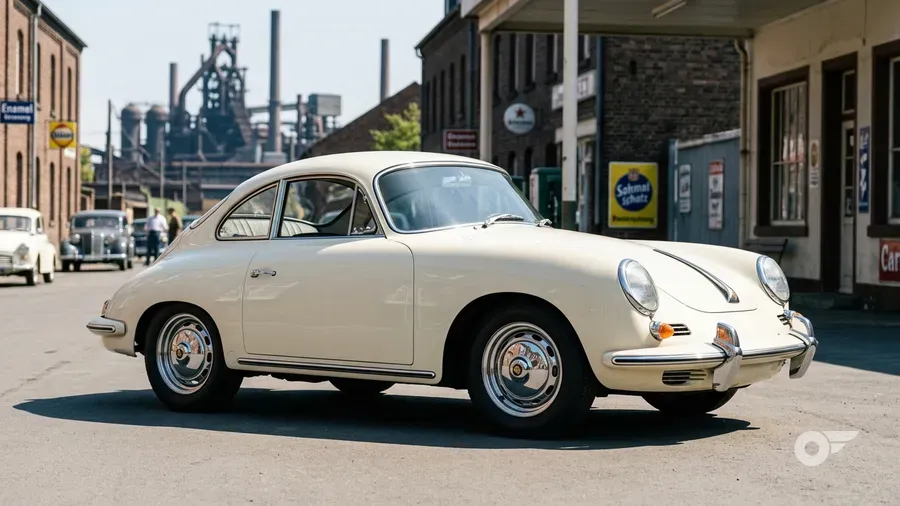
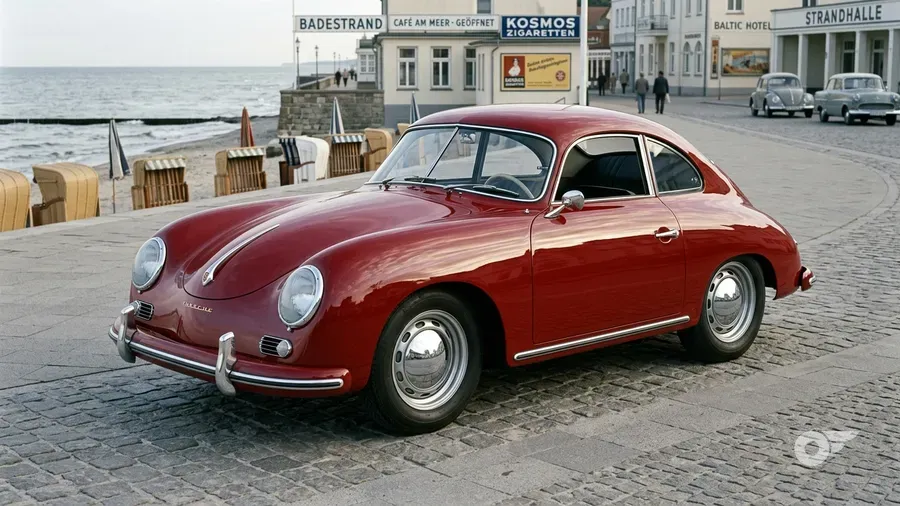
The 356 A is the moment the shape stops being provisional. In October 1955 the split and creased windscreens went and a single curved pane took their place. The dash top was padded, the door glass became toughened Sekurit, the front torsion bars were softened to eight leaves, the steering got a damper and more castor. Nothing about the silhouette changed and everything about living with it did.

Underneath, the 1,582cc Type 616 became the engine most 356s would use for the next decade, 60 PS in the 1600 and 75 in the 1600 Super. Above them Porsche put a road version of Ernst Fuhrmann's four-camshaft racing engine from the 550: 100 PS from 1,498cc in a car weighing 885 kilos, and the first genuinely exotic engine you could order in a Porsche road car.

The Speedster peaked here, 1,171 cars in 1957 alone, and then died. 21,045 A-series cars were built in four years, nearly three times the pre-A's entire run, and America took the largest share of them.

Distinctions

The defining attributes and collector status that make this car garage-worthy.

Legend
A car that transcended the hobby, known far beyond the people who drive them.
Octane Files Select
Renowned for its history, engineering, or cultural weight.

Collectibility scorecard

Rated 1 to 10 on the traits that matter for owning, driving, and holding on to a car like this.

Desirability
9/10
Rarity
6/10
Driving thrill
7/10
Investment trajectory
7/10
Usability
5/10
Ease of restoration
6/10
Cultural impact
8/10
Electronic dependence
Fully analogHeavily electronic

Still six volts, still points and a distributor, still no electrical assistance anywhere on the car. The 1600 and 1600 Super run twin downdraught Zenith carburettors; the four-cam Carrera runs twin-choke carburettors and dual ignition with two plugs per cylinder, which is the most complicated system in the series and is still only a mechanical timing problem. The instruments are cable and capillary driven. There is nothing on this car a 1950s mechanic could not diagnose by ear.

Market data

Demand tier, price trend, and typical values by condition. Our own assessment, not a quoted valuation.

Demand tier
EntrySolidHighBlue-chip

The proven elite. Values are established, liquid, and defended at every auction.

Value trajectory
AppreciatingStableCooling

Values are holding steady. What you pay today is what it's worth tomorrow.

Price by condition
Driver
$85k
Excellent
$130k
Concours
$200k

classic.com's average for the A is $242,284 against $163,914 for all 356s, but that average is doing a lot of work: Carrera cars average $640,070 and Speedsters carry a market of their own. An A coupe averages $117,024 and a cabriolet $199,224. The records are $1,325,000 for a 1958 1500 GS/GT Carrera Speedster in August 2022, $590,000 for a 1957 Speedster in December 2023, and $434,000 for a 1956 European cabriolet in August 2022. Blue-chip and stable. Nothing in the A market is cheap and nothing is moving fast in either direction. The rare cars have held while the ordinary end has drifted slightly softer, in line with the rest of the model. The band below describes a 1600 or 1600 Super coupe, the A most buyers will actually see, and excludes Speedsters, Convertible Ds and every four-cam.

Values as of August 2026.

Buyer's guide

What anyone seriously considering this car should know first.

Why it's worth it
The series that settled the 356's shape and put a four-cam racing engine in a road car
Callout
Porsche built 1,171 Speedsters in 1957, its best year ever, and then killed the model
What to watch for
Work out whether you are looking at a T1 or a T2 before anything else. The A ran in two body specifications, T1 from late 1955 and T2 from early 1957, and the differences run through handles, exhaust exits, washer equipment and interior fittings. Neither is worth more. A car described as one and built as the other is telling you something about the rest of it. Engine identity is where the money is. A 1600 Super is worth meaningfully more than a 1600, the difference is a stamped number and a set of internals, and the 1300 cars are quietly the cheapest way into an A. Ask for the factory Kardex record and match it against what is in the car. Four-cam cars are their own discipline. A Type 547 has bevel-driven camshafts, a roller-bearing crankshaft and a rebuild bill that starts where a pushrod engine's finishes, and the number of people who can do the work properly is small enough to name. Buy the engine's history, not the car's paint. On open cars, look hardest at the sills. A Speedster or Convertible D has no roof structure at all, so a soft shell is soft everywhere.

The Story

Driving character

This is where the 356's reputation was made and where its handling has to be explained. The engine hangs behind the rear axle line and the rear suspension is a swing axle on trailing arms, so under power the outside rear wheel tucks under and the tail comes round. Lift mid-corner and it comes round faster. Porsche knew this and chose it: Ferry Porsche argued publicly that a car with 55 percent of its weight at the back could have been made to understeer, and that a mild tendency to oversteer was safer and therefore more useful. From the seat that means a car you steer with the throttle. The 1600 Super's 75 PS in 885 kilos is enough to make it genuinely useful, the steering is light and utterly unfiltered, and the car changes direction the instant you ask. Get it wrong and it will spin, which is why the 356 built a generation of drivers who understood weight transfer before they had a word for it. The four-cam adds noise. It is harder, louder, revs to 6,500 where the pushrod car has given up, and it is the only 356 that sounds like a racing car because it is one.

Design

The curved windscreen is the whole change and it is the best decision anyone made about this car. The creased pane of 1953 to 1955 was a compromise fitted into a split screen's aperture. The A's single curved glass finally matches the curve of everything around it, and it is why the A is the 356 that photographs best. Everything else is quieter. The A has lower, rounder front wings than the B that follows, with headlamps set into them rather than perched above, and bumpers that hug the body instead of standing off it. Wheels are 15 inch. The coupe's drag coefficient has been quoted at 0.31, against 0.389 for a Mercedes 300 SL, which for a 1955 production car with an air-cooled engine hanging out the back is remarkable. Inside, the dash top is padded for the first time. Two body specifications ran through the series, T1 to the end of 1956 and T2 from early 1957, and enthusiasts read a car's date off its door handles and exhaust exits rather than off its paperwork.

Motorsport pedigree

The A is the series that made the four-cam engine a customer proposition, and privateers took it straight to the Nürburgring. A 1500 GS Carrera won the Gran Turismo class up to two litres at the Nürburgring 1000 km in 1956, 1957 and 1958. In 1958 Paul-Ernst Strähle and Hans-Joachim Walter averaged 118.61 km/h in that class, quicker than the winner of the class above two litres, which tells you what a 900-kilo car with a properly engineered engine could do to bigger machinery. The same pair took the class again in 1959 with the Carrera 1600 GT. The Gran Turismo cars were built for exactly this. Aluminium doors and lids, bucket seats, no rear seat, and an options list running to a limited-slip differential, a sports exhaust, Rudge centre-lock hubs, velocity stacks in place of air filters and an electrically heated windscreen. It is also the era when American club racing filled up with Speedsters, because a stripped 356 with a Super engine was the cheapest genuinely competitive thing on a grid, and Max Hoffman had put several thousand of them in the country.

In culture

No Porsche has been copied as often as this one. The A Speedster is the most replicated shape in the hobby, built in glassfibre on Volkswagen floorpans since the 1970s by a trade that now spans continents: Apal in Belgium and later Germany, PGO in France on a Peugeot 206 CC platform, Replicar Hellas in Greece, and a large American industry supplying cars that look right from twenty feet and cost a fraction of the real thing. Wikipedia's own article notes, drily, that within the last twenty-five years replicas of the 356 A have become very popular. Porsche has never encouraged it and has never really fought it either. The effect on the real cars runs both ways. Replicas keep the shape in the public eye and give people who will never own a Speedster something to drive on a Sunday. They also mean any open A needs its identity established before its condition. The trade knows it, the registries know it, and the first question anyone asks about a Speedster for sale is whether it is steel.

Owning One

Why collectors want it

The A is the connoisseur's 356. It has the resolved shape without the American-market changes the B brought, and it has the Speedster in its best years, which is why classic.com's A average of $242,284 sits so far above the B's $125,838 despite the A being the older car.

Two things drive that money. The first is the Speedster: a cut-down screen, bucket seats and no wind-up windows, sold as the cheap 356 and now the expensive one, with a record of $590,000 for a 1957 car. The second is the Carrera. Four-cam cars average $640,070 on classic.com and the top result is $1,325,000 for a 1958 1500 GS/GT Carrera Speedster.

Underneath all that, an A coupe averages $117,024. That buys the best windscreen Porsche ever put on a 356, the 1600 Super engine and a car you can drive across a country. The gap between the halo and the volume car is wider on the A than on any other series, and that gap is the opportunity.

Which one to look for

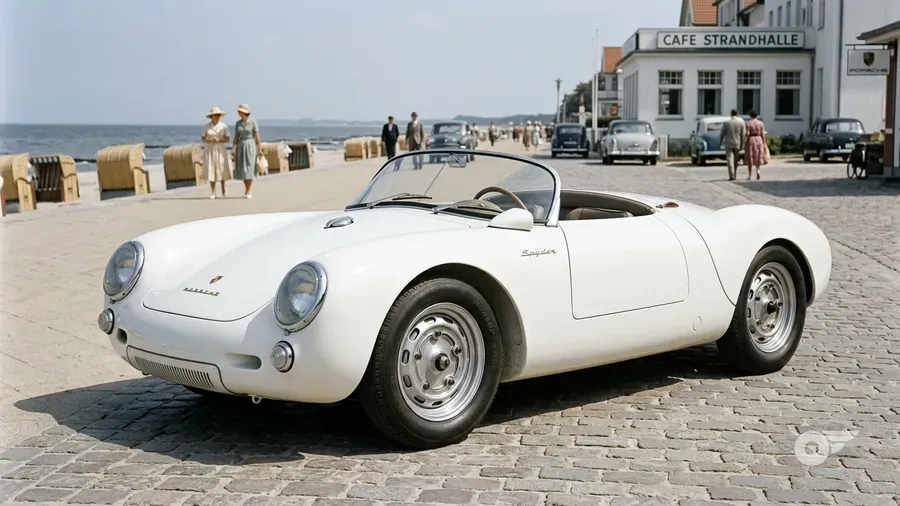
The Speedster is the one everybody wants and the one that suits almost nobody: no wind-up windows, a screen you can unbolt for a race weekend, a hood that is more gesture than roof. 2,910 were built as A-series cars, production peaked at 1,171 in 1957, and it was gone by late 1958. Its replacement, the Convertible D, is the sensible version and the value in the open cars. Taller screen, wind-up glass, proper seats, 1,330 built. The D is for Karosseriewerk Drauz of Heilbronn, who built the bodies. The Carrera is the grail. The 1500 GS made 100 PS and the stripped Gran Turismo 110; from 1958 the 1600 GS de Luxe made 105 and the 1600 GT 115. Only 35 of the 1500 GS/GT were built. The European is a footnote worth knowing. 156 cars badged for America from autumn 1955 after Ford objected to the Continental name, using up a batch of front fenders already punched for a script. About thirty survive. For everyone else there is the 1600 Super coupe, which is the A that makes the most sense and always has.

1600 Super · 1955–1959

The A most people should be looking for. 75 PS at 5,000 rpm from 1,582cc on 8.5 to 1 compression, 117 Nm at 3,700, 175 km/h, in a coupe weighing 885kg. It is the engine that makes an A feel quick rather than merely willing, and the premium over the 60 PS 1600 is real enough that the case numbers are worth checking.

Carrera 1500 GS / GT · 1955–1959

The first four-cam Carrera you could buy as a road car, using Ernst Fuhrmann's Type 547 racing engine from the 550 Spyder. 1,498cc, four camshafts driven by bevel shafts, 100 PS in GS de Luxe form and 110 PS as the stripped Gran Turismo, roughly 198 km/h. The GT added aluminium doors and lids, bucket seats and an options list running to a limited-slip differential, Rudge centre-lock hubs, velocity stacks and an electrically heated windscreen.

Carrera 1600 GS / GT · 1958–1959

The four-cam enlarged for the A's last two seasons. The 1600 GS de Luxe made 105 PS at 6,500 rpm from 1,587cc and roughly 200 km/h; from model year 1959 the Carrera 1600 GT replaced the 1500 Gran Turismo with 115 PS from 1,588cc. Six extra louvres each side of the engine grille identify a GT.

Convertible D · 1958–1959

The sensible Speedster and the value in the A's open cars. A taller windscreen that gives real headroom with the hood up, wind-up glass side windows and properly padded seats instead of buckets. It lost the Speedster's romance and gained everything that makes a car usable in weather.

European · 1955–1956

The rarest badge on any 356 and a direct consequence of the Continental dispute. After Ford objected to the Continental name, Porsche shipped a further 156 cars to Max Hoffman badged 'European', partly in order to use up a batch of front fenders already punched for a script logo. All were T1 cars.

Speedster · 1955–1958

The Speedster's best and last years. Carried over from the pre-A onto the A's curved-windscreen body, still with a removable low screen, bucket seats and side curtains instead of wind-up glass, and still the cheapest way into a new Porsche. American club racing filled up with them, because a stripped 356 with a Super engine was the cheapest genuinely competitive thing on a grid.
What owning one is like

Everything a 356 does badly, the A does too, and the heater channel and longitudinal story is set out on the 356 B page. What the A adds is variety. Two body specifications, three body styles, five engine types and a four-year run mean the parts book is full of small changes, and a car assembled from whatever came to hand looks fine right up until you need one specific piece. Open cars carry their own weight. The Speedster and Convertible D have no roof structure, so the shell relies entirely on the floor and sills, and a soft one is soft everywhere. Speedster screen frames and their chrome surrounds are among the most expensive small parts in the 356 world. The four-cam is the honest warning. It is a magnificent engine and it does not tolerate short journeys, cold running or a rebuilder learning on your money. Owners who use them properly report no more trouble than a pushrod car. Owners who leave them standing find out what bevel drives cost. The rest is a simple 1950s car that rewards being driven, which is the best problem a classic can have.

Upkeep & parts

Mechanically the A is well served. The Type 616 pushrod engine ran from 1955 to 1965 and then into the 912, which means crankcases, cylinders, valve gear and clutches are all still available and any air-cooled specialist can rebuild one. Gearboxes, brakes and suspension are the same story.

Trim and glass are where the money goes. Speedster and Convertible D screens, their frames, side curtains and hoods, and the T1 and T2 specific handles and lamps are all reproduced, but in small batches, and discovering you have bought a wrong-year part is a common and expensive rite of passage.

Budget properly for a four-cam if you buy one. A Type 547 rebuild runs into tens of thousands of dollars, takes a long time, and the shops that do them are few enough to be a queue rather than a market.

The Porsche 356 Registry and its 356Talk forum are where the knowledge lives, and the Registry's classifieds are the largest 356 marketplace anywhere. Join before you buy, not after. It is the cheapest thing you will do all year.

Country of origin
Germany
Class
Sports
Production years
1955–1959
Units built
~21,045
Model
356
Nickname
Bathtub
Body
Coupe, Convertible, Roadster
Layout
Rear-engine, RWD
Engine
1,286cc Type 506 flat four (44 PS), 1,286cc Type 506/2 1300 S flat four (60 PS), 1,582cc Type 616/1 1600 flat four (60 PS), 1,582cc Type 616/2 1600 S flat four (75 PS), 1,498cc Type 547/1 four-cam Carrera 1500 GS (100 PS) and 1500 GT (110 PS), 1,587cc Type 692/2 four-cam Carrera 1600 GS de Luxe (105 PS), 1,588cc Type 692/0 and 692/1 four-cam Carrera 1600 GT (115 PS)
Transmission
4-speed Porsche ring-synchronised manual
Designer
Erwin Komenda (body, head of Porsche body design)