Octane Files
Explore CarsPorsche 356 C

Porsche 356 C

Overview

The last 356 is the best one to own, which is not the same as the one people want most. Announced for the 1964 model year and built from mid-1963, the C looks almost identical to a late T6 B and is a materially different car underneath: disc brakes on all four wheels, ATE units built under Dunlop licence, replacing the alloy drums Porsche had spent fifteen years refining. Radial Pirelli Cinturato tyres came with them.

The engine range was cut to three. The 60 PS car, which the factory itself called the Dame, was dropped. The 1600 C took over the old Super's 75 PS, and above it sat the 1600 SC at 95 PS, the most powerful pushrod engine Porsche ever built. The four-cam Carrera 2 carried on.

Then the 911 arrived and Porsche went on selling the 356 beside it. 1964 was the 356's best year ever at 14,151 cars, the same year the 911 reached America. 16,678 Cs were built in all, and the last of them went to North America in 1965.

Distinctions

The defining attributes and collector status that make this car garage-worthy.

Octane Files Select
Renowned for its history, engineering, or cultural weight.

Collectibility scorecard

Rated 1 to 10 on the traits that matter for owning, driving, and holding on to a car like this.

Desirability
8/10
Rarity
5/10
Driving thrill
7/10
Investment trajectory
6/10
Usability
7/10
Ease of restoration
7/10
Cultural impact
7/10
Electronic dependence
Fully analogHeavily electronic

The most developed 356 is still an entirely mechanical car. The brakes are hydraulic discs with no servo assistance of any kind, the SC's extra power comes from compression and carburation rather than from any control system, the ignition is points and a distributor, and the electrics remain six volts. Porsche assembled the very last 356s, ten cabriolets finished in March 1966, for the Dutch highway police, and even those got no more than a radio and a lamp. The only reason to touch the wiring on a C is to see better at night.

Market data

Demand tier, price trend, and typical values by condition. Our own assessment, not a quoted valuation.

Demand tier
EntrySolidHighBlue-chip

Strong, sustained collector demand. Good examples never wait long for a buyer.

Value trajectory
AppreciatingStableCooling

Values are holding steady. What you pay today is what it's worth tomorrow.

Price by condition
Driver
$65k
Excellent
$95k
Concours
$155k

The C is the quiet value in the 356 range. classic.com's average is $119,993 and a C coupe averages $85,820, barely above the B and well under half the A, for the best-braked and most powerful pushrod version of the car. Open and rare cars behave differently. SC cabriolets average $185,667 with a record of $362,500 for a 1964 Reutter car in August 2024, an SC sunroof coupe took $160,000 in November 2023, and a 1964 Carrera 2 coupe took $500,000 in January 2026. Above everything sits the $1,760,000 Janis Joplin cabriolet of December 2015, which is a provenance result and not a market signal. High and stable, with one caveat stated honestly: Hagerty moved its 356 C SC coupe guide down roughly ten percent over the last year, which matches a general softening at the volume end of the whole 356 market rather than anything specific to the C. The band below describes a 1600 C or SC coupe and excludes cabriolets and the Carrera 2 entirely.

Values as of August 2026.

Buyer's guide

What anyone seriously considering this car should know first.

Why it's worth it
Discs on all four corners and 95 PS, the most usable and most powerful pushrod 356
Callout
The 356's best year was its second to last: 14,151 cars in 1964, with the 911 already on sale
What to watch for
C or SC is the first question and the only one that moves the price much. The 1600 C makes 75 PS on 8.5 to 1 compression, the 1600 SC makes 95 on 9.5 to 1, and the difference in the car is large. As with the B's Super 90, the proof is in the case and head numbers, and an SC badge costs nothing to fit. Then check the brakes are the car's own. The C's ATE discs are a Porsche-specific design, gripped from inside the disc and carried on a star-shaped hub, and they are neither a Volkswagen part nor a modern caliper. Cars converted to later or generic hardware are common and are not automatically bad, but they are not original and should not be priced as though they were. After that it is the same inspection as any 356, starting under the sills with someone who knows where to poke. The C's advantage over the earlier cars is that almost every mechanical and structural part is still made. Its disadvantage is history: these were the cheap 356s for decades, so expect more accident repair, more filler and more mixed parts than on an A. Buy the best documented car, not the shiniest one.

The Story

Driving character

The discs change the car more than the extra horsepower does. A drum-braked 356 asks you to plan. The C asks you to point it. You can brake late and repeatedly down a mountain road and the pedal comes back the same every time, and the whole car feels a size larger in consequence. The SC engine is the other half of it. 95 PS at 5,800 rpm out of 1,582 air-cooled cubic centimetres is a lot of specific output for 1964, and it arrives high up, so you use the gearbox, and the ring-synchronised four-speed is still one of the sweetest shifts of the period. Peak torque at 4,200 rpm means the SC wants revs where the old 60 PS car wanted none, and it is the first 356 that feels genuinely brisk rather than merely willing. The swing axle is still a swing axle, so the tail still moves, but by 1964 Porsche had spent fifteen years softening it and the rear compensating spring was on the options list. Fitted, the C is the most trustworthy 356 in a fast corner. It is still not a car you lift off in.

Design

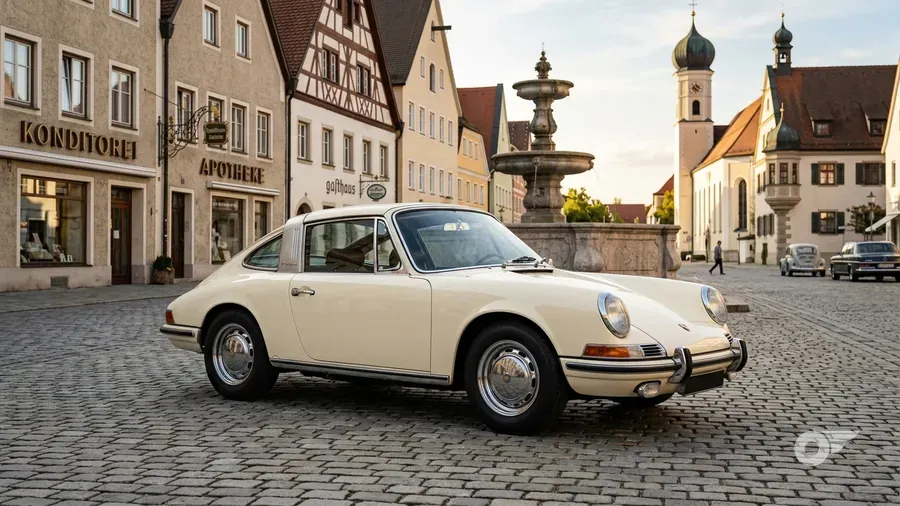
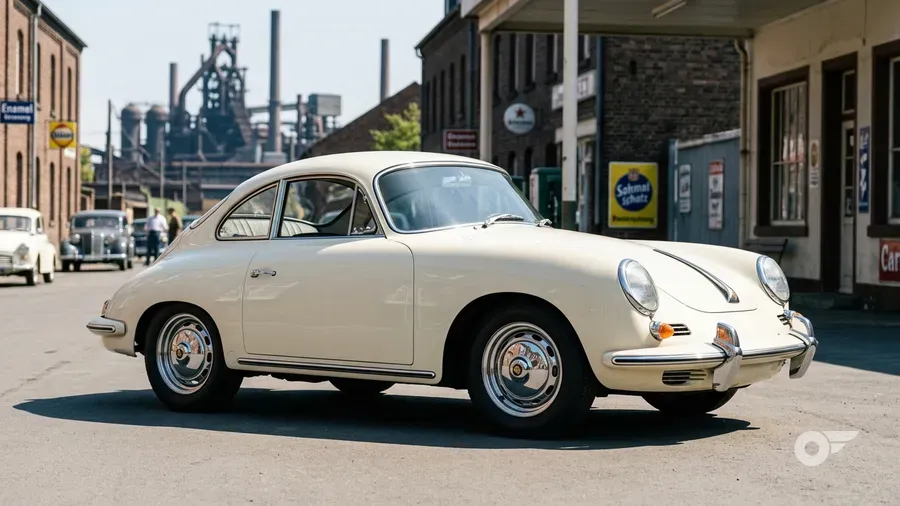
There is almost nothing to see, and that is the story. The C is a T6 356 B with different wheels, and even the wheels changed only because there are discs behind them. The hubcaps arrived plainer and, at first, without the Porsche crest. Porsche had shown with the B that it would restyle the car when commerce demanded it. With the C it changed only what the engineering demanded and left a fifteen-year-old shape alone in its final form. That restraint is the design note. Sports Car International ranked the 356 C tenth on its list of the top sports cars of the 1960s in 2004, which for a body drawn in 1948 by a man who had already shaped the Volkswagen is an extraordinary result, and a quiet vindication of leaving well alone. The last 356s carry a footnote of their own. Ten cabriolets were assembled in March 1966, after the line had stopped, for the Dutch Rijkspolitie, who went on running Porsches on the motorway network for another thirty years.

Motorsport pedigree

By 1964 the works had moved on. Porsche's competition department was building the 904, a mid-engined car designed from nothing to win GT races, and the 356's factory career was effectively over before the C reached its second season. That is why this page has no championship to report, and it is a deliberate choice by Porsche rather than a failure of the car. What is left is privateer, and it is not nothing. Porsche listed a competition option pack for the 1600 SC that reads like a race entry form: 70 or 90-litre tanks, velocity stacks in place of air filters, a roll bar, underguards for engine and gearbox, a Plexiglas rear window, bucket seats, 15-inch light-alloy wheels and the rear compensating spring. Most of it ended up in rallying, where a light, tough, disc-braked 356 was still a serious tool. At the sharp end the flat-nosed 2000 GS-GT the Germans called Dreikantschaber, the three-cornered scraper, kept going in private hands. Günter Klass campaigned one with a 1.6-litre engine in long-distance racing through 1964, two years after the shape first appeared at Le Mans. The 356's real legacy is that it taught Porsche how to win a class, and the company has never stopped.

In culture

The most famous 356 in the world is a C. In 1968 Janis Joplin bought a four-year-old 356 C 1600 SC cabriolet from a Beverly Hills dealer for $3,500 and handed it to Dave Richards, a roadie with Big Brother and the Holding Company, who covered the grey paint in candy apple red and then spent weeks painting what he called the History of the Universe over it: portraits of the band up the left flank, Joplin's Capricorn sign on the right rear quarter. She drove it everywhere and parked it in the street. It was stolen at least once and came back. It has been restored twice and shown at the Whitney. When it sold at RM Sotheby's in New York in December 2015 it was estimated at $400,000 to $600,000 and made $1,760,000, the highest price ever paid for any Porsche 356 at public auction, and it still holds that record. A repainted, non-original, four-year-old used car became the most valuable example of the model there has ever been, which tells you something worth knowing about what people are actually buying when they buy a 356.

Rivals

Cars from other manufacturers that competed for the same buyers when new.
Owning One

Why collectors want it

Buy a C if you intend to drive. It has the whole model's development in it and almost none of its compromises: four-wheel discs that stop repeatedly rather than once, 95 PS in SC form, the T6 body's usable luggage space and big glass, and radial tyres from the factory.

The market has not fully priced that in, which is the point. classic.com's C average is $119,993 and a C coupe averages $85,820, barely above the B and well under half an A. You are paying less for the better car because it looks like the one before it, and because being last has never carried the romance of being first.

The exceptions sit at the top. A 1964 Carrera 2 coupe took $500,000 in January 2026, and SC cabriolets average $185,667 with a record of $362,500. And the C owns the single most famous 356 in the world: Janis Joplin's hand-painted 1964 SC cabriolet, which made $1,760,000 in 2015 and is still the most anyone has ever paid for a 356 at public auction.

Which one to look for

Two pushrod cars and one four-cam, and the choice is unusually clear. The 1600 C is the standard car: 75 PS at 5,200 rpm, 175 km/h, the engine that had been the B's Super. It is a genuinely good car and the cheapest way into a disc-braked 356. The 1600 SC is the one to find. 95 PS at 5,800 rpm, 9.5 to 1 compression, 185 km/h, and the most powerful pushrod engine Porsche ever put in a road car. It costs more, it always has, and it is worth it. The Carrera 2 continued into the C almost unchanged apart from the ATE brakes and a revised dashboard. Two litres, four camshafts, 130 PS, 200 km/h, and 126 of the 436 Carrera 2s built were C cars, which makes it the rarest 356 you can plausibly go looking for. Porsche also listed a competition kit for the SC that reads like an entry form: 70 or 90-litre tanks, velocity stacks in place of air filters, a roll bar, underguards for engine and gearbox, a Plexiglas rear window, bucket seats, 15-inch light-alloy wheels and the rear compensating spring.

1600 C · 1964–1965

The standard 356 C, and the cheapest way into a disc-braked one. 75 PS at 5,200 rpm from 1,582cc on 8.5 to 1 compression, 123 Nm at 3,600, 175 km/h. The engine is the old 356 B 1600 Super, promoted to base model when Porsche dropped the 60 PS car the factory called the Dame. ATE discs on all four corners and radial Pirelli Cinturato tyres are standard, which is the whole reason to want a C.

1600 SC · 1964–1965

The most powerful pushrod engine Porsche ever built for a road car, and the 356 to buy if you intend to drive one. 95 PS at 5,800 rpm from 1,582cc on 9.5 to 1 compression, 124 Nm at 4,200, 185 km/h. Peak torque high up means you use the gearbox, and the ring-synchronised four-speed is one of the sweetest shifts of the period. With four-wheel discs behind it, this is the fastest and most confident 356 that is not a Carrera.

Carrera 2 · 1964–1965

The four-cam flagship, carried into the C almost unchanged apart from the new ATE disc brakes and a revised dashboard. Two litres, four camshafts driven by bevel shafts, 130 PS at 6,200 rpm, 200 km/h. It is the rarest 356 anyone can plausibly go looking for, and the last road car to use the Fuhrmann engine before the 904 took it racing.
What owning one is like

The C's problems are a 356's problems, and the heater channel and longitudinal anatomy is set out in full on the 356 B page. What is specific to the C is the brakes and the way these cars were used. ATE discs are Porsche's own design, gripped from inside the disc and carried on a star-shaped hub carrier, and they are not interchangeable with anything else. Original calipers can be rebuilt and are, but they are a specialist item, and a great many Cs were converted to later Porsche or generic hardware at some point because it was cheaper at the time. The other issue is history. The C was the last 356, the cheapest 356 for decades, and the one most likely to have served as everyday transport well into the 1980s. That means more accident repair, more filler and more mixed parts than you will find on an A, and it is why the honest advice on a C is to buy the best documented car rather than the best presented one. Mechanically it is the strongest of the four. The SC engine in particular is famously durable, provided it is actually used.

Upkeep & parts

This is where the 356's reproduction economy earns its reputation, and it is among the best in 1960s motoring. Between Stoddard, Klasse 356 and the wider specialist trade you can buy essentially every part of a 356 C new: floor pans, longitudinals, heater channels, rocker panels, complete wing sections, engine internals, brake components, glass, seals, looms, upholstery and German square-weave carpet. Some of it comes off original tooling and some is careful reproduction, and the practical result is that no 356 is beyond saving, only beyond sense.

That does not make it cheap. It makes it predictable, which is more useful. A structural rebuild on a C is quoted rather than guessed at.

The C also benefits from sharing the Type 616 pushrod engine with the 912, which Porsche built in a higher-revving 616/36 form from April 1965 and sold nearly 33,000 times. Crankcases and internals are supported by two owner communities rather than one.

The Porsche 356 Registry is the club: nearly 7,000 members in 40 countries, a magazine, the 356Talk forum, and classifieds that are the largest 356 marketplace in existence, for parts as much as for cars.

Country of origin
Germany
Class
Sports
Production years
1963–1965
Units built
~16,678
Model
356
Nickname
Bathtub
Body
Coupe, Convertible
Layout
Rear-engine, RWD
Engine
1,582cc Type 616/15 1600 C flat four (75 PS), 1,582cc Type 616/16 1600 SC flat four (95 PS), 1,582cc Type 616/26 1600 SC police-specification flat four, 1,966cc Type 587/1 and 587/2 four-cam Carrera 2 flat four (130 PS)
Transmission
4-speed Porsche ring-synchronised manual
Designer
Erwin Komenda (body, head of Porsche body design)