Octane Files
Explore CarsNissan Skyline R30

Nissan Skyline R30

Overview

The R30 is the Skyline that had to make the badge mean something again without a GT-R to do it with, and it managed. In October 1981 Nissan dropped the FJ20E into a stripped-out coupé called the 2000RS: 1,990cc, twin cams, four valves per cylinder, and the first four-cylinder engine any Japanese manufacturer had built with more than two valves per cylinder. Nissan's own launch line was that you could not talk about DOHC without four valves. The car weighed 1,130kg and had almost no equipment in it.

February 1983 added a turbocharger and made the FJ20ET the most powerful Japanese production engine of its era at 190 PS. August 1983 gave the RS a new nose with slim headlamps and no radiator grille at all, which owners immediately named 鉄仮面, the iron mask. A 1984 intercooler took it to 205 PS.

Around all of that sat an ordinary Skyline: 26 variations, four bodies including a five-door liftback unique to this generation, diesels, wagons and four-cylinder TI cars. Japan named the whole thing the Newman Skyline, after the American film star fronting Nissan's advertising.

Distinctions

The defining attributes and collector status that make this car garage-worthy.

Octane Files Select
Renowned for its history, engineering, or cultural weight.

Collectibility scorecard

Rated 1 to 10 on the traits that matter for owning, driving, and holding on to a car like this.

Desirability
6/10
Rarity
5/10
Driving thrill
6/10
Investment trajectory
6/10
Usability
5/10
Ease of restoration
4/10
Cultural impact
6/10
Electronic dependence
Fully analogHeavily electronic

A 2. The FJ20E and FJ20ET run electronic fuel injection and, from early 1985, Nissan's Plasma Spark ignition, and top models offered suspension dampers the driver could adjust while moving, which Wikipedia records as another first for a mass-produced Japanese car. The 1983 RS-X even listed anti-skid control among its equipment. What none of it touches is the driving. There is a cable throttle, a mechanical wastegate running six to seven psi, an entirely unassisted relationship between the pedal and the turbo, and no traction control of any kind.

Market data

Demand tier, price trend, and typical values by condition. Our own assessment, not a quoted valuation.

Demand tier
EntrySolidHighBlue-chip

A dependable market. Well-kept cars hold their value and find ready buyers.

Value trajectory
AppreciatingStableCooling

Values are climbing. The market wants more of these than exist.

Price by condition
Driver
$12k
Excellent
$30k
Concours
$60k

The R30 sits a clear step above the C210 and a long way below anything wearing a GT-R badge, which is roughly where its significance puts it. Solid is the tier and it applies to DR30 cars: a four-cylinder TI or a diesel wagon is a different and much cheaper market. The trajectory is upward, because the R30 story has been rediscovered along with everything else 1980s and Japanese, because the iron mask RS-X is one of the most recognisable JDM shapes of the decade, and because the supply of unmodified FJ20 cars is genuinely finite. The band rests on classic.com aggregates: an average of 30,728 dollars, a verified high of 60,500 for a 1984 DR30 RS-X Turbo in October 2022, and a low of 11,250 for a 1983 Turbo EL in October 2025. It describes a DR30. One caveat carries over: most R30 trade still happens through Japanese auction houses in yen, where a hammer price needs export, shipping and compliance costs added before it compares with these numbers.

Values as of August 2026.

Buyer's guide

What anyone seriously considering this car should know first.

Why it's worth it
The Skyline that got the badge racing again, and did it without a GT-R
Callout
The FJ20 was the first Japanese four-cylinder with more than two valves per cylinder
What to watch for
The first thing to establish is the chassis code, because it tells you the engine and the engine is the car. DR30 means an FJ20, either the naturally aspirated E or the turbocharged ET. HR30 means an L20 six, turbocharged or not. RHR30 is the liftback. Anything else is a four-cylinder TI, a diesel or a wagon, and none of those is what the market wants. Then work out where in the run it sits, because the R30 changed twice in four years. February 1983 brought the FJ20ET. August 1983 brought a facelift across the whole range, with four-wheel discs standard, revised bumpers, door mirrors in place of fender mirrors and smoked tail lamps, and it gave the RS the iron mask nose. 1984 added the intercooler, the Turbo C at 205 PS, and an automatic option. After that it is condition and originality, which on a forty-year-old JDM car amount to the same thing. Rust in the sills, arches and floors, and a long look at whether the FJ20 in front of you is the one the chassis plate says it should be. Engine swaps into R30 shells are common and are not always disclosed.

The Story

Driving character

The FJ20 is what everyone comes for and it delivers something quite specific: a hard, flat, faintly industrial four-cylinder noise and a real willingness to rev, which almost nothing else in a Japanese showroom in 1981 offered. The naturally aspirated 2000RS at 1,130kg and 150 PS is the sweeter car to drive quickly, light and honest and unencumbered by equipment. The turbo is a period turbo and behaves like one. Six to seven psi through a small turbine, with no intercooler at all until 1984, means a soft bottom end, a hard shove through the middle and a top end that arrives all at once. The intercooled Turbo C is both the more usable engine and the more exciting one, which is not the usual order of things. The rest of the car is 1981 Nissan and it shows: a C31 Laurel platform underneath, steering that is accurate rather than communicative, and four-wheel disc brakes that only became standard with the August 1983 facelift, which is worth knowing before you drive an early one hard. The RS-X gained about 105kg of equipment over the 2000RS, and you can feel every kilo of it.

Design

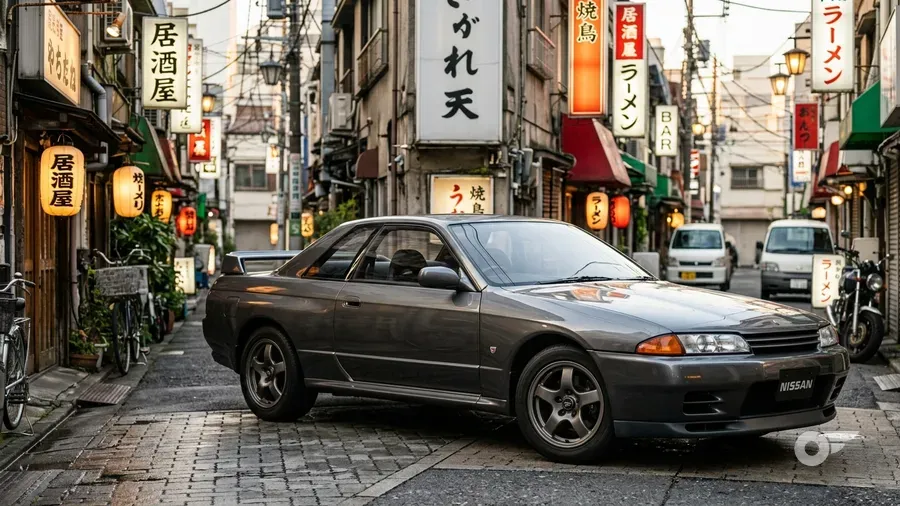
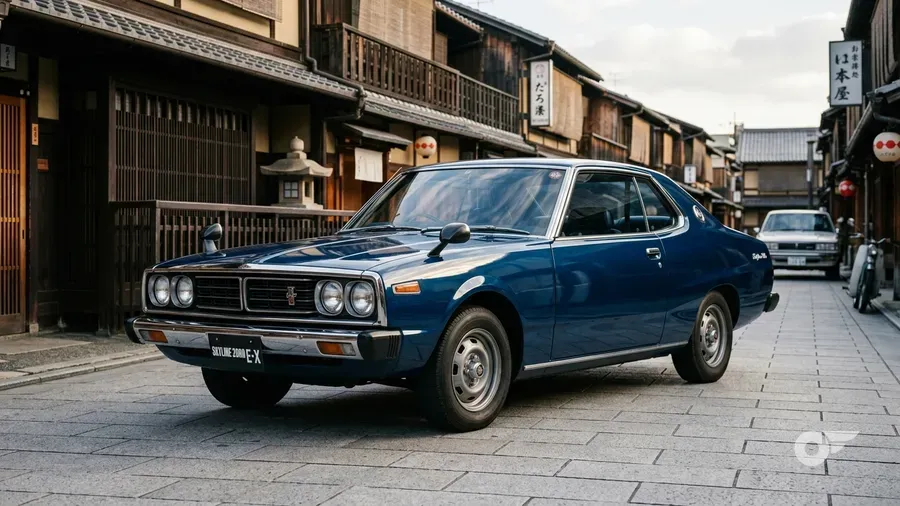
The R30 is where Sakurai's Skyline got smaller and sharper on purpose. Four- and six-cylinder cars shared a front end of the same length for the first time, ending the long-nose GT and short-nose TI split that had defined the C210, and Nissan's own framing was that a tighter car looked fresher. The surf line crease over the rear arch, carried since the second generation, was dropped here. Four bodies were offered and one is unique to this generation: a five-door liftback the Skyline never had before or since. The two-door stayed a pillarless hardtop with roll-down rear quarter windows. The wagon again got its own lamps and headlights and, as before, none of the good engines. Four round tail lamps stayed on everything except the wagon. The design event is the August 1983 RS nose. Slim headlamps, no radiator grille at all, and a bonnet sloping down into two narrow slits above a new bumper and air dam. Owners named it 鉄仮面, iron mask, and that name belongs to that nose on that model rather than to the generation as a whole.

Motorsport pedigree

The R30 has two racing careers and they barely overlap. The first is the Tomica Skyline Turbo, which contested the Fuji Super Silhouette Series under Group 5 rules from 1982 to 1984. Nissan's GT-R Works built it on a Nova Engineering steel tubular spaceframe with Mooncraft bodywork, and it shared essentially nothing with the road car but its outline. The engine was an LZ20B, 2,083cc, twin Garrett T05B turbochargers, roughly 570 PS, in a car weighing 1,005kg. Masahiro Hasemi won twice in 1982 and five times in 1983, eight wins from seventeen races in all, and it ran the Kyalami 9 Hours in 1982. The second happened in Australia, after the R30 had gone out of production. Gibson Motorsport's factory-backed Nissan Team debuted the DR30 at the opening round of the 1986 Australian Touring Car Championship. George Fury won four of the ten rounds and lost the title by five points to Robbie Francevic's Volvo. Garry Scott put one on pole for the James Hardie 1000 and finished third with a young Glenn Seton. Nissan took the 1986 manufacturers' title from BMW and shared the 1987 one with them. The same team would win Bathurst with the R32 five years later.

In culture

Japan calls this generation the Newman Skyline, and it is one of the odder pieces of car marketing anywhere. Nissan hired Paul Newman, an American film star who was also a serious SCCA racer, to front its Japanese advertising for a car he never raced and probably never drove. The name attached itself to the whole generation in Japanese vernacular, which is a rare thing for an advertising campaign to pull off twice in a row, the C210 before it having become the Skyline Japan by exactly the same route. Nissan then went further and sold a Paul Newman Version in 1983: a top-spec turbo GT-E-S with 15-inch alloys, bronze glass and his signature reproduced on the bonnet. The early cars had run a different line, New Love Skyline, a sequel to the C110's famous campaign. It lost to Newman. At home the FJ20 R30 has kept a following that never faded. There are still dedicated one-make drag racing events for the model in Japan, which is not something many forty-year-old saloons can claim.

Rivals

Cars from other manufacturers that competed for the same buyers when new.
Owning One

Why collectors want it

The R30 is the generation that rebuilt the Skyline's credibility, and it did it with a four-cylinder engine, which is not how the story usually gets told. That combination of genuine significance and slightly awkward specification is why it is still affordable relative to what sits on either side of it.

The car to have is a DR30. That chassis code means an FJ20, and everything the R30 is remembered for is a DR30: the 1981 2000RS, the February 1983 RS-Turbo, the August 1983 RS-X with the iron mask nose, and the 1984 intercooled Turbo C at 205 PS. There are still dedicated one-make drag events for FJ20 R30s in Japan, forty years on.

Everything else is a period Japanese saloon with a following of its own. The five-door liftback exists only in this generation. The Paul Newman Version, a top-spec L20ET turbo with his signature on the bonnet, is a genuine oddity and increasingly sought.

Wikipedia's own verdict is that the FJ20-powered R30 is credited with rejuvenating the Skyline brand and paving the way for the GT-R's return.

Nissan's published total for the generation is 406,432 cars sold. That is a Japanese-market figure: R30 exports went only to the Middle East and Oceania, and Nissan never broke out how many.

Which one to look for

Everything worth having is a DR30. The 2000RS of 2 October 1981 is the purist's car: FJ20E, 150 PS at 6,000 rpm and 181 Nm at 4,800, 1,130kg, and almost no equipment, which was the point of it. The 2000RS-Turbo of February 1983 is the historically important one. The FJ20ET made 190 PS at 6,400 and 225 Nm on six to seven psi of boost, and Nissan called it the strongest Skyline in history, which was a strange thing to say about a four-cylinder car with no GT-R badge and was also true. August 1983 brought the RS-X, with electric windows, air conditioning and power steering as standard and roughly 1,235kg as a result, plus the slim-headlamp grille-less nose that owners named the iron mask. The stripped interior remained available to order. The one to hunt is the 1984 RS-X Turbo C. An air-to-air intercooler let compression rise from 8.0:1 to 8.5:1 for 205 PS and 245 Nm, and it is the version the Super Silhouette racer was based on. Separately, the 1983 Paul Newman Version is not a DR30 at all. It is a top-spec L20ET turbo GT-E-S with 15-inch alloys, bronze glass and Newman's signature on the bonnet.

1800TI and 2000TI · 1981–1985

The four-cylinder range: Z18S 1.8 at 105 PS, replaced by the CA18E at 115 PS in the August 1983 facelift, plus Z20E and CA20E two-litre fours.

2000 Turbo GT-E·S Paul Newman Version · 1983

A top-spec L20ET turbo six with Newman's signature reproduced on the bonnet and embroidered inside, plus 15-inch alloy wheels, bronze glass and model-specific stickers.

2000 Turbo RS-X · 1983–1985

The RS turned flagship: electric windows, air conditioning and power steering as standard, power lumbar adjustment, anti-skid control, fog lamps and a rear spoiler, at roughly 1,235 kg. The stripped race-style interior could still be ordered.

2000 Turbo RS-X Turbo C · 1984–1985

The one to hunt. An air-to-air intercooler let compression rise from 8.0:1 to 8.5:1 with a revised turbine housing, for 205 PS at 6,400 rpm and 245 Nm at 4,400.

2000GT and 2000GT Turbo · 1981–1985

The six-cylinder range: L20E at 130 PS, or the L20ET turbo at 140 PS, which was the top of the line until the FJ20 arrived.

2000RS · 1981–1983

The purist's R30. FJ20E 2.0 DOHC 16-valve four, 150 PS at 6,000 rpm and 181 Nm at 4,800, in a stripped-out coupé quoted at 1,130 kg with the luxury equipment left out.

2000RS-Turbo · 1983

FJ20ET, 190 PS at 6,400 rpm and 225 Nm at 4,800 on six to seven psi, with substantially upgraded front brakes to cope. No intercooler.

Datsun and Nissan Skyline (export) · 1981–1987

Export cars used larger but less powerful carburetted sixes: 2.4 and 2.8 litres with Hitachi twin carburettors, at 120 PS or 139 PS. Australia took sedans from November 1981 and liftbacks from August 1982.

What owning one is like

Buying an R30 today is mostly a question of what has already happened to it, because these were cheap performance cars in Japan for a very long time. Start with the engine. The FJ20 is a strong unit, but it is also a 1981 twin-cam with no factory support left, and it has spent forty years being tuned. Establish that the FJ20 in the car is the one the chassis plate implies, because dropping an FJ20 into a lesser R30 shell is common and is not always disclosed. On a turbo, check whether the intercooler is there or not, because that alone tells you whether you have a 190 PS car or a 205 PS one. Then rust, which on a Japanese unibody saloon of this age means sills, rear arches, floors, boot floor and the base of the windscreen. None of it is unusual and none of it is hard to repair; finding correct panels is the slow part. Parts are the ongoing reality of ownership. Mechanical items shared with the wider Nissan range are fine. Body panels, glass, lamps, badges and interior trim are Japanese-market, out of production, and a hunt through specialist channels rather than a purchase.

Upkeep & parts

The R30 divides neatly into the parts that are easy and the parts that are not, and the line runs straight through the engine bay.

The L-series sixes, the Z and CA fours and the LD diesels are all shared with Laurels, Cedrics, Bluebirds and Nissan light commercials, so service items and rebuild parts for those are ordinary. The FJ20 is not. It went into the DR30 Skyline and the S12 Silvia and Gazelle and nothing else, it went out of production in the mid-1980s, and there is no factory heritage-parts programme behind it the way there is behind the RB26. Specialist suppliers in Japan and Australia carry most of what exists.

Body and trim are the same story as any JDM car of the period: mechanical parts have a part number, cosmetic parts need a search.

The support network is broader than it first looks. The GT-R Owners Club takes in the whole Prince and Skyline lineage despite its name, the Prince and Skyline Museum in Nagano is the closest thing the line has to an archive, and Australia's touring car history means serious R30 knowledge exists in English as well as Japanese.

Country of origin
Japan
Class
Sports
Production years
1981–1985
Units built
~406,432
Model
Skyline
Nickname
Newman Skyline
Body
Sedan, Coupe, Liftback, Wagon
Layout
Front-engine, RWD
Engine
1.8L Z18S I4, 1.8L CA18E I4, 2.0L CA20E I4, 2.0L Z20E I4, 2.0L FJ20E DOHC I4, 2.0L FJ20ET DOHC turbo I4, 2.0L L20E I6, 2.0L L20ET turbo I6, 2.4L L24 I6 (export), 2.8L L28 and L28E I6 (export), 2.0L LD20 I4 diesel, 2.8L LD28 I6 diesel
Transmission
4-speed manual, 5-speed manual, 3-speed automatic, 4-speed automatic
Designer
Shinichiro Sakurai (chief engineer, Nissan)