Octane Files
Explore CarsNissan Skyline C210

Nissan Skyline C210

Overview

Every Japanese enthusiast calls this generation the Skyline Japan, and the reason is an advertising line. Nissan sold it under the slogan SKYLINE JAPAN, over the claim that this was a fine car born of Japan's own climate. In 1977 that was a strange thing to say about a car in its home market, and it tells you exactly what the C210 was for. The GT-R had been dead four years, killed by emissions law and the oil crisis, and Nissan needed the Skyline to mean something other than racing.

So it sold the car as a national object. Four doors, two doors, a wagon and a van; four-cylinder and six-cylinder ranges on different wheelbases; a diesel at the bottom and, from April 1980, a turbocharged 2.0 six called the 2000 Turbo GT-EX at the top, the first turbocharged Skyline. Shinichiro Sakurai, who had run the line from the beginning and would run it until the R31, was still chief engineer.

It worked commercially, and it is still the Skyline generation people skip. No GT-R, no race record, no myth, and the only one of the line sold on being Japanese rather than on being fast.

Distinctions

The defining attributes and collector status that make this car garage-worthy.

Octane Files Select
Renowned for its history, engineering, or cultural weight.

Collectibility scorecard

Rated 1 to 10 on the traits that matter for owning, driving, and holding on to a car like this.

Desirability
4/10
Rarity
5/10
Driving thrill
4/10
Investment trajectory
5/10
Usability
5/10
Ease of restoration
4/10
Cultural impact
5/10
Electronic dependence
Fully analogHeavily electronic

A 2, and the position is set by one engine. Most of the C210 range ran carburettors, electronic ignition and nothing else worth the name. The fuel-injected L20E and the turbocharged L20ET added electronic injection, and on the turbo a very early kind of boost control: no intercooler, and no blow-off valve, just an emergency pressure release valve. There is no ABS, no traction control, and nothing between the pedal and the throttle plate but a cable. Everything a driver actually touches on this car is mechanical.

Market data

Demand tier, price trend, and typical values by condition. Our own assessment, not a quoted valuation.

Demand tier
EntrySolidHighBlue-chip

The accessible way in. Prices still forgive mistakes, and the upside is real.

Value trajectory
AppreciatingStableCooling

Values are climbing. The market wants more of these than exist.

Price by condition
Driver
$10k
Excellent
$25k
Concours
$55k

The C210 sits at the bottom of the Skyline market and will probably stay there a while, which is most of what makes it interesting. Its neighbours have run away from it: the Hakosuka and Kenmeri GT-Rs are blue-chip now, and the R30 has a following of its own, while the C210 has no GT-R, no race record and no film. Appreciating is the call because it moves in the wake of those cars rather than on its own merits, and because a turbo GT-EX coupe is a genuinely scarce object today. The band is approximate and worth reading as such, because the public record is thin: the firmest data point is a 1979 2000 GT hardtop coupe that made 29,707 dollars at CCA Everyman Classics in Britain in September 2024, and a 1980 2000GT carried a 55,000 to 65,000 pound estimate at Brightwells, which is an estimate rather than a result and informs the top of the band without setting it. Most C210 trade still happens through Japanese domestic channels in yen, where the numbers that surface are asking prices, and where export, shipping and compliance costs have to be added before a figure means anything to a buyer elsewhere. The band describes a hardtop coupe; sedans and the four-cylinder cars sit well below it.

Values as of August 2026.

Buyer's guide

What anyone seriously considering this car should know first.

Why it's worth it
The first turbocharged Skyline, and the generation that had to live without a GT-R
Callout
Sold on being Japanese: the SKYLINE JAPAN campaign gave the whole generation its name
What to watch for
Understand what you are buying before you go looking, because the C210 range is enormous and only part of it is worth importing. The six-cylinder cars sit on a 2,615mm wheelbase with a longer nose; the four-cylinder cars use 2,515mm. The badge tells you which: GT means a six, TI means a four, and GT-EX means the turbo. Then check the model code, because Nissan changed it mid-run. Cars built after the late-1978 facelift became 211 rather than 210, so a C211 is a later car with revised trim inside and out, and that is also when the Skyline first went on sale in Europe. One more badge trap: on the L16T and L18T, the T means twin carburettors. Nissan only started using T for turbo with the L20ET. Everything else is condition. These are forty-five-year-old Japanese unibody saloons that mostly lived in Japan, so start at the sills, the arches, the floors and the base of the screen. The L-series engines underneath are the same units that ran in a million other Nissans and are the easy part. Trim, glass and interior parts are the hard part.

The Story

Driving character

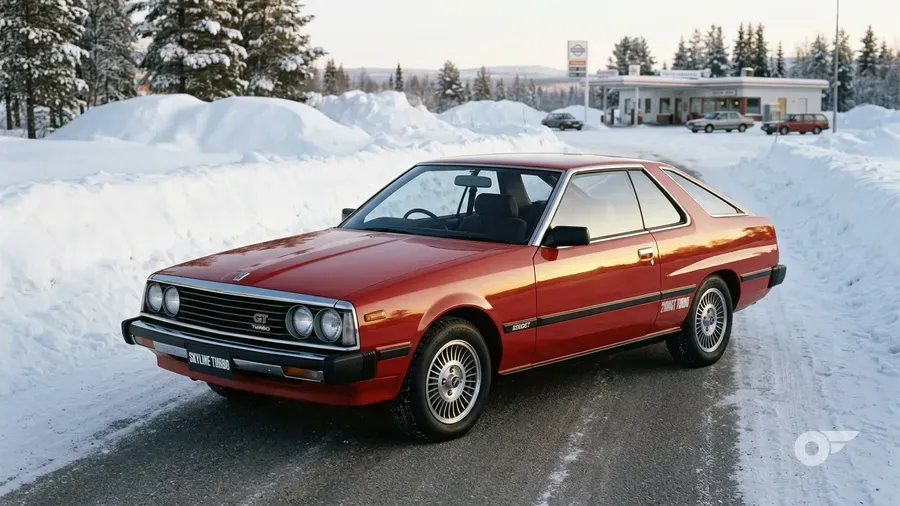
This is a 1970s Japanese saloon and it drives like one, which is more charming than it sounds. The L20E six is smooth, torquey low down and completely unbothered, making the sort of soft, even, slightly muffled noise that Japanese sixes of this era all made. It will cruise all day and it will not be hurried. The turbo car is the most interesting and the least satisfying. With no intercooler, and an emergency relief valve where a later car would have proper boost control, the L20ET builds pressure slowly, delivers it as a lump somewhere in the middle of the rev range, and then runs out. It is worth driving for what it represents rather than what it does. In 1980 Japan, 145 PS in a car of this weight was quick. It is not quick now. The hardtop coupé is the body to drive. Pillarless, with the rear quarter windows wound down, it has a lightness the sedan does not, and the four round tail lamps in the mirror of the car behind you are most of the reason for owning a Skyline of this era at all.

Design

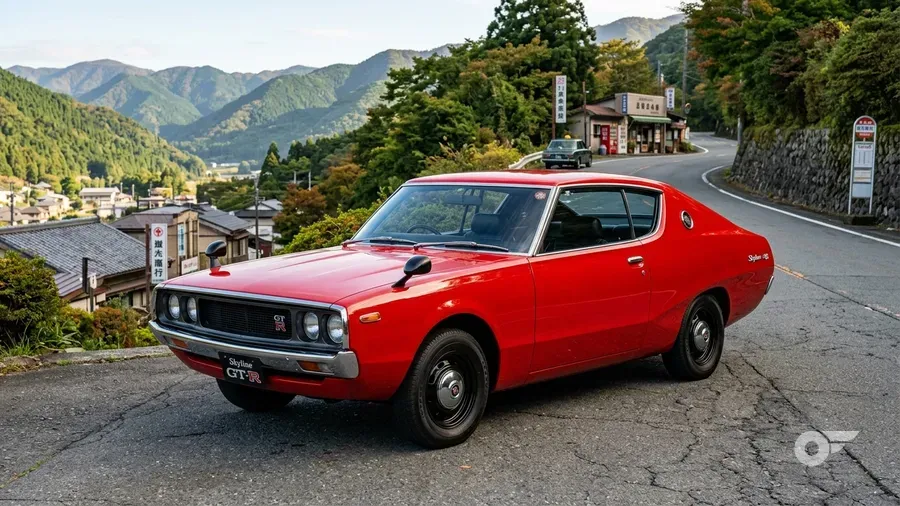
Sakurai's C210 is a careful, conservative evolution of the C110 it replaced, and its signatures are the ones the Skyline had already established: four round tail lamps, a long six-cylinder nose on the GT cars, and the surf line crease running back over the rear wheel arch, which this was the last generation to carry. The range split visibly. Six-cylinder cars got 100mm more wheelbase and 200mm more length than the fours, all of it ahead of the windscreen, which gives the GT its proportions and the TI its slightly stubby ones. The two-door is a proper pillarless hardtop with roll-down rear quarter windows, a feature the Skyline had run since the C10 and would keep into the R30. The wagon is the oddity. It has a much smaller window between the C and D pillars than any estate of the period, plus its own tail lamps and headlamps, and from the B-pillar back it looks like a different car altogether. The late-1978 facelift changed the model code from 210 to 211 and marked the Skyline's first appearance in European showrooms, Germany among them.

Motorsport pedigree

There is essentially nothing here, and the absence is the story rather than a gap in the research. The C210 arrived in August 1977, in the middle of the sixteen-year hole in the GT-R line. Nissan's works racing programme had been disbanded at the end of the 1972 season when the oil crisis hit, and the S20 twin-cam that made the Hakosuka and Kenmeri GT-Rs competitive could not be made to pass Japan's tightening emissions law. What eventually replaced it at the top of the Skyline range was a 145 PS single-cam turbocharged saloon engine designed to satisfy a ministry as much as a driver. So the C210 has no works entry, no championship and no signature result. It is the generation that kept the badge warm: four years in which Skyline meant a well-built family car with a good engine and an advertising campaign about national identity, rather than a car that won things. The R30 that followed put that right, and did it with a four-cylinder engine and a silhouette racer rather than with a GT-R.

In culture

The SKYLINE JAPAN campaign is the C210's cultural story, and it is a bigger one than the car. Nissan sold this Skyline to Japanese buyers on the grounds that it was Japanese, running the line that it was a fine car born of Japan's own climate, at a moment when Japanese industry was still commonly framed at home as a follower rather than a leader. The slogan stuck so hard that the generation simply became the Skyline Japan, and forty-five years later that is still what people call it. It followed a hard act. The C110 before it had run the Skyline of Love campaign, which Nissan's own heritage material describes as a sensation that can only be called a social phenomenon, and which is where the Kenmeri got its name. On screen the C210 belongs to Seibu Keisatsu, the long-running police drama that used Nissans throughout, and Nissan's Heritage Collection keeps a C210 built as a replica of the show's car. Outside Japan the generation is almost unknown, which is a fair reflection of how few left.

Rivals

Cars from other manufacturers that competed for the same buyers when new.
Owning One

Why collectors want it

The C210 is collectible for exactly the reason it gets overlooked. It is the cheapest way into the Sakurai Skyline lineage, and everything on either side of it has been priced out of reach. Hakosuka and Kenmeri GT-Rs now trade in six figures. The C210 has the same chief engineer, the same four round tail lamps and the same pillarless hardtop coupé proportions, without the badge that costs the money.

Within the range the coupé is what people want, and the 2000 Turbo GT-EX at the top of it. That car matters historically rather than dynamically: 145 PS from a single-cam turbo six with no intercooler is not a lot now, but it was the first turbocharger fitted to a Skyline and only the second fitted to any Nissan.

The rest is a genuine 1970s Japanese saloon range, which is a category that barely survives. Wagons, vans, diesels and four-cylinder TI cars were used up and scrapped, so a straight example of any of them is rarer today than the sales figures suggest. Almost everything that survives is right-hand drive and Japanese-market.

The sales figures themselves come with a caveat worth stating. Nissan's published total for the generation is 539,727 cars sold, and a separate cumulative count of domestic new-car registrations, taken to the month before sales ended, is higher still at 586,498. Both are Japanese-market numbers and they do not reconcile with each other, so treat either as an approximation rather than a build count.

Which one to look for

Start with the 2000 Turbo GT-EX, which arrived in April 1980 and is the only C210 with a real historical claim. Its L20ET six made 145 PS and 21.0 kg-m, the engine having already appeared in the Cedric and Gloria the previous December. It ran no intercooler and no blow-off valve, just an emergency pressure release valve, and Nissan pitched it on economy as much as performance, because that was how it got the engine approved. Below it, the fuel-injected 2000GT-EL and 2000GT are the ones to have, both L20E sixes making 130 PS. The pillarless hardtop coupé is the body to want, carrying the roll-down rear quarter windows the Skyline had used since the C10. Export markets got a car Japan never did. The 2.4 L24 six was reserved entirely for export, badged Datsun 240K-GT and later just Datsun Skyline, and in fuel-injected L24E form it made 127 to 130 PS DIN, which put it level with the home-market turbo. At the bottom sit the four-cylinder TI cars, a 2.0 diesel van and a 2.8 six-cylinder GT-Diesel making 91 PS. Complete examples of any of them are now genuinely rare.

1800TI / 1600TI · 1977–1981

The four-cylinder range on the shorter 2,515mm wheelbase. L16 or Z16 1.6 at 95 to 100 PS, Z18 1.8 at 105 PS, and the fuel-injected Z18E 1800TI-EL at 115 PS.

2000 Turbo GT-EX · 1980–1981

The flagship, and the first turbocharged Skyline. L20ET 2.0 SOHC fuel-injected turbo six, 145 PS and 21.0 kg-m. No intercooler and no blow-off valve, only an emergency pressure release valve.

2000GT · 1977–1981

The volume six, L20E 2.0 I6 with 130 PS. Available as sedan or pillarless hardtop coupé.

2000GT-EL · 1977–1981

The fuel-injected six-cylinder luxury car: L20E 2.0 I6, 130 PS and 17.0 kg-m, on the long 2,615mm six-cylinder wheelbase.

280D GT · 1980–1981

The 2.8 six-cylinder GT-Diesel, LD28 making 91 PS and 18.0 kg-m. Added alongside the fuel-injected Z20E four in June 1980.

Datsun 240K-GT / Datsun Skyline · 1977–1981

The export car, and the only Skyline with the 2.4 L24 six. Carburetted at 113 PS DIN, or fuel-injected as the L24E at 127 to 130 PS DIN, with a claimed 186 km/h.
What owning one is like

The honest starting point is that almost every C210 you will find has spent forty-plus years in Japan and has either been kept or been used up, with very little in between. Rust is where the money goes. Look at the sills, the rear arches, the floors, the boot floor and the base of the windscreen, and on the wagon look hard at everything behind the B-pillar, because that bodyshell is unique to it. The repair work itself is ordinary panel work by classic-car standards. Sourcing correct panels is not. Mechanically it is benign. The L-series fours and sixes are among the most over-engineered engines Nissan ever built and share parts with an enormous number of other cars, so a tired one is a rebuild rather than a search. The turbo is the exception: with no intercooler and an emergency relief valve where a modern car would have real boost control, heat management matters, and a neglected cooling system will find the head gasket first. The real challenge is trim. Interior plastics, glass, badges, lamps and the model-specific brightwork were made for a Japanese-market car and were never sold anywhere else in numbers.

Upkeep & parts

Mechanically this is one of the easier Japanese classics to keep running, and administratively one of the harder ones to own outside Japan.

The good part first. The L16, L18, Z18, Z20E, L20E and L24 engines under a C210's bonnet are shared with Bluebirds, Laurels, Cedrics, Datsun pickups and the export 240K, so bearings, gaskets, pumps and injection parts still circulate freely. Suspension and brake components are ordinary. Nothing here needs a specialist.

The awkward part is everything that makes the car a C210. Body panels, lamps, glass, badges and interior trim were Japanese-market items for a Japanese-market car, so outside Japan they mean a shipping quote rather than a part number. Budget time as well as money, and expect to buy from Japanese suppliers.

The support that exists is worth using. The Prince and Skyline Museum in Nagano, open April to November and billed as Japan's first single-model car museum, is the closest thing the line has to an archive. The GT-R Owners Club takes in the whole Prince and Skyline lineage despite its name. Nissan's own Heritage Collection lists three C210s among its cars.

Country of origin
Japan
Class
Sports
Production years
1977–1981
Units built
~539,727
Model
Skyline
Nickname
Japan
Body
Sedan, Coupe, Wagon
Layout
Front-engine, RWD
Engine
1.6L L16T/S I4, 1.8L L18E/T I4, 1.8L Z18E/S I4, 2.0L Z20E I4, 2.0L L20E I6, 2.0L L20ET turbo I6, 2.4L L24 and L24E I6 (export only), 2.0L LD20 I4 diesel, 2.8L LD28 I6 diesel
Transmission
3-speed column-shift manual, 4-speed manual, 5-speed manual, 3-speed automatic
Designer
Shinichiro Sakurai (chief engineer, Nissan)