Octane Files
Browse CarsNissan Skyline GT-R C10

Nissan Skyline GT-R C10

Overview

Nissan's first GT-R was a four-door saloon, which is the detail everyone forgets. In February 1969 the company took the Skyline 2000GT body, deleted the radio and the heater to save weight, and fitted the S20: 1,989cc, twin overhead camshafts, four valves per cylinder, three sidedraught Mikuni-Solex carburettors, 160 PS at 7,000 rpm. That engine was not developed for a saloon. It is the road-going descendant of the Prince GR8, the four-valve racing six from the mid-engined R380 prototype, and the whole car existed so that engine could go touring car racing. It worked immediately. Over two years and ten months the C10 GT-R took fifty victories on Japanese circuits, forty-nine of them consecutive, and the line that followed it round the paddock was that the Skyline's only rival was the Skyline. The hardtop coupe arrived in October 1970 and is the one collectors chase now, though the sedan did most of the winning. 2,029 were built in all. In Japan this is the founding document of an entire enthusiast culture, and the car every later GT-R gets measured against.

Distinctions

The defining attributes and collector status that make this car garage-worthy.

Homologation Special
Built for the road only because racing rules demanded it.
Octane Files Select
Renowned for its history, engineering, or cultural weight.

Collectibility scorecard

Rated 1 to 10 on the traits that matter for owning, driving, and holding on to a car like this.

Desirability
9/10
Rarity
9/10
Driving thrill
7/10
Investment trajectory
8/10
Usability
4/10
Ease of restoration
3/10
Cultural impact
8/10
Electronic dependence
Fully analogHeavily electronic

Nothing on this car is electronic in any modern sense. Three Mikuni-Solex sidedraught carburettors feed it, breaker-point ignition fires it, and the throttle is a rod and a cable. There is no engine management, no fuel injection, no power steering and no anti-lock braking. The only electricity involved runs the lights, the wipers, the instruments and the charging system, and the earliest cars did not even carry a radio because Nissan deleted it to save weight. Every input you make reaches the mechanism directly, which is exactly what Sakurai wanted from a car built to go racing.

Market data

Demand tier, price trend, and typical values by condition, based on recent sales data.

Demand tier
EntrySolidHighBlue-chip

The proven elite. Values are established, liquid, and defended at every auction.

Value trajectory
AppreciatingStableCooling

Values are climbing. The market wants more of these than exist.

Price by condition
Driver
$175k
Excellent
$300k
Concours
$475k

Blue-chip on rarity, on being first, and on a documented competition record, with a market that has only moved one way since the mid-2010s. Verified anchors: a KPGC10 made $242,000 at RM Sotheby's in 2014, then a restored KPGC10 made ¥33,880,000, about $308,150, in Tokyo in January 2020. Coupes carry a clear premium over sedans. The band below describes a genuine, documented, driver-quality car through to a properly restored one; unrestored survivors with period race history and the very best restorations sit above it. The single largest risk to a buyer is not the market, it is authenticity, since converted GT and GT-X cars outnumber genuine GT-Rs many times over.

Values as of August 2026.

Buyer's guide

What anyone seriously considering this car should know first.

Why it's worth it
The first GT-R, and a family saloon that beat everything in Japan
Callout
Fifty race wins in two years and ten months, forty-nine of them consecutive
What to watch for
Start with the chassis number and refuse to move past it. A real car reads PGC10 or KPGC10. A GT or GT-X dressed up with a chin spoiler, flared arches and an L-series six reads KGC10 or GC10, and there are far more of those in circulation than there are genuine cars. The S20 engine number is the second check, because a real shell with a substituted engine is a different proposition financially. After that it is rust, and Japanese steel of the late sixties was not treated for it: sills, rear arches, the floor around the rear seat pan, the front strut towers and the base of the windscreen. Restored cars have usually had all of it replaced, so ask what was cut out rather than whether anything was. Mechanically the S20 is the exposure. It is a low-volume 24-valve twin-cam on triple sidedraughts, built in tiny numbers, and its wear parts come from Japan slowly and expensively when they come at all. A car that has been standing is a rebuild waiting to be paid for. Photographic records from a known Japanese restorer are worth real money here.

The Story

Driving character

The S20 is the reason to do this. It idles unevenly, it is flat below 4,000 rpm in a way that feels almost broken if you have arrived from anything turbocharged, and then it comes onto the cams and pulls hard to a 7,000 rpm peak with a hard metallic edge, because it is more or less a racing engine wearing a road exhaust. Three sidedraught carburettors give it a throttle response no injected engine quite matches and fill the cabin with induction noise. Around it sits an 1,100 kg car on MacPherson struts and semi-trailing arms, advanced for a Japanese saloon in 1969 and now merely honest: it turns in willingly, it moves around on its outside rear tyre, and it wants to be driven on the throttle. The unassisted steering is heavy at parking speed and talkative once rolling. The brakes are the period weak point and the part that surprises people most. Nothing about the car feels heavy or insulated, and nothing about it is trying to flatter you.

Design

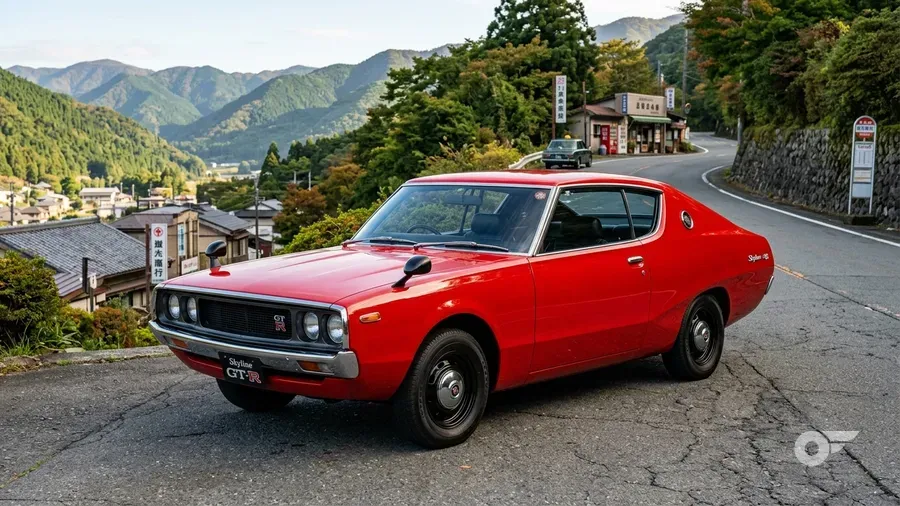
Hako means box, and the C10's slab sides, upright glass and flat surfaces earned the name honestly. The GT-R takes that plain saloon and adds only what the racing required: steel arches rolled out over wider wheels, a chin spoiler, a bootlid lip, and on most cars a set of five-spoke wheels that have been copied endlessly since. The badging is deliberately restrained. No stripes, no bonnet scoop, just a small round GT-R badge on a car that looks like something the family down the road might own, which is a large part of why it is loved. The coupe of October 1970 is the shape that carried the legend: shorter, pillarless, with a hardtop roofline and the arches doing more visual work over less body. The four round tail lamps, two per side, arrived on the C10 and became a Skyline signature that ran unbroken to the R34 and on into the R35. Very few design cues survive thirty-six years intact.

Motorsport pedigree

This is the record the whole nameplate rests on, and Nissan's own heritage archive documents it race by race. The first win came on 3 May 1969, in the TS-b race supporting the JAF Grand Prix at Fuji, in the PGC10 sedan. From there the Skyline won and kept winning: fifty victories in two years and ten months, forty-nine of them consecutive, twenty-one of them at Fuji. The saloons did the bulk of it before the coupe joined the team in March 1971. The streak ended in December 1971 when Mazda's rotary-engined Savanna RX-3 took overall victory at the Fuji Tourist Trophy and denied the Skyline its fiftieth, which started a rivalry Japanese enthusiasts still argue about. Nissan got the fiftieth on 20 March 1972 at the Fuji 300km, K. Takahashi driving. The phrase that attached itself to the car in that period was that the Skyline's only rival was the Skyline. Nothing the badge did later, including 29 Group A wins from 29 starts twenty years on, was more formative than this.

In culture

In Japan the Hakosuka occupies roughly the position a 1969 Camaro holds in America, except that it also won everything. It is the emblem of the kyusha and shakotan scenes, lowered on deep-dish wheels with an oversized exhaust, and it turns up in manga, in model kits, in Gran Turismo and at every Japanese classic meet worth attending. The name is vernacular, not official: hako for box, suka from sukairain, the Japanese pronunciation of Skyline. Nissan never coined it. Owners did, and it stuck so hard that Nissan's own material now uses it back. Outside Japan the C10 was invisible for decades, because it was never sold new in America or Europe and the badge meant nothing in the West until Australian journalists started writing about the R32 twenty years later. That has reversed completely. The Hakosuka is now the car Western collectors point at to explain that the GT-R story did not begin in 1989, and what a good one costs reflects exactly that.

Owning One

Why collectors want it

The Hakosuka GT-R has sat at the top of the Japanese classic market for a decade, and the reason is not nostalgia. It is the first car to wear the badge, it has a competition record a marque authority will confirm race by race, and it exists in numbers that make ownership close to impossible. 2,029 cars, split 832 sedans and 1,197 coupes, from a period when Japanese cars were used until they wore out and then scrapped. The hierarchy inside that is clear. The KPGC10 coupe outruns the PGC10 sedan at auction by a wide margin, on looks rather than history, which is slightly unfair to the car that won most of the races. Early sedans with documented competition history sit above both. What really moves the market is how few honest cars survive: most Hakosukas offered for sale are GT or GT-X models converted to look like GT-Rs, and the genuine article is identified by chassis prefix rather than by badge. A restored KPGC10 made ¥33,880,000, about $308,150, at auction in January 2020, and nothing has come back down since.

Which one to look for

Two cars wear this badge and they are not interchangeable. The PGC10 came first, a four-door saloon built from February 1969 to October 1970, 832 made, and it is the one that did the winning. Longer in the wheelbase, odd in its proportions by modern collector taste, and for years the cheap way in. That is no longer true, and a documented early sedan is arguably the more interesting thing to own. The KPGC10 hardtop coupe followed in October 1970 and ran to September 1972, 1,197 built, on a shorter wheelbase with the flared steel arches that define the shape in most people's heads. It is the one the market wants and the one that sets records. Roughly three in ten left the factory white. Below both sit the KGC10 GT and GT-X, ordinary L-series six-cylinder Skylines that share the body but not the engine, the arches or the badge. They are lovely cars, they cost a fraction, and a very large number of them have been rebuilt to look exactly like a GT-R. Know which one you are being offered.

KPGC10 2000GT-R Hardtop Coupe · 1970–1972

The pillarless two-door hardtop, on a shorter wheelbase with flared steel arches over wider wheels. Same S20, same 160 PS, same five-speed. It joined the works team in March 1971 and is the shape most people picture when the word Hakosuka is used, which is why it carries a clear market premium over the sedan.

PGC10 2000GT-R Sedan · 1969–1970

The original. A four-door Skyline 2000GT shell with the S20 twin-cam six, stripped of radio and heater, on a 2,570mm wheelbase at 1,100kg. This is the car that did the winning: its first victory came on 3 May 1969 at Fuji and the sedans built the bulk of the fifty-win record before the coupe arrived.
What owning one is like

Owning a Hakosuka is a rust story and a parts story, and every owner will tell you the same two things. Japanese steel of this period was thin and untreated, so sills, rear arches, floors, strut towers and screen surrounds all go, and a car that lived in a coastal prefecture has had work. That is normal and not a disqualifier. What matters is who did it and whether there are photographs. The S20 is the other half. It is beautifully made and reliable when it is right, but it was built in the low thousands, it runs three sidedraught carburettors that want synchronising, and its wear parts are produced in small batches by Japanese specialists who do not always have stock. Valve clearances are shims under buckets and take a day. Expect a relationship with a shop that knows the engine rather than with a local garage. The rest of the car is a 1970 Nissan saloon: simple, well made and mercifully conventional. Nothing about running one is mysterious. It is just specialised, and the specialists are mostly in Japan.

Upkeep & parts

Two supply chains matter and they run in opposite directions. Body and trim parts for the ordinary C10 Skyline are reasonably available, because Japan's classic industry supports the GT and GT-X in numbers, and a great deal of a GT-R is shared with them: glass, lamps, interior, bushings, brake components. GT-R-specific items are where it gets hard. Steel arches, correct wheels, badges and above all S20 internals come from Japanese specialists in small runs at prices that reflect it, so budget for shipping and for waiting. Nissan's Nismo Heritage Parts programme has reissued discontinued parts since 2017, but its focus is the R32 onward and it does not help the S20 cars. On the community side, GTROC covers Prince-era cars through to the R35 and is recognised by Nissan, the GTR Register forum carries decades of accumulated knowledge, and the Japanese kyusha shops are the real authority here. Servicing is straightforward for anyone comfortable with carburettors and a feeler gauge. Sorted, the annual cost is modest. Getting one sorted is where the money goes.

Country of origin
Japan
Class
Sports
Production years
1969–1972
Units built
2,029
Model
Skyline GT-R
Nickname
Hakosuka
Body
Sedan, Coupe
Layout
Front-engine, RWD
Engine
1,989cc S20 DOHC 24-valve inline-six (160 PS)
Transmission
5-speed manual
Designer
Shinichiro Sakurai (chief engineer, Prince/Nissan)