Octane Files
Explore CarsIso Grifo

Iso Grifo

Overview

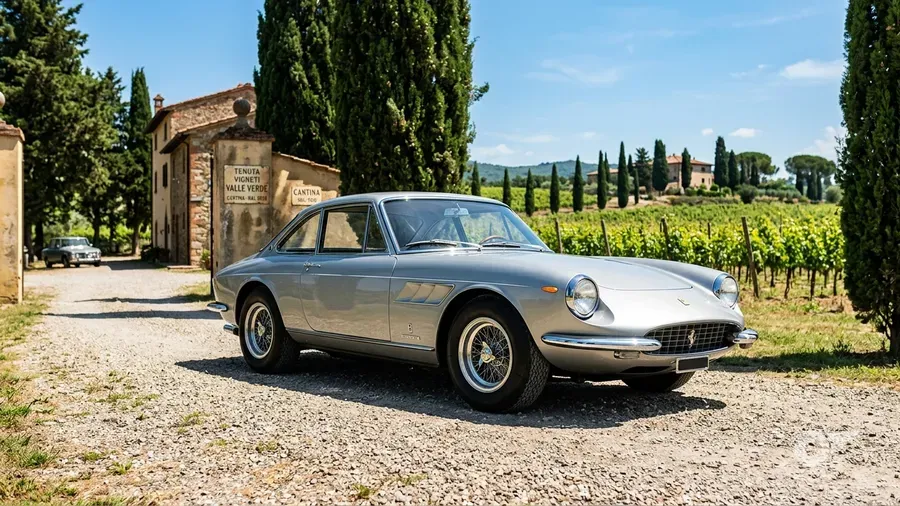
Renzo Rivolta made his fortune on refrigerators and the Isetta bubble car, then spent it building the car he actually wanted. The Grifo appeared at Turin in October 1963 as two machines sharing one name: the A3/L road car, styled by Giorgetto Giugiaro at Bertone, and Giotto Bizzarrini's competition A3/C. When Bizzarrini and Rivolta fell out, the racer left with its engineer and became the Bizzarrini 5300 GT under its own marque. What stayed at Bresso was the beautiful one.

Series production began in 1965 on a shortened Iso Rivolta platform, with a Chevrolet 327 set well back in the frame, a de Dion rear axle and inboard rear discs. Autocar timed one at 161 mph in April 1966, the fastest figure the magazine had ever recorded in a road test, and nothing beat it until the Miura.

Renzo Rivolta did not see most of what followed. He died in August 1966 and his son Piero ran the company from the age of twenty-five.

Over nine years the car took a 427, then a 454, then Marcello Gandini's hidden-headlamp nose, and finally a Ford 351 when the Chevrolet supply ran out. Around 413 were built before Iso collapsed in the oil crisis.

Distinctions

The defining attributes and collector status that make this car garage-worthy.

Octane Files Select
Renowned for its history, engineering, or cultural weight.

Collectibility scorecard

Rated 1 to 10 on the traits that matter for owning, driving, and holding on to a car like this.

Desirability
8/10
Rarity
9/10
Driving thrill
8/10
Investment trajectory
7/10
Usability
6/10
Ease of restoration
4/10
Cultural impact
4/10
Electronic dependence
Fully analogHeavily electronic

Nothing in the powertrain is electronic. Every engine offered ran carburettors and a points-and-coil ignition, there is no computer of any kind, and the throttle is a cable to a linkage. The steering is worm-and-nut and entirely mechanical, and the brake servo is vacuum, not electric. The only current the car really needs is for lights, wipers, instruments and whatever convenience gear the original owner ticked, plus the motors behind the Series II headlamp lids. A Grifo will run with a flat battery and a push.

Market data

Demand tier, price trend, and typical values by condition. Our own assessment, not a quoted valuation.

Demand tier
EntrySolidHighBlue-chip

Strong, sustained collector demand. Good examples never wait long for a buyer.

Value trajectory
AppreciatingStableCooling

Values are holding steady. What you pay today is what it's worth tomorrow.

Price by condition
Driver
$200k
Excellent
$330k
Concours
$450k

The Grifo went from bargain to serious money across the 2010s and has held there rather than kept climbing. Hagerty's average sits between roughly $320,000 and $430,000, and recent results bear that out: $346,000 for a good 1968 small-block in August 2025, $390,000 and $555,000 for 7 Litri cars in 2024 and 2025. The 2022 high of $637,500 for a Series I Targa has not obviously been beaten since. Supply is the whole story, because 413 cars will not become more.

Values as of August 2026.

Buyer's guide

What anyone seriously considering this car should know first.

Why it's worth it
Ferrari looks and Ferrari pace, with a Chevrolet V8 any garage could fix
Callout
Autocar timed one at 161 mph in April 1966, the fastest road test it had ever recorded
What to watch for
Start underneath, because the Grifo is a steel car built in small numbers by hand and nobody galvanised anything. The trunk floor is the classic rot spot, usually fed by water coming in around the aerial hole, and the lower door skins and sills go the same way. None of that is unusual for the era. What is unusual is the cost of putting it right: with barely more than 400 cars built there is no panel supply, so a rusted wing or door bottom means a panel beater making one, and the auction catalogues for restored cars routinely list six-figure euro invoices. Then check what is in front of the bulkhead. Chevrolet engines are easy to swap and plenty have been, so establish whether the block matches the chassis designation and whether the work was done sympathetically. A later small-block in a GL 300 is not a disaster, but it is a price. Gearbox next. The Borg-Warner four-speed is geared long enough that many owners fitted the ZF five-speed or shortened the differential, so a genuine factory ZF car is worth chasing. On Series II cars, work the headlamp covers before you agree anything, and budget for the wiring.

The Story

Driving character

It wants a bit of throttle to fire and sounds grumpy for the first mile, and then it does the thing no Italian V12 of the period could do: it pulls hard from anywhere, in any gear, without being asked twice. First gear runs to 68 mph. The soundtrack is pure American, a blaring, battering noise that belongs at Goodwood rather than in a Milanese boulevard car, and it is one of the better reasons to own one. The steering is worm-and-nut, heavy at parking speeds and better the faster you go. The de Dion rear axle and the low build keep the car planted through long sweeping bends at 60 and 70 mph, which is exactly what it was designed for; it is less interested in tight corners. The servo-assisted discs are strong enough that you stop thinking about them. The ZF five-speed has a precise gate and is worth the search. The clutch will judder unless you launch it properly. And the cabin gets hot, because the engine sits a long way back under the scuttle.

Design

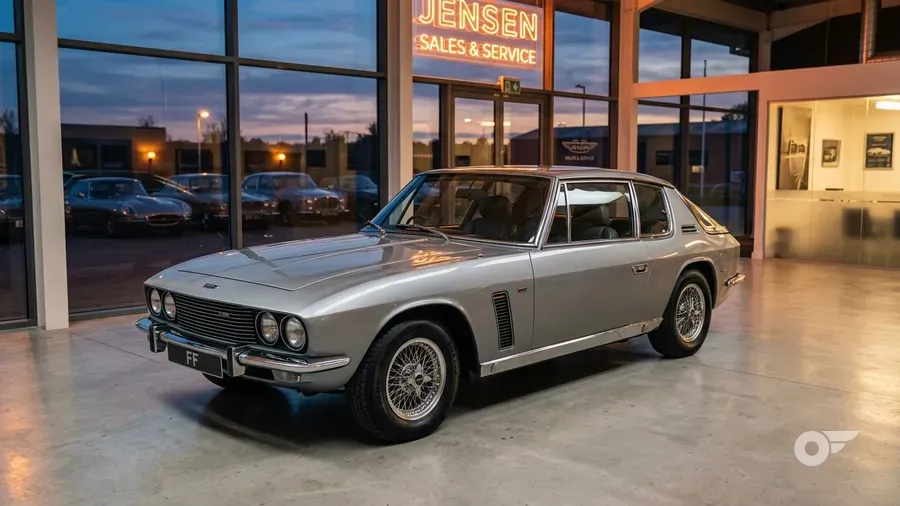
Grifo is Italian for griffin, and the badge is literal: the lion half comes from Renzo Rivolta's family arms, the eagle half stands for the United States. The little sculpture sits on the nose between what Iso people call the nostrils. Giugiaro's shape is a long, low, flat-sided berlinetta with a nose that drops away almost to nothing, a cabin pushed back over the rear axle and a cut-off tail, and it is a masterclass in leaving things out. The details reward a second look: fluting on the door panels, sills and rear seat inserts, and Campagnolo alloys under the arches. Then 1968 broke the discipline in the most entertaining way. The L71 427 would not fit under the hood, so a raised box was added over the carburettors, and the club world named it the Penthouse. It is the least Italian thing on the car and everybody wants one. For 1970 Marcello Gandini, who had replaced Giugiaro at Bertone, gave the nose semi-retractable headlamp lids and a one-piece grille. Sleeker, more modern, and a little less pure.

Motorsport pedigree

The road Grifo never raced, and the reason is that its racing half walked out of the building. When the Grifo appeared at Turin in 1963 it came in two forms, and the competition car, Bizzarrini's A3/C, was the serious one: engine shoved back behind the front axle, built at Piero Drogo's shop in Modena rather than at Bresso. Twenty-two were made under the Iso name before Rivolta and Bizzarrini fell out, after which the design continued as the Bizzarrini 5300 GT. Those twenty-two earned the marque its one real result. At Le Mans in 1965 an Iso Grifo A3/C shared by Regis Fraissinet and Jean de Mortemart finished ninth overall and won the over-5-litre class, in a race only fourteen of fifty-one starters completed. Iso's other brush with competition was purely commercial, and it helped kill the company. In 1973 the new American owner put the marque's name on Frank Williams' Formula One cars, which ran as Iso-Marlboro. The sponsorship was gone before 1974, and so, shortly afterwards, was Iso.

In culture

The Grifo's public life is small, specific and better than its obscurity suggests. A right-hand-drive 1967 car imported to Britain by Trojan appears briefly in the Beatles' Magical Mystery Tour, and it then went to Mike Hailwood, who used it as everyday transport at the peak of his motorcycle career and shipped it to South Africa in 1969 for the Springbok season. On a road there he hit a cow at speed with Peter Gethin alongside him, and a horn came through the seat back. It is not the kind of provenance most grand tourers carry. An Italian-market 1967 car turns up in Sergio Martino's 1973 crime film The Violent Professionals, which is about as period-correct a use of a Grifo as exists. Beyond that, the car is a specialist's pleasure. It is not on posters, it was never a video-game staple, and most people who see one in traffic have to ask what it is. That, for a lot of owners, is the point.

Owning One

Why collectors want it

The argument for a Grifo is that it does the hard part and the easy part at once. Giugiaro drew one of the few 1960s berlinettas that survives comparison with a Ferrari 275 from any angle, and underneath it is a Chevrolet, which means the thing that usually ruins ownership of an Italian GT simply is not there. That combination is rare, and around 413 cars is not many to go round.

The hierarchy inside the generation is steep and well understood. The 7 Litri sits at the top, its raised hood bulge and 427 making it the one everyone photographs, and 2024-25 auction results put good ones between roughly $390,000 and $555,000. The factory Targas are next, four of them Series II cars. Series I small-block coupes are the volume car and the sane buy. At the bottom sit the last Ford-engined IR-8s, about 34 cars, which are among the rarest Grifos of all and still the cheapest, because the badge on the rocker covers says Ford.

Values climbed hard through the 2010s and have held. Nothing about the supply is going to improve.

Which one to look for

Series I cars, 1965 to 1970, carry the original open-headlamp nose and are badged for their engine: GL 300, GL 365, and from 1967 the GL 350 that replaced the 365 when the hotter 327 gave way to a milder one. That is a different engine, not a different way of measuring the same one. The ZF five-speed became optional in 1967 and is the gearbox to have. The connoisseur's Series I is the 7 Litri, launched at Geneva in March 1968 with the Tri-Power L71 427 and the raised hood section the club world calls the Penthouse. Ninety Grifos across all series got a big-block. Series II arrived in 1970 with Gandini's nose and its semi-hidden lamps. Its big-block, the Can Am, used the 454, and roughly two dozen were built. Fourteen Series I Targas and four Series II Targas left the factory, and they are the rarest bodies. Then the coda. From 1972 the IR-8 used a Ford 351 Cleveland because the Chevrolet supply had gone, about 34 cars, the last Isos of any kind. Rare, cheap, and unloved for the wrong reason.

7 Litri · 1968–1970

Launched at Geneva in March 1968 with the Tri-Power Chevrolet L71 427, an advertised minimum of 435hp and a raised hood section over the carburettors that the club world calls the Penthouse. The factory claimed 300 km/h; nobody independently recorded it.

Can Am (IR-9) · 1970–1972

The Series II big-block, using the Chevrolet 454 in place of the 427. Fastest-looking Grifo of all with the Gandini nose and the tall hood, and one of the least common.

GL 300 · 1965–1970

The entry car and the one most Series I buyers took. Chevrolet 327 small-block in its softer state of tune, Borg-Warner four-speed as standard, open headlamps. Nothing about it feels like a base model from the driver's seat.

GL 350 · 1967–1970

Replaced the GL 365 for 1967 with a softer, easier-living 327. A genuinely different engine rather than a re-rated one, and the version most late Series I cars carry. The ZF five-speed became available alongside it.

GL 365 · 1965–1967

The hot 327 of the launch range, badged for its horsepower and good for the 161 mph Autocar recorded in April 1966. Withdrawn in 1967 when Iso moved to a milder engine.

GL Series II · 1970–1972

Marcello Gandini's restyled nose with semi-retractable headlamp lids and a one-piece grille, on the same small-block chassis. Cleaner and more modern than the Series I, and less loved for it.

IR-8 · 1972–1974

The last Grifo and the last Iso. Chevrolet supply had dried up, so Iso fitted the Ford 351 Cleveland, with a taller hood scoop to clear it. Built while the company was being sold, spending on Formula One and running out of time.

Targa · 1966–1971

Introduced in October 1966 with a lift-out roof panel. The rarest body Iso built, and the one that has set the highest recorded Series I price at auction.

What owning one is like

The mechanical half of a Grifo is the easy half. Chevrolet small-blocks and big-blocks are as durable and as understood as any engine ever made, the Borg-Warner gearbox and the Salisbury differential are ordinary industrial parts, and none of it minds being used. Owners drive these cars properly, which is not something you can say about every 400-off Italian GT. The Italian half asks more. It is a steel body with no rust protection worth the name, so the trunk floor, the lower doors and the sills are where the money hides, and water finding its way in around the aerial is a known route. Wiring that is now sixty years old gets tired and corroded, suspension bushes perish, and rubber and glass seals are age-limited rather than mileage-limited. Heat is the everyday one. The engine sits well back under the scuttle and the cabin takes the consequences, which is charming in March and less so in August. And the Series II headlamp mechanism is one more thing that has to work. None of it is mysterious. Most of it is just time.

Upkeep & parts

Running a Grifo splits cleanly down the middle, and knowing which side a job falls on is most of the skill. Anything from the bellhousing forward is American, cheap and everywhere: a 327 rebuild is a solved problem in any competent machine shop on either side of the Atlantic, and the same goes for the 427, the 454 and the Ford 351. The German club publishes a spare-parts and interchange list precisely because so much of the car is somebody else's part number.

Everything Italian is the other story. Bertone body panels, brightwork, glass and interior trim were made in the hundreds and are effectively bespoke now, which is why full restorations turn up in auction catalogues carrying six-figure euro invoices and three thousand hours of labour.

The club network is small and unusually good. The Iso & Bizzarrini Owners Club has run since 1980 and has published its magazine, Griffon, since 1981, there are active German and French clubs, and a handful of specialists including a former Iso employee still working in Clusone keep the cars going. Join before you buy, not after.

Country of origin
Italy
Class
Grand Tourer
Production years
1965–1974
Units built
~413
Model
Grifo
Nickname
No nickname ("Penthouse" names the 7 Litri's raised hood section specifically, not the generation)
Body
Coupe, Targa
Layout
Front-engine, RWD
Engine
5.4-litre Chevrolet 327 small-block V8 (badged GL 300, GL 365 and from 1967 GL 350), 7.0-litre Chevrolet 427 big-block V8 (L71 Tri-Power, 7 Litri), 7.4-litre Chevrolet 454 big-block V8 (Can Am / IR-9), 5.8-litre Ford 351 Cleveland V8 (IR-8)
Transmission
4-speed Borg-Warner T-10 manual, 5-speed ZF manual (optional from 1967), 3-speed automatic
Designer
Giorgetto Giugiaro (Bertone), Marcello Gandini (Bertone, Series II nose), Giotto Bizzarrini (chassis engineering)