Octane Files
Explore CarsJensen Interceptor

Jensen Interceptor

Overview

Jensen Motors spent the early 1960s building other companies' cars. Austin-Healey bodies for BMC, Sunbeam Tigers, Volvo P1800s: contract work that paid the wages while Jensen's own models sold in the hundreds. The Interceptor changed that balance, and it very nearly did not happen in this shape at all. Chief engineer Eric Neale's in-house replacement for the C-V8, the P66, was killed by the board, and the job went to Milan instead. Carrozzeria Touring's proposal, drawn by Federico Formenti, was bought outright. Touring was collapsing and could not build it, so the drawings went to Vignale, who made the prototype and the first production bodies before the work came home to Kelvin Way in West Bromwich.

What appeared at Earls Court in October 1966 sat on the C-V8's tubular steel chassis, carried a Chrysler 383 V8, and had a wraparound glass hatch nobody else had attempted. It ran for ten years and roughly 6,400 cars across three Marks, gained a 440, a six-barrel SP, a convertible and a notchback coupe, and it outlasted the company that built it. Jensen went into receivership in September 1975 and the line stopped the following May.

Distinctions

The defining attributes and collector status that make this car garage-worthy.

Octane Files Select
Renowned for its history, engineering, or cultural weight.

Collectibility scorecard

Rated 1 to 10 on the traits that matter for owning, driving, and holding on to a car like this.

Desirability
7/10
Rarity
7/10
Driving thrill
6/10
Investment trajectory
6/10
Usability
5/10
Ease of restoration
4/10
Cultural impact
6/10
Electronic dependence
Fully analogHeavily electronic

Nothing on an Interceptor thinks for itself. Carburettors feed both engines, the great majority left the factory on breaker points and a condenser, and the TorqueFlite shifts hydraulically. Steering is Adwest hydraulic assistance, the brakes work through a vacuum servo, and everything else is Lucas switchgear driving a motor: windows, wipers, the air conditioning that became standard on the Mk III. The one wrinkle worth knowing is that the cooling fans are electric rather than engine-driven, so a dead relay is a genuine overheating risk. Electronic ignition on these cars is almost always a later retrofit.

Market data

Demand tier, price trend, and typical values by condition. Our own assessment, not a quoted valuation.

Demand tier
EntrySolidHighBlue-chip

A dependable market. Well-kept cars hold their value and find ready buyers.

Value trajectory
AppreciatingStableCooling

Values are holding steady. What you pay today is what it's worth tomorrow.

Price by condition
Driver
$25k
Excellent
$48k
Concours
$80k

Values have climbed a long way from nothing but still trail the British GTs the Interceptor was cross-shopped against in period. classic.com puts the Mk III average near $35,800, with the whole-model average close behind, and UK auction results through 2025 and 2026 have run from £17,685 to £45,760, which is the spread you get when condition rather than specification sets the price. The record is $135,000 for a 1973 Interceptor III S in November 2023. The band below describes the Mk III 440 saloon; SPs, convertibles and coupes all sit above it.

Values as of August 2026.

Buyer's guide

What anyone seriously considering this car should know first.

Why it's worth it
Britain's hand-built Italian-bodied GT with an off-the-shelf Chrysler V8 under the bonnet
Callout
Barely two dozen Interceptors were built with a manual gearbox, and all of them were Mk Is
What to watch for
Assume rot until the car proves otherwise, because on an Interceptor the structure is the whole negotiation. The two big chassis tubes usually survive; the sheet metal and outriggers around them often do not, and there is a great deal of car to take apart before you can see any of it. Everything in the bottom six inches is at risk: sills, floorpans, front and rear valances, door bottoms, lower wings, the base of the front bulkhead, jacking points, seatbelt mounts and the top chassis rails. The sills are the expensive ones. Behind that stainless cover sit an inner and an outer sill, and the inner cannot be inspected by eye. Put a screwdriver into the drainage holes at either end; it should not disappear more than about an inch and a half. A pair starts around £3,000 in the UK and climbs from there. Then look at the back. Corrosion around the base of the rear screen and the hatch hinges is common, and even light bubbling can mean lifting that huge curved glass out, which is hard to refit well. Mk I and Mk II cars are generally reckoned the better built. Mk III volume rose sharply and the men on the line felt some components were cheapened.

The Story

Driving character

The Interceptor's method is torque, not revs. A 440 at light throttle in top will pick the car up from almost any speed without the TorqueFlite bothering to change down, and that lazy, unhurried shove is the whole character of the thing. Motor Sport got over 135mph out of a 1973 car and 0-60 in not much more than eight seconds, and returned 10 to 14mpg doing it. Early 383 cars are quicker off the line, just over seven seconds, and noisier with it. The Mk II had a marked V8 warble that the emissions-era Mk III mostly lost, which owners either miss or quietly appreciate depending on how far they drive. The Adwest steering is light without being numb and turns the car inside 38 feet, which for something this wide is a real gift in town. The chassis is set up for the motorway and it shows: grip runs out early in the wet and the tail goes first. The brakes stop it properly without ever inspiring the way an Aston's do. And the vast glasshouse makes the cabin feel like a conservatory, which is delightful in Scotland and less so in Spain.

Design

The shape is Italian, the proportions are British, the hardware is American, and the joins barely show. Federico Formenti drew it at Carrozzeria Touring, whose finances were failing so badly that Jensen bought the design outright, took the Superleggera markings off the drawings and handed them to Vignale to build. Touring stopped production the same year the Interceptor launched, which makes this one of the last significant designs to carry its fingerprints. The signature is at the back. The rear screen is one enormous piece of curved glass, hinged at the top, doing duty as both window and tailgate, and it is why the vernacular calls the Interceptor's back end the goldfish bowl. It floods the cabin with light and opens onto a load bay no GT of the period could match. The Marks are easy to date once you know the nose. Mk I is the plainest of the three. Mk II brought revised headlamp surrounds, grille and bumper. Mk III revised all three again and added cast headlamp finishers and 15in GKN alloy wheels. The FF, which shares the body, gives itself away with an extra louvre on each front wing and four more inches of wheelbase.

Motorsport pedigree

Jensen never raced the Interceptor and never seriously considered it. There was no competition department, no budget to build one, and no series in which a two-ton hand-built four-seat GT with an automatic gearbox made any sense. A company that could not fund a works effort for the FF, which had genuinely novel four-wheel drive worth showing off, was never going to fund one for the road car. What Jensen had instead was other people's racing. Between 1952 and 1966 the West Bromwich factory built the bodies for BMC's Austin-Healey 100 and 3000, cars that took class wins across European rallying, and it assembled the Sunbeam Tiger, two of which ran the 1964 Le Mans 24 Hours and neither of which finished. The Interceptor's own engine had a competition life it never shared: the same 440 Six Pack that made the SP the fastest road-going Jensen was Chrysler's drag-strip weapon in the 1969 A12 cars. The Interceptor met that engine at the other end of its career, wearing leather and a vinyl roof.

In culture

In Britain the Interceptor is a television car. Lynley drove one through the first two series of the BBC's Inspector Lynley Mysteries, which ran from 2001 to 2008, before the production moved him into a Bristol 410, and the 2025 revival put him back in a 1969 Mk I. The long-running joke is that American viewers were introduced to him as the detective with the Bentley, which he drives in Elizabeth George's novels and never once drove on screen. The owner list is the other half of it, and it is very much of its period: John Bonham, whose 1972 Mk III has since been through auction, plus Eric Morecambe, Ernie Wise, Cliff Richard, Henry Cooper and Ginger Baker. A Jensen was what you bought in 1972 when you had money and did not want an Aston. One clarification worth making, because it comes up constantly. The V8 Interceptor of the Mad Max films is an Australian Ford Falcon XB. It has nothing to do with West Bromwich beyond sharing a name.

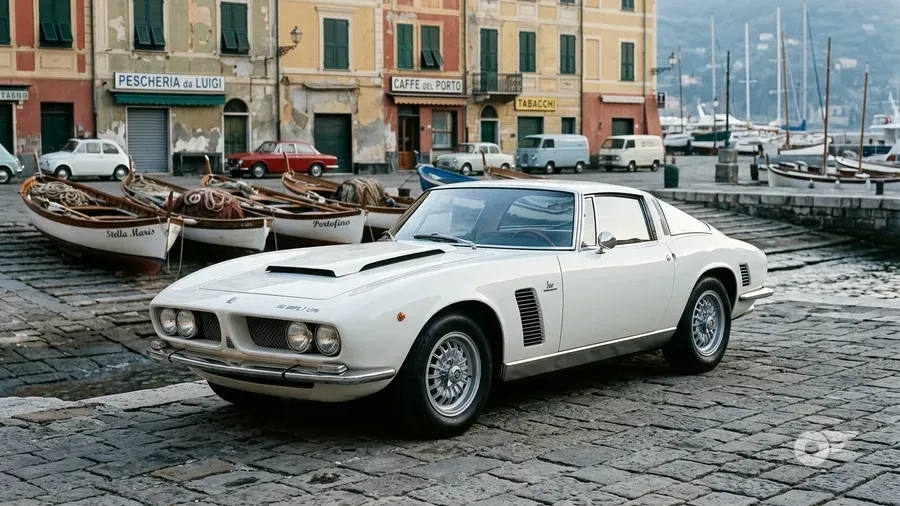
Rivals

Cars from other manufacturers that competed for the same buyers when new.
Owning One

Why collectors want it

The case for an Interceptor has always come down to arithmetic. Motor Sport tested a Mk III in February 1974 at £7,179 and pointed out it was nearly £2,500 cheaper than an Aston Martin DBS V8 and about £1,400 under a BMW CSi, doing the same job with an engine any competent garage already understood. That gap never closed. The Interceptor still trades well below the Astons it was cross-shopped against in period, for exactly the same reason: the engine came from Detroit rather than from a British racing department, and the market has spent fifty years pricing that as a discount rather than an advantage.

The hierarchy inside the ten-year run is settled. The 232 SPs are the connoisseur's car and the only Interceptors that reliably command serious money. Convertibles follow, then the tiny run of notchback coupes, rare enough that the registers cannot agree how many exist. Vignale-bodied early Mk Is carry provenance the later cars do not. The Mk III 440 saloon is the volume car, the one most buyers will actually meet, and it is where the sensible money sits.

Which one to look for

Start with the Mk III 440 saloon, because 4,255 of the roughly 6,400 cars built were Mk IIIs and that is what the market actually offers. It has the easier engine, GKN alloys and standard air conditioning, and it is the cheapest way in. The grail is the SP. Built from 1971 to 1973, 232 cars, it took the 440 with three twin-choke carburettors, the arrangement Chrysler sold as the Six Pack and Jensen abbreviated to SP. It was quoted at 385bhp in Britain and 330hp SAE net in American terms, which is one engine measured two ways rather than two different engines. A contrasting vinyl roof and two sets of bonnet louvres each side mark it out, and 147mph was claimed. Below that, the convertible from 1974 is the money car of the late run, and the notchback coupe of 1975 and 1976 is the oddity, its roof subcontracted to Panther and its production variously given as 60 cars or as the 46 marque historian Richard Calver could actually document. Early Vignale-bodied Mk Is and the couple of dozen manual cars are the specialist's picks.

Convertible · 1974–1976

Power-operated soft top on the Mk III platform, launched at Geneva in 1974 and aimed mainly at America. The most expensive Interceptor when new, at nearly £10,000 in Britain and $25,812 in the United States by 1976.

Coupé · 1975–1976

A notchback derived from the convertible body, so it does without the goldfish-bowl hatch that defines every other Interceptor. Shown at Earls Court in 1975 and built for barely a year before the receivers closed the line.

Mk I · 1966–1969

The launch car. Chrysler 383 V8, Vignale-built bodies at first before assembly moved to Kelvin Way in West Bromwich, and the plainest nose of the three Marks. The only Interceptor offered with a four-speed manual gearbox, and almost nobody took it.

Mk II · 1969–1971

Revised headlamp surrounds, grille and bumper, a new double-wishbone front suspension and Girling brakes. The interior was reworked for American regulations and air conditioning became an option. Still the 383, and still with the V8 warble later cars lost.

Mk III · 1971–1976

The volume car and the one the market offers. The 440 replaced the 383 after Chrysler's compression cuts gutted the smaller engine's ratings. Grille, headlamp finishers and bumper revised again, 15in GKN alloys and air conditioning standard.

SP · 1971–1973

The fast one. The 440 with three twin-choke carburettors, Chrysler's Six Pack setup, abbreviated by Jensen to SP. Quoted at 385bhp in Britain and 330hp SAE net in American terms, with 147mph claimed. Contrasting vinyl roof and two sets of bonnet louvres each side identify it.

What owning one is like

Two things define living with an Interceptor: rust and heat. The rust is structural and expensive, and it is why so many were scrapped in the years when they were merely old cars worth nothing. The heat is more manageable but catches people out. The cooling system was marginal when new, the fans are electric rather than belt-driven, and a silted radiator or a scaled block will have a 440 climbing the gauge in traffic. Owners solve it properly with a good radiator and a fan circuit rewired and fused sensibly, then stop thinking about it. Everything else is gentler than the reputation suggests. The Chrysler V8 and the TorqueFlite are close to unbreakable and were built in millions. Lucas switchgear does Lucas things. The hatch seals give up eventually and the glass surround is where water finds its way in. Interior wood and leather are lovely and not cheap to redo. Fuel is the standing joke and the honest number is 10 to 14mpg, which is fine once you accept that this is a car for long Sunday distances rather than short errands.

Upkeep & parts

The Interceptor splits neatly into a cheap half and an expensive half. Everything American is the cheap half. The 383 and 440, the TorqueFlite, the ignition and the fuel system are ordinary Chrysler parts, made in enormous numbers, still catalogued by every Mopar supplier, and a rebuild costs roughly what the same rebuild costs on a Charger.

Everything British and Italian is the expensive half. Panels, structure, brightwork and glass are specialist items, and that is where the money goes. Martin Robey holds Jensen tooling and sells panels and cooling upgrades. Cropredy Bridge in Oxfordshire runs its own body, engine and trim shops. Jensen Service, which grew out of Rejen, covers Interceptors, FFs and C-V8s.

Budget for structure before anything else: a pair of sills starts around £3,000 in the UK, and bodywork is what turns a cheap Interceptor into an expensive one.

The support network is unusually good for a marque that died in 1976. The Jensen Owners' Club runs an active forum, and the Jensen Museum publishes production figures, dates and chassis records that make an individual car's history checkable.

Country of origin
UK
Class
Grand Tourer
Production years
1966–1976
Units built
~6,408
Model
Interceptor
Nickname
No nickname ("Goldfish bowl" names the wraparound rear screen specifically, not the generation)
Body
Hatchback, Coupe, Convertible
Layout
Front-engine, RWD
Engine
383ci (6.3-litre) Chrysler RB V8, 440ci (7.2-litre) Chrysler RB V8, 440ci six-barrel Chrysler V8 (SP)
Transmission
Chrysler TorqueFlite A727 three-speed automatic, four-speed manual (Mk I only)
Designer
Federico Formenti (Carrozzeria Touring Superleggera); early bodies built by Carrozzeria Vignale