Octane Files
Explore CarsIsdera Imperator 108i

Isdera Imperator 108i

Overview

Mercedes-Benz built the CW311 in 1978 and then did nothing with it. Eberhard Schulz, a design engineer at Porsche who had drawn the car in his own time and had it built by Rainer Buchmann's b+b workshop, was allowed to wear the three-pointed star on that single example and no more. Mercedes had no interest in production. So Schulz set up his own firm in Leonberg in 1982, called it Isdera after the German for an engineering office for styling, design and racing, and built the show car himself with almost nothing changed.

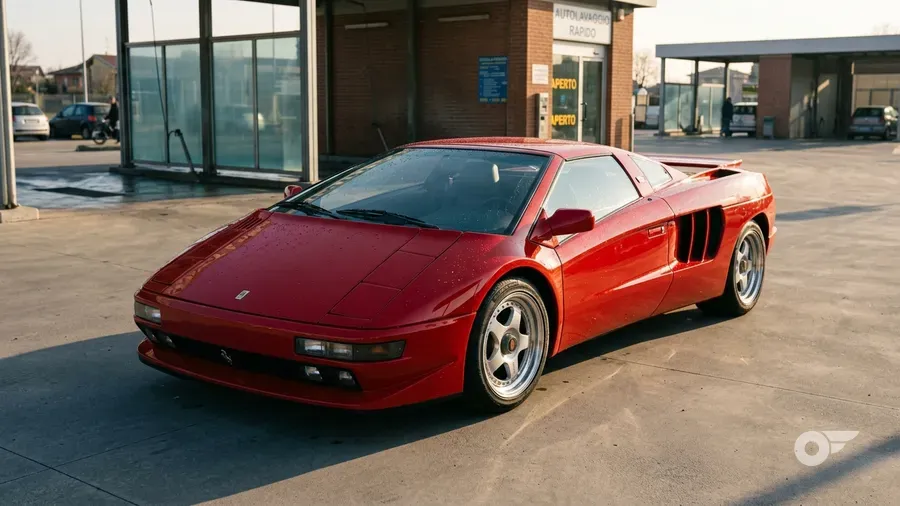
The Imperator 108i reached the Geneva show in March 1984: gullwing doors, a fibreglass body bonded to a tubular steel spaceframe, a Mercedes V8 behind the seats, and a periscope on the roof where the door mirrors should have been.

Thirty were built in nine years. There were no dealers and no showrooms. By every account you telephoned Schulz, left a deposit, and waited about a year while a handful of people assembled your car by hand. The engines tracked whatever Mercedes and AMG were building, from a 5.0-litre M117 at launch to a 32-valve AMG 6.0 at the end. Isdera stopped in 1993, when the company ran out of money.

Distinctions

The defining attributes and collector status that make this car garage-worthy.

Octane Files Select
Renowned for its history, engineering, or cultural weight.

Collectibility scorecard

Rated 1 to 10 on the traits that matter for owning, driving, and holding on to a car like this.

Desirability
7/10
Rarity
10/10
Driving thrill
7/10
Investment trajectory
7/10
Usability
3/10
Ease of restoration
2/10
Cultural impact
4/10
Electronic dependence
Fully analogHeavily electronic

The engines are fuel-injected Mercedes and AMG V8s with electronic ignition, so there is a management box in the car, but that is where the electronics stop. ABS was an option rather than standard equipment, and there is no traction control, no stability system, no adjustable damping and no drive-by-wire. The gearbox is a five-speed manual, the instruments are analogue dials, and the rear view comes from a mirror in a roof periscope rather than a camera. Nothing about driving it depends on software.

Market data

Demand tier, price trend, and typical values by condition. Our own assessment, not a quoted valuation.

Demand tier
EntrySolidHighBlue-chip

Strong, sustained collector demand. Good examples never wait long for a buyer.

Value trajectory
AppreciatingStableCooling

Values are holding steady. What you pay today is what it's worth tomorrow.

Price by condition
Driver
Excellent
Concours

No price band is published here because the market is too thin to support one. Thirty cars exist and only a handful have traded publicly. The verified data points are these: a 1991 Series 2 sold at Bonhams in Monaco on 23 April 2021 for EUR 690,000, having had roughly EUR 130,000 of restoration work; RM Sotheby's offered a Series 2 at Monterey in 2024 against an estimate of USD 800,000 to 1,000,000 and it did not sell; and RM listed another for Miami in February 2026 estimated at USD 650,000 to 850,000. Read together, those say the car is a solid six-figure asset whose ceiling has not yet been proved. Asking prices from dealers run well ahead of that and are not evidence. Condition and history dominate, since a car needing structural or bespoke bodywork can absorb a large fraction of its own value in one restoration.

Buyer's guide

What anyone seriously considering this car should know first.

Why it's worth it
The Mercedes supercar that Mercedes would not build
Callout
A periscope on the roof instead of door mirrors
What to watch for
Start with the structure, because the body will not tell you anything. The fibreglass panels are bonded to a tubular steel spaceframe, so the questions are about the frame, the bonding seams and any accident history that has been smoothed over in filler. A car that has been apart before is not a problem in itself, but you want to know who did the work: the Bonhams Monaco car carried a partial restoration by two German specialists costing around EUR 130,000, which is a useful yardstick for what a proper job costs. Everything Mercedes is straightforward. The M117 and AMG V8s, the ZF five-speed and most of the running gear can be serviced anywhere competent. Everything Isdera cannot. The periscope housing, the gullwing hinges and struts, the screen, the lamps and every panel are bespoke to a thirty-car run. Check which engine the car actually has and whether it is the one it left Leonberg with, because the specification moved through the production run. Ask whether it has the optional ABS. And check the paperwork hard. With thirty cars built, an example with no traceable history should make you wonder why.

The Story

Driving character

It weighs 1,250kg, which is the number that governs everything else. An iron-block Mercedes V8 in a car that light does not need to be exotic to feel quick, and the launch 5.0-litre version was already good for 176mph and five seconds to 60mph without any of the drama the shape implies. The theatre is in the details. The gullwing doors mean you drop in rather than climb in. The seating position is close to the floor and the screen is a long way ahead of you. And the rear view is a periscope: a single image in a housing above your head, which takes about a mile to get used to and then feels entirely normal, right up to the moment somebody asks you to reverse into a space. Power delivery is Mercedes rather than Italian. There is torque low down, the V8 pulls without needing revs, and the ZF five-speed is unhurried. It is a fast car built by an engineer, not a race car with numberplates, and it drives the way that sounds.

Design

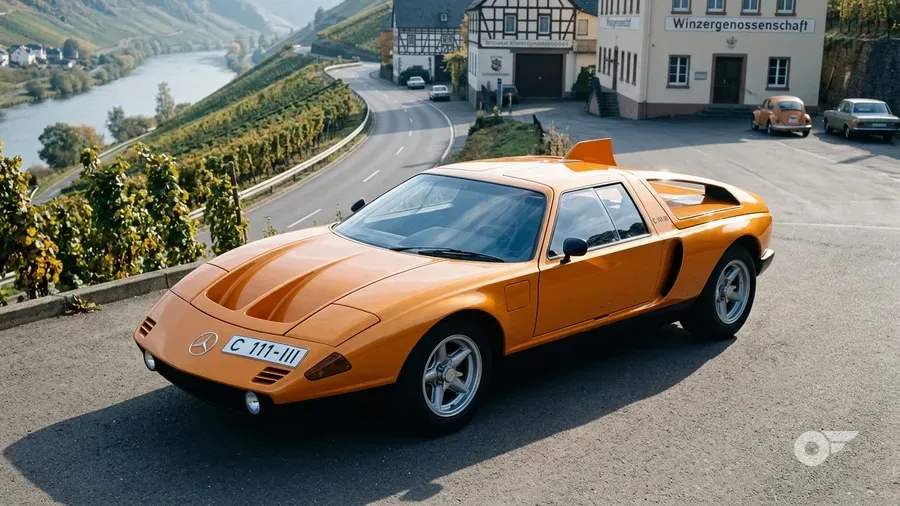
The CW311 was Schulz's answer to two Mercedes cars he loved: the 300 SL for the doors, and the C111 research cars for the wedge. Its drag coefficient of 0.311 gave the concept its name. What is remarkable is how little of it he had to change to sell it. The production Imperator lost the pop-up headlamps for fixed units and took Mercedes tail lights, and that was largely that until 1991, when the facelift put the pop-ups back and rounded the surfaces. The signature is the roof. The periscope bulge sits above the cabin like a fin, and it exists because Schulz wanted the rear view without the drag and visual clutter of door mirrors. Inside, the switchgear and much of the trim comes from the Porsche 928, which is the tell that this was an engineer's car built from the best parts he could reach rather than a stylist's clean sheet. Nothing about the shape is fashionable now. It was not fashionable in 1984 either. It was a 1978 drawing, built stubbornly, for nine years.

Motorsport pedigree

Isdera never raced the Imperator, and the reason is arithmetic rather than temperament. The R in the company name stands for racing, and Schulz came out of Porsche, but a firm turning out three or four cars a year has no budget for a homologation programme and nothing to gain from one when every customer is already known by name. The lineage is more interesting than a results table. The shape descends from the Mercedes C111 research cars, which is a genuine competition bloodline: the C111 series ended with high-speed record running at Nardo in 1979, and the CW311 that became the Imperator appears in the C111 story as one of the things that came after it. The engines have their own record too, since the M117 and its AMG derivatives were the Mercedes V8s that AMG had been campaigning in European touring cars. So the car carries racing DNA at one remove, through the parts and through the shape, and never turned a competitive lap itself. For thirty hand-built cars sold to people who telephoned the factory, that was never the point.

In culture

The Imperator's cultural footprint is small, specific and oddly durable. The 1978 CW311 that started it all appeared in the 1980 comedy Car-napping, which is the only time any version of this car reached a mass audience. After that it disappeared into the back pages of the supercar books, the car everyone half-remembered as a Mercedes that Mercedes never made. The internet gave it a second life. Road and Track ran it in 2016 as a Mercedes-Benz wedge from the future. Car and Driver covered a car for sale the same year under the headline Down Periscope. Hagerty came back to it in 2021. The pattern is always the same: a writer discovers the periscope, the gullwing doors and the story of Schulz and Mercedes, and the piece writes itself. Two of the thirty were reportedly exported to Japan, which is where a good number of Europe's stranger 1980s supercars ended up and where the model retains a following. Nobody has ever put an Imperator on a bedroom wall in numbers. It is a connoisseur's car, known by the people who know it.

Owning One

Why collectors want it

Thirty cars is the whole story, and every one of them descends directly from a factory Mercedes design study that the factory declined to make. That is a rarer thing than the numbers alone suggest. Plenty of small firms drew their own supercar in the 1980s. This one was drawn inside the German industry, wore a genuine Mercedes badge for a moment in 1978, and reached production only because the man who penned it refused to let it die.

The market has caught up slowly. A partially restored Series 2 took EUR 690,000 at Bonhams in Monaco in April 2021, which was the moment the Imperator stopped being an obscure answer to a pub question and started being a serious collector car. Within the run the hierarchy is clear enough: the 1991 facelift cars with the pop-up lamps and the later AMG engines sit at the top, the early fixed-headlamp cars below them, and documented history matters more than mileage because so few people have ever worked on one.

Nothing else in the period does what it does. The Vector and the Cizeta were outsiders looking in. The Isdera came from inside Stuttgart and left with the drawings.

Which one to look for

The split that matters is 1984 to 1990 against the 1991 facelift, which auction houses now call the Series 2. The facelift brought back the pop-up headlamps from the 1978 show car, replaced the trio of front vents with a NACA duct, softened the body surfaces, moved the indicators down under the lamps and added optional wing mirrors for owners who did not trust the periscope. The engines are the other axis, and they run 5.0-litre Mercedes M117, then 5.6 M117, then a 5.6 AMG, then the 32-valve AMG 6.0 that took the car to around 390hp. A late Series 2 with the AMG 6.0 is the one to hunt. Be careful with the counts. Wikipedia says 24 of the thirty were pre-facelift and separately that around 17 carried the facelift bodywork, which cannot both be true. RM Sotheby's describes its Series 2 cars as one of thirteen. The total of thirty is solid and the split is not, so buy the individual car's history rather than a claimed rarity within the rarity.

Series 1 · 1984–1990

The car as it left the 1978 CW311 show car, with the pop-up headlamps replaced by fixed units, three vents across the nose and Mercedes tail lights. Engines are the 5.0-litre Mercedes M117 V8 at launch and later the 5.6-litre M117. Fibreglass body bonded to a tubular steel spaceframe, gullwing doors, roof periscope, Porsche 928 switchgear.

Series 2 · 1991–1993

The 1991 facelift and the one to hunt. The pop-up headlamps from the original show car return, a NACA duct replaces the three nose vents, the body surfaces are rounded, indicators move below the lamps and wing mirrors become an option for owners who did not trust the periscope. AMG engines take over, ending with the 32-valve 6.0-litre V8 at around 390hp.

What owning one is like

Owning one is an exercise in knowing which half of the car you are dealing with. The Mercedes half is dependable and unremarkable, which is exactly why Schulz used it: the V8s are long-lived, the ZF gearbox is tough, and the running gear is period Stuttgart engineering that nobody needs to be frightened of. The Isdera half is where the effort goes. Every panel is bespoke fibreglass, the periscope and its housing exist on no other car, and the gullwing struts and seals are one-offs. None of it is unfixable, but all of it means fabrication rather than ordering a part, so plan work around long lead times. The cabin gets warm, as it does in most mid-engined cars of the era with a big V8 and a low glasshouse. Rear vision through a single periscope image takes practice. And factory support is not what it was: the German company has changed hands more than once and the entity that built these cars is long gone, so the knowledge lives with a small number of specialists in Germany rather than with the marque.

Upkeep & parts

Budget separately for the mechanical side and the bodywork side, because they behave nothing alike. Mercedes M117 parts are shared with the W126 and R107 era, so pistons, heads, injection components and ancillaries are all obtainable from the ordinary Mercedes specialist trade, and the AMG 32-valve units are rarer but still supported by the German AMG restoration world. The ZF five-speed and the 928-sourced interior switchgear are similarly findable.

Everything else is a fabrication job. There is no parts catalogue, no reproduction panel supply and no club selling remanufactured trim, because thirty cars cannot sustain any of that. The Bonhams car's roughly EUR 130,000 restoration is the number to keep in mind when a car is described as needing work.

There is no owners club and no registry. What exists is a long-running German-language Isdera forum on Carpassion where owners and specialists have been comparing notes for years, and the marque's own website. For a car this rare, the network is the parts supply, so make the introductions before you buy rather than after.

Country of origin
Germany
Class
Exotic
Production years
1984–1993
Units built
30
Model
Imperator 108i
Nickname
No nickname
Body
Coupe
Layout
Mid-engine, RWD
Engine
5.0L Mercedes-Benz M117 V8, 5.6L Mercedes-Benz M117 V8, 5.6L AMG V8, 6.0L AMG 32-valve V8
Transmission
5-speed ZF manual
Designer
Eberhard Schulz